

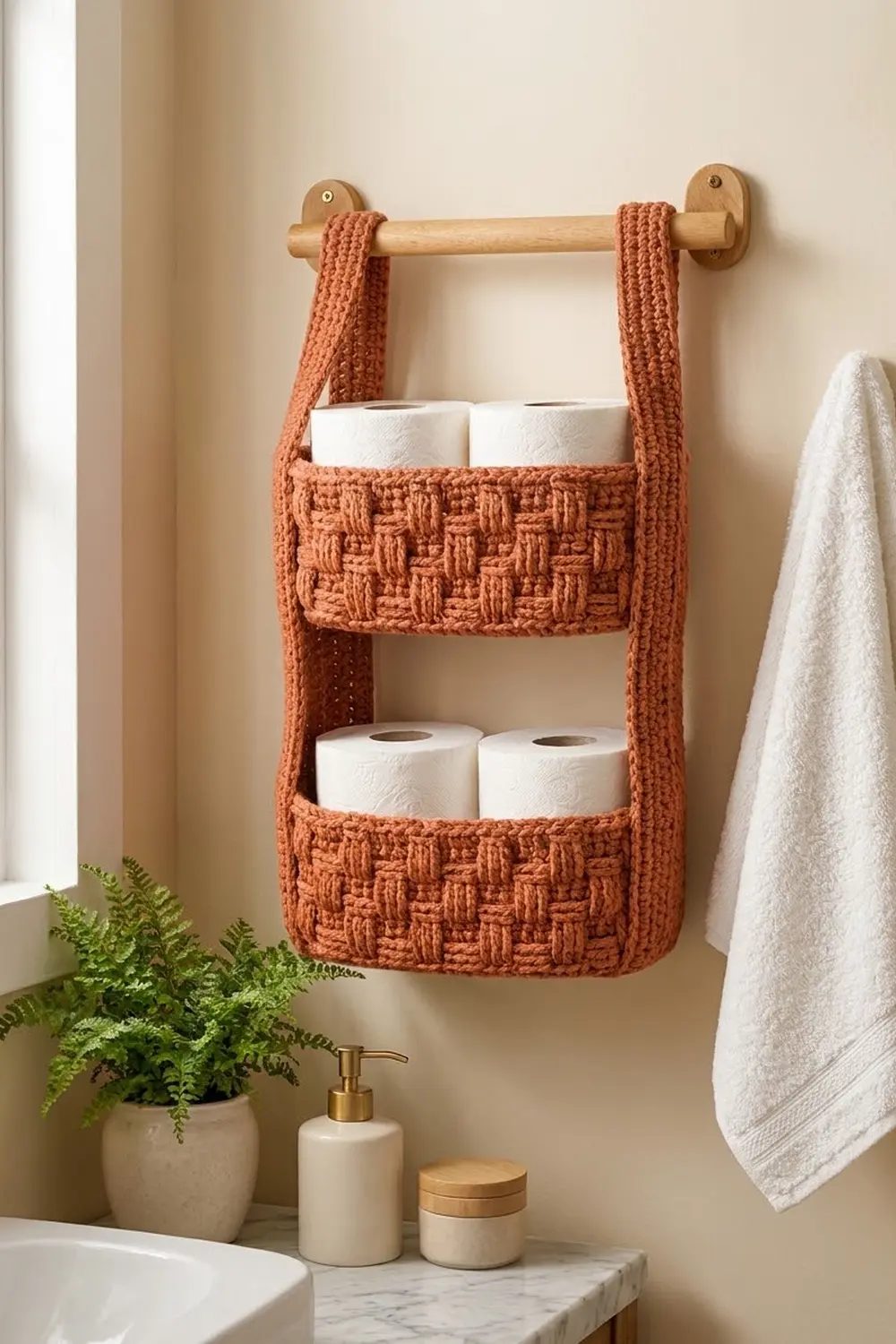
This hanging organizer holds four spare toilet rolls in two sturdy basketweave baskets. Two long flat straps run up the short ends of both baskets and loop over a towel bar, so the whole thing hangs neatly beside the sink or toilet.
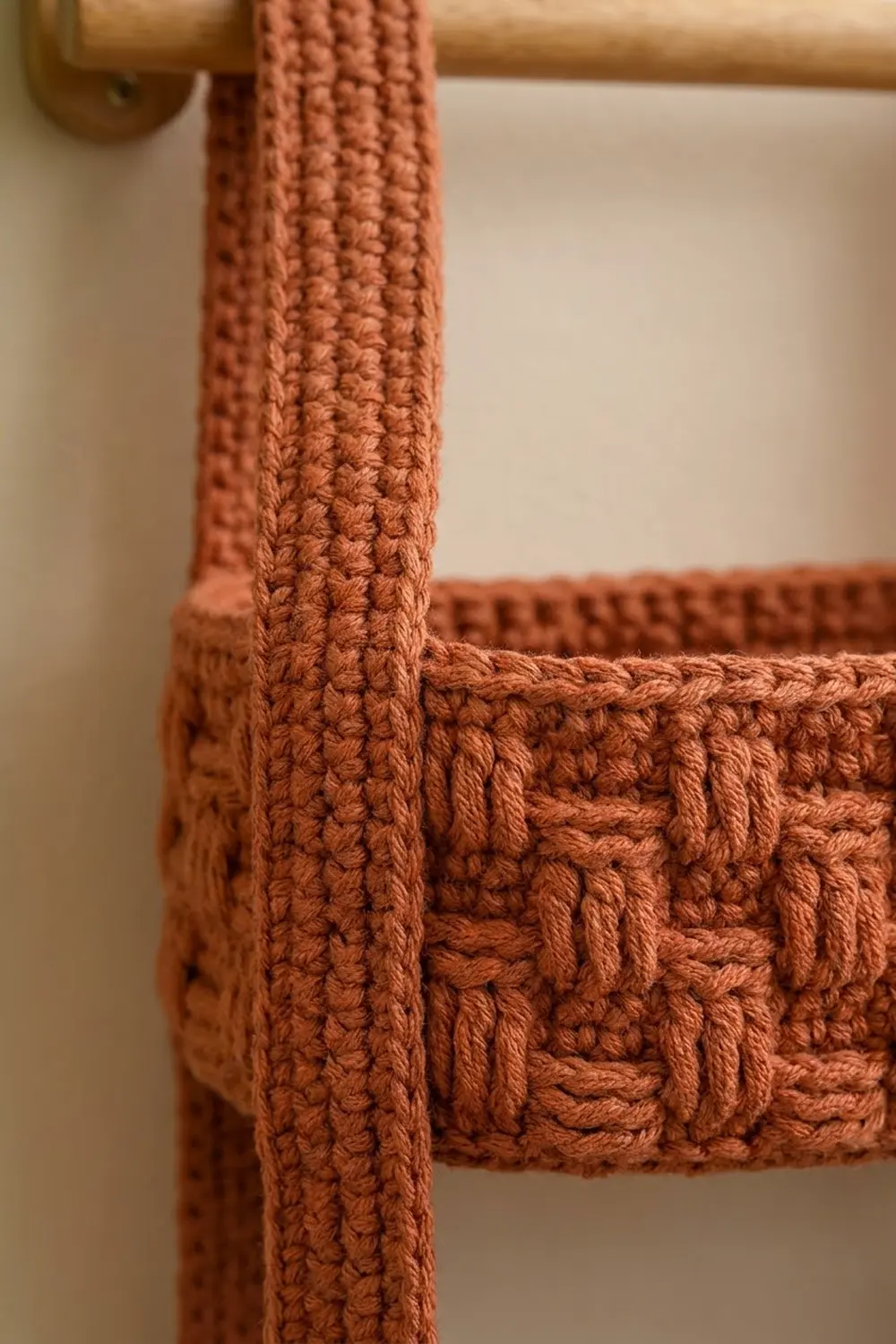
The sample uses one warm terracotta (rust-orange) bulky cotton. Each basket base is plain single crochet. The walls use blocks of front and back post double crochet that make a woven, checkerboard texture. A firm single crochet rim finishes each top edge.
This pattern uses US crochet terms. Each basket base is about 11.3 x 5.3 in (28.7 x 13.5 cm), and each basket is 5 in (12.7 cm) tall. The assembled organizer is about 12 in (30.5 cm) wide and hangs 24 in (61.0 cm) from the top of the bar to the bottom of the lower basket.
Construction is simple. Crochet two oval baskets in joined rounds and two straps in rows, then edge the straps. Whipstitch the straps to the outside of each basket’s curved ends and fold the tops into hanging loops.
Finished Size and Construction
- Finished size (assembled): about 12 in (30.5 cm) wide x 24 in (61.0 cm) tall
- Skill level: Intermediate (post stitches, oval base)
- Terminology: US
- Yarn weight: Bulky (#5) cotton or cotton blend
- Hook: 6 mm (J-10)
- Number of pieces: 4 (2 baskets, 2 straps)
- Layout: 2 baskets stacked vertically, 1 strap on each short end
- Basket size: base 11.3 x 5.3 in (28.7 x 13.5 cm), height 5 in (12.7 cm)
- Strap size before edging: 2 in (5.1 cm) wide x 28 in (71.1 cm) long
- Basket wall before rim: 4.3 in (10.9 cm)
- Rim (border) depth: 0.7 in (1.8 cm), 2 rounds of sc
Materials
Choose a firm bulky cotton or cotton-blend yarn, or a soft cotton cord of similar thickness. Cotton holds the basket shape well and is easy to wash. Avoid very soft acrylic, because it lets the walls slump.
- Terracotta: 400 g, about 440 m (481 yd) total; sample yarn is 100 g = 110 m (120 yd)
- Each basket uses about 120 g (132 m / 144 yd)
- Each strap uses about 35 g (39 m / 43 yd)
- 6 mm (J-10) crochet hook
- 4 locking stitch markers
- Tapestry needle
- Scissors
- Tape measure
- Rust-proof pins or clips for assembly
The 400 g total includes a margin of roughly 25 to 30% over the estimated use, because post stitches use yarn quickly and tension varies.
Abbreviations (US Terms)
- ch: chain
- sl st: slip stitch
- sc: single crochet
- dc: double crochet
- BLO: back loop only
- inc: 2 sc in the same stitch
- st(s): stitch(es)
- rnd: round
Special stitches
- FPdc (front post double crochet): Yarn over. Insert the hook from front to back to front around the post of the stitch, yarn over and pull up a loop, then (yarn over, pull through 2 loops) twice.
- BPdc (back post double crochet): Yarn over. Insert the hook from back to front to back around the post of the stitch, then finish as a dc.
Gauge and Checkpoints
- Single crochet: 12 sts x 12 rows = 4 in (10.2 cm), so 3 sts and 3 rows per inch
- Double crochet and post stitches: 12 sts x 7 rnds = 4 in (10.2 cm)
Make one basket first and use its base as your gauge test. Measure at these checkpoints:
- After Rnd 4: about 2.7 x 8.7 in (6.9 x 22.1 cm)
- After Rnd 8 (finished base): about 5.3 x 11.3 in (13.5 x 28.7 cm), 84 sts, perimeter 28 in (71.1 cm)
- After Rnd 16: wall about 4.3 in (10.9 cm) tall, measured from the base ridge
- After Rnd 18: wall 5 in (12.7 cm) tall
- Strap after Row 84: 2 in (5.1 cm) wide x 28 in (71.1 cm) long
If your base is too big, go down half a hook size. If it’s too small, go up half a hook size. Use the same hook for both baskets and both straps so all the pieces match. Two standard rolls are about 4.5 in (11.4 cm) across each, so the inside of the base must be at least 9 in (22.9 cm) long.
Basket (Make 2)
Oval Base
Ch 21.
Rnd 1: 3 sc in 2nd ch from hook, sc in next 18 ch, 3 sc in last ch. Rotate and work along the other side of the foundation ch: sc in next 18 ch. Join with sl st to first sc. (42 sts: 3 end, 18 side, 3 end, 18 side)
From here on, start each rnd with ch 1 (does not count) and end it with a sl st to the first sc. You only increase in the two curved end sections.
Rnd 2: 2 sc in each of next 3 sts, sc in next 18, 2 sc in each of next 3 sts, sc in next 18. (48 sts)
Rnd 3: (sc in next st, inc) 3 times, sc in next 18, (sc in next st, inc) 3 times, sc in next 18. (54 sts)
Rnd 4: (sc in next 2 sts, inc) 3 times, sc in next 18, (sc in next 2 sts, inc) 3 times, sc in next 18. (60 sts)
Rnd 5: (sc in next 3 sts, inc) 3 times, sc in next 18; repeat once more. (66 sts)
Rnd 6: (sc in next 4 sts, inc) 3 times, sc in next 18; repeat once more. (72 sts)
Rnd 7: (sc in next 5 sts, inc) 3 times, sc in next 18; repeat once more. (78 sts)
Rnd 8: (sc in next 6 sts, inc) 3 times, sc in next 18; repeat once more. (84 sts: 24 end, 18 side, 24 end, 18 side)
Place a marker in the first and last st of each curved end (4 markers). Move them up as you work so you always know where the 18-st long sides and 24-st curved ends are.
Walls
Rnd 9 (turning ridge): Ch 1, sc in BLO of each st around. (84 sts) This makes the crisp edge between the base and the wall.
Rnd 10: Ch 2 (does not count), dc in each st around. Join to first dc. (84 sts)
Rnd 11: Ch 2 (does not count), FPdc around next 3 sts, BPdc around next 3 sts; repeat from * 13 more times. Join to first FPdc. (84 sts: 14 repeats, 28 blocks of 3)*
Rnd 12: Repeat Rnd 11, working FPdc over FPdc and BPdc over BPdc. (84 sts)
Rnd 13: Ch 2 (does not count), BPdc around next 3 sts, FPdc around next 3 sts; repeat from * 13 more times. Join. (84 sts)*
Rnd 14: Repeat Rnd 13. (84 sts)
Rnds 15–16: Repeat Rnds 11–12. (84 sts each)
You now have three bands of woven blocks. 84 sts make 28 blocks, an even number, so the blocks alternate cleanly all the way around and match at the join. Check that the wall is about 4.3 in (10.9 cm) tall. Go straight on to the rim in the Border section.
Strap (Make 2)
Ch 7.
Row 1: Sc in 2nd ch from hook and in each ch across. (6 sts)
Rows 2–84: Ch 1, turn, sc in each st across. (6 sts)
Check that the strap is 2 in (5.1 cm) wide x 28 in (71.1 cm) long. Don’t fasten off. Go on to the strap edging in the Border section.
Mark these row zones with scrap yarn, counting from Row 1:
- Rows 1–15: sewn to the lower basket, 5 in (12.7 cm)
- Rows 16–27: open gap, 4 in (10.2 cm)
- Rows 28–42: sewn to the upper basket, 5 in (12.7 cm)
- Rows 43–59: free strap, about 5.7 in (14.5 cm)
- Rows 60–84: hanging loop and overlap
Make All Pieces
All pieces use the single terracotta color.
- Baskets: 2 in terracotta (about 120 g each)
- Straps: 2 in terracotta (about 35 g each)
Layout, seen from the front:
   [loop]                      [loop]
   strap A                     strap B
     |                            |
     |   [   UPPER BASKET    ]    |
     |      gap 4 in (10.2 cm)    |
     |   [   LOWER BASKET    ]    |
Each strap runs straight up the center of one curved end on both baskets.
Joining
Method: Whipstitch on the outside of the baskets with matching yarn. Work through the strap’s edging sc and the matching wall stitches.
Placement: Each curved end has 24 sts. The edged strap is 8 sts wide, so it covers sts 9–16 and leaves 8 sts free on each side. That puts it exactly in the center.
Stitch-to-stitch logic:
- Pin Rows 1–15 of strap A to the outside of one curved end of the lower basket, with the bottom edge of the strap level with the Rnd 9 ridge.
- Whipstitch the 10 sts of the strap’s bottom short end to the 8 marked ridge sts. Work the 2 corner sts into the first and last ridge sts.
- Whipstitch each long edge, joining 1 edging sc of the strap to 1 point on the wall, 15 stitches per side. Both pieces have about 3 rows per inch, so the edges stay level.
- Leave Rows 16–27 unsewn.
- Pin Rows 28–42 to a curved end of the upper basket in the same centered position. Line up the bottom of Row 28 with that basket’s Rnd 9 ridge. Whipstitch both long edges, 15 stitches per side.
- Repeat with strap B on the opposite curved ends.
Tension: Pull each whipstitch snug but not tight. Pulling too tight puckers the wall and twists the woven blocks out of line.
Size checkpoint: Lay the joined organizer flat. The two baskets should be parallel, with a 4 in (10.2 cm) gap between the rim of the lower basket and the base of the upper one. The overall width should be about 12 in (30.5 cm).
Hanging loops: Fold each strap over the bar at Row 72, so that Rows 79–84 lie on top of Rows 60–65. Whipstitch all edges of this 2 in (5.1 cm) overlap through both layers. If your bar doesn’t come off, sew the loops closed around the bar. The hanging length from the fold to the bottom edge is about 24 in (61.0 cm).
Border
The border has two parts: the basket rim and the strap edging. Both use sc at the base gauge of 3 sts per inch.
Basket Rim
Rnd 17: Ch 1, sc in each st around. Join. (84 sts: 24 end, 18 side, 24 end, 18 side)
Rnd 18: Ch 1, sc in each st around. (84 sts) Fasten off with an invisible join and weave in the ends.
Why it works: 84 sts at 3 sts per inch is 28 in (71.1 cm), the same as the base perimeter. There are no increases or decreases in the walls or rim, so the sides rise straight and the rim doesn’t flare or cup. The rim adds 0.7 in (1.8 cm) and brings the wall to 5 in (12.7 cm).
Strap Edging
After Row 84, ch 1 and turn. Work one round:
- Top short end: 3 sc in first st, sc in next 4 sts, 3 sc in last st (10 sts)
- Long side 1: 1 sc in each row end (84 sts)
- Bottom short end: working in the foundation ch, 3 sc in first ch, sc in next 4 ch, 3 sc in last ch (10 sts)
- Long side 2: 1 sc in each row end (84 sts)
Join to first sc. (188 sts) Fasten off.
The short-end counts include the corner groups, and the long-side counts don’t. One sc per row end matches the 3 rows per inch, so the long edges lie flat. The edging adds 1 st on each side, so the strap ends up about 2.7 in (6.9 cm) wide and 28.7 in (72.9 cm) long.
Final Blocking
- Finish the strap edging and weave in all ends before you block.
- Mist the baskets and straps evenly with cool water until damp, not soaked.
- Fill each basket with a folded towel or a box about 11 x 5 in (27.9 x 12.7 cm) so the walls stand straight.
- Pat the curved ends into smooth half-circles and press the rims level.
- Lay the straps flat, straighten the edges and pin them to 2.7 x 28.7 in (6.9 x 72.9 cm).
- Let everything dry completely, for at least 24 hours, before you assemble.
Final Quality-Control Checklist
- Both bases have 84 sts and measure about 5.3 x 11.3 in (13.5 x 28.7 cm).
- The woven blocks line up vertically and alternate cleanly in three bands.
- Both baskets are 5 in (12.7 cm) tall.
- Both straps have 84 rows and 188 edging sts.
- Each strap is centered over sts 9–16 of each curved end.
- The gap between the baskets is 4 in (10.2 cm) on both sides.
- The hanging loops are the same size, so the baskets hang level.
- All ends are woven in securely.
Troubleshooting
- Curved ends look pointed: The increases are stacking on top of each other. On alternate rounds, move the inc to the middle of each repeat. The stitch count stays the same.
- Walls lean outward: The post rounds are too loose. Go down half a hook size for Rnds 10–18 only.
- Base cups upward: Your sc is too tight. Go up half a hook size for the base.
- Blocks shift at the join: Always join to the first post st, never to the ch 2.
- Baskets hang crooked: Check the overlaps. Both loops must fold at Row 72.
- Strap ripples: There are too many edging sts. Work exactly 1 sc per row end.
Care
Hand wash in cool water with mild soap. Press the water out in a towel, reshape and dry flat. Don’t tumble dry, because heat can distort the woven walls.
Final Notes
Each measurement leads to the next. A gauge of 3 sts per inch gives an 84-st base that is 28 in (71.1 cm) around and about 5.3 x 11.3 in (13.5 x 28.7 cm). Ten straight rounds bring the wall to 5 in (12.7 cm). Each 84-row strap is 28 in (71.1 cm) long before edging. It sets the 4 in (10.2 cm) gap between the baskets and folds into a loop that hangs the organizer about 24 in (61.0 cm) below the bar. Check each number as you go, and both baskets will match and hang level.
Happy crocheting!