
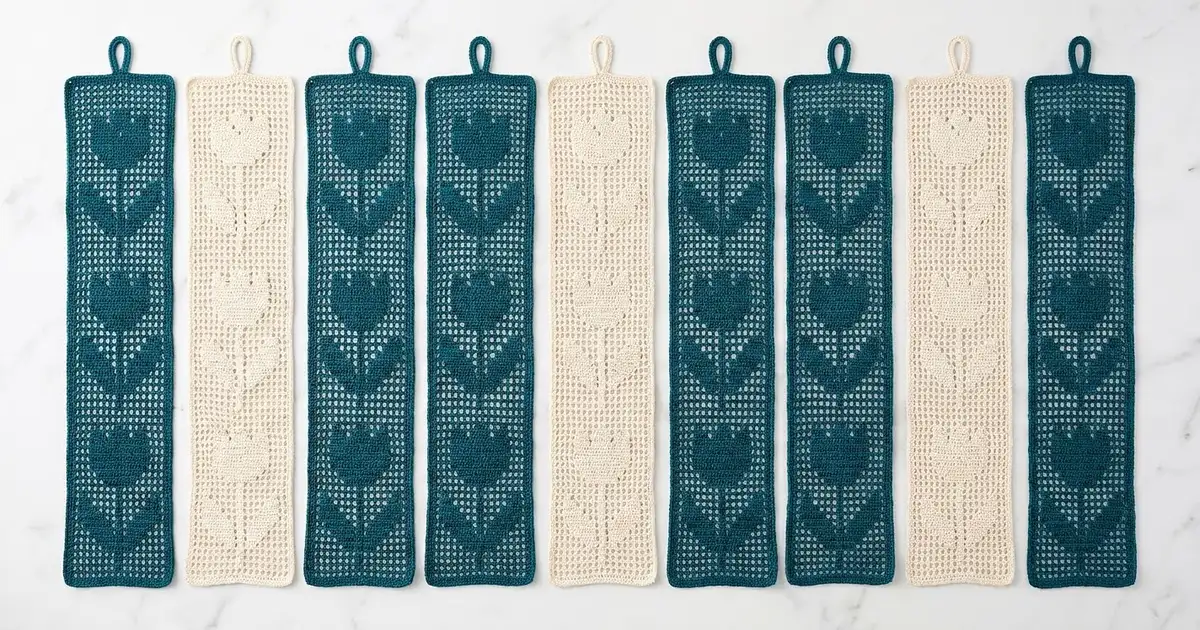
Tulip Lane is a strip-style door curtain worked in classic filet crochet. Seven separate strips hang side by side from a rod. Each strip has a column of solid-block tulips on an open square mesh, so light passes through and the tulips stand out clearly.
The sample alternates four deep teal strips with three natural cream strips. The look is fresh and a little vintage, like a cottage doorway. Because the strips are not joined, you can walk straight through the curtain, and each strip can be washed or replaced on its own.
This pattern uses US crochet terms. Each finished strip measures 7 in x 72.5 in (17.8 cm x 184.2 cm). Hung edge to edge, the seven strips cover a width of 49 in (124.5 cm).
Each strip is one long filet rectangle, 13 blocks wide and 144 rows long. It gets a single round of single crochet as a border, then a sewn tab loop at the top. After blocking, you slide the strips onto a rod in alternating colours.
Finished Size and Construction
- Finished strip size: 7 in x 72.5 in (17.8 cm x 184.2 cm)
- Skill level: Intermediate
- Terminology: US crochet terms
- Yarn weight: #2 fine / sport-weight mercerized cotton
- Hook: 3.5 mm (E-4)
- Number of pieces: 7 strips (4 teal, 3 cream)
- Layout: 7 strips in one row, hung separately with no joining
- Piece size before border: 6.5 in x 72 in (16.5 cm x 182.9 cm)
- Border depth: 0.25 in (0.6 cm) on each edge
- Tab loop: 1.7 in (4.3 cm) wide, 2 in (5.1 cm) tall when folded
Materials
Choose a smooth, mercerized sport-weight cotton. It shows the filled blocks crisply, keeps its shape when hanging, and holds up to washing. Avoid fuzzy or very stretchy yarns, because a long strip will slowly lengthen under its own weight.
- Color A, Teal: 400 g, about 1240 m (1356 yd), for 4 strips
- Color B, Cream: 300 g, about 930 m (1017 yd), for 3 strips
Tools:
- 3.5 mm (E-4) crochet hook
- Tapestry needle
- Stitch markers
- Rustproof pins and blocking mats, or a clean towel on the floor
- Spray bottle
- Tape measure
- Curtain rod, up to 1.25 in (3.2 cm) in diameter
The yarn quantities include a margin of about 10% for swatching and weaving in ends.
Abbreviations (US Terms)
- ch: chain
- sl st: slip stitch
- sc: single crochet
- dc: double crochet
- sp: space
- st(s): stitch(es)
- RS / WS: right side / wrong side
Special stitches (filet blocks):
- Open block (O): ch 2, skip the next 2 sts, dc in the next dc. If the block below is open, you skip its ch-2 space.
- Filled block (F): dc in each of the next 3 sts. If the block below is open, work 2 dc in its ch-2 space, then 1 dc in the next dc.
- Turning chain: ch 3 counts as the first dc of every row.
Every row has 14 dc posts and 13 blocks, for a total of 40 sts. An open block contains 2 ch and a filled block contains 2 dc, but either way each block plus its closing post adds 3 sts.
Gauge and Checkpoints
Filet gauge: 4 blocks x 4 rows = 2 in x 2 in (5.1 cm x 5.1 cm) after blocking. Each block is 0.5 in (1.3 cm) square.
Border gauge: 6 sc = 1 in (2.5 cm).
Work a swatch first: ch 17, then follow Row 1 below for 4 blocks and work 4 rows in total. Block it and measure.
Then make one full strip and check it before starting the other six. Checkpoints:
- After Row 1: width 6.5 in (16.5 cm)
- After Row 22 (first tulip complete): length 11 in (27.9 cm)
- After Row 72: length 36 in (91.4 cm)
- After Row 144: 6.5 in x 72 in (16.5 cm x 182.9 cm), after blocking
- After the border: 7 in x 72.5 in (17.8 cm x 184.2 cm)
If your blocks are too big, go down half a hook size. If they are too small, go up half a size. Sport cotton often works up a little short in height before blocking, so measure your length checkpoints on a pinned and steamed swatch, not on loose fabric.
Strip Pattern
Foundation and Row 1 (RS): Ch 44. Dc in the 8th ch from the hook. Ch 2, skip 2 ch, dc in the next ch. Repeat from * to * 11 more times. Turn. (13 open blocks, 40 sts)
Row 2: Ch 3 (counts as dc), then work 13 open blocks. Turn. (13 O, 40 sts)
The Tulip Repeat (20 rows)
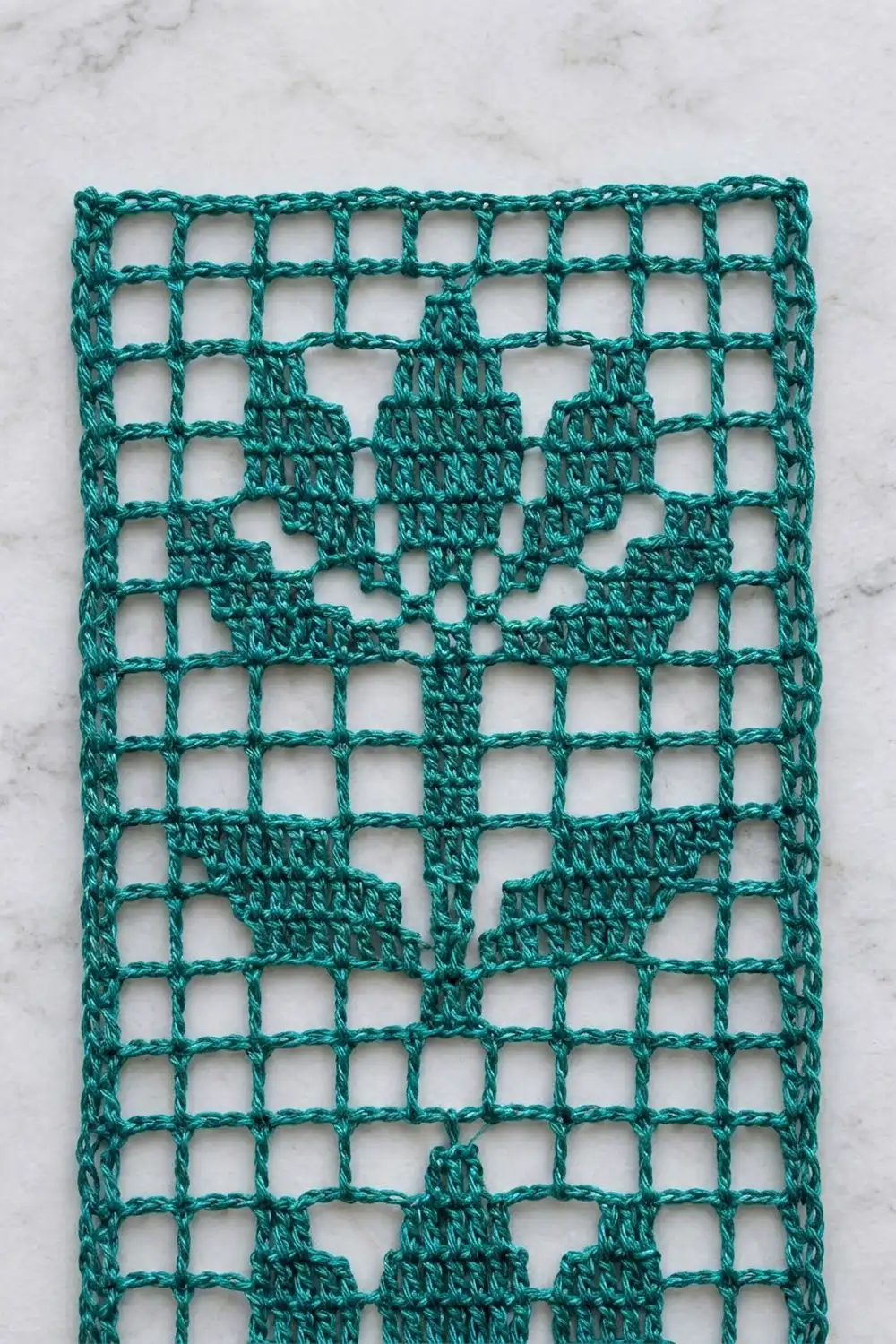
Each line below lists the columns that are filled (numbered 1–13). All other blocks are open. The motif is symmetric, so you can read every row from either side.
- r1: none (13 O)
- r2: 7 (stem)
- r3: 5–9
- r4: 3, 4, 5, 7, 9, 10, 11
- r5: 2, 3, 7, 11, 12
- r6: 7
- r7: 7
- r8: 5–9
- r9: 3, 4, 5, 7, 9, 10, 11
- r10: 2, 3, 4, 7, 10, 11, 12
- r11: 2, 7, 12
- r12: 5–9 (flower base)
- r13: 4–10
- r14: 3, 4, 6, 7, 8, 10, 11
- r15: 3, 4, 6, 7, 8, 10, 11
- r16: 3, 6, 7, 8, 11
- r17: 6, 7, 8
- r18: 7 (petal tip)
- r19: none
- r20: none
Rows r3–r5 form the lower leaf pair, which angles up and outward from the stem. Rows r8–r11 form the upper leaf pair. In rows r14–r16, the side petals are separated from the centre petal by the open blocks in columns 5 and 9, which gives the three-petal flower its shape.
Filled blocks per repeat: 77. Every row still has 40 sts.
Rows 3–142: Work the 20-row repeat 7 times. Strip row = 2 + 20 x (repeat number − 1) + r. For example, the stem start in the third tulip is Row 2 + 40 + 2 = Row 44.
Rows 143–144: Ch 3, then work 13 open blocks. Turn. (40 sts)
Fasten off. You should have 144 rows and 7 tulips. Before the border, the strip measures 6.5 in x 72 in (16.5 cm x 182.9 cm).
Tip: Place a marker at the start of each repeat. Counting to 20 is much easier than counting to 144.
Make All Pieces
- Color A, Teal: 4 strips
- Color B, Cream: 3 strips
Give each strip its own border and tab before you block it.
Layout, viewed from the room side, left to right on the rod:
| A | B | A | B | A | B | A |
 T   C   T   C   T   C   T
Every strip has the same stitch count, so any strip can go in any position of its colour.
Joining (Hanging Assembly)
The strips are not joined to one another. Each strip is complete with its own border, and they only come together on the rod. This keeps the curtain easy to pass through. It also means no strip’s border count depends on its neighbours.
The tabs are the only sewing, and they are sewn stitch-to-stitch:
- Make the tab (see Border, Tab section) and fold it to the WS.
- Line up the 10 sts of the tab’s last row with the same 10 border sc it started from (sc 15–24 of the top edge).
- Whipstitch one tab stitch to one border sc, all 10, through the back loops only.
Keep your whipstitch tension firm but flat. If you pull too tight, the top edge puckers. If it is too loose, the tab twists and the strip hangs crooked.
Size checkpoint: Slide all seven strips onto the rod with their edges touching. The total width should be 7 x 7 in = 49 in (124.5 cm). For a narrower door, push the strips closer together so they overlap slightly. The length from the rod to the bottom edge is about 74.5 in (189.2 cm): the 72.5 in (184.2 cm) strip plus the 2 in (5.1 cm) tab.
Border
Work 1 round of sc in the same colour as the strip.
Border gauge: 6 sc = 1 in (2.5 cm). Each filet row is 0.5 in (1.3 cm) tall, so 3 sc per row-end matches the gauge exactly.
Round 1 (RS): Join the yarn in the second st of Row 144 (the first ch next to the corner post). Ch 1.
- Top edge: sc in each st between the two end posts. (38 sc)
- Corner: ch 1.
- First long side: work 3 sc around each row-end post, from Row 144 down to Row 1. (144 x 3 = 432 sc)
- Corner: ch 1.
- Bottom edge: working into the foundation chain, work 2 sc in each of the 13 ch-2 spaces and 1 sc at the base of each of the 12 interior dc. (26 + 12 = 38 sc)
- Corner: ch 1.
- Second long side: work 3 sc around each row-end, from Row 1 up to Row 144. (432 sc)
- Corner: ch 1. Sl st to the first sc.
Total: 38 + 432 + 38 + 432 = 940 sc plus 4 ch-1 corner spaces.
Why the math works: The 38 interior sts on the top and bottom edges span about 6.3 in (16 cm), and 38 ÷ 6 ≈ 6.3. On the long sides, 144 rows x 0.5 in = 72 in, and 72 x 6 = 432. The corners are only ch-1 spaces, so no corner stitch is counted twice. Each edge grows by one sc height, which is 0.25 in (0.6 cm). That brings the strip from 6.5 in x 72 in to 7 in x 72.5 in (17.8 cm x 184.2 cm).
Tab
Count the 38 top-edge sc. Join the yarn in sc 15, leaving 14 sc on each side.
Row 1: Ch 1, sc in the same st and in each of the next 9 sc. Turn. (10 sc)
Rows 2–20: Ch 1, sc in each st across. Turn. (10 sc)
The tab is now about 4 in (10.2 cm) long and 1.7 in (4.3 cm) wide. Fasten off, leaving a 12 in (30.5 cm) tail. Fold the tab to the WS and sew it as described in Joining. This makes a loop 2 in (5.1 cm) tall.
Final Blocking
- Weave in all ends along the dc posts. Never weave them across open mesh, where they would show.
- Soak each strip in cool water for 10 minutes, then press out the water in a towel. Do not wring.
- Lay the strip flat. If your mats are too short, pin it in sections.
- Pin the width to 7 in (17.8 cm) every 6 in (15.2 cm) along the length.
- Pin the length to 72.5 in (184.2 cm). Check that each tulip repeat measures 10 in (25.4 cm).
- Square the open blocks with the side of a pin. Make sure the stem runs in a straight line down the centre column.
- Let the strip dry completely. Unpin it, then hang it for 24 hours before your final measurement.
Final Quality-Control Checklist
- Every strip has 144 rows and 7 complete tulips.
- Every row has 40 sts and 13 blocks.
- The border has 940 sc and 4 ch-1 corners.
- Each tab is 10 sc wide and centred over sc 15–24.
- All strips measure 7 in x 72.5 in (17.8 cm x 184.2 cm) within 0.25 in (0.6 cm).
- The tulips line up across strips when hung.
- The colour order is A, B, A, B, A, B, A.
Troubleshooting
The strip slants or narrows. You probably skipped the turning-chain dc or the last dc of a row. Count your 14 posts every few rows.
The filled blocks bulge. Your dc are taller than your chains. Tighten your dc slightly, or work ch 2 a little looser.
The sides ruffle. Work 2 sc per row-end instead of 3 only if your border gauge is 4 sc per in (2.5 cm), and recount the sides to match.
The sides pull in. Your border tension is too tight. Go up half a hook size for the border only.
The strip has grown longer after hanging. This is normal for cotton. Re-block it with a little extra width to counter the stretch.
The tab twists. Re-sew it through matching stitches. It must be centred exactly.
Care
Hand wash in cool water with mild soap and dry flat. Lightly re-block after washing so the strips hang straight.

Final Notes
The measurement chain is simple:
- One block = 0.5 in (1.3 cm).
- 13 blocks = 6.5 in (16.5 cm) wide.
- 144 rows = 72 in (182.9 cm) long.
- One sc border round adds 0.25 in (0.6 cm) per edge, giving 7 in x 72.5 in (17.8 cm x 184.2 cm).
- Seven strips edge to edge = 49 in (124.5 cm) of tulip curtain.
Check your gauge on the first strip and the other six will follow.
Happy crocheting!