

This curtain pair is made from eight-pointed lace stars in deep burgundy cotton. Each star has a small open center, eight textured leaf petals and a light chain outline. When the stars are joined, the spaces between them open into round windows of lace, so the panels filter daylight without blocking it.
The design uses one color, a deep berry red. It looks warm for the holidays and still works the rest of the year. The style is classic motif lace, open and graphic. All instructions use US crochet terms.
Each finished panel measures 21 x 51 in (53.3 x 129.5 cm) without the rod loops. With the loops, it is 52.25 in (132.7 cm) long. You make two panels.
The construction is simple. You crochet 80 star motifs and join them as you go on the last round, 4 across and 10 down per panel. Then you add a border. It straightens the top and sides, keeps the pointed lower edge and adds five rod loops.
Finished Size and Construction
- Finished panel size: 21 x 51 in (53.3 x 129.5 cm), plus 1.25 in (3.2 cm) of rod loops
- Skill level: Intermediate
- Terminology: US crochet terms
- Yarn weight: DK (light worsted, #3)
- Hook: 3.5 mm (E-4)
- Number of pieces: 2 panels, 40 star motifs each (80 total)
- Layout per panel: 4 motifs across x 10 motifs down
- Motif size: 5 in (12.7 cm) from cardinal tip to cardinal tip, so each motif fills a 5 x 5 in (12.7 x 12.7 cm) grid space
- Panel size before border: 20 x 50 in (50.8 x 127.0 cm)
- Border depth: 0.5 in (1.3 cm) on each edge
Materials
Yarn: Use a smooth mercerized cotton or cotton blend in DK weight, about 110 m per 50 g. Cotton gives crisp petals and blocks to clean points. Avoid fuzzy yarns, because they blur the lace.
- Burgundy: 400 g / 880 m (eight 50 g balls). One motif uses about 3.5 g / 7.7 m. The borders on both panels together use about 40 g / 88 m.
These quantities include a margin of about 15% for swatching and tension differences. Buy all of your yarn from a single dye lot.
Tools:
- 3.5 mm (E-4) hook
- Tapestry needle
- Rust-proof pins
- Blocking mats
- Tape measure
- Spray bottle
- Stitch markers
Abbreviations (US Terms)
- ch: chain
- sl st: slip stitch
- sc: single crochet
- dc: double crochet
- tr: treble crochet
- dtr: double treble crochet
- st(s): stitch(es)
- sp: space
- lp: loop
- RS: right side
- tr4tog / tr5tog: treble 4 (or 5) together
Special stitches:
- tr5tog: *Yarn over twice, insert hook in next st, pull up a loop, (yarn over, pull through 2 loops) twice. Repeat from * 4 more times (6 loops on hook). Yarn over and pull through all 6 loops.
- Cardinal tip (unjoined): (dc, ch 5, dc) in the same st.
- Cardinal tip (joined): dc, ch 2, sl st in the neighbor’s ch-5 tip lp, ch 2, dc in the same st.
- Diagonal spur (new ring): dc, ch 4, ch 5, sl st in the 5th ch from hook to make a small ring, ch 4, dc in the same st.
- Diagonal spur (shared ring): dc, ch 4, sl st in the existing corner ring, ch 4, dc in the same st.
Gauge and Checkpoints
Make one complete motif, block it and measure it before you start the curtain. Every other measurement depends on this one.
- After Round 1: 1.75 in (4.4 cm) across
- After Round 2: 3 in (7.6 cm) across
- After Round 3: 4 in (10.2 cm) across
- After Round 4: 4.5 in (11.4 cm) from cluster to cluster
- After Round 5: 5 in (12.7 cm) from cardinal tip to cardinal tip, blocked
If your motif is larger, change to a 3.25 mm hook. If it is smaller, change to a 3.75 mm hook. An error of just 0.25 in (0.6 cm) per motif adds up to 2.5 in (6.4 cm) over 10 rows.
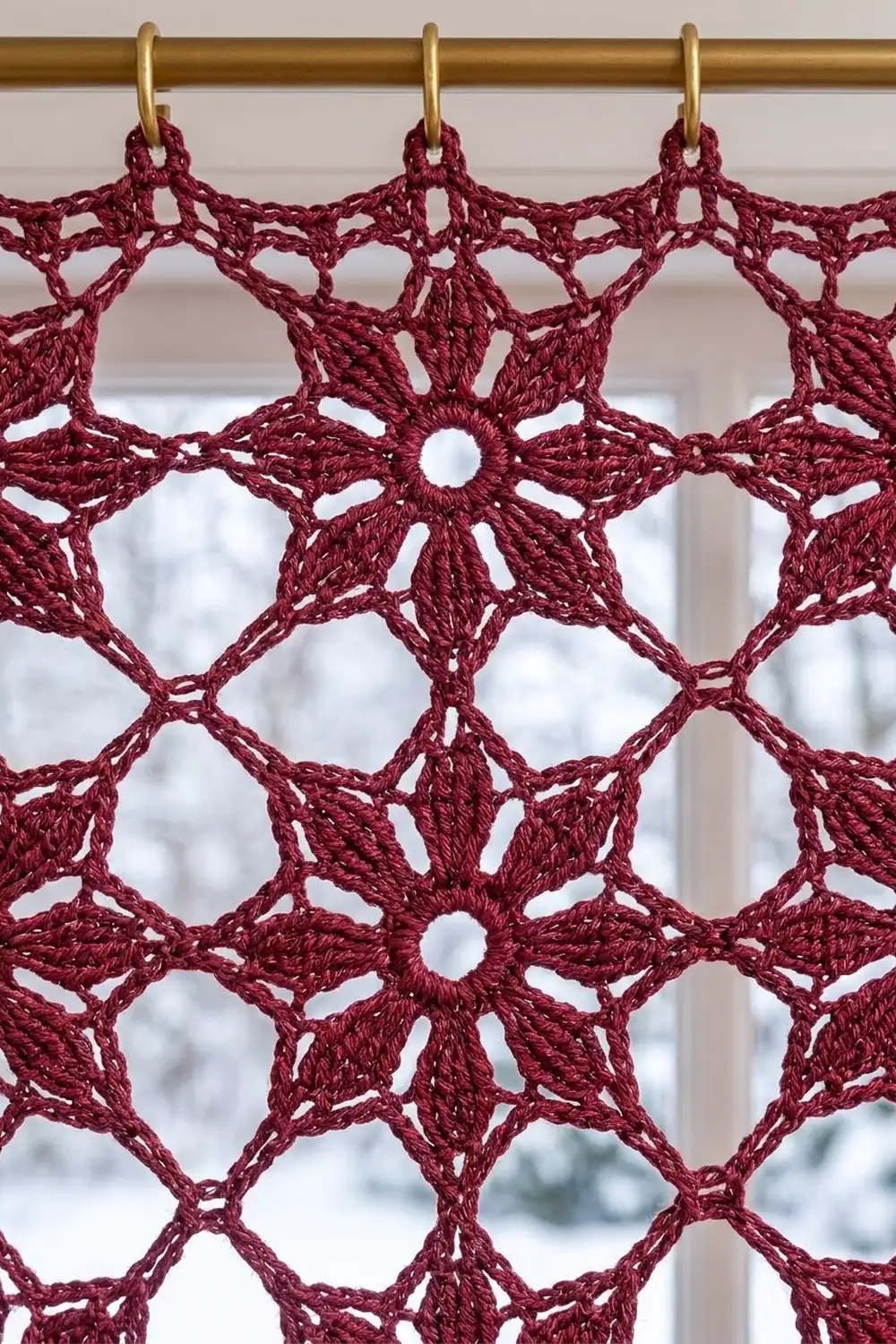
Star Motif
The points alternate around the star: cardinal tip, diagonal spur, cardinal tip, diagonal spur. The four cardinal tips (top, right, bottom, left) join to neighbors. The four diagonal spurs meet in shared corner rings.
Round 1: Ch 8, sl st in first ch to form a ring. Ch 3 (counts as dc), 23 dc in ring, sl st in top of beginning ch-3. (24 dc)
Round 2: Ch 4 (counts as tr), tr in next 2 sts, ch 3, tr in next 3 sts, ch 3; repeat from * 6 more times, sl st in top of beginning ch-4. (24 tr in 8 groups of 3, 8 ch-3 sps)*
Round 3: Ch 4 (counts as tr), tr in same st, tr in next st, 2 tr in next st, ch 4, skip ch-3 sp, 2 tr in next st, tr in next st, 2 tr in next st, ch 4, skip ch-3 sp; repeat from * 6 more times, sl st in top of beginning ch-4. (40 tr in 8 groups of 5, 8 ch-4 sps)*
This round widens the petals into leaf shapes.
Round 4: Ch 4, tr4tog over next 4 sts (counts as first tr5tog), ch 5, sc in next ch-4 sp, ch 5, tr5tog over next 5 sts, ch 5, sc in next ch-4 sp, ch 5; repeat from * 6 more times, sl st in top of first cluster. (8 clusters, 8 sc, 16 ch-5 lps)*
The clusters close each leaf into a point. The sc between them form the star’s inner valleys.
Round 5 (first motif only):
- Ch 3 (counts as dc), ch 5, dc in same st. This makes the first cardinal tip.
- Ch 3, sc in next ch-5 lp, ch 3, sc in next sc, ch 3, sc in next ch-5 lp, ch 3*.
- In the top of the next cluster, work the next point. Alternate between a diagonal spur (new ring) and a cardinal tip (unjoined).
- Repeat from * around, ending the last repeat at **.
- Sl st in top of beginning ch-3. Fasten off.
Round 5 count: 16 dc, 24 sc, 32 ch-3 sps, 4 cardinal tip lps and 4 diagonal spurs.
Make All Pieces
Each panel needs 40 motifs, for 80 motifs in total, all in burgundy:
- Panel A: 40 motifs (140 g / 308 m)
- Panel B: 40 motifs (140 g / 308 m)
Work Rounds 1–4 the same way for every motif. Work Round 5 with join-as-you-go, row by row from left to right, starting with the top row.
Layout per panel (M = motif):
Row 1:  M  M  M  M
Row 2:  M  M  M  M
Row 3:  M  M  M  M
Row 4:  M  M  M  M
Row 5:  M  M  M  M
Row 6:  M  M  M  M
Row 7:  M  M  M  M
Row 8:  M  M  M  M
Row 9:  M  M  M  M
Row 10: M  M  M  M
Joining
Method: Join as you go, on Round 5 only.
Stitch-to-stitch logic:
- Left neighbor: Your left cardinal tip joins the neighbor’s right tip lp.
- Neighbor above: Your top cardinal tip joins the upper motif’s bottom tip lp.
- Corners: The first motif to reach a corner makes a new ring. Every later motif works a shared-ring spur into that same ring. An interior ring holds 4 spurs, an edge ring holds 2 and a panel corner ring holds 1.
- Free points: Work any point with no neighbor unjoined.
A joined tip uses ch 2 + sl st + ch 2, which matches the ch 5 of a free tip. Joined and free points therefore stay the same size, and no stitches are added at any seam.
Tension: Keep each joining sl st snug but not tight. A hard pull puckers the tip and tilts the star. After every join, lay the work flat and check that the tips line up.
Size checkpoint: One row of 4 motifs measures 20 in (50.8 cm). A full panel of 10 rows measures 50 in (127.0 cm) from tip to tip. Check after Rows 1, 5 and 10.
Border
Work the border on each panel separately. Rounds 1–2 go all the way around the panel. Rows 3–4 are worked across the top only.
Border gauge: 24 sc = 5 in (12.7 cm), or 4.8 sc per inch, measured on Round 2.
Round 1 (fill round): With RS facing, join with sc in the top-left corner ring.
Top and side edges: For each motif, work: ch 2, tr in next sc, ch 2, dtr in valley sc, ch 2, tr in next sc, ch 2, sc in cardinal tip lp, ch 2, tr in next sc, ch 2, dtr in valley sc, ch 2, tr in next sc, ch 2, sc in next ring.
The tall stitches fill the valleys and straighten the edge. Each motif adds 8 sts and 8 ch-2 sps.
Bottom edge: For each motif, work: ch 3, sc in next sc, ch 3, sc in valley sc, ch 3, sc in next sc, ch 3, (sc, ch 3, sc) in tip lp, ch 3, sc in next sc, ch 3, sc in valley sc, ch 3, sc in next sc, ch 3, sc in next ring.
Each motif adds 9 sts and 9 ch-3 sps, and this edge keeps the points.
Round 1 counts per side (including both corner sc):
- Top: (4 x 8) + 1 = 33 sts, 32 ch-2 sps
- Each side: (10 x 8) + 1 = 81 sts, 80 ch-2 sps
- Bottom: (4 x 9) + 1 = 37 sts, 36 ch-3 sps
Sl st in first sc to join. Each corner sc belongs to two sides, so the round total is 33 + 81 + 37 + 81 − 4 = 228 sts.
Round 2 (conversion round): Ch 1, then work around the panel:
- 1 sc in each st
- 2 sc in each sp, except the 4 tip sps
- (sc, ch 3, sc) in each tip sp
- 3 sc in each corner sc
Sl st in first sc.
Round 2 counts per side (including both corner sts):
- Top: 33 sts worked 1 per st + 64 sc in sps + 2 corner extras = 99 sc
- Each side: 81 + 160 + 2 = 243 sc
- Bottom: 37 + 64 + 8 (tip sps) + 2 = 111 sc, plus 4 ch-3 picots
Why the math works: On a straight edge, each motif becomes 8 sts + (8 x 2) = 24 sc. At 4.8 sc per inch, that is 5 in (12.7 cm), which is exactly the motif’s grid space. So the top is (4 x 24) + 1 + 2 = 99 sc, and each side is (10 x 24) + 1 + 2 = 243 sc. The border neither ruffles nor pulls in.
Row 3 (rod loops): Do not turn. Ch 1. Number the top sts 1 to 99, from the left corner st to the right corner st.
- Sc in each st across.
- At sts 1, 26, 50, 74 and 99, work the sc, then ch 16 and sl st in that same sc to make a loop. Sts 26, 50 and 74 sit above the rings between motifs.
(99 sc, 5 ch-16 lps) Turn.
Row 4: Ch 1, sc in each sc across, working 24 sc into each ch-16 lp. (99 + 120 = 219 sc) Fasten off and weave in all ends.
The rod loops are about 1 in (2.5 cm) across. They fit rods up to 0.75 in (1.9 cm) in diameter.
Final Blocking
- Soak each panel in cool water for 15 minutes, then press the water out without wringing.
- Roll the panel in a towel to remove excess water.
- Lay it flat and pin the corners to 21 x 51 in (53.3 x 129.5 cm).
- Pin the top and side edges straight, with a pin every 2.5 in (6.4 cm).
- Pin each bottom point and picot, spacing the points 5 in (12.7 cm) apart.
- Pin open each corner ring so it is round.
- Let the panel dry completely. Block the second panel and compare the two.
Final Quality-Control Checklist
- Every motif measures 5 in (12.7 cm) from cardinal tip to cardinal tip.
- Each panel has 40 motifs, 4 across and 10 down.
- Every spur is attached to the correct ring.
- Border Round 2 counts are 99 / 243 / 111 / 243.
- There are 5 rod loops of 24 sc each.
- Each panel measures 21 x 51 in (53.3 x 129.5 cm).
- Ends are woven into petals or chains, not across open spaces.
Troubleshooting
- Motif cups: Round 3 is too tight. Work Rounds 3–5 with a hook 0.25 mm larger.
- Motif ruffles: Round 5 chains are too loose. Tighten your chains.
- Panel leans: A spur is joined to the wrong ring. Check every diagonal before you start the next row.
- Top edge waves: Your dtr are too tall for your tension. Replace them with tr.
- Sides pull in: Recount Round 2. Each side should have 243 sc.
- Rod loops twist: Work Row 4 a little more loosely.
Care
Hand wash the panels in cool water with mild soap and dry them flat, pinning if needed. Strong sun can fade cotton, so swap the panels’ positions from time to time.

Final Notes
The measurement chain:
- One motif = 5 in (12.7 cm).
- Four across = 20 in (50.8 cm).
- Ten down = 50 in (127.0 cm).
- The border adds 0.5 in (1.3 cm) on each edge, for 21 x 51 in (53.3 x 129.5 cm).
- The rod loops add 1.25 in (3.2 cm), for a total length of 52.25 in (132.7 cm).
Check your first motif, keep your joins snug and count each border round. If you do, both panels will hang straight and match.
Happy crocheting!