

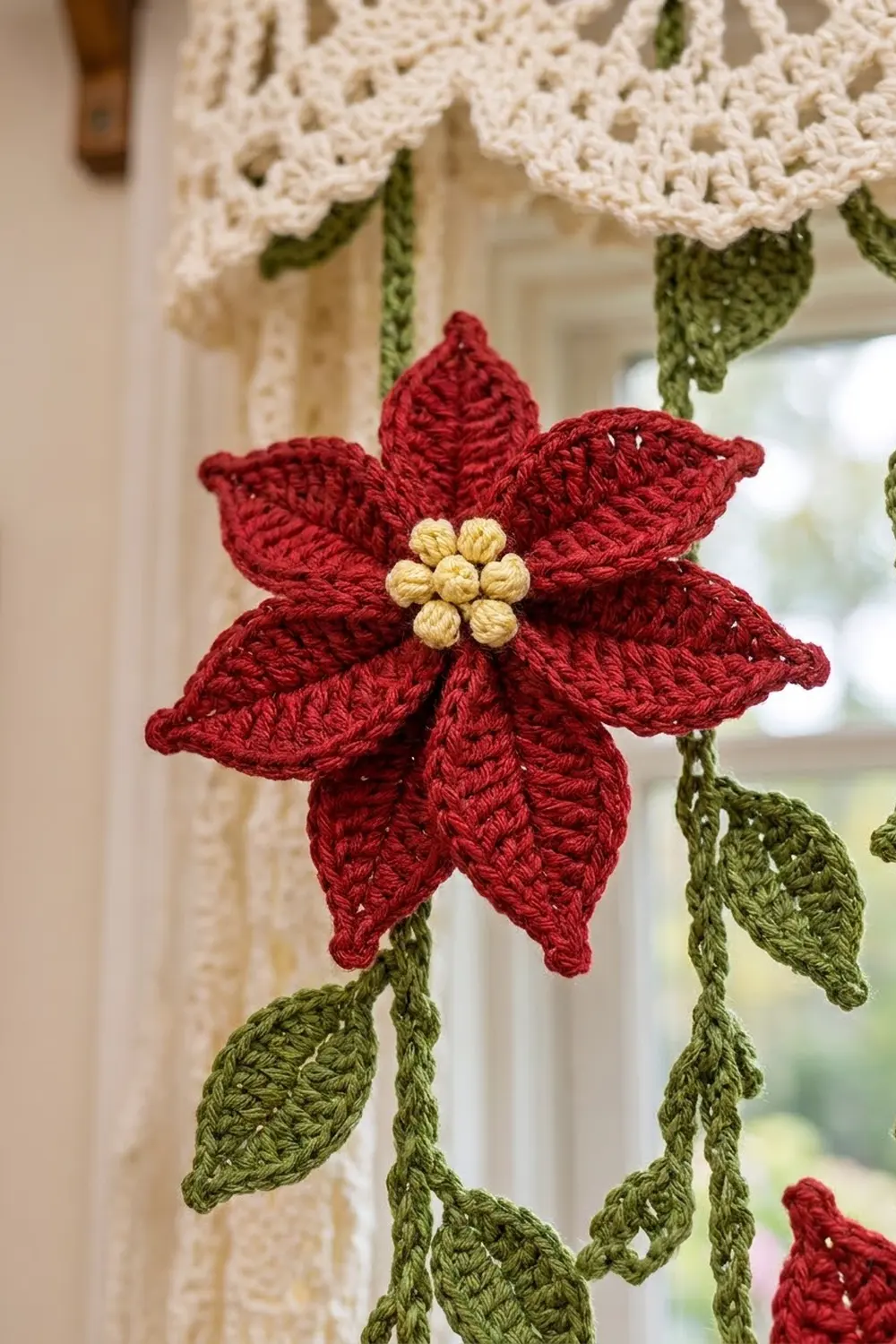
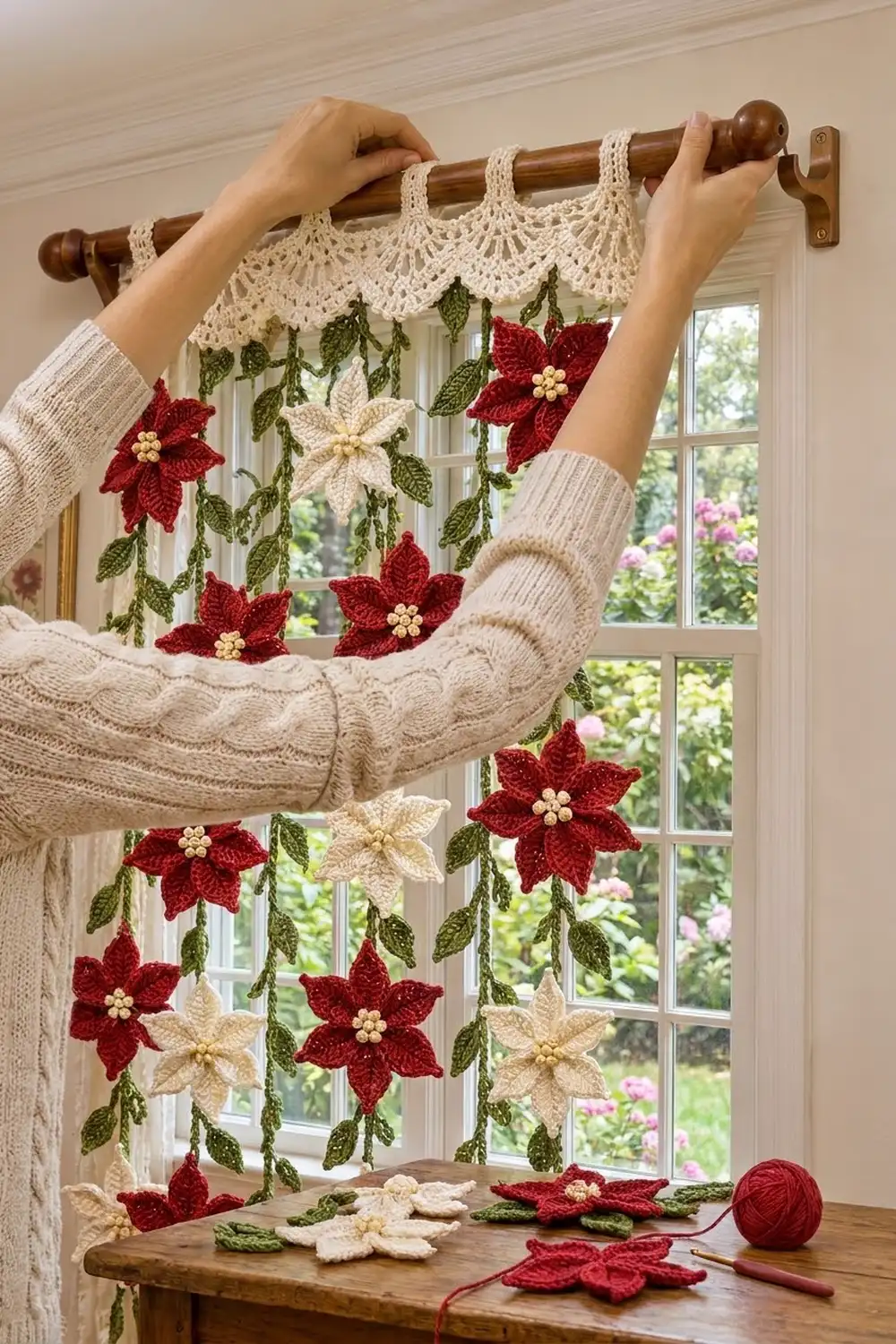
This window curtain brings a holiday garden indoors. A scalloped cream lace valance hangs from a wooden rod on ten tab loops, and nine leafy green vines fall from the scallop points. Red eight-petal poinsettias and cream six-petal poinsettias alternate down the vines, each one finished with a cluster of butter-yellow bobbles in the center.
The palette is classic and warm: deep red, soft cream, leaf green, and a pale butter yellow for the centers. The look is cottage-style and airy. Light comes through between the strands, so the curtain decorates the window without blocking it.
The finished curtain measures 36 in (91.4 cm) wide. The valance is 5.5 in (14.0 cm) deep, and the vines hang 42 in (106.7 cm) below it, for a total drop of 47.5 in (120.7 cm). All instructions use US crochet terms.
Construction is modular. You crochet the valance flat in rows, add a scalloped border, and work the tabs off the top edge. The flowers, bobble centers, and vines are made separately. Leaves are worked straight off the vine chain as you go. Finally you sew the centers to the flowers, sew the vines to the scallop points, and sew the flowers onto the vines.
Finished Size and Construction
- Finished size: 36 in (91.4 cm) wide x 47.5 in (120.7 cm) total drop
- Skill level: Intermediate
- Terminology: US crochet terms
- Yarn weight: DK (weight 3) cotton or cotton blend
- Hook: 4.0 mm (US G-6)
- Number of pieces: 82 (1 valance, 18 red flowers, 18 cream flowers, 36 bobble centers, 9 vines)
- Layout: 9 vines spaced 4 in (10.2 cm) apart, each carrying 4 flowers
- Piece sizes: flower 4.25 in (10.8 cm) across; center 1 in (2.5 cm); vine 42 in (106.7 cm) long
- Valance size before border: 36 x 4 in (91.4 x 10.2 cm)
- Border depth: 1.5 in (3.8 cm), bringing the valance to 5.5 in (14.0 cm)
Materials
Pick a smooth mercerized or matte cotton in DK weight. Cotton holds the petal points and scallops crisply and does not stretch much once the curtain is hanging. The amounts below assume about 115 m (126 yd) per 50 g.
- Cream: 150 g, about 345 m (valance, tabs, and cream flowers)
- Red: 100 g, about 230 m (red flowers)
- Green: 100 g, about 230 m (vines and leaves)
- Butter yellow: 50 g, about 115 m (bobble centers)
These quantities include a margin of about 25 percent for gauge swatches and tails.
Tools:
– 4.0 mm (US G-6) hook
– Tapestry needle
– Rust-proof pins and a blocking mat
– Tape measure
– Stitch markers
– Spray bottle
Abbreviations (US Terms)
- ch – chain
- sl st – slip stitch
- sc – single crochet
- hdc – half double crochet
- dc – double crochet
- tr – treble crochet
- sk – skip
- sp – space
- st(s) – stitch(es)
- MR – magic ring
- RS / WS – right side / wrong side
Special stitch – bobble: (Yarn over, insert hook in ring, yarn over and pull up a loop, yarn over and pull through 2 loops) 4 times, then yarn over and pull through all 5 loops on the hook.
Back bump: the horizontal bar on the back of a chain. Working into the back bumps leaves the two top loops free for a later round.
Gauge and Checkpoints
Main gauge: 18 dc and 9 dc rows = 4 in (10.2 cm). In sc, 18 sts and 20 rows = 4 in (10.2 cm).
Chain gauge: 5 ch = 1 in (2.5 cm), measured with the chain hanging relaxed.
Test one red flower before anything else. It is quick, and it tells you whether your tension will match. If your flower comes out larger than 4.25 in (10.8 cm), go down half a hook size. If it is smaller, go up half a size.
Checkpoints at each stage:
– Flower Rnd 1: 0.6 in (1.5 cm) across
– Finished flower: 4.25 in (10.8 cm) from petal tip to opposite petal tip
– Bobble center: 1 in (2.5 cm)
– Valance Row 2: 36 in (91.4 cm) wide
– Valance after Row 10: 4 in (10.2 cm) deep
– One vine section: 3 in (7.6 cm)
If the valance is too wide, your chain will also run long, so change hooks for everything, not just one piece. Keep the same hook for all parts so the proportions stay right.
Valance Body
With cream, ch 163.
Row 1: Sc in 2nd ch from hook and in each ch across, turn. (162 sc)
Row 2: Ch 3 (counts as dc), dc in each st across, turn. (162 dc)
Row 3 (mesh): Ch 3 (counts as dc), dc in next st, ch 1, sk 1, dc in next st; repeat from * to end, turn. (82 dc + 80 ch-1 sps = 162 sts)
Rows 4–8: Ch 3 (counts as dc), dc in next dc, ch 1, dc in next dc; repeat from * to end, turn. (82 dc + 80 ch-1 sps = 162 sts)
Row 9 (conversion): Ch 3 (counts as dc), dc in next dc, dc in ch-1 sp, dc in next dc; repeat from * to end, turn. (82 dc worked 1-per-dc + 80 dc worked into ch-1 sps = 162 dc)
Row 10: Ch 1, sc in each st across, turn. (162 sc)
Checkpoint: 36 x 4 in (91.4 x 10.2 cm). Do not fasten off; the border starts here.
Tabs
Tabs are worked into the free loops of the foundation chain along the top edge. Number the 162 loops from right to left with the RS facing.
Work a tab over each of these groups of 4 loops: 1–4, 17–20, 35–38, 53–56, 71–74, 89–92, 107–110, 125–128, 143–146, and 159–162. That makes 10 tabs. The end tabs sit flush with the sides. The 8 inner tabs are centered over the seams between scallop blocks, with 12 sts between the end tab and its neighbor and 14 sts between inner tabs.
Tab Row 1: Join cream in the first loop of the group, ch 1, sc in same loop and next 3 loops, turn. (4 sc)
Tab Rows 2–20: Ch 1, sc in each st, turn. (4 sc)
Fasten off, leaving a 10 in (25.4 cm) tail. Each tab measures 0.9 x 4 in (2.3 x 10.2 cm). Fold it to the WS and sew Row 20 to the back of valance Row 2. The loop fits a rod up to 1 in (2.5 cm) in diameter. For a thicker rod, add 2 rows to each tab for every extra 0.4 in (1.0 cm) of length you need.
Poinsettia Flowers
Red flower (make 18):
Rnd 1: With red, MR, 8 sc in ring, sl st in first sc. (8 sc)
Rnd 2 (petals): Ch 9. Working in the back bumps from the 2nd ch from hook: sl st, sc, hdc, dc, tr, tr, dc, hdc (8 sts). Sl st in the next sc of Rnd 1. Repeat from * 7 more times. The last sl st goes into the first sl st. (8 petals, 8 sts each = 64 sts)
Rnd 3 (petal edging): For each petal, work up the free top loops of the petal chain: sc, sc, hdc, hdc, dc, dc, hdc, sc (8 sts). Work (sc, ch 2, sc) in the unworked tip ch. Then work down the other side with sc in each of the 8 Rnd 2 sts, and sl st in the sl st between petals. Repeat around. (8 petals x 18 sts = 144 sts + 8 ch-2 tips)
The petal chain stays visible as a raised vein down the middle of each petal. Fasten off and weave in the ends.
Cream flower (make 18): Work as for the red flower in cream, using 6 sc in Rnd 1 and making 6 petals. (Rnd 1: 6 sc. Rnd 2: 6 petals x 8 sts = 48 sts. Rnd 3: 6 x 18 = 108 sts + 6 ch-2 tips.) Both flowers measure 4.25 in (10.8 cm) across.
Bobble Centers (make 36)
Rnd 1: With butter yellow, MR, ch 2 (does not count), bobble in ring, ch 1; repeat from * 5 more times. Pull the ring closed and sl st in the top of the first bobble. (6 bobbles + 6 ch-1 sps)
Fasten off, leaving a 12 in (30.5 cm) tail. Using the tail, make one tight French knot in the center hole to look like a seventh bead. The center measures 1 in (2.5 cm).
Vines (make 9)
Leaf: Ch 8. Working in the back bumps from the 2nd ch from hook: sl st, sc, hdc, dc, dc, hdc, sc (7 sts). Sl st in the vine ch where the leaf started. Each leaf is about 1.5 in (3.8 cm) long, with a pointed tip and a slim almond shape.
With green, leave a 10 in (25.4 cm) tail and ch 1. This is the top ch of the vine.
Section (work 14 times): Ch 14, make a leaf, ch 1, make a second leaf, laying it on the opposite side of the vine.
Fasten off. Each vine has a spine of 1 + (14 x 15) = 211 ch and carries 28 leaves. Each section measures 3 in (7.6 cm), so the vine is 42 in (106.7 cm) long.
Make All Pieces
- Cream: 1 valance with 10 tabs, 18 cream flowers
- Red: 18 red flowers
- Butter yellow: 36 bobble centers
- Green: 9 vines (252 leaves in total)
Layout grid. S1 to S9 are the vines from left to right, heights are measured from the scallop point down the vine, R is a red flower, C is a cream flower, and a dot means no flower at that height.
Height           S1 S2 S3 S4 S5 S6 S7 S8 S9
6 in (15.2 cm)   R  .  R  .  R  .  R  .  R
11 in (27.9 cm)  .  C  .  C  .  C  .  C  .
16 in (40.6 cm)  C  .  C  .  C  .  C  .  C
21 in (53.3 cm)  .  R  .  R  .  R  .  R  .
26 in (66.0 cm)  R  .  R  .  R  .  R  .  R
31 in (78.7 cm)  .  C  .  C  .  C  .  C  .
36 in (91.4 cm)  C  .  C  .  C  .  C  .  C
41 in (104.1 cm) .  R  .  R  .  R  .  R  .
Odd vines carry 2 red and 2 cream flowers, and so do even vines. Total: 5 x 2 + 4 x 2 = 18 red and 18 cream.
Joining
Finish the scalloped border (next section) before you start joining. The vines hang from its center picots.
Centers to flowers: Center a bobble disc on each flower’s Rnd 1. Sew around the disc’s ch-1 sps through Rnd 1 only, so the petals stay free.
Vines to valance: Thread the top tail of a vine and sew its top ch to the 6th (center) ch-3 picot of a scallop, passing through 3 times. Attach one vine to each of the 9 scallops. That puts the vines 4 in (10.2 cm) apart, with the outer vines 2 in (5.1 cm) in from the sides.
Flowers to vines: Hang the valance and let the vines settle for an hour. Measure each flower height from the picot. Sew through Rnd 1 of the flower and around the vine chain with 4–5 small stitches, then knot on the back. Leave the petals unstitched so they lift slightly.
Tension: Sew firmly but don’t cinch. Pulling the vine chain while sewing shortens it. Checkpoint: each vine hangs 42 in (106.7 cm) and the full drop is 47.5 in (120.7 cm). If a vine runs 1 in (2.5 cm) or more long, gently pull it back into shape. If it’s still long, take out one leaf pair at the bottom.
Scalloped Border
Border gauge: One 18-st block of Row 10 = one scallop = 4 in (10.2 cm) wide. The scallops sit along the bottom edge only. The sides and the tabbed top edge are left plain.
Work across the 162 sts of Row 10 as 9 blocks of 18 sts.
Row B1 (fans): Ch 1. For each block: sc in st 1, sk 7, 6 tr in st 9, 6 tr in st 10, sk 7, sc in st 18. Turn. (Per block: 2 sc + 12 tr. Total: 18 sc + 108 tr = 126 sts)
Row B2: Ch 1. For each block: sc in first sc, (dc in next tr, ch 1) 11 times, dc in 12th tr, sc in last sc. Turn. (Per block: 2 sc + 12 dc + 11 ch-1 sps. Total: 18 sc + 108 dc + 99 ch-1 sps)
Row B3 (picots): Ch 1. For each block: sc in first sc, (sc, ch 3, sc) in each of the 11 ch-1 sps (skipping the dc), sc in last sc. (Per block: 24 sc + 11 picots. Total: 216 sc + 99 picots)
Fasten off. Border depth: 1.5 in (3.8 cm).
Why the math works: 162 = 9 x 18, so the 9 blocks use every stitch with nothing left over. Each block uses 1 + 7 + 2 + 7 + 1 = 18 sts, and the two sc between blocks make a neat valley. Because 11 picots is an odd number, there is a true center picot (the 6th) with 5 on each side, so every vine hangs from the exact tip of its scallop.
Final Blocking
- Mist the valance until it is damp, not soaked.
- Pin it to 36 x 5.5 in (91.4 x 14.0 cm), keeping the Row 10 line straight.
- Pin out each scallop as a smooth arc, putting a pin in the center picot.
- Mist each flower and pin every ch-2 tip so the flower measures 4.25 in (10.8 cm).
- Let everything dry completely.
- Hang the vines and give them a light mist. Their own weight straightens them.
Final Quality-Control Checklist
- Valance is 36 in (91.4 cm) wide with 9 even scallops
- Tabs are evenly spaced, sewn securely, and fit the rod
- Every flower is 4.25 in (10.8 cm) across with sharp tips
- Centers are tightly sewn and sit in the middle of the flower
- Each vine has 28 leaves and hangs 42 in (106.7 cm)
- Flowers sit at the grid heights
- All ends are woven in and secured
Troubleshooting
- Scallops ruffle: Your tension is loose in the tr. Work B1 with a hook half a size smaller.
- Scallops cup: Your tr are too tight. Use a hook half a size larger for B1.
- Petals curl: Block with pins in the tips, or work Rnd 3 a little looser.
- Vines twist: Work all the leaves into the back bumps, then let the vine hang with a light mist.
- Valance leans: Check that Row 3 has 82 dc and that the end tabs line up.
- Flowers droop forward: Sew through Rnd 1 at both the top and bottom of the flower.
Care
Hand wash in cool water with mild soap, roll in a towel to press out the water, and dry flat, then rehang the curtain. Do not wring the vines.
Final Notes
The measurement chain is simple. 18 sts = 4 in (10.2 cm) gives a 162-st valance that is 36 in (91.4 cm) wide. That splits into 9 scallops of 4 in (10.2 cm), and each scallop carries one vine. Each vine is 14 sections of 3 in (7.6 cm), or 42 in (106.7 cm), and holds 4 flowers of 4.25 in (10.8 cm). If your gauge swatch and your test flower both match, every other piece will fall into place.
Happy crocheting!