

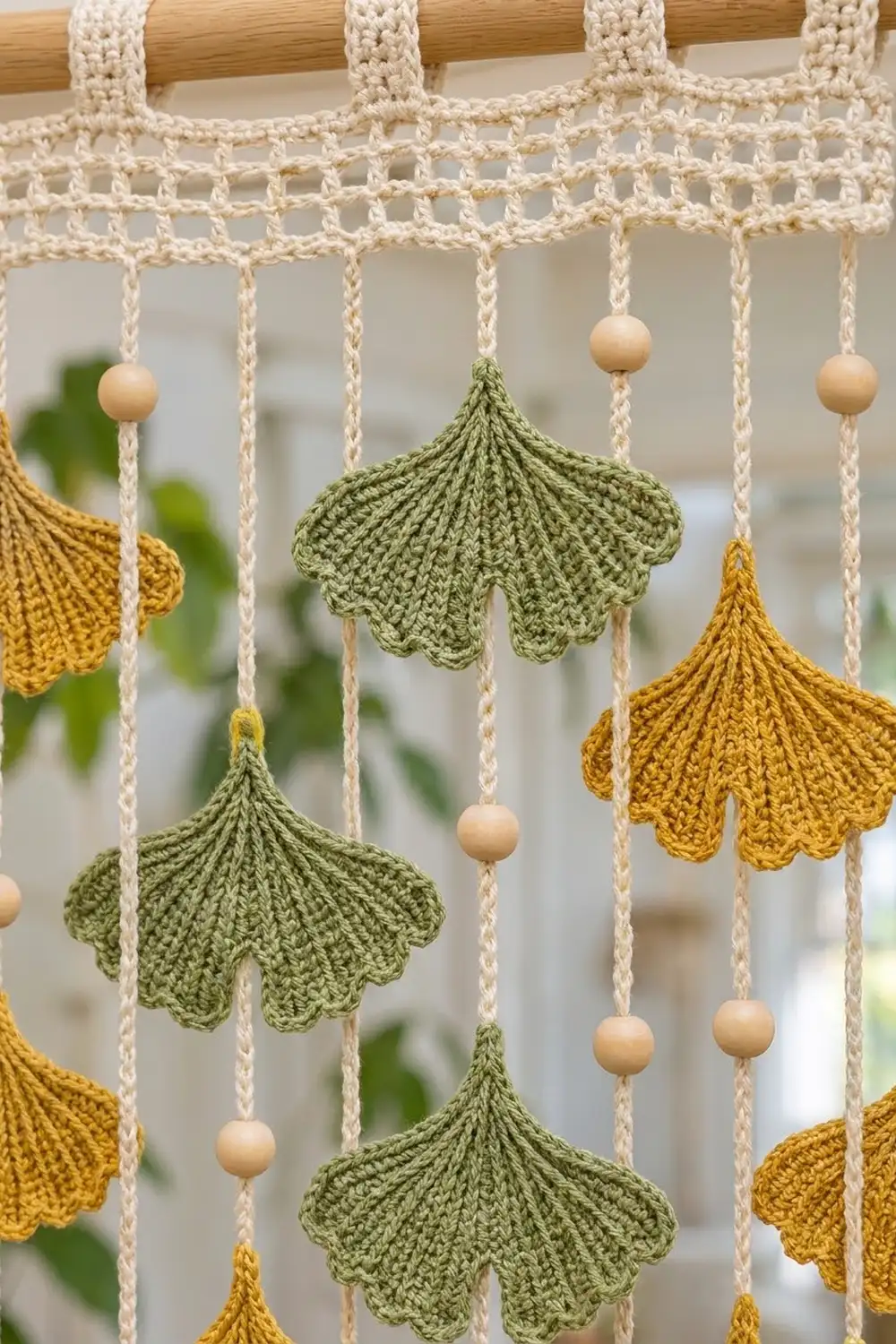
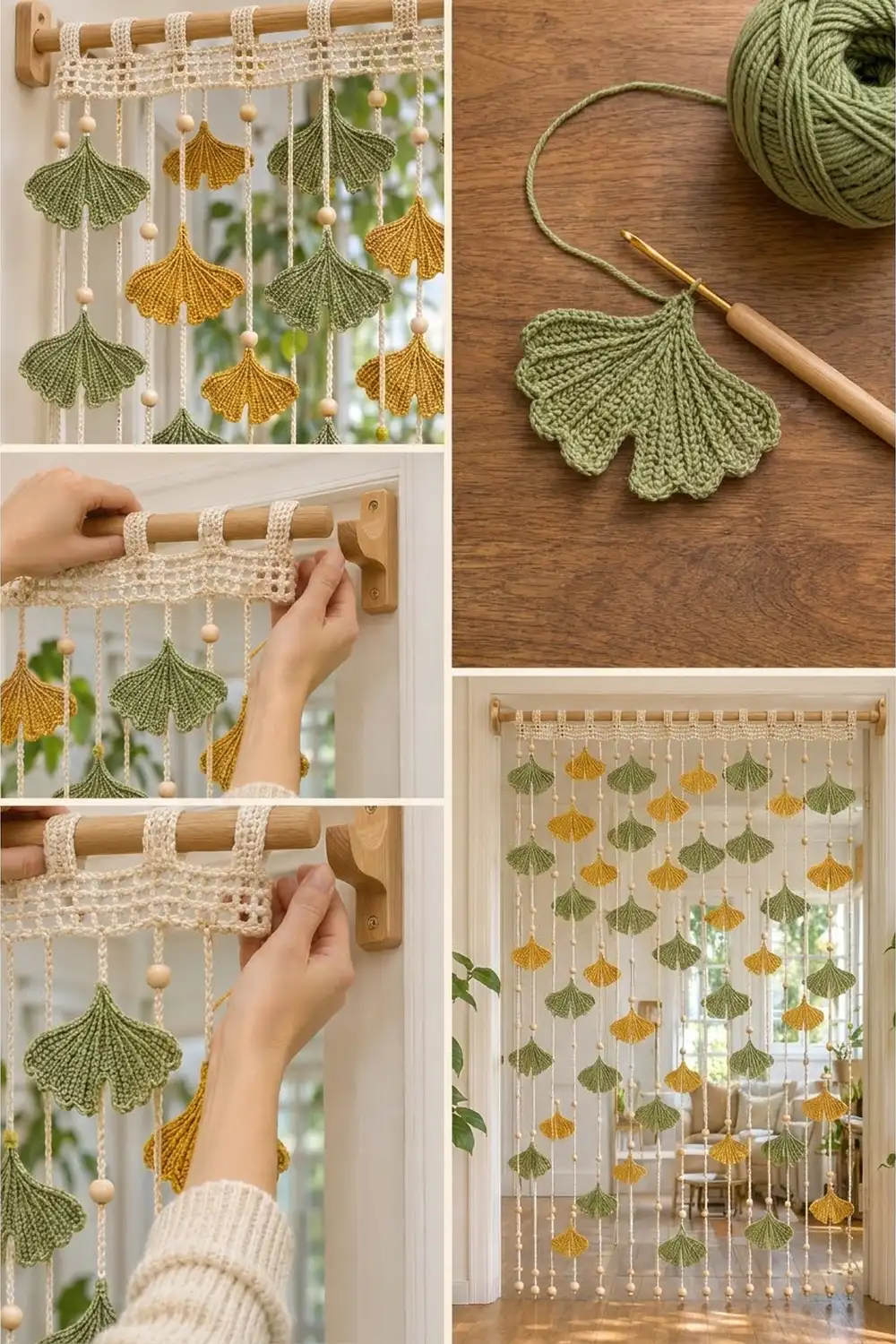
The Ginkgo Drift Doorway Curtain is a light, airy hanging made from fan-shaped ginkgo leaves on beaded cream cords. A cream filet mesh header band hangs from a wooden rod by fabric tabs. Thirteen cords hang from the header. Each one is a chain with slip stitches worked back along it, and each carries seven leaves with natural wooden beads between them.
The colors are soft and earthy: cream for the header and cords, sage green and mustard gold for the leaves. Each cord uses one leaf color, and the colors alternate across the curtain. Neighboring cords are offset by half a repeat. The leaves form a staggered checkerboard that still lets light and air through, and it suits a boho, botanical, or Japandi room.
This pattern uses US crochet terms. The finished curtain measures 36.7 in (93.2 cm) wide and about 80 in (203.2 cm) long, including the tab loops. Each leaf is 4.5 in (11.4 cm) wide and 4 in (10.2 cm) tall, stem included.
Construction is simple and modular:
- You crochet the leaves flat in turned rows, starting from the base of the fan. Each leaf gets a scalloped edge and a slip-stitch stem.
- You work the header in rows, then edge it with one round of single crochet.
- You work the tabs and beaded cords directly off the header’s border.
- You sew the leaves onto the cords last.
Finished Size and Construction
- Finished size: 36.7 in (93.2 cm) wide × about 80 in (203.2 cm) long
- Skill level: Intermediate (simple stitches, but lots of repetition and counting)
- Terminology: US crochet terms
- Yarn weight: DK (light worsted, weight 3) cotton
- Hook: 3.5 mm (E-4)
- Number of pieces: 91 leaves, plus 1 header band with 10 tabs, plus 13 cords worked onto the header
- Layout: 13 cords with 7 leaves each; cords alternate green and mustard
- Leaf size: 4.5 in (11.4 cm) wide × 4 in (10.2 cm) tall
- Header size before border: 36.2 in × 1.7 in (91.9 cm × 4.3 cm)
- Border depth: 0.25 in (0.6 cm) on every edge, so the bordered header is 36.7 in × 2.2 in (93.2 cm × 5.6 cm)
- Cord length: 77 in (195.6 cm) below the header
Materials
Choose a smooth mercerized or combed DK cotton. Cotton holds the fan shape after blocking and doesn’t stretch much under the weight of the beads. Avoid acrylic: the leaves will curl, and the cords will slowly get longer. The quantities below assume about 115 m per 50 g.
- Cream (header, tabs, cords): 150 g / 345 m
- Sage green (49 leaves): 200 g / 460 m
- Mustard gold (42 leaves): 175 g / 402.5 m
All quantities include a margin of about 20% for gauge swatches and tension differences. Each leaf uses about 3 g.
Tools:
- 3.5 mm (E-4) crochet hook, plus a 4 mm hook for the foundation chain
- 189 natural wooden beads, 12 mm, with holes of at least 3 mm (buy 200 to have spares)
- Big-eye beading needle or a dental-floss threader, for stringing the beads
- Tapestry needle
- Stitch markers
- Wooden rod up to 1.25 in (3.2 cm) in diameter and at least 40 in (101.6 cm) long, with 2 brackets
- Blocking mats, rust-proof pins, spray bottle
- Measuring tape
Abbreviations (US Terms)
- ch – chain
- sl st – slip stitch
- sc – single crochet
- dc – double crochet
- sk – skip
- st(s) – stitch(es)
- sp – space
- rep – repeat
Special stitch – bead chain (bead ch): Slide 1 pre-strung bead up against the hook. Yarn over behind the bead and pull through the loop on the hook. This locks the bead into that chain, and the bead ch counts as 1 chain.
Gauge and Checkpoints
Gauge: 20 dc and 10 rows = 4 in (10.2 cm) with a 3.5 mm hook. At this gauge:
- Each dc is 0.2 in (0.5 cm) wide.
- Each dc row is 0.4 in (1.0 cm) tall.
- Each sc row is 0.25 in (0.6 cm) tall.
Cord gauge: 25 ch, slip-stitched back along the chain, = 5 in (12.7 cm).
Make 1 complete leaf before you start production, and check it at each of these stages:
- After Row 1: 0.4 in (1.0 cm) from the base point
- After Row 4: 1.6 in (4.1 cm) from the base point
- After Row 6: 2.4 in (6.1 cm) from the base point
- Finished and blocked: 4.5 in (11.4 cm) wide, with a 2.75 in (7.0 cm) blade and a 1.25 in (3.2 cm) stem
If the leaf is too big, change to a 3.25 mm hook. If it’s too small, change to a 3.75 mm hook. Small size differences between leaves don’t matter as long as all the leaves match. Header gauge matters more, because the header sets the curtain width and the cord spacing.
Ginkgo Leaf (Make 91)
You work the leaf in turned rows that fan out from a single base point. The dc posts stack into columns, and the increases move position on each row. As a result, the columns spread out like ginkgo veins.
Row 1: Ch 4. Work 5 dc in the 4th ch from the hook (the 3 skipped ch count as the first dc). Turn. (6 dc)
Row 2: Ch 3 (counts as a dc throughout). Dc in the same st, then 2 dc in each of the next 5 sts. Turn. (12 dc)
Row 3: Ch 3, 2 dc in the next st. Dc in the next st, 2 dc in the next st; rep from * 5 times. Turn. (18 dc)*
Row 4: Ch 3, dc in the next st, 2 dc in the next st. Dc in each of the next 2 sts, 2 dc in the next st; rep from * 5 times. Turn. (24 dc)*
Row 5: Ch 3, dc in each st across. Turn. (24 dc)
This straight row keeps the fan a wedge rather than a full half circle.
Row 6: Ch 3, dc in each of the next 2 sts, 2 dc in the next st. Dc in each of the next 3 sts, 2 dc in the next st; rep from * 5 times. Turn. (30 dc)*
Row 7 (scalloped edge with center notch): Number the 30 sts of Row 6 from 1 to 30 as you work.
- Ch 1, sc in st 1.
- *Sk 1, 5 dc in the next st, sk 1, sc in the next st; rep from * 2 more times. You are now at st 13.
- Sc in st 14.
- Sl st in sts 15 and 16. These 2 sl sts form the notch.
- Sc in sts 17 and 18.
- **Sk 1, 5 dc in the next st, sk 1, sc in the next st; rep from ** 2 more times, ending in st 30.
Row 7 count: You work across all 30 sts of Row 6 and end with 6 shells (30 dc), 10 sc, and 2 sl st. The shells sit on sts 3, 7, 11, 20, 24, and 28, so they mirror each other on either side of the notch.
Side edges and stem (trim):
- Don’t turn. Work down the side with 2 sc in each row-end of Rows 6 through 1 (12 sc).
- At the base point, ch 9. Sl st in the 2nd ch from the hook and in each of the next 7 ch (8 sl st stem).
- Sl st into the base point.
- Work 2 sc in each row-end of Rows 1 through 6 (12 sc).
- Sl st to the first sc of Row 7.
- Fasten off, leaving a 12 in (30.5 cm) tail for sewing.
Make All Pieces
- Sage green: 49 leaves (7 cords × 7 leaves)
- Mustard gold: 42 leaves (6 cords × 7 leaves)
Layout (front view): Each column is a cord. G = green leaf, M = mustard leaf, and · means no leaf at that height.
Cord:   1  2  3  4  5  6  7  8  9 10 11 12 13
Tier 1  G  ·  G  ·  G  ·  G  ·  G  ·  G  ·  G
Tier 2  ·  M  ·  M  ·  M  ·  M  ·  M  ·  M  ·
Tier 3  G  ·  G  ·  G  ·  G  ·  G  ·  G  ·  G
Tier 4  ·  M  ·  M  ·  M  ·  M  ·  M  ·  M  ·
...continue alternating until each cord has 7 leaves...
The odd cords are green and start higher. The even cords are mustard and start 5 in (12.7 cm) lower. Block all the leaves before assembly (see Final Blocking).
Header Band
Use cream throughout.
Row 1: With the 4 mm hook, ch 182. Change to the 3.5 mm hook. Sc in the 2nd ch from the hook and in each ch across. Turn. (181 sc)
Row 2: Ch 4 (counts as dc + ch 1), sk the next st, dc in the next st. Ch 1, sk 1, dc in the next st; rep from * across. Turn. (91 dc, 90 ch-1 sps)*
Rows 3–4: Ch 4, dc in the next dc. Ch 1, dc in the next dc; rep from * across, working the last dc in the 3rd ch of the turning ch. Turn. (91 dc, 90 ch-1 sps)*
Row 5: Ch 1, sc in each dc and each ch-1 sp across. (91 + 90 = 181 sc)
Checkpoint: 36.2 in × 1.7 in (91.9 cm × 4.3 cm). Don’t fasten off. Work Border Round 1 now (see Border below), then come back to Joining. The tabs and cords are placed on border stitches.
Joining: Tabs and Beaded Cords
Tabs (make 10): Count the top-edge border sc from the right corner.
- Tabs start every 18 sts: sts 7–13, 25–31, 43–49, and so on. The last tab is on sts 169–175.
- Check: 6 margin sts + (10 tabs × 7 sts) + (9 gaps × 11 sts) + 6 margin sts = 181.
To make each tab:
- Join cream and work 7 sc. Work 15 more rows of 7 sc (16 rows; 4 in / 10.2 cm).
- Fold the tab to the back. Whipstitch its last row to the back of Row 5, matching the same 7 sts stitch for stitch.
Keep your whipstitches firm but not tight, or the header will pucker.
Beaded cords (make 13): Before joining the yarn, string 15 beads for each odd cord or 14 beads for each even cord.
The cords hang from bottom-edge border sc 1, 16, 31, and so on, up to sc 181. That is every 15 sts, or 3 in (7.6 cm). The 12 gaps × 15 sts = 180 sts, so the outer cords sit exactly at the corners.
Unit: bead ch, ch 4, ch 20 (leaf zone), ch 12, bead ch, ch 12. (50 ch = 10 in / 25.4 cm)
- Odd cords (1, 3, … 13): Sl st to join, then ch 14. Work the unit 7 times. Ch 20, then work 1 bead ch. (14 + 350 + 21 = 385 ch)
- Even cords (2, 4, … 12): Sl st to join, then ch 39. Work the unit 6 times. Then work: bead ch, ch 4, ch 20 (leaf zone), ch 20, bead ch. (39 + 300 + 46 = 385 ch)
To finish each cord:
- Sl st in the back bump of the 2nd ch from the hook, then in each ch back up to the header (384 sl st).
- Sl st into the header and fasten off.
The bead in the last chain locks the bottom tip. Every cord should measure 77 in (195.6 cm). Hold the cord straight while you slip-stitch, and don’t pull the loops tight.
Attaching the leaves:
- Place a leaf face up over each 20-ch leaf zone, with the stem tip at the top of the zone.
- From the back, use the leaf’s tail to sew the stem tip, the base point, and the center of Row 6 to the cord.
The cord stays hidden behind the leaf. Leaves on the same cord should hang 10 in (25.4 cm) apart.
Border
Border gauge: On the long edges, work 1 sc per header st. On the short edges, work 2 sc per dc row-end and 1 sc per sc row-end. The border adds 0.25 in (0.6 cm) on every side.
Round 1: Continue from Row 5.
- Ch 1 and turn the corner. Work 8 sc down the short side: 1 sc in the Row 5 end, 2 sc in each of the 3 dc row-ends, and 1 sc in the Row 1 end.
- Ch 1 at the corner, then work 181 sc along the bottom, 1 in each foundation ch.
- Ch 1, then work 8 sc up the second short side.
- Ch 1, then work 181 sc across the top.
- Ch 1 and sl st to the first sc.
Count: 181 sc on each long side and 8 sc on each short side (378 sc in total). The corners are ch-1 sps and aren’t counted as stitches.
Why the math works:
- The long sides keep exactly 181 sts, so the tab and cord placements match the row count exactly.
- On the short sides, a dc row is 0.4 in (1.0 cm) tall, which equals 2 sc widths of 0.2 in (0.5 cm). That’s why 2 sc per dc row-end keeps the corners flat.
- The border adds 0.25 in (0.6 cm) to each short end, so the width goes from 36.2 in (91.9 cm) to 36.7 in (93.2 cm).
Final Blocking
- Soak the leaves in cool water for 10 minutes, then roll them in a towel to press out the water.
- Pin each leaf to 4.5 in (11.4 cm) wide. Open the scallops and pinch the notch.
- Spray the header, pin it to 36.7 in × 2.2 in (93.2 cm × 5.6 cm), and pin the tabs flat.
- Let everything dry for 24 hours.
- After assembly, hang the curtain for a day so the cords settle at their final length.
Final Quality-Control Checklist
- 91 leaves (49 green, 42 mustard), each 4.5 in (11.4 cm) wide
- Header 36.7 in (93.2 cm) wide
- 10 tabs, evenly spaced and securely sewn
- 13 cords, each 77 in (195.6 cm) long, with 15 beads on odd cords and 14 on even cords
- Each cord is a single color, and the colors alternate across the curtain
- Even cords offset 5 in (12.7 cm) lower than odd cords
- All ends woven in on the back
Troubleshooting
- Leaf cups: Rows 5–6 are too tight. Block more firmly or go up a hook size.
- Leaf ruffles: Row 6 has too many stitches. Recount; it should have 30.
- Notch fades: Snug up the 2 sl sts and pin the notch while blocking.
- Header flares at the base: The foundation chain is too tight. Use the 4 mm hook for the chain.
- Cords twist: Spray them with water and hang them overnight with a light weight on each.
- Beads slide: Each bead must be locked inside its own chain, not just sitting loose on the yarn.
- Cords hang at different lengths: Re-measure your cord gauge and keep your slip-stitch tension even.
Care
Hand wash in cool water with mild soap, press out the water, and dry flat or hanging. Don’t machine wash it, because the cords will tangle.
Final Notes
Here is how the measurements connect:
- A gauge of 20 dc to 4 in (10.2 cm) gives a 4.5 in (11.4 cm) leaf.
- The 181-stitch header measures 36.2 in (91.9 cm), and the border brings it to 36.7 in (93.2 cm).
- The 13 cords sit 3 in (7.6 cm) apart. Each cord is 385 ch, or 77 in (195.6 cm), with a leaf every 10 in (25.4 cm).
Check each of these numbers as you go, and the curtain will hang straight and evenly spaced.
Happy crocheting!