

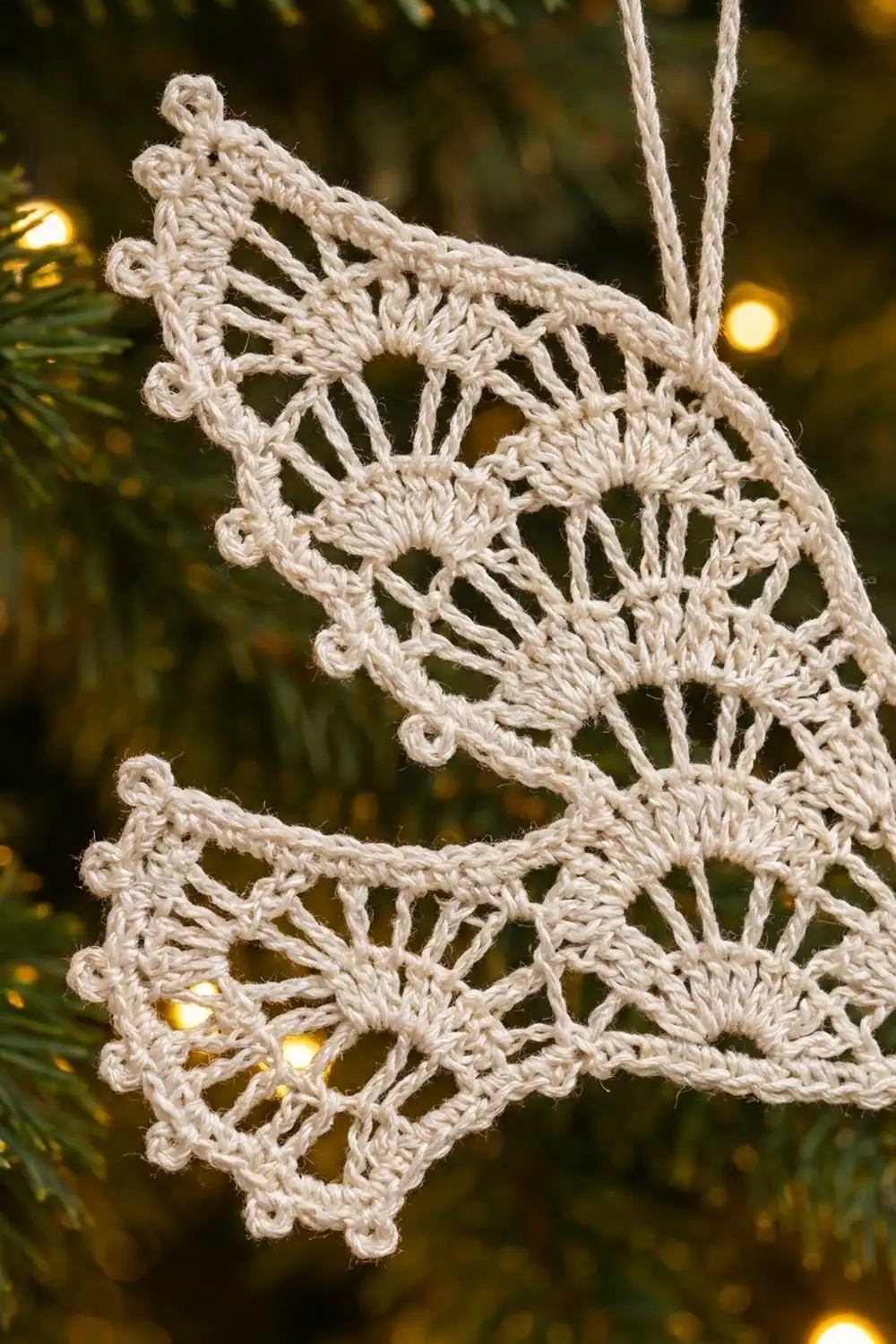
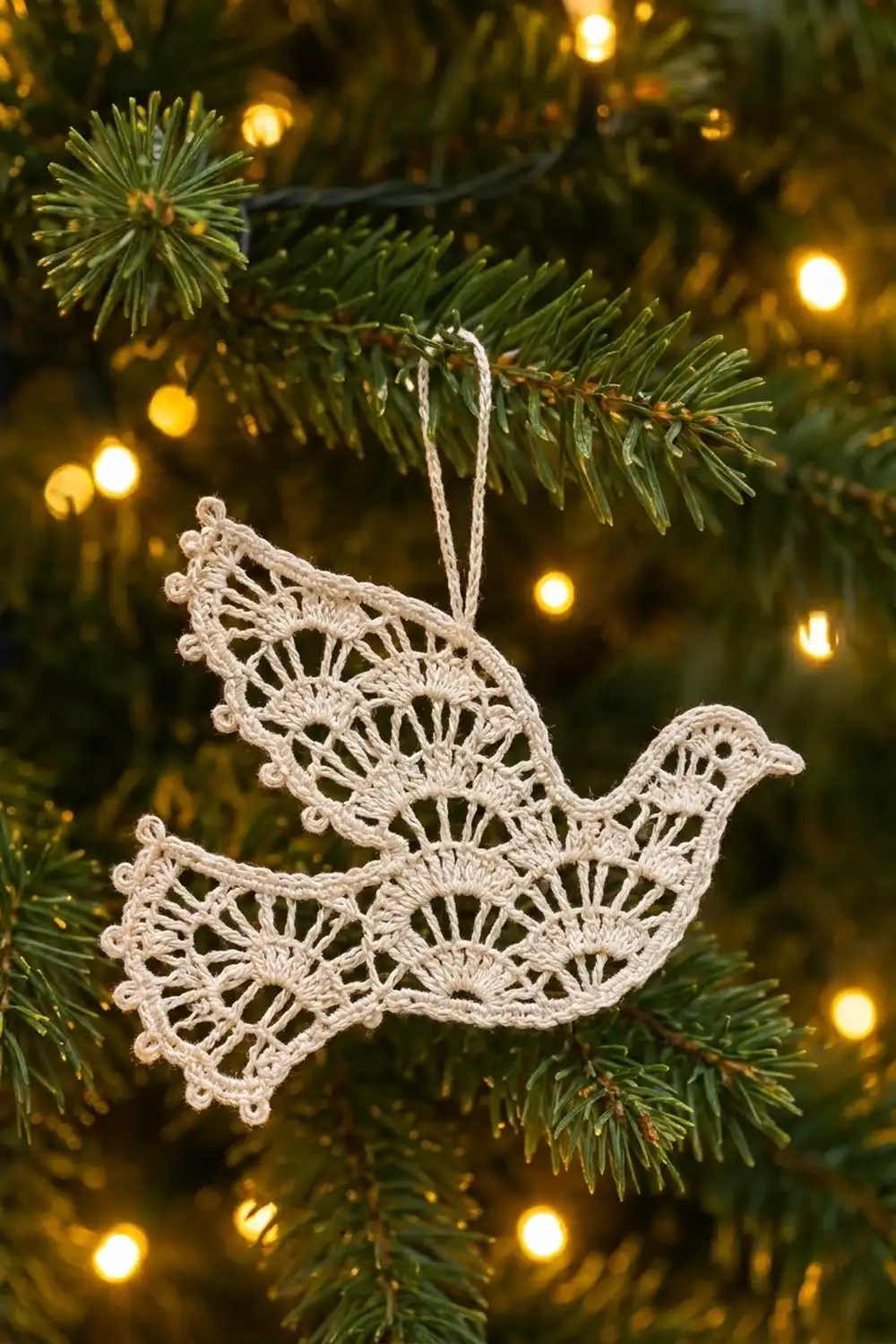
The Winter Grace Dove is a lace ornament worked in fine cotton thread. Staggered rows of open fans fill the body, tail and raised wing, so the bird looks like it is covered in soft scalloped feathers. A picot border outlines the whole shape. A small solid head with an eyelet eye and a tiny pointed beak finishes it off.
The sample is made in ivory cotton, which reads beautifully against green branches and warm tree lights. It also suits a white wedding tree, a peace-themed gift tag or a window hanging. The style is classic thread lace: airy, crisp after blocking and light enough to hang from the thinnest branch.
This pattern uses US crochet terms. The finished dove measures 6.75 in (17.1 cm) wide from tail tip to beak and 5 in (12.7 cm) tall, not counting the hanging loop.
The dove is a single piece, built in sections that grow out of each other. You crochet a three-row body-and-tail band of fans first. The wing rises from the left part of the body in six rows that step in from the right, and the head is worked on the right part of the body. One edging round in single crochet and one round of picots then outline everything. You finish with a chain loop for hanging.
Finished Size and Construction
- Finished size: 6.75 in (17.1 cm) wide × 5 in (12.7 cm) tall
- Skill level: Intermediate (thread work, simple shaping)
- Terminology: US crochet terms
- Yarn weight: Lace (0), size 10 crochet cotton thread
- Hook: 1.5 mm steel hook
- Number of pieces: 1 (one continuous dove motif)
- Layout: Single motif; no assembly
- Piece size before border: 6 in (15.2 cm) wide × 4.5 in (11.4 cm) tall
- Border depth: about 0.25 in (0.6 cm) on every side, including picots
- Beak: sticks out about 0.25 in (0.6 cm) past the border at the front of the head
Materials
Thread: Use a mercerized size 10 cotton crochet thread. Mercerized cotton holds starch well, shows stitch definition clearly and stays bright for years. Avoid fuzzy or acrylic threads, because the fans lose their crisp spokes.
- Ivory/cream: about 8 g, roughly 65 m
This quantity includes a margin of about 25% for your gauge swatch, the hanging loop and weaving in ends.
Tools:
- 1.5 mm steel crochet hook
- Fine tapestry needle or small-eye sewing needle
- Small sharp scissors
- 2–3 stitch markers
- Ruler or tape measure
- Foam blocking board and rustproof pins
- Liquid starch, spray starch or a sugar-water stiffener
Abbreviations (US Terms)
- ch – chain
- sl st – slip stitch
- sc – single crochet
- hdc – half double crochet
- dc – double crochet
- sk – skip
- sp – space
- st(s) – stitch(es)
- tch – turning chain
- RS / WS – right side / wrong side
Special stitches:
- Fan: (dc, ch 1) 4 times, then dc, all in the same stitch. That makes 5 dc and 4 ch-1 spaces. The center dc is the 3rd dc.
- Half fan (HF): (dc, ch 1) twice, then dc, all in the same stitch. That makes 3 dc and 2 ch-1 spaces. At the start of a row, ch 4 (counts as dc and ch 1), then work (dc, ch 1, dc) in the first stitch.
- Picot: ch 3, sl st in 3rd ch from hook.
Gauge and Checkpoints
Gauge: 1 fan repeat (6 foundation chains) = 0.6 in (1.5 cm), and 1 fan row = 0.5 in (1.3 cm), both after blocking.
Test before you start: Ch 25. Work Rows 1–2 of the body pattern over 4 repeats, then repeat them once more, for 4 rows in total. Pin the swatch flat, without stretching, and measure it. It should be 2.4 in (6.1 cm) wide and 2 in (5.1 cm) tall.
- Swatch too big: Change to a smaller hook (1.25 mm) or tighten your foundation chain.
- Swatch too small: Change to a larger hook (1.75 mm). Thread lace often comes out small when the dc stitches are pulled short, so let each loop rise to its full height.
Checkpoints during the work:
- After Row 2: the body band is 6 in (15.2 cm) wide × 1 in (2.5 cm) tall.
- After Row 3: the band is 1.5 in (3.8 cm) tall. The Row 3 section is 4.8 in (12.2 cm) wide, and an unworked tail ledge of 1.2 in (3.0 cm) remains at the left.
- After Wing Row 6: the dove is 4.5 in (11.4 cm) tall at the wing tip.
- After the head: the head rises about 0.9 in (2.3 cm) above the body.
- After the edging: the dove is 6.75 in × 5 in (17.1 × 12.7 cm).
Body and Tail
The body is worked in rows. Row 1 is RS. The foundation chain becomes the belly line.
Foundation: Ch 61.
Row 1 (RS): Sc in 2nd ch from hook. Sk 2 ch, Fan in next ch, sk 2 ch, sc in next ch. Repeat from * 10 times total. Turn.
[10 fans, 11 sc]
Row 2 (WS): Ch 4 (counts as dc and ch 1). (Dc, ch 1, dc) in first sc to complete the HF. Sc in center dc of next fan, Fan in next sc. Repeat from * 9 times total. Sc in center dc of last fan, then HF in last sc. Turn.
[9 fans, 2 HF, 10 sc. Width 6 in (15.2 cm).]
Row 3 (RS): Ch 1. Sc in first dc. Fan in next sc, sc in center dc of next fan. Repeat from * 8 times total. Leave the remaining stitches unworked. Turn.
[8 fans, 9 sc]
The unworked stitches at the left end of Row 2 form the top of the tail: the left half of one fan, 1 sc, 1 full fan, 1 sc and the HF. For reference, number the 9 sc of Row 3 from the right as sc0 through sc8. Sc8 is the last sc you made, at the left.
Wing
The wing continues directly from Row 3, with no fasten-off. Each pair of rows stops one repeat short on the right. This makes a stepped front edge and a pointed tip at the upper left.
Wing Row 1 (WS): Ch 4 (counts as dc and ch 1). (Dc, ch 1, dc) in sc8. Sc in center dc of next fan, Fan in next sc. Repeat from * 3 times total. Sc in center dc of next fan, then HF in next sc (sc4). Leave the rest unworked. Turn.
[3 fans, 2 HF, 4 sc. Width 2.4 in (6.1 cm).]
Wing Row 2 (RS): Ch 1. Sc in first dc. Fan in next sc, sc in center dc of next fan. Repeat from * 3 times total. Fan in next sc, then sc in 3rd ch of tch. Turn.
[4 fans, 5 sc]
Wing Row 3 (WS): Ch 4. (Dc, ch 1, dc) in first sc. Sc in center dc of next fan, Fan in next sc. Repeat from * twice. Sc in center dc of next fan, then HF in next sc. Leave the last fan and sc unworked. Turn.
[2 fans, 2 HF, 3 sc. Width 1.8 in (4.6 cm).]
Wing Row 4 (RS): Ch 1. Sc in first dc. Fan in next sc, sc in center dc of next fan. Repeat from * twice. Fan in next sc, then sc in 3rd ch of tch. Turn.
[3 fans, 4 sc]
Wing Row 5 (WS): Ch 4. (Dc, ch 1, dc) in first sc. Sc in center dc of next fan, Fan in next sc, sc in center dc of next fan, HF in next sc. Leave the last fan and sc unworked. Turn.
[1 fan, 2 HF, 2 sc. Width 1.2 in (3.0 cm).]
Wing Row 6 (RS): Ch 1. Sc in first dc, Fan in next sc, sc in center dc of next fan, Fan in next sc, sc in 3rd ch of tch.
[2 fans, 3 sc]
Fasten off. The wing is now 3 in (7.6 cm) tall above the body, and its left edge is 3.5 in (8.9 cm) long measured from the tail ledge.
Head
Between the wing and the head there is a gap of two unworked Row 3 fans (above sc3), and this gap forms the curve of the neck. Hold the work with the WS facing you.
Head Row 1 (WS): Join the thread with a sl st in sc2. Ch 4 (counts as dc and ch 1). (Dc, ch 1, dc) in same sc. Sc in center dc of next fan, Fan in sc1, sc in center dc of next fan, HF in sc0. Turn.
[1 fan, 2 HF, 2 sc = 21 sts and ch-sps across]
Head Row 2 (RS): Ch 3 (counts as dc). Dc in next 3 sts. Ch 1 and sk next st to make the eye. Dc in next 7 sts, hdc in next 4 sts, sc in next 4 sts, then sl st in 3rd ch of tch.
[11 dc including ch-3, 1 ch-1 eye, 4 hdc, 4 sc, 1 sl st = 21]
The head is tall at the front and slopes down toward the neck. Fasten off.
Border
Border gauge: 10 sc = 1 in (2.5 cm) along straight edges.
Count stitches by type as you go:
- Fan tops: 1 sc in each dc and ch-1 sp (9 per fan, 5 per HF), plus 1 sc in each sc between fans.
- Row ends: 5 sc per fan row and 4 sc for Head Row 2.
- Foundation: 1 sc in each chain.
Work with the RS facing you, going counterclockwise around the dove.
Round 1: Join the thread at the bottom-left corner, in the first foundation ch. Ch 1, then work the segments in this order:
- Belly: sc in each of 61 foundation ch = 61
- Chest and head front: 5 sc in each of Rows 1, 2 and 3 and Head Row 1, plus 4 sc in Head Row 2 = 24
- Beak (not counted in the round total): ch 4, sl st in 2nd ch from hook, sc in next ch, hdc in next ch
- Head top: sc in each of the 21 sts of Head Row 2 = 21
- Back of head: 5 sc down Head Row 1 = 5
- Neck: 9 + 1 + 9 across the 2 unworked fans and the sc between them = 19
- Front of wing: 5 + 5 up Wing Rows 1–2, 10 across the unworked fan and sc, 5 + 5 up Wing Rows 3–4, 10 across the unworked fan and sc, 5 + 5 up Wing Rows 5–6 = 50
- Wing top: 9 + 1 + 9 + 1 + 1 across Wing Row 6 = 21
- Back of wing: 5 sc down each of Wing Rows 6 through 1 and Row 3 = 35
- Tail top: 4 + 1 + 9 + 1 + 5 across the unworked Row 2 stitches = 20
- Tail end: 5 sc down each of Rows 2 and 1 = 10
Sl st in the first sc to join.
[266 sc in total]
Round 2: Ch 1. Sc in next 7 sc, picot. Repeat from * 38 times total. When you pass the beak, let it stand free and keep working into the Round 1 sc on either side of it. Sl st in first sc to join.
[266 sc, 38 picots]
Why the math works: The segment counts add up to 61 + 24 + 21 + 5 + 19 + 50 + 21 + 35 + 20 + 10 = 266. Since 266 = 7 × 38, the picot repeat comes out even and no partial repeat is needed at the join. The beak stitches are left out of the 266 on purpose, so the picot rhythm stays intact. The 0.6 in (1.5 cm) picot spacing is close to one fan repeat, which gives the outline its regular beaded look. The two edging rounds add 0.25 in (0.6 cm) on each side, turning 6 in × 4.5 in (15.2 × 11.4 cm) into 6.5 in × 5 in (16.5 × 12.7 cm). The beak adds the final 0.25 in (0.6 cm) of width.
Hanging loop: Join the thread to the Round 2 sc above the last sc of the wing-top segment, at the wing’s front corner. Ch 30, which is about 3 in (7.6 cm), and sl st in the same st. Work 30 sc into the loop and sl st to the base. The loop folds to about 1.5 in (3.8 cm) tall. Before you weave in the end, hold the dove up by the loop. If it tips forward or back, move the loop one or two stitches until the dove hangs level.
Final Blocking
- Weave in all ends along the back of the sc border. Do not weave them through the fan spokes.
- Soak the dove in starch solution for 5 minutes, then press out the excess in a towel. Do not wring it.
- Lay it on the blocking board RS up. Pin the belly straight to 6 in (15.2 cm) before the border.
- Pin the wing tip so the dove is 5 in (12.7 cm) tall overall.
- Pin out every picot, then open each fan into an even half-circle with the pin tip.
- Shape the beak to a point and push a pin through the eye to keep it open.
- Let it dry completely, usually 12–24 hours, before unpinning.
Final Quality-Control Checklist
- [ ] The dove measures 6.75 in × 5 in (17.1 × 12.7 cm).
- [ ] All fans have 5 dc spokes and are evenly spread.
- [ ] Round 1 has 266 sc and Round 2 has 38 picots.
- [ ] The beak points forward and the eye is open.
- [ ] The wing tip is sharp, and the wing’s front edge shows three clear steps.
- [ ] The tail ledge is flat, with no ruffling.
- [ ] The loop is secure and the dove hangs level.
- [ ] No thread ends show on the RS.
Troubleshooting
- The belly ruffles: The border is too loose along the foundation. Redo that segment with a smaller hook.
- The tail or wing curls: The fans are tighter than the sc. Loosen your dc stitches, or block with extra starch.
- Your stitch count is off in Round 1: Count each segment separately and place a marker at the end of each one.
- The picots lean: Make the ch-3 stitches the same size and sl st through the front loop and back bar.
- The eye closed up: Push a pin or a toothpick through it while the starch dries.
Care
Hand wash in cool water with mild soap, re-starch, and block flat to dry. Store flat in tissue paper so the picots and wing tip keep their shape.
Final Notes
The measurements build on each other in a simple chain:
- A fan repeat of 0.6 in (1.5 cm) gives a 6 in (15.2 cm) body.
- Fan rows of 0.5 in (1.3 cm) give a 1.5 in (3.8 cm) body and a 4.5 in (11.4 cm) wing tip.
- Two edging rounds and the beak bring the dove to 6.75 in × 5 in (17.1 × 12.7 cm).
If your swatch matches the gauge, every checkpoint after it will fall into place. Make one dove, or a whole flock for the tree.
Happy crocheting!