

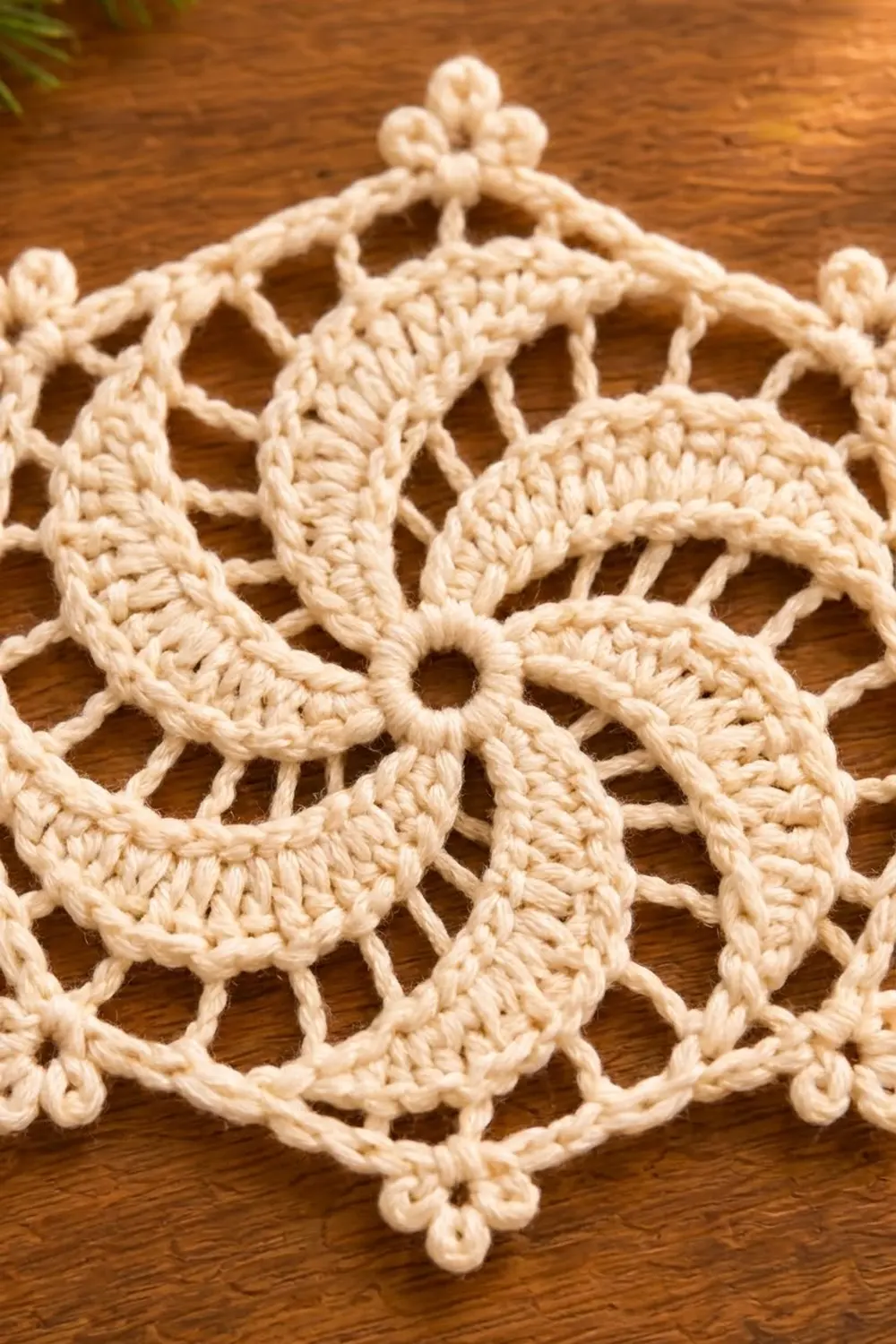
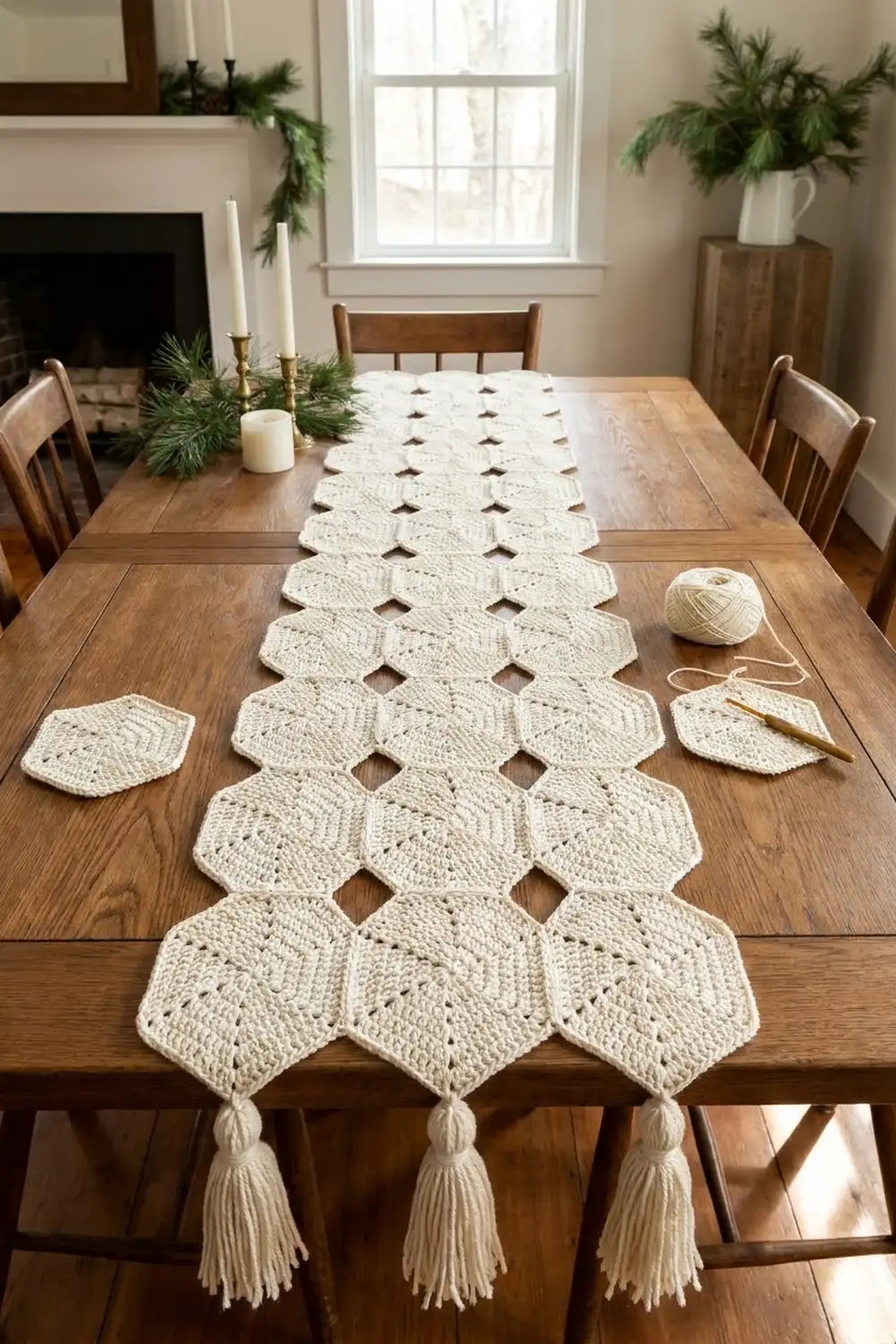
The Winter Pinwheel Table Runner is a lacy hexagon runner in one soft cream color. Each motif has six crescent arms that curve around a small open center like a pinwheel. Open chain spaces and short spokes surround the swirl, and every point ends in a tiny three-loop trefoil.
The look is warm and classic. It suits a holiday table but also works all year. Because the whole runner is one color, the texture does the work. The swirl arms read as solid curves, and the openwork around them lets the wood of the table show through.
This pattern uses US crochet terms. The finished runner measures 20 in (50.8 cm) wide and 64 in (162.6 cm) long from trefoil tip to trefoil tip, not counting tassels. With a 5 in (12.7 cm) tassel at each end, the total length is 74 in (188.0 cm).
You make 24 hexagon motifs and join each one to its neighbors on its last round (join-as-you-go). The motifs sit in a straight grid 3 wide and 8 long. There is no added border because the trefoil-and-sc edge of the motifs is the finished edge. Six tassels finish the two short ends.
Finished Size and Construction
- Finished size: 20 in (50.8 cm) wide x 64 in (162.6 cm) long, plus 5 in (12.7 cm) tassels at each end
- Skill level: Intermediate
- Terminology: US crochet terms
- Yarn weight: DK (weight 3) cotton or cotton blend
- Hook: 3.5 mm (E-4)
- Number of pieces: 24 hexagon motifs + 6 tassels
- Layout: 3 motifs wide x 8 motifs long, with the pointy tops facing the runner’s ends
- Motif size: 6 in (15.2 cm) flat side to flat side; 7 in (17.8 cm) point to point, not counting trefoils
- Size before border: 20 in (50.8 cm) x 64 in (162.6 cm) (this is also the final size)
- Border depth: 0 in (0 cm), because no separate border is added
Materials
Choose a smooth mercerized or combed cotton in DK weight. Cotton keeps the swirl arms crisp and the picots round. Aim for a label of about 115 m per 50 g (126 yd per 1.75 oz).
- Cream: 200 g (460 m / about 503 yd)
- About 6 g (13 m) per motif; 24 motifs = about 136 g (312 m)
- About 5 g (11 m) per tassel; 6 tassels = about 29 g (66 m)
These quantities include a margin of roughly 15-20% for your gauge swatch, joining, and tassel trimming.
Tools:
- 3.5 mm (E-4) crochet hook
- Tapestry needle
- Scissors
- Stitch marker
- Cardboard rectangle 5 in (12.7 cm) tall, for the tassels
- Blocking mats, rust-proof pins, and a spray bottle
- Measuring tape
Abbreviations (US Terms)
- ch – chain
- sl st – slip stitch
- sc – single crochet
- dc – double crochet
- sk – skip
- sp – space
- st(s) – stitch(es)
- beg – beginning
- standing sc – with a slip knot on the hook, insert the hook in the indicated place and work a sc
Special stitch – Trefoil (tref): Ch 4 (this is the stem). Ch 3, sl st in the top stem ch (the 4th ch from the hook on the first picot); repeat from * 2 more times, all into that same top stem ch, to make 3 small loops. Sl st in each of the remaining 3 stem ch, back down to the base.
Joining trefoil (join-tref): Ch 4 (stem). Ch 3, sl st in top stem ch (first picot). Ch 1, sl st in the middle picot of the neighbor’s trefoil, ch 1, sl st in top stem ch (middle picot, now joined). Ch 3, sl st in top stem ch (third picot). Sl st in each of the remaining 3 stem ch.
Gauge and Checkpoints
Make one complete motif before anything else. That motif is your gauge swatch, and it becomes motif 1.
Motif gauge: One motif = 6 in (15.2 cm) flat side to flat side after Round 9, lightly blocked.
Checkpoints (unblocked, measured flat):
- After Round 2: 1.75 in (4.4 cm) across
- After Round 4: 3 in (7.6 cm) across
- After Round 7: 4.75 in (12.1 cm) across
- After Round 8: 5.5 in (14.0 cm) flat side to flat side
- After Round 9: 6 in (15.2 cm) flat side to flat side, 7 in (17.8 cm) point to point
If your motif is too big by more than 0.25 in (0.6 cm), go down to a 3.25 mm hook. If it is too small, go up to a 3.75 mm hook. Check the stitch counts first, because a skipped dc in the arms changes the swirl and the size faster than hook size does.
Motif Pattern
Join each round. You never turn, so the right side always faces you.
Round 1: Make a magic ring. Ch 3 (counts as dc), 11 dc in ring. Join with sl st to top of beg ch-3. Pull the ring closed but leave a small hole. (12 dc)
Round 2: Ch 3 (counts as dc), dc in same st, 2 dc in each st around. Join to top of beg ch-3. (24 dc)
Round 3: Ch 3 (counts as dc), dc in next 3 sts, ch 2, dc in next 4 sts, ch 2; repeat from * 4 more times. Join to top of beg ch-3. (24 dc in 6 groups of 4, 6 ch-2 sps)
These 6 groups are the start of the 6 swirl arms. From now on, each arm drops its first stitch and grows into the space ahead of it. That shift is what makes the arms curve.
Round 4: Sl st in next dc. Ch 3 (counts as dc), dc in next 2 dc, 2 dc in ch-2 sp, ch 3, sk next dc, dc in next 3 dc, 2 dc in ch-2 sp, ch 3; repeat from * 4 more times. Join to top of beg ch-3. (30 dc: 6 arms of 5 dc, 6 ch-3 sps)
Round 5: Sl st in next dc. Ch 3 (counts as dc), dc in next 3 dc, 2 dc in ch-3 sp, ch 4, sk next dc, dc in next 4 dc, 2 dc in ch-3 sp, ch 4; repeat from * 4 more times. Join. (36 dc: 6 arms of 6 dc, 6 ch-4 sps)
Round 6: Sl st in next dc. Ch 3 (counts as dc), dc in next 4 dc, 2 dc in ch-4 sp, ch 5, sk next dc, dc in next 5 dc, 2 dc in ch-4 sp, ch 5; repeat from * 4 more times. Join. (42 dc: 6 arms of 7 dc, 6 ch-5 sps)
Round 7: Sl st in next dc. Ch 3 (counts as dc), dc in next 5 dc, 2 dc in ch-5 sp, ch 6, sk next dc, dc in next 6 dc, 2 dc in ch-5 sp, ch 6; repeat from * 4 more times. Join. (48 dc: 6 arms of 8 dc, 6 ch-6 sps)
Each arm should now look like a curved crescent, thin where it begins and full where it ends. The long chains form the open ladder between the arms.
Round 8 (spokes and corners): Sl st in next dc (2nd dc of the arm). Ch 5 (counts as dc + ch 2), sk next dc, dc in next dc, [ch 2, sk next dc, dc in next dc] 2 times, ch 2, (2 dc, ch 3, 2 dc) in ch-6 sp, ch 2, sk first dc of next arm, dc in next dc, [ch 2, sk next dc, dc in next dc] 3 times, ch 2, (2 dc, ch 3, 2 dc) in ch-6 sp, ch 2; repeat from * 4 more times. Join to 3rd ch of beg ch-5. Fasten off.
Count for Round 8: Each repeat uses all 8 arm dc and makes 4 spoke dc + 4 corner dc = 8 dc and 5 ch-2 sps. (48 dc, 30 ch-2 sps, 6 ch-3 corner sps)
Each side, from one corner ch-3 sp to the next, now reads: 2 dc, ch-2 sp, 4 spoke dc with ch-2 sps between them, ch-2 sp, 2 dc. That is 8 dc and 5 ch-2 sps per side. The ch-3 sps are the 6 points of the hexagon.
Round 9 (outline and trefoils), motif 1: Join with standing sc in any corner ch-3 sp, tref, sc in same sp, sc in next 2 dc, [2 sc in ch-2 sp, sc in next dc] 4 times, 2 sc in ch-2 sp, sc in next 2 dc, (sc, tref, sc) in next corner ch-3 sp; repeat from * 4 more times. Sc in next 2 dc, [2 sc in ch-2 sp, sc in next dc] 4 times, 2 sc in ch-2 sp, sc in next 2 dc. Join to first sc. Fasten off.
Count for Round 9: Each side gets 2 + 12 + 2 + 2 = 18 sc worked into Round 8, plus 1 corner sc at each end. Per side = 20 sc (18 + 2 corner sc), counted between two trefoils. Total = 120 sc and 6 trefoils.
Make All Pieces
All 24 motifs are Cream. Work Rounds 1-8 the same way for every motif, and work Round 9 for motif 1 as written. For motifs 2-24, work Round 9 the same way, but use a join-tref at each corner that touches a motif you have already made.
- Cream: 24 motifs
- Cream: 6 tassels
Layout grid (columns A-C, rows 1-8, pointy tops toward the ends):
      A    B    C
 1   [1]  [2]  [3]
 2   [4]  [5]  [6]
 3   [7]  [8]  [9]
 4  [10] [11] [12]
 5  [13] [14] [15]
 6  [16] [17] [18]
 7  [19] [20] [21]
 8  [22] [23] [24]
Name the trefoils of each motif clockwise: Top, Upper Right, Lower Right, Bottom, Lower Left, Upper Left.
Joining
Method: Join-as-you-go on Round 9, trefoil to trefoil, through the middle picot only.
Side-by-side motifs (for example, motif 2 next to motif 1): Join the new motif’s Upper Left trefoil to the old motif’s Upper Right trefoil, and its Lower Left trefoil to the old motif’s Lower Right trefoil. The vertical flat sides face each other with an open gap between them.
Stacked motifs (for example, motif 4 below motif 1): Join the new motif’s Top trefoil to the old motif’s Bottom trefoil, point to point.
A motif in the middle of the runner, such as motif 5, joins 3 times. Its Top joins motif 2’s Bottom, and its Upper Left and Lower Left join motif 4’s Upper Right and Lower Right. Diamond-shaped gaps stay open between the rows. No trefoil ever joins to more than one other trefoil.
Stitch logic: The join happens inside the trefoil’s middle picot. You work the sc on each side exactly as in motif 1, so every motif still has 20 sc per side and 120 sc total. Joining adds and removes nothing.
Tension: Keep the ch-1s on either side of the joining sl st loose and even. A tight join pulls the trefoil sideways and puckers the flat sides. Lay the motifs flat after each join to check.
Size checkpoint: Once row 1 (motifs 1-3) is joined, it should measure 20 in (50.8 cm) across the outer flat sides. After 2 rows, the length from the tip of motif 1’s Top trefoil to the tip of motif 4’s Bottom trefoil should be 16 in (40.6 cm). That is two 7 in (17.8 cm) motifs, plus a 1 in (2.5 cm) joined trefoil gap, plus two 0.5 in (1.3 cm) end trefoils.
Border
This runner has no stitched border. The Round 9 sc outline and trefoils already make a clean, finished edge. A border around the hexagon points would need filler pieces, and this design doesn’t use them.
Edge gauge: Each flat side of a 6 in (15.2 cm) hexagon is about 3.5 in (8.9 cm) long and holds 20 sc. That works out to about 5.7 sc per inch (2.2 sc per cm).
Long edges: Each long edge is made of 8 vertical flat sides, one from each motif in column A (or column C). That gives 8 x 20 = 160 sc of outline per long edge, with trefoils and open gaps between the sides. No stitches are added at the seams because the joins sit inside the trefoils.
Short ends: Each end shows the 3 free end trefoils of row 1 (or row 8), plus the angled sides between them.
Tassels (6): Wrap Cream 40 times around the 5 in (12.7 cm) card. Slide a 10 in (25.4 cm) strand under the wraps at the top and tie it tightly. Cut the loops at the bottom. Wrap a second strand 6 times around the tassel, 0.75 in (1.9 cm) below the top, and knot it; hide the ends inside. Trim to 5 in (12.7 cm). Use the top tie to attach one tassel to the Top trefoil of motifs 1, 2, and 3, and one to the Bottom trefoil of motifs 22, 23, and 24. Tie through the stem, just below the picots.
Why the math works: Every motif has 20 sc per side, and joins add 0 sts. The width is 3 x 6 in (15.2 cm) + 2 x 1 in (2.5 cm) = 20 in (50.8 cm). The length is 8 x 7 in (17.8 cm) + 7 x 1 in (2.5 cm) + 2 x 0.5 in (1.3 cm) = 64 in (162.6 cm).
Final Blocking
- Weave in all ends before blocking, along the sc outline or through the solid arms.
- Lay the runner right side up on blocking mats.
- Pin the outer flat sides into straight lines so the width is 20 in (50.8 cm).
- Pin the length to 64 in (162.6 cm) tip to tip, checking that the columns are straight.
- Pin out each free trefoil so its three picots open evenly.
- Shape each swirl arm with your fingers so all the curves point the same way.
- Mist with water until damp, not soaked.
- Let it dry completely, then unpin.
- Comb the tassels and trim them to an even 5 in (12.7 cm).
Final Quality-Control Checklist
- 24 motifs, each with 6 arms curving in the same direction
- Each motif has 120 sc and 6 trefoils on Round 9, with 20 sc per side
- Each motif is 6 in (15.2 cm) flat to flat and 7 in (17.8 cm) point to point
- Side-by-side motifs are joined at 2 trefoils; stacked motifs at 1
- No loose or twisted joins; all gaps lie open and flat
- The runner is 20 in (50.8 cm) x 64 in (162.6 cm) after blocking
- 6 tassels, all 5 in (12.7 cm) long and firmly tied
- All ends woven in and trimmed
Troubleshooting
The arms look like straight wedges instead of a swirl. You probably forgot to skip the first dc of each arm. Recount Round 4: it should have 5 dc per arm.
The motif cups or ruffles. Check that the chain lengths grow by 1 each round (ch 2, 3, 4, 5, 6). Too many chains make it ruffle; too few make it cup.
The hexagon’s sides bow inward. Make sure you worked 2 sc, not 1, in every ch-2 sp on Round 9.
The trefoils lean or twist. Work the 3 sl sts down the stem firmly so the stem stands straight.
The columns drift out of line. Every side join should use the Upper and Lower trefoils of the facing flat sides, never the Top or Bottom trefoil.
The tassels look thin. Add 10 more wraps for a fuller tassel.
Care
Hand wash in cool water with mild soap. Roll the runner in a towel to remove water, then dry it flat and reshape the trefoils. A cool iron through a pressing cloth can refresh the arms.
Final Notes
The whole runner follows one measurement chain. Round 2 at 1.75 in (4.4 cm) leads to Round 7 at 4.75 in (12.1 cm). That gives a finished motif of 6 in (15.2 cm) flat to flat and 7 in (17.8 cm) point to point. Three motifs with two 1 in (2.5 cm) joined gaps give 20 in (50.8 cm) of width. Eight rows give 64 in (162.6 cm) of length, and the 5 in (12.7 cm) tassels bring the total to 74 in (188.0 cm). Check your first motif carefully, and the rest will fall into place.
Happy crocheting!