

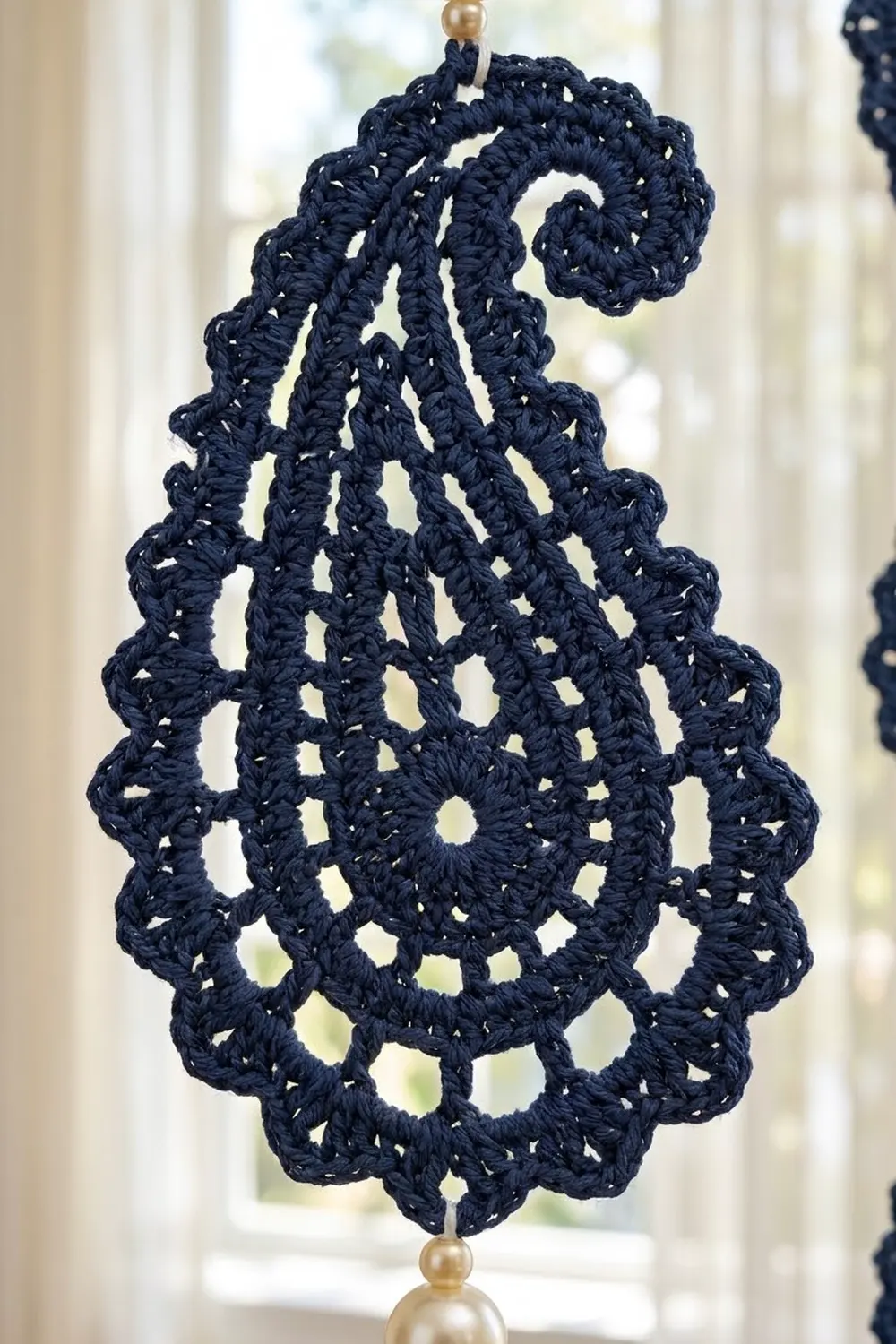
This curtain is made of strands of navy lace motifs, round wheels and curling paisleys, hung from a wooden rod. Ivory and champagne pearls sit between the motifs, and each strand ends in a navy tassel. When light comes through a window behind it, the open spokes and mesh rounds cast lacy shadows into the room.
The palette is one deep navy cotton thread with white cord and two pearl tones. The style sits between boho and classic lace, and the motifs look good with both linen and wood.
This pattern uses US crochet terms. The finished panel is about 41.5 in (105.4 cm) wide, and each strand hangs about 76 in (193.0 cm) from the rod to the tip of the tassel.
You’ll crochet two small motifs over and over: a wheel worked in the round and a paisley built around a small center ring. After a scalloped edge round and blocking, you string the motifs on cord with pearls, tie the cords to crocheted tabs and finish each strand with a tassel.
Finished Size and Construction
- Finished size: 41.5 in (105.4 cm) wide × 76 in (193.0 cm) long
- Skill level: Intermediate
- Terminology: US crochet terms
- Yarn weight: Size 3 cotton crochet thread (#1 super fine, fingering weight)
- Hook: 2.25 mm (US B-1)
- Number of pieces: 84 wheels, 84 paisleys, 12 tabs, 12 tassels
- Layout: 12 vertical strands of 14 motifs each, with strand centers 3.5 in (8.9 cm) apart
- Piece size: wheel 2.5 in (6.4 cm) across; paisley 4.5 in (11.4 cm) × 3 in (7.6 cm)
- Size before border: wheel 1.75 in (4.4 cm); paisley 4 in (10.2 cm) × 2 in (5.1 cm)
- Border depth: wheel 3/8 in (1.0 cm) on each side; paisley 0.5 in (1.3 cm) on each side
Materials
Use a smooth mercerized cotton thread. It shows stitch detail clearly, holds its shape when blocked and won’t stretch when it hangs. Avoid fuzzy or very stretchy blends, because the strands will droop over time.
- Navy cotton thread: 500 g (about 1,700 m)
- White cotton cord, 2 mm: 35 m (100 in (254.0 cm) per strand, plus extra)
- Ivory pearl beads, 10 mm: 360 (you need 348)
- Champagne pearl beads, 8 mm: 180 (you need 168)
Tools:
– 2.25 mm (US B-1) hook
– Tapestry needle
– Big-eye beading needle (or tape wrapped tightly around the cord end)
– Sharp scissors
– Rust-proof pins and a blocking mat
– A 4 in (10.2 cm) piece of cardboard for the tassels
– A wooden curtain rod up to 1 in (2.5 cm) in diameter
– Measuring tape
All quantities include a margin of about 15%.
Abbreviations (US Terms)
- ch: chain
- sl st: slip stitch
- sc: single crochet
- hdc: half double crochet
- dc: double crochet
- tr: treble crochet
- sp(s): space(s)
- st(s): stitch(es)
- MR: magic ring
Shell (special stitch): work 5 dc in the stitch or space given.
Gauge and Checkpoints
Make one wheel and one paisley first, then block them. They are your gauge swatch.
- Wheel after Round 1: 0.75 in (1.9 cm) across
- Wheel after Round 2: 1.5 in (3.8 cm)
- Wheel after Round 3: 1.75 in (4.4 cm)
- Wheel after the border: 2.5 in (6.4 cm)
- Paisley after Round 2: 1 in (2.5 cm) across
- Paisley after Round 4: 4 in (10.2 cm) × 2 in (5.1 cm)
- Paisley after the border: 4.5 in (11.4 cm) × 3 in (7.6 cm)
If your blocked wheel is bigger than 2.5 in (6.4 cm), switch to a 2.0 mm hook. If it’s smaller, use a 2.5 mm hook. Being off by 0.25 in (0.6 cm) on each wheel adds up quickly along a strand, so check before you make a batch.
Wheel Motif
Round 1: MR, ch 3 (counts as dc), 11 dc in ring, sl st to top of beginning ch-3. (12 dc)
Pull the ring tightly closed. This makes the solid center.
Round 2: Ch 4 (counts as tr), ch 3, tr in next st, ch 3; repeat from * 10 more times, sl st to 4th ch of beginning ch-4. (12 tr and 12 ch-3 sps, 48 sts in total)
These tall stitches are the 12 open spokes.
Round 3: Ch 1, sc in next tr, 3 sc in next ch-3 sp; repeat from * 11 more times, sl st to first sc. (12 + 36 = 48 sc)
This round makes the solid outer ring. Fasten off only if you are pausing. Otherwise, go straight on to the border round.
Paisley Motif
Round 1 (eye): MR, ch 3 (counts as dc), 11 dc in ring, sl st to top of beginning ch-3. (12 dc)
Round 2: Ch 1, 2 sc in each st around, sl st to first sc. (12 + 12 = 24 sc)
Number these stitches 1–24 in your head. Place a marker in stitch 1.
Round 3 (shaping and tail): Ch 1 and work the body as follows:
- sc in sts 1–3
- hdc in sts 4–5
- dc in st 6
- 2 dc in st 7
- 2 tr in each of sts 8–17
- 2 dc in st 18
- dc in st 19
- hdc in sts 20–21
- sc in sts 22–24
That gives (24 sts worked + 12 increases = 36 body sts).
The tall increases bunch on one side and swell into the rounded end of the teardrop. The short stitches on the other side keep the eye close to the edge.
Don’t join yet. To make the tail, ch 14. Working back down the chain, sc in the 2nd ch from the hook and the next 2 ch, hdc in the next 3 ch, dc in the next 4 ch, and tr in the last 3 ch. Then sl st in the first sc of the round. (13 tail sts)
Round 4: Ch 1. Work 1 sc in each of the 36 body sts. Next, sc in each of the 13 free loops along the underside of the tail chain, 3 sc in the tip ch, and sc in each of the 13 tail sts back down to the base. Sl st to the first sc. (62 sc worked one per stitch or loop + 2 extra at the tip = 65 sc)
The tall tail stitches pull the tail into its curl. You’ll set the curve when you block.
Make All Pieces
- Wheels: 84 navy (about 6 m / 1.8 g each)
- Paisleys: 84 navy (about 10 m / 3 g each)
- Tabs: 12 navy (about 3 m each)
- Tassels: 12 navy (about 8.5 m each)
Tab: Ch 9, sc in the 2nd ch from the hook and in each ch across. (8 sc) For Rows 2–14, ch 1, turn and work 8 sc. The tab measures 1.25 in (3.2 cm) × 3.5 in (8.9 cm). Leave a 12 in (30.5 cm) tail for sewing.
Tassel: Wrap thread 40 times around the 4 in (10.2 cm) card. Tie the top with an 8 in (20.3 cm) length, then cut the loops at the bottom. Wrap the neck 8 times, 0.5 in (1.3 cm) below the top, and trim the tassel to 4 in (10.2 cm).
Strand A starts with a wheel and Strand B starts with a paisley. This staggers the motifs across the curtain.
Strand:  1  2  3  4  5  6  7  8  9  10 11 12
Type:    A  B  A  B  A  B  A  B  A  B  A  B
Pos 1:   W  P  W  P  W  P  W  P  W  P  W  P
Pos 2:   P  W  P  W  P  W  P  W  P  W  P  W
Pos 3-14: keep alternating down each strand
(W = wheel, P = paisley; 7 of each per strand)
Joining: Stringing the Strands
The motifs aren’t sewn to each other. Each one is woven onto its own cord.
Hanging points:
- Wheel: The top is the 1st sc of the border round, and the bottom is the 7th sc. They sit directly opposite each other because 12 is even.
- Paisley: The top is the center tip sc of the tail. The bottom is the 3rd dc of the 5th shell, which is the middle of 9.
Method:
1. Fold a tab around the rod and whipstitch the short ends together to make a loop. Sew through both loops of every stitch along both short ends: 8 stitches to 8 stitches.
2. Cut 100 in (254.0 cm) of cord. Tie one end through the seam at the bottom of the tab with a double overhand knot.
3. Thread 1 ivory pearl. Weave the cord through the top hanging point from front to back, under the center ring on the wrong side, and out through the bottom hanging point. Tie an overhand knot snug against the top and the bottom of the motif.
4. Thread 1 ivory pearl, 1 champagne pearl and 1 ivory pearl. Knot so the gap from knot to knot is 1.5 in (3.8 cm).
5. Repeat Steps 3–4 in strand order until you have 14 motifs and 14 gaps.
6. Tie the tassel’s top tie to the cord end and trim the extra cord.
Tension: Each knot should touch the motif without puckering it. Don’t pull the cord tight across the back. The motif should hang flat and its weight should rest on the knots.
Size checkpoint: One repeat is a wheel (2.5 in), a gap (1.5 in), a paisley (4.5 in) and a gap (1.5 in), which comes to 10 in (25.4 cm). Seven repeats make 70 in (177.8 cm). Add the 2 in (5.1 cm) drop from the rod, and the strand should measure 72 in (182.9 cm) before the tassel. With the tassel, it’s 76 in (193.0 cm).
Border: Scalloped Motif Edging
Every motif gets a scalloped border before you string it. On the wheel, each 5-dc shell adds about 3/8 in (1.0 cm) on each side. On the paisley, the mesh round and shell round together add 0.5 in (1.3 cm) on each side.
Wheel Round 4 (shell border): Ch 1, sc in the first sc, skip 1, shell in the next st, skip 1. Then sc in the next st, skip 1, shell in the next st, skip 1; repeat from * 10 more times, sl st to the first sc. (12 shells + 12 sc = 72 sts)
Why the math works: Each repeat uses 4 stitches. Round 3 has 48 stitches, and 48 ÷ 4 = 12 shells, so there is one shell for each spoke. The border adds 3/8 in (1.0 cm) on each side, so 1.75 in + 0.75 in = 2.5 in (6.4 cm).
Paisley Round 5 (mesh): Ch 5 (counts as dc and ch 2), skip the next st. Then dc in the next st, ch 2, skip the next st; repeat from * 16 more times across the body. (18 dc and 18 ch-2 sps over the 36 body sts) Next, sc in each of the 29 tail sts, working 3 sc in the center tip st. Sl st to the 3rd ch of the beginning ch-5. (18 dc, 18 ch-2 sps, 29 + 2 = 31 tail sc)
Paisley Round 6 (shells): Sl st into the first ch-2 sp. Ch 3 (counts as dc), 4 dc in the same sp, sc in the next ch-2 sp. Then shell in the next ch-2 sp, sc in the next ch-2 sp; repeat from * 7 more times. (9 shells, 9 sc) Next, sc in each of the 31 tail sts, working 3 sc in the center tip st. Sl st to the top of the beginning ch-3 and fasten off. (45 dc + 9 sc + 33 tail sc = 87 sts)
Why the math works: The 36 body stitches make 18 spaces, and 18 ÷ 2 = 9 shells. The tail only gets single crochet, so it stays slim and curls cleanly. The border adds 0.5 in (1.3 cm) on each side, so the 2 in (5.1 cm) width becomes 3 in (7.6 cm). The 0.5 in at the round end brings the length from 4 in (10.2 cm) to 4.5 in (11.4 cm).
Final Blocking
- Weave in all ends before blocking.
- Soak the motifs in cool water for 10 minutes, then press out the water in a towel.
- Pin each wheel to a 2.5 in (6.4 cm) circle. Put one pin at the tip of each shell and open up every spoke.
- Pin each paisley to 4.5 in (11.4 cm) × 3 in (7.6 cm). Curve the tail toward the eye side and pin every shell.
- Let everything dry completely, which takes about 24 hours.
- After stringing, hang the curtain. Lightly steam the tassels and comb them straight.
Final Quality-Control Checklist
- [ ] Every wheel has 12 spokes and 12 shells and measures 2.5 in (6.4 cm).
- [ ] Every paisley has 9 shells and measures 4.5 in (11.4 cm) × 3 in (7.6 cm).
- [ ] Each tail curls in the same direction.
- [ ] Each gap is 1.5 in (3.8 cm) and has 3 pearls.
- [ ] Every strand is 72 in (182.9 cm) before the tassel.
- [ ] Strands alternate A and B.
- [ ] All tassels are trimmed to 4 in (10.2 cm).
Troubleshooting
- Wheel ruffles: Your spokes are too long. Check that you have exactly ch 3 between the tr stitches, or go down a hook size.
- Wheel cups: Recount Round 3. It must have 48 sc, with 3 sc in each space.
- Paisley has no point: You skipped the 3 sc at the tip in Rounds 4–6.
- Tail won’t curl: Re-wet it and pin a tighter curve.
- Strands are different lengths: Re-tie the gap knots, measuring 1.5 in (3.8 cm) each time.
- Motif hangs crooked: The cord isn’t going through the true center point. Count the scallops again.
Care
Hand wash in cool water with mild soap and press dry in a towel. Re-pin the motifs if needed, and let the curtain dry flat or hanging, away from strong heat.

Final Notes
The whole curtain depends on a few measurements:
- The wheel is 1.75 in (4.4 cm) before its border and 2.5 in (6.4 cm) after.
- The paisley is 4 in × 2 in (10.2 × 5.1 cm) before its border and 4.5 in × 3 in (11.4 × 7.6 cm) after.
- One repeat of wheel, gap, paisley and gap is 10 in (25.4 cm).
- Seven repeats plus the 2 in drop from the rod make 72 in (182.9 cm), and the tassel brings each strand to 76 in (193.0 cm).
- Twelve staggered strands give a panel 41.5 in (105.4 cm) wide.
If you check every motif against these numbers, the strands will hang evenly.
Happy crocheting!