

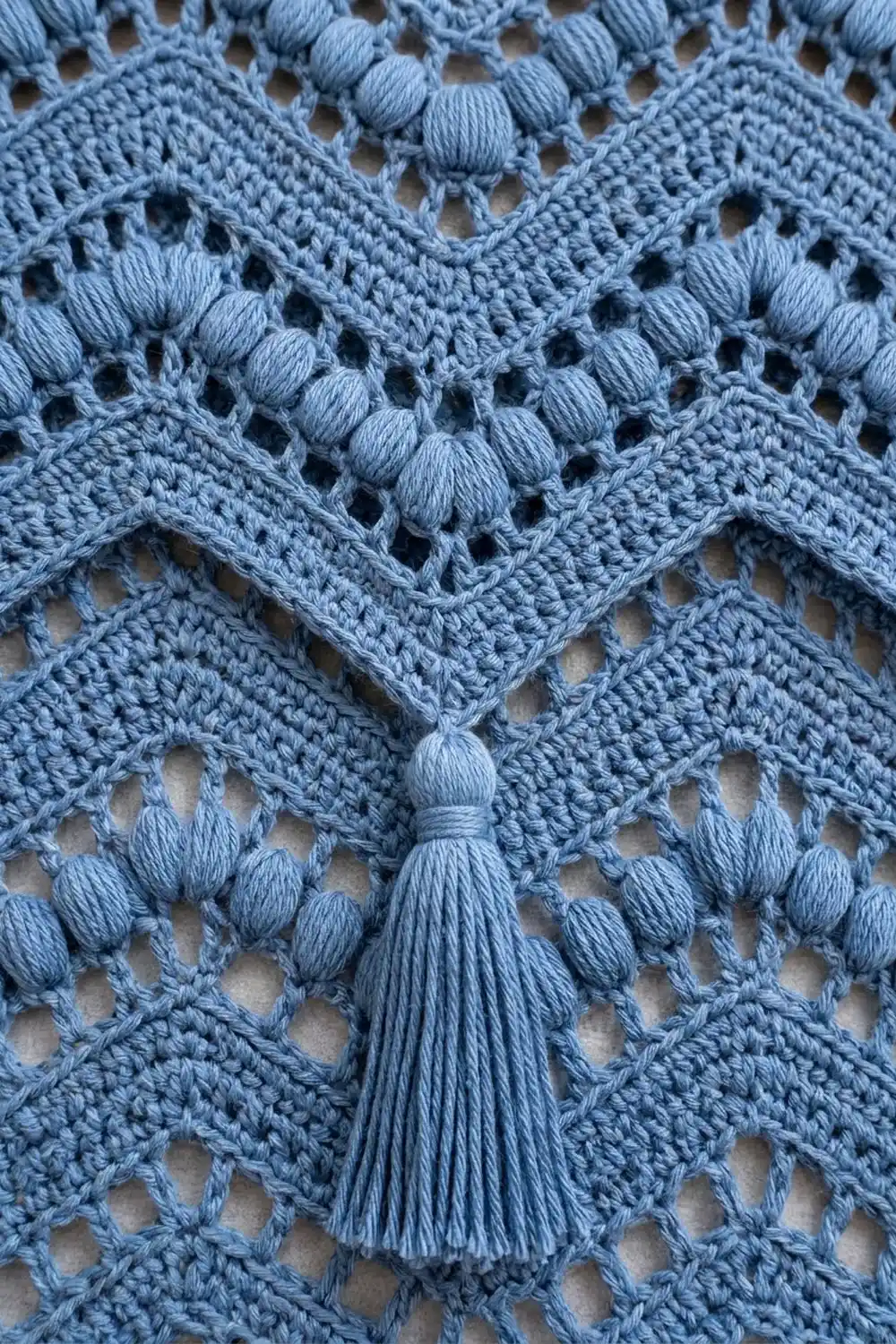
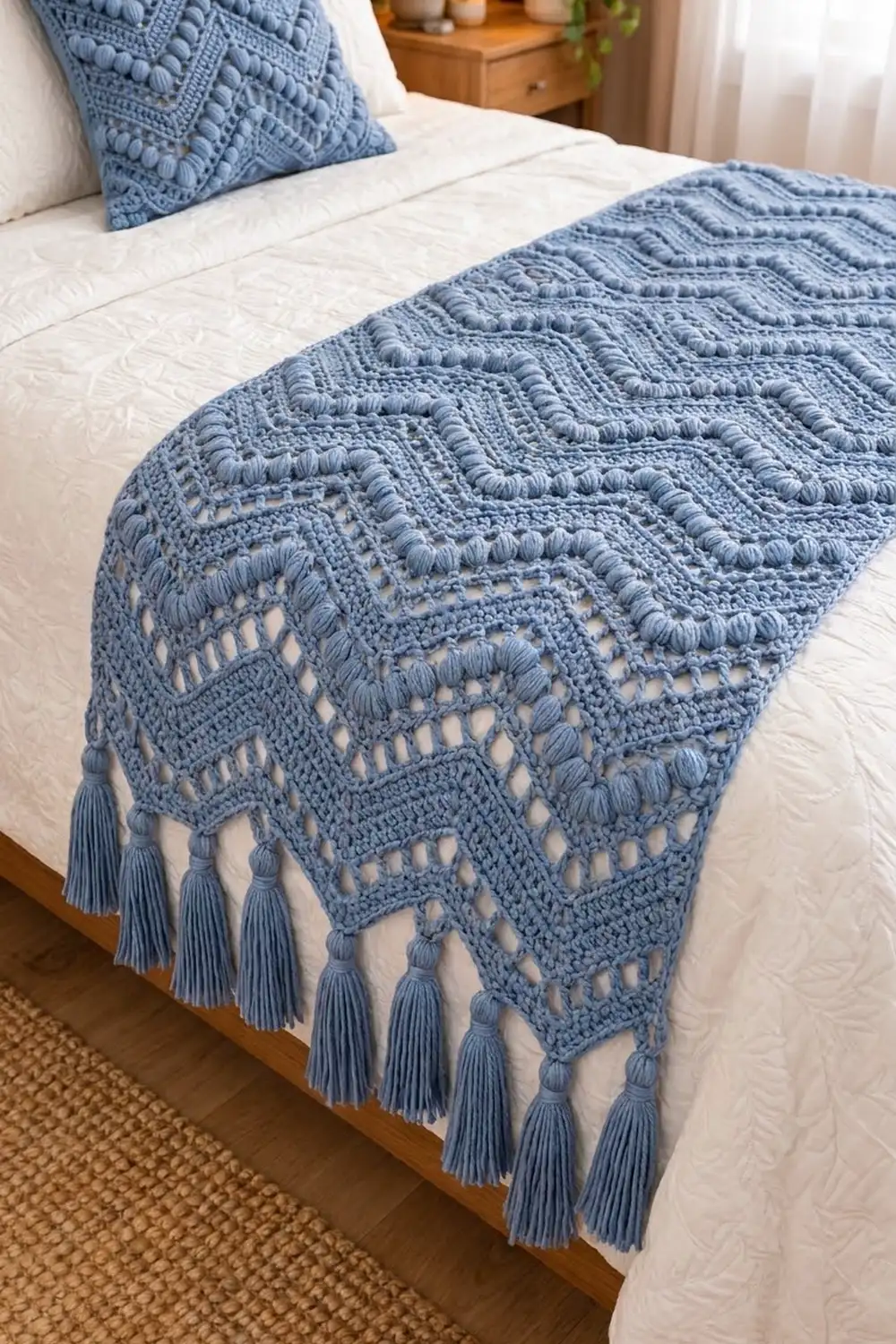
The Bluewater Ripple Bed Runner is one long rectangular piece worked in deep chevron rows. It is laid across the foot of the bed. Bands of solid single crochet alternate with open eyelet mesh rows and a row of round puff stitches. The foot end is cut into points, and a full tassel hangs from every point.
The runner uses one color, a soft dusty denim blue, so the texture does the work. The style is calm and cozy, a bit coastal and a bit farmhouse, and it suits white or cream bedding well.
This pattern uses US crochet terms. The finished runner measures 21 in (53.3 cm) wide by 68 in (172.7 cm) long after the border. The tassels add 5 in (12.7 cm) at the foot end.
Construction is simple. You chain the width, work 196 ripple rows in one piece, add a two-round single crochet border that follows the zigzag, then attach 9 tassels to the points at the foundation end. There is no joining.
Finished Size and Construction
- Finished size: 21 in x 68 in (53.3 cm x 172.7 cm), plus 5 in (12.7 cm) tassels
- Skill level: Intermediate
- Terminology: US crochet terms
- Yarn weight: Worsted (#4)
- Hook: 5.0 mm (H-8)
- Number of pieces: 1 runner + 9 tassels
- Layout: single piece, 8 chevron repeats across the width
- Piece size before border: 20 in x 67 in (50.8 cm x 170.2 cm)
- Border depth: 0.5 in (1.3 cm) on every edge, 2 rounds
Materials
Choose a smooth worsted yarn with good stitch definition. A cotton blend or a soft acrylic both work. Avoid fuzzy or very loose yarns, because they blur the puffs and fill in the eyelets.
Color: Dusty Denim Blue (one color only)
- Runner body and border: 650 g (approx. 1190 m)
- Tassels: 50 g (approx. 92 m)
- Total to buy: 800 g (approx. 1464 m), for example 8 balls of 100 g / 183 m
These quantities include a margin of about 100 g for swatching, gauge differences, and spare tassel strands.
Tools
- 5.0 mm (H-8) crochet hook
- Tapestry needle
- Stitch markers (at least 9)
- Measuring tape
- Sharp scissors
- A stiff card 5.5 in (14.0 cm) tall for tassels
- Blocking mats and rust-proof pins
- Spray bottle
Abbreviations (US Terms)
- ch – chain
- sc – single crochet
- dc – double crochet
- sk – skip
- st(s) – stitch(es)
- sp – space
- sl st – slip stitch
- yo – yarn over
- sc2tog / sc3tog – single crochet 2 / 3 together
- dc2tog / dc3tog – double crochet 2 / 3 together
- RS / WS – right side / wrong side
- rep – repeat
Special stitch – Puff (puff st): (Yo, insert hook in st, yo, pull up a loop to the height of a dc) 4 times, yo and draw through all 9 loops on hook, ch 1 to close. The closing ch 1 does not count as a stitch and is never worked into. Each puff counts as 1 st.
Peak: 3 sts worked in the same st. Valley: a 3-together decrease. Every row has 8 peaks and 7 valleys, with a half-valley (2-together) at each edge.
Gauge and Checkpoints
Flat gauge: 16 sc and 16 rows = 4 in (10.2 cm). In dc, 8 rows = 4 in (10.2 cm). So each sc row is 0.25 in (0.6 cm) tall and each dc or puff row is 0.5 in (1.3 cm) tall.
Ripple gauge: One 14-st repeat = 2.5 in (6.4 cm) from peak to peak, blocked.
Test piece first. Ch 30 and work Rows 1–9 below using 2 repeats (29 sts) instead of 8. Use “rep from * 0 more times” where the pattern says 6. The blocked swatch should measure 5 in (12.7 cm) wide and 3 in (7.6 cm) tall at the side edge.
- Too big: go down a hook size, to 4.5 mm (7).
- Too small: go up a hook size, to 5.5 mm (I-9).
- Width matters most. If the width is right and the height is off by a row or so, adjust by adding or removing whole 8-row repeats.
Checkpoints during the work (measured straight up the side edge):
- After Row 9: 20 in (50.8 cm) wide, 3 in (7.6 cm) long
- After Row 65: 22.25 in (56.5 cm) long
- After Row 129: 44.25 in (112.4 cm) long
- After Row 193: 66.25 in (168.3 cm) long
- After Row 196: 67 in (170.2 cm) long
Runner Body
The stitch count is 113 in every row. The math is 14 sts x 8 repeats + 1 = 113.
Chain-1 or chain-2 turning chains never count as stitches. Each ch-1 in a mesh row counts as 1 st.
Foundation: Ch 114.
Row 1 (RS): Sc2tog over 2nd and 3rd ch from hook, sc in next 5 ch, 3 sc in next ch, sc in next 5 ch, sc3tog over next 3 ch; rep from * 6 more times, sc in next 5 ch, 3 sc in next ch, sc in next 5 ch, sc2tog over last 2 ch. Turn. (113 sts)*
Check: 1 + (13 x 8) + 7 + 1 = 113.
The three row types are written out below. Every row starts the same way. The edge decrease uses 2 sts, the next 5 sts lead up to the peak stitch, and the peak always sits in the center st of the previous peak.
Row A (sc ripple row): Ch 1, sc2tog over first 2 sts, sc in next 5 sts, 3 sc in next st, sc in next 5 sts, sc3tog over next 3 sts; rep from * 6 more times, sc in next 5 sts, 3 sc in next st, sc in next 5 sts, sc2tog over last 2 sts. Turn. (113 sts)*
Row B (eyelet mesh row): Ch 2, dc2tog over first 2 sts, (ch 1, sk next st, dc in next st) twice, ch 1, sk next st, 3 dc in next st, (ch 1, sk next st, dc in next st) twice, ch 1, sk next st, dc3tog over next 3 sts; rep from * 6 more times, (ch 1, sk next st, dc in next st) twice, ch 1, sk next st, 3 dc in next st, (ch 1, sk next st, dc in next st) twice, ch 1, sk next st, dc2tog over last 2 sts. Turn. (113 sts, including 48 ch-1 sps)*
Check: 1 + 8 x (5 + 3 + 5) + 7 + 1 = 113. This row makes 6 eyelets per repeat, in two diagonal lines that follow each chevron.
Row C (puff row): Ch 2, dc2tog over first 2 sts, dc in next st, puff in next st, dc in next st, puff in next st, dc in next st, 3 dc in next st, dc in next st, puff in next st, dc in next st, puff in next st, dc in next st, dc3tog over next 3 sts; rep from * 6 more times, dc in next st, puff in next st, dc in next st, puff in next st, dc in next st, 3 dc in next st, dc in next st, puff in next st, dc in next st, puff in next st, dc in next st, dc2tog over last 2 sts. Turn. (113 sts, including 32 puffs)*
When you work a Row A on top of Row B, place 1 sc in each dc and 1 sc in each ch-1 sp. On top of Row C, place 1 sc in each dc and in the top of each puff, never in the closing ch.
Band repeat (Rows 2–9):
- Rows 2–4 (WS, RS, WS): Row A. (113 sts)
- Row 5 (RS): Row B. (113 sts)
- Row 6 (WS): Row A. (113 sts)
- Row 7 (RS): Row C. (113 sts)
- Row 8 (WS): Row A. (113 sts)
- Row 9 (RS): Row B. (113 sts)
One band repeat has 5 sc rows (1.25 in / 3.2 cm) and 3 tall rows (1.5 in / 3.8 cm), so it is 2.75 in (7.0 cm) tall.
Rows 10–193: Rep Rows 2–9 another 23 times, for 24 band repeats in total.
Rows 194–196: Row A. This closes the last band with a solid sc edge. Do not fasten off; go straight into the border.
Row totals: 196 rows. There are 124 sc rows (Row 1, 120 in the bands, and Rows 194–196), giving 31 in (78.7 cm). There are 72 tall rows (48 mesh and 24 puff), giving 36 in (91.4 cm). The total is 67 in (170.2 cm).
Border
Border gauge: 4 sc per 1 in (2.5 cm) along the side edges. That is the same as the flat sc gauge, so the sides stay straight and do not ruffle.
The border is worked in rounds around the whole runner. The two ends follow the zigzag. The corner groups are counted as part of the ends.
Round 1 (RS): Ch 1, then work in this order.
- Top end (Row 196): Work 3 sc in the first st (corner), then 1 sc in each st. Work 3 sc in the center st of each of the 8 peaks and sc3tog over each of the 7 valleys. Work 3 sc in the last st (corner). Count: 113 (1 per st) + 16 (peaks) – 14 (valleys) + 4 (corners) = 119 sc.
- Side 1: Work 1 sc in each sc row end and 2 sc in each dc or puff row end. Count: 124 + 144 = 268 sc.
- Foundation end: Work into the free loops of the foundation chain. Work 3 sc in the corner ch, then 1 sc in each ch. At the 7 downward points (under the Row 1 sc3tog), work 3 sc in the center ch. At the 8 inward points (under the Row 1 peaks), work sc3tog. Work 3 sc in the last ch (corner). Count: 113 + 14 – 16 + 4 = 115 sc.
- Side 2: Same as Side 1, 268 sc.
Join with sl st to the first sc. (770 sts)
Round 2: Ch 1, then work 1 sc in each st around, with the same shaping as before. Work 3 sc in the center sc of each corner and each outward point, and sc3tog centered over each inward point.
- Top end: 119 + 16 – 14 + 4 = 125 sc
- Each side: 268 sc (1 per st, no change)
- Foundation end: 115 + 14 – 16 + 4 = 117 sc
Join. (778 sts) Fasten off and weave in the ends.
Why the math works: The sides carry 268 sc over 67 in (170.2 cm), which is exactly 4 sc per inch, the flat sc gauge. On each end, every outward point gains 2 sts and every inward point loses 2. Those changes keep the zigzag angles the same as in the body, so the points stay sharp and the ends lie flat.
The two ends have different counts because the top end has 8 outward peaks, while the foundation end has 7 outward points plus 2 pointed corners. Two rounds of sc add 0.5 in (1.3 cm) on each edge. That turns 20 in x 67 in (50.8 cm x 170.2 cm) into 21 in x 68 in (53.3 cm x 172.7 cm).
Tassels
Make 9 tassels.
- Wrap the yarn 30 times around the 5.5 in (14.0 cm) card.
- Slide a 12 in (30.5 cm) tie strand under the top loops and knot it tightly.
- Cut the bottom loops.
- Wrap a second strand 6–8 times around the tassel, 0.75 in (1.9 cm) below the top, to form the head. Knot it and bury the tails inside.
- Trim the tassel to 5 in (12.7 cm).
Use the top tie to sew one tassel firmly to each of the 2 pointed corners and each of the 7 downward points on the foundation end. Place a stitch marker on each point before sewing, so the spacing stays even at 2.5 in (6.4 cm) apart.
Final Blocking
- Soak the runner in cool water for 15 minutes, then press the water out. Do not wring it.
- Roll it in a towel to remove extra moisture.
- Lay it flat with the RS up. Pin both side edges straight and parallel, 21 in (53.3 cm) apart.
- Pin the length to 68 in (172.7 cm). Measure along a side edge, not along a zigzag.
- Pin each point and corner sharply. Then pin each inward point so it forms a clean V.
- Lightly mist the puff rows and pat them round with your fingers. Do not flatten them.
- Let it dry completely, which usually takes 24–48 hours. Keep the tassels unpinned and comb them straight with your fingers while they are damp.
Final Quality-Control Checklist
- Every row held 113 sts, with 8 peaks and 7 valleys.
- The peaks line up in straight vertical columns from end to end.
- The eyelets are open and the puffs are evenly rounded on the RS.
- The side edges are straight, with no waves or pulling.
- Each side has 268 sc in Round 1 of the border.
- The width is 21 in (53.3 cm) and the length is 68 in (172.7 cm) after blocking.
- All 9 tassels are 5 in (12.7 cm) long and securely attached.
- All ends are woven in along the stitch columns, not across the eyelets.
Troubleshooting
- Peaks drifting sideways: You missed or added a stitch. Count to 113 at the end of every row, and place a marker in each peak center st.
- Side edges wavy: Your border sts were too many for your row gauge. Work exactly 1 sc per sc row and 2 sc per tall row.
- Side edges pulling in: Your turning chains or border are too tight. Loosen the turning chains, or rework the border with a 5.5 mm (I-9) hook and keep the same 268 sc per side.
- Flat puffs: Pull each loop up to the full height of a dc, and close the puff firmly with the ch 1.
- Mesh too dense: Your tension is tight on the dc rows. Relax your hand on Row B, and pull each dc up to its full height.
- Points rounding off: Pin the points harder when you block, and check that every peak uses 3 sts in the center st.
- Runner too short for your bed: Each extra band repeat adds 2.75 in (7.0 cm). Add whole repeats before Rows 194–196, then add 4 sc per side for each extra sc row and 2 sc per side for each extra tall row in the border.
Care
Hand wash, or machine wash on a cool, gentle cycle in a laundry bag. Then lay it flat to dry and reshape the points. Do not hang the runner by its tassels while wet.
Final Notes
The measurement chain is short and simple. One 14-st repeat measures 2.5 in (6.4 cm), and 8 repeats make 113 sts and 20 in (50.8 cm) across.
Each 8-row band measures 2.75 in (7.0 cm). Twenty-four bands plus 4 extra sc rows give 67 in (170.2 cm).
A two-round border at 4 sc per inch adds 0.5 in (1.3 cm) all around, for a finished size of 21 in x 68 in (53.3 cm x 172.7 cm). Nine 5 in (12.7 cm) tassels finish the pointed foot end.
Count often, keep your peaks stacked, and block those points crisp.
Happy crocheting!