

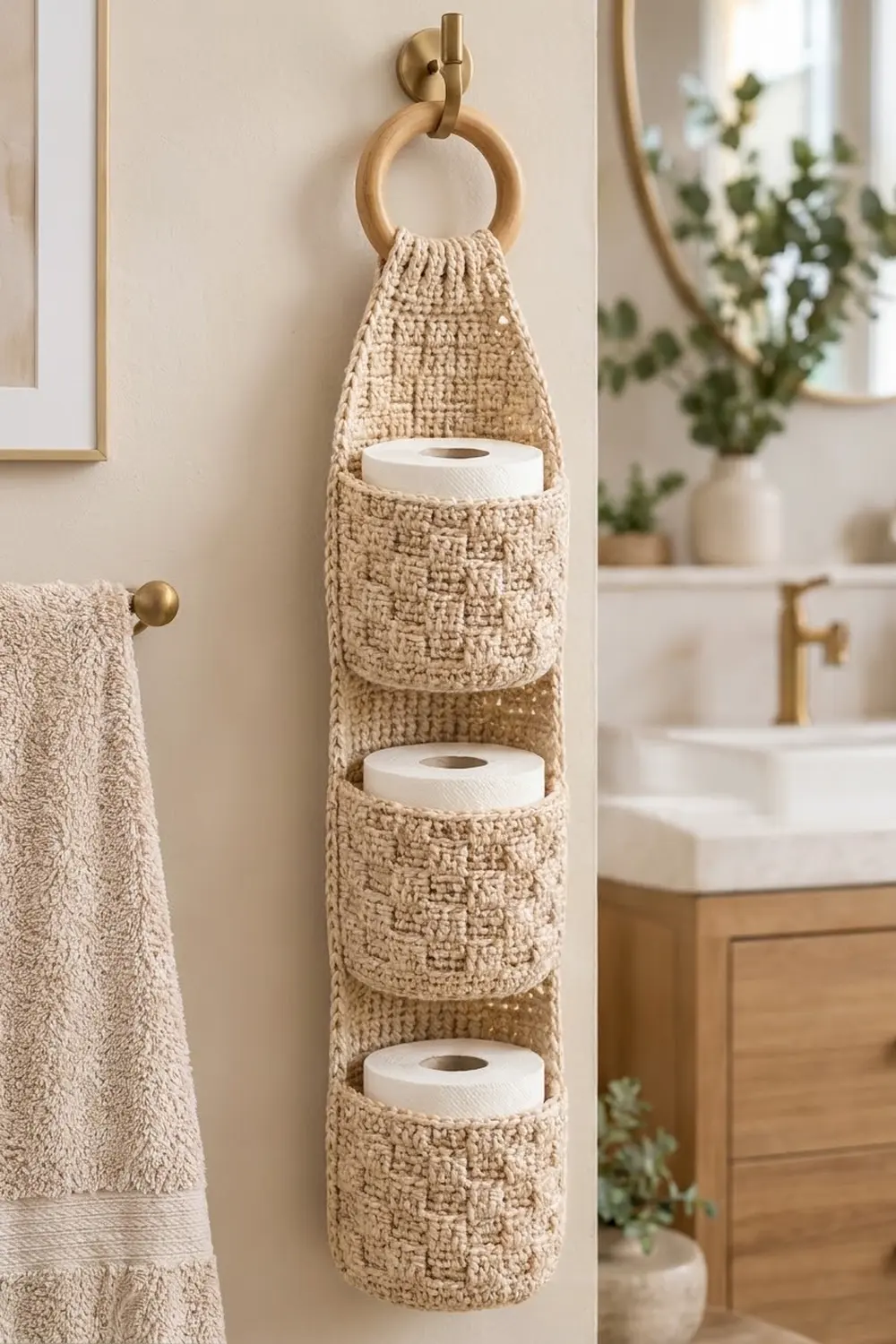
This hanging holder stores three spare rolls in a slim column on the wall. A long back panel with a checkerboard texture carries three round pockets, and a ribbed strap gathers over a wooden ring at the top so the whole thing hangs from a single hook.
The sample uses one oatmeal beige cotton-blend yarn. The checkerboard comes from blocks of front post and back post double crochet, so you get a woven look without changing colors. A corded reverse single crochet edge finishes the panel sides and the pocket rims.
The pattern uses US crochet terms. The finished panel measures 5.4 in (13.7 cm) wide and 24.75 in (62.9 cm) long from the bottom edge to the start of the strap. Once the strap is folded over the ring, the holder hangs about 26.25 in (66.7 cm) below the ring.
Here’s the construction in short: you work the back panel flat in rows and taper it into a ribbed strap. Each pocket is worked in the round, starting with a flat single crochet base and continuing up into basketweave walls. You sew the three pockets to the panel, add the border, fold the strap over the ring and block.
Finished Size and Construction
- Finished size: 5.4 in x 24.75 in (13.7 cm x 62.9 cm) for the panel body; hangs 26.25 in (66.7 cm) below the ring
- Skill level: Intermediate (post stitches, working in the round, sewing)
- Terminology: US
- Yarn weight: Worsted (#4)
- Hook: 5.0 mm (H-8)
- Number of pieces: 4 (1 back panel, 3 pockets)
- Layout: 1 column of 3 pockets on one vertical panel
- Piece size: panel 4.9 in x 24.5 in (12.4 cm x 62.2 cm) plus the strap; each pocket 4.9 in (12.4 cm) across and 4 in (10.2 cm) tall
- Size before border: 4.9 in x 24.5 in (12.4 cm x 62.2 cm)
- Border depth: 0.25 in (0.6 cm) per side
Materials
Pick a smooth worsted cotton or cotton blend at about 170 m per 100 g. Cotton keeps the pockets firm and stands up to bathroom humidity. Avoid fuzzy or very loose-plied yarn, because it hides the post-stitch blocks and splits easily.
- Oatmeal (light beige): 300 g, approx. 510 m (panel about 85 g, each pocket about 55 g)
These quantities include a margin of about 50 g for gauge differences, sewing and the gauge swatch.
Tools:
– 5.0 mm (H-8) crochet hook
– 3 in (7.6 cm) wooden ring
– Tapestry needle
– 8 locking stitch markers
– Rust-proof pins
– Measuring tape
– Blocking mat and spray bottle
Abbreviations (US Terms)
- ch – chain
- sl st – slip stitch
- sc – single crochet
- dc – double crochet
- dc2tog – double crochet 2 together
- BLO – back loop only
- FPdc – front post double crochet
- BPdc – back post double crochet
- rev sc – reverse single crochet
- MR – magic ring
- st(s) – stitch(es)
- RS / WS – right side / wrong side
Special stitch – reverse single crochet (rev sc): Working from left to right (right-handed), insert the hook into the next st to the right, yarn over, pull up a loop, yarn over and pull through both loops on the hook. This makes the twisted, corded edge.
Note: The ch 2 at the start of a row or round does not count as a stitch unless the pattern says otherwise.
Gauge and Checkpoints
Gauge: 14 sts and 8 rows = 4 in (10.2 cm) in basketweave. That works out to 3.5 sts and 2 rows per inch. Single crochet uses the same 3.5 sts per inch, with 4 rows per inch.
Test one piece first. Make one pocket before anything else. It’s the smallest piece, and it tells you whether your gauge works and whether a roll fits.
Checkpoints:
– Pocket base after Round 9: about 4.9 in (12.4 cm) across, lying flat
– Pocket after Round 11: circumference 15.4 in (39.1 cm); 7.7 in (19.6 cm) wide when flattened
– Finished pocket: 4 in (10.2 cm) tall
– Panel after Row 1: 4.9 in (12.4 cm) wide
– Panel after Row 45: 22.5 in (57.2 cm) long
– Panel after Row 49: 24.5 in (62.2 cm) long
– Strap: 3 in (7.6 cm) long
Too big? Go down 0.5 mm. Too small, or does the roll not fit? Go up 0.5 mm. Post stitches tighten the fabric widthwise, so loosen your yarn-overs on the post rows rather than adding stitches. Adding stitches would break the 6-stitch block repeat.
Pocket (Make 3)
Work in joined rounds with the RS always facing.
Base
Round 1: Make an MR, ch 1, 6 sc in ring, sl st to first sc. (6 sts)
Round 2: Ch 1, 2 sc in each st around, sl st to first sc. (12 sts)
Round 3: Ch 1, [sc in next st, 2 sc in next st] 6 times, sl st to first sc. (18 sts)
Round 4: Ch 1, [sc in next 2 sts, 2 sc in next st] 6 times, sl st. (24 sts)
Round 5: Ch 1, [sc in next 3 sts, 2 sc in next st] 6 times, sl st. (30 sts)
Round 6: Ch 1, [sc in next 4 sts, 2 sc in next st] 6 times, sl st. (36 sts)
Round 7: Ch 1, [sc in next 5 sts, 2 sc in next st] 6 times, sl st. (42 sts)
Round 8: Ch 1, [sc in next 6 sts, 2 sc in next st] 6 times, sl st. (48 sts)
Round 9: Ch 1, [sc in next 7 sts, 2 sc in next st] 6 times, sl st. (54 sts)
Checkpoint: the base is flat and about 4.9 in (12.4 cm) across.
Walls
Round 10 (turning round): Ch 1, sc in BLO of each st around, sl st to first sc. (54 sts) The free front loops make a crisp fold so the base sits flat.
Round 11: Ch 2, dc in each st around, sl st to first dc. (54 sts)
Round 12: Ch 2, [FPdc in next 3 sts, BPdc in next 3 sts] 9 times, sl st to first FPdc. (54 sts: 9 raised blocks, 9 recessed blocks)
Round 13: Repeat Round 12. (54 sts)
Round 14: Ch 2, [BPdc in next 3 sts, FPdc in next 3 sts] 9 times, sl st to first BPdc. (54 sts)
Round 15: Repeat Round 14. (54 sts)
Rounds 16–17: Repeat Round 12 twice. (54 sts) That gives three bands of checkerboard.
Round 18: Ch 1, sc in each st around, sl st to first sc. (54 sts)
Round 19: Ch 1, rev sc in each st around, sl st to first rev sc. (54 sts)
Fasten off and weave in the ends.
The heights add up like this: Round 10 at 0.25 in, Round 11 at 0.5 in, Rounds 12–17 at 3 in, and Rounds 18–19 at 0.25 in, for 4 in (10.2 cm) total. The 54-stitch circumference makes a 4.9 in (12.4 cm) inside diameter, which leaves easy room for a standard 4.5 in (11.4 cm) roll.
Back Panel
Body
Row 1: Ch 19, dc in 4th ch from hook (the skipped 3 ch count as a dc), dc in each remaining ch. Turn. (17 sts)
Row 2 (RS): Ch 2, dc in first st, [FPdc in next 3 sts, BPdc in next 3 sts] twice, FPdc in next 3 sts, dc in top of turning ch. Turn. (17 sts: 1 edge dc, 15 post sts, 1 edge dc)
Row 3 (WS): Ch 2, dc in first st, [BPdc in next 3 sts, FPdc in next 3 sts] twice, BPdc in next 3 sts, dc in last st. Turn. (17 sts) Working the opposite post on WS rows keeps the same blocks raised on the RS.
Row 4 (RS): Ch 2, dc in first st, [BPdc in next 3 sts, FPdc in next 3 sts] twice, BPdc in next 3 sts, dc in last st. Turn. (17 sts)
Row 5 (WS): Ch 2, dc in first st, [FPdc in next 3 sts, BPdc in next 3 sts] twice, FPdc in next 3 sts, dc in last st. Turn. (17 sts)
Rows 6–45: Repeat Rows 2–5 ten more times, for 11 repeats in total. (17 sts)
Checkpoint: 4.9 in x 22.5 in (12.4 cm x 57.2 cm).
Taper
Row 46: Ch 2, dc in first st, dc2tog, dc in each st to last 3 sts, dc2tog, dc in last st. Turn. (15 sts)
Row 47: Repeat Row 46. (13 sts)
Row 48: Repeat Row 46. (11 sts)
Row 49: Repeat Row 46. (9 sts)
Checkpoint: 24.5 in (62.2 cm) long.
Ribbed Strap
Row 50: Ch 1, sc in each st across. Turn. (9 sts)
Rows 51–61: Ch 1, sc in BLO of each st across. Turn. (9 sts)
The strap is 3 in (7.6 cm) long and 2.6 in (6.6 cm) wide. Fasten off, leaving a 24 in (61.0 cm) tail.
Make All Pieces
You need 4 pieces, all in Oatmeal:
- Back panel: 1 (about 85 g)
- Pockets: 3 (about 55 g each, 165 g total)
Layout (panel rows, counted from the bottom):
[ ring + strap ]   Rows 50–61
[ taper        ]   Rows 46–49
[ empty panel  ]   Rows 39–45  (3.5 in / 8.9 cm)
[ POCKET 3     ]   Rows 31–38  (4 in / 10.2 cm)
[ empty panel  ]   Rows 24–30  (3.5 in / 8.9 cm)
[ POCKET 2     ]   Rows 16–23  (4 in / 10.2 cm)
[ empty panel  ]   Rows 9–15   (3.5 in / 8.9 cm)
[ POCKET 1     ]   Rows 1–8    (4 in / 10.2 cm)
Joining
Method: Whipstitch with a 36 in (91.4 cm) length of the same yarn, working on the RS of the panel.
Stitch-to-stitch logic:
1. On each pocket, put markers in 17 consecutive stitches of Round 18. These make up the back wall, and the other 37 stitches form the curved front.
2. Pin the pocket so its base sits level with the bottom of its first panel row: Row 1, Row 16 or Row 31.
3. Across the top, sew the 17 marked stitches of Round 18 to the 17 stitches of the panel’s top pocket row (Row 8, 23 or 38), one stitch to one stitch.
4. Down each side, sew the pocket’s back edge to the panel’s edge dc column. Work through the inner leg of the edge dc so the row ends stay free for the border. Pin at every 1 in (2.5 cm) mark first so the 4 in pocket matches the 8 panel rows.
5. Across the bottom, sew the 17 matching stitches of Round 10 to the bottom of the panel row, one stitch to one stitch.
Since the 17 back-wall stitches match the panel’s 17 stitches, the pocket’s back lies flat against the panel at 4.9 in (12.4 cm). The remaining 37 stitches bow out in front to hold the roll.
Tension: Snug each whipstitch until it just meets the fabric. If you pull harder, the panel will pucker.
Size checkpoint: The panel is still 4.9 in (12.4 cm) wide, with no waves between pockets. The gaps are 3.5 in (8.9 cm) each.
Border
Border gauge: Work 2 sc per dc row end, which comes to 4 sc per inch along the length. Work 1 sc per stitch along the bottom.
Row 1 (RS): Join the yarn at the left edge of Row 49. Work 2 sc in each row end down the left side. (49 rows x 2 = 98 sc) In the first foundation ch, work 3 sc for the corner. Sc in each of the next 15 ch. In the last ch, work 3 sc for the corner. Work 2 sc in each row end up the right side. (98 sc)
Counts: left side 98 sc. Bottom 21 sc, which is 17 sts worked 1 per foundation st plus 4 extra corner sts (2 per corner). Right side 98 sc. Total: 217 sc.
Row 2: Ch 1, do not turn. Rev sc in each sc back across, putting 1 rev sc in each corner sc. (217 sts: 98 + 21 + 98)
Fasten off.
Why the math works: Each dc row is 0.5 in (1.3 cm) tall, and 2 sc fill that height. So 98 sc cover exactly the 49 rows, or 24.5 in (62.2 cm), without ruffling. The 4 extra sts at each bottom corner let the edge turn without cupping. The border adds 0.25 in (0.6 cm) to each side, bringing the width to 5.4 in (13.7 cm) and the body length to 24.75 in (62.9 cm).
Attach the ring: Fold the strap over the wooden ring toward the WS. Whipstitch the 9 sts of Row 61 to the 9 sts of Row 49 on the WS. The ribs will gather softly around the ring.
Final Blocking
- Weave in all the ends before you block.
- Spritz the whole holder until it’s evenly damp. Don’t soak it.
- Lay it flat with the RS up and pin the panel to 5.4 in x 24.75 in (13.7 cm x 62.9 cm).
- Push each pocket into a round shape from the inside. A rolled towel tucked inside helps.
- Straighten the corded edges and square up the bottom corners.
- Let it dry completely, then remove the pins and hang it.
Final Quality-Control Checklist
- Panel is 5.4 in (13.7 cm) wide and straight along both sides
- Every panel row has 17 sts, and the blocks alternate cleanly in a checkerboard
- Each pocket is 54 sts around and 4 in (10.2 cm) tall
- The pockets sit at Rows 1–8, 16–23 and 31–38, with even 3.5 in (8.9 cm) gaps
- Border count: 98 / 21 / 98
- Strap is sewn securely and the ring turns freely
- A roll slides into each pocket without forcing
- All ends are woven in and invisible
Troubleshooting
- Blocks look stacked, not checkered: You worked the same post on a WS row. Remember that on WS rows the post type flips.
- Pocket too tight for a roll: Your gauge is tight. Remake with a hook 0.5 mm larger and keep 54 sts.
- Base curls up: Your sc is tight. Go up a hook size for Rounds 1–9 only.
- Panel wavy at the sides: You’re working too many border sc. Keep to exactly 2 per row end.
- Pocket sags forward: Add a second line of whipstitch across the back wall at Round 14.
- Strap twists: Fold it straight and match Row 61 stitch for stitch to Row 49.
Care
Hand wash in cool water with mild soap. Press out the water in a towel, reshape the pockets and dry flat.

Final Notes
The measurement chain is simple: 3.5 sts and 2 rows per inch. That gives a 17-stitch panel at 4.9 in (12.4 cm) and 49 rows at 24.5 in (62.2 cm). The 54-stitch pockets are 4 in (10.2 cm) tall and spaced 3.5 in (8.9 cm) apart, and the 98/21/98 border brings everything to 5.4 in x 24.75 in (13.7 cm x 62.9 cm). Check each number as you go, and the holder will hang straight and hold its rolls neatly.
Happy crocheting!