

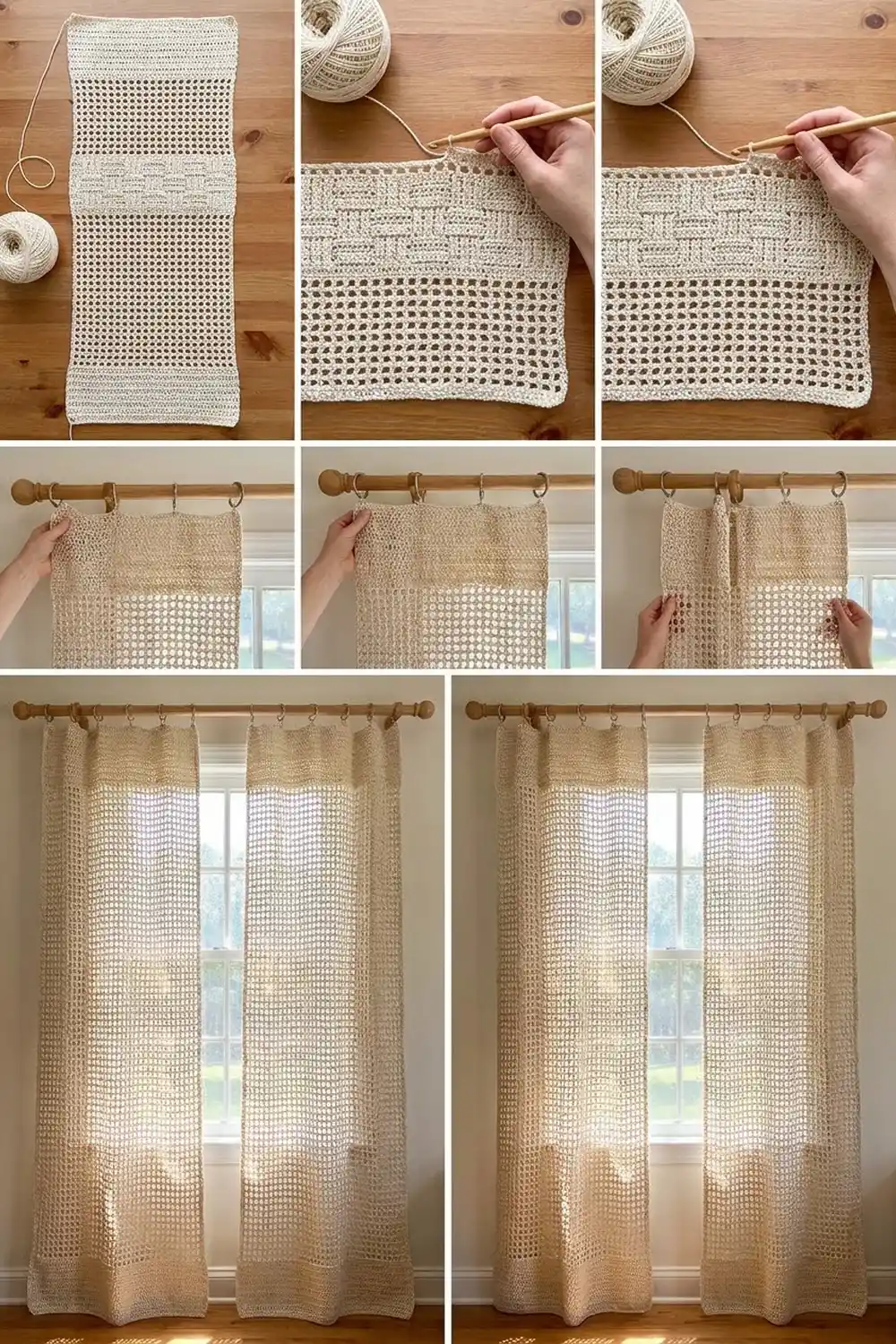
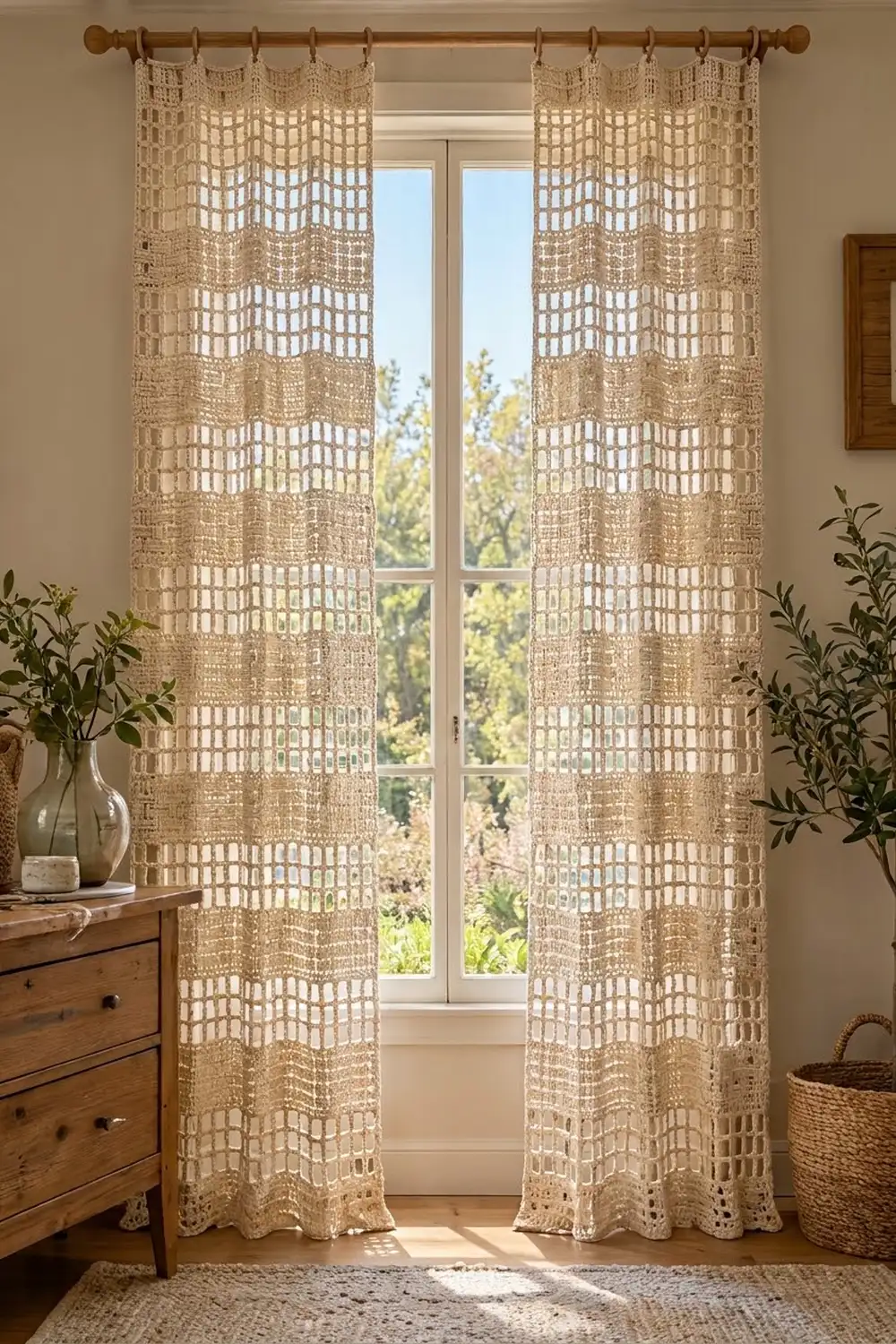
The Oat Lattice Curtain Panel is a floor-length crochet curtain that mixes two textures you can see from across the room: airy filet mesh that lets the light pour through, and solid bands of basketweave that add weight, privacy, and a woven, handmade look.
It is worked in a single natural oatmeal cotton, so the whole design depends on texture rather than color. The style is calm, modern farmhouse: simple, warm, and easy to pair with wood, linen, and plants.
This pattern uses US crochet terms. One finished panel measures 29.75 in x 83.5 in (75.6 cm x 212.1 cm) after the border and blocking. Make two panels for a pair, as shown at the window.
Construction is straightforward. You work one panel flat in rows from the top header down to the bottom hem: a solid double-crochet header, nine repeats of mesh plus basketweave, a final mesh band, and a solid hem. A two-round single-crochet border finishes all four edges.
Finished Size and Construction
- Finished size (one panel): 29.75 in x 83.5 in (75.6 cm x 212.1 cm)
- Skill level: Intermediate (post stitches, long rows, accurate counting)
- Terminology: US crochet terms
- Yarn weight: Worsted (#4) cotton
- Hook: US H-8 (5.0 mm)
- Number of pieces: 1 panel (make 2 for a pair; the panels are not joined)
- Layout: One rectangle, worked in rows, top to bottom
- Piece size before border: 28.75 in x 82.5 in (73.0 cm x 209.6 cm)
- Border depth: 0.5 in (1.3 cm), two rounds of single crochet
Materials
Yarn: Choose a smooth worsted-weight cotton or cotton blend, either mercerized or soft combed. Cotton holds the square mesh shape, hangs straight, and washes well. Avoid very fuzzy yarns, which blur the mesh windows.
- Natural Oatmeal (main and only color): 800 g, approx. 1,520 m (1,662 yd) per panel
- For a pair: 1,600 g, approx. 3,040 m (3,325 yd)
These quantities include a margin of about 10–15% for your gauge swatch and small tension differences. Buy all yarn from one dye lot.
Tools:
- US H-8 (5.0 mm) crochet hook
- Stitch markers (at least 4)
- Tapestry needle
- Scissors
- Measuring tape
- Rust-proof pins and blocking mats, or a large clean towel-covered surface
- Spray bottle
- 12 curtain clip rings per panel, and a curtain rod
Abbreviations (US Terms)
- ch – chain
- sc – single crochet
- dc – double crochet
- FPdc – front post double crochet
- BPdc – back post double crochet
- sk – skip
- st(s) – stitch(es)
- sp – space
- tch – turning chain
- RS / WS – right side / wrong side
- rep – repeat
- rnd – round
Special stitches:
- FPdc: Yarn over, insert the hook from front to back to front around the post of the stitch below, yarn over and pull up a loop, (yarn over, pull through 2 loops) twice.
- BPdc: Yarn over, insert the hook from back to front to back around the post of the stitch below, then complete as a dc.
The ch-3 at the start of a dc row counts as 1 dc. The ch-5 at the start of a mesh row counts as 1 dc plus a ch-2 space.
Gauge and Checkpoints
Gauge: 16 sts and 8 rows = 4 in (10.2 cm) in dc, blocked. One mesh square (dc plus ch-2) is 0.75 in (1.9 cm) wide and 0.5 in (1.3 cm) tall.
Test swatch first. Before you commit to a 165-row panel, make a small piece with the same structure:
- Ch 27. Row 1 (RS): Dc in 4th ch from hook and in each ch across (25 sts).
- Row 2: Ch 3, dc in each st across (25 sts).
- Rows 3–11: Work the Mesh Rows below (9 dc, 8 ch-2 sps).
- Row 12 (WS): Work the Set-Up Row (25 sts).
- Rows 13–18: Work the Basketweave Rows as follows: 2 edge dc, then (3 FPdc, 3 BPdc) 3 times, 3 FPdc, then 2 edge dc. Use the same front/back switching as the main panel (25 sts).
Block the swatch. It should measure 6.25 in x 9 in (15.9 cm x 22.9 cm). After Row 11 it should be about 5.5 in (14.0 cm) tall.
If your swatch is too big, go down one hook size. If it is too small, go up one hook size. Match the width first, because width controls how the panel fits the rod.
Main panel checkpoints:
- After Row 6 (header): 28.75 in (73.0 cm) wide, 3 in (7.6 cm) long
- After Row 22 (first full repeat): 11 in (27.9 cm) long
- After Row 150 (nine repeats): 75 in (190.5 cm) long
- After Row 159 (final mesh band): 79.5 in (201.9 cm) long
- After Row 165 (hem): 82.5 in (209.6 cm) long
- After border: 29.75 in x 83.5 in (75.6 cm x 212.1 cm)
Measure with the work lying flat and relaxed, not hanging.
Panel Pattern
Odd-numbered rows are RS rows and even-numbered rows are WS rows. Turn at the end of every row.
Header Band
Foundation: Ch 117.
Row 1 (RS): Dc in 4th ch from hook (skipped ch count as 1 dc) and in each ch across. Turn. (115 sts)
Rows 2–6: Ch 3, dc in each st across, ending with dc in top of tch. Turn. (115 sts)
The header is a solid 3 in (7.6 cm) band, strong enough to hold clip rings without stretching.
Mesh Rows
First Mesh Row (worked over a solid row): Ch 5, sk next 2 sts, dc in next st, ch 2, sk next 2 sts, dc in next st; rep from * across, ending with the last dc in top of tch. Turn. (39 dc, 38 ch-2 sps)*
Following Mesh Rows: Ch 5, sk first ch-2 sp, dc in next dc, ch 2, dc in next dc; rep from * across, ending with the last dc in 3rd ch of tch. Turn. (39 dc, 38 ch-2 sps)*
Each mesh row still accounts for 115 sts: 39 dc + (38 x 2 ch) = 115. The dc posts stack directly on top of each other, forming the square windows.
Set-Up Row
Set-Up Row (WS): Ch 3, 2 dc in next ch-2 sp, dc in next dc; rep from * across, working the last dc in 3rd ch of tch. Turn. (115 sts)*
Count: 1 + (38 x 3) = 115 sts. This solid row gives the post stitches a full row of posts to wrap around.
Basketweave Rows
The 2 edge sts on each side are always plain dc, so the side edges stay straight. Between them are 37 blocks of 3 sts (111 sts).
Basket Row A: Ch 3, dc in next st, (3 FPdc, 3 BPdc) 18 times, 3 FPdc, dc in next st, dc in top of tch. Turn. (115 sts)
Basket Row B: Ch 3, dc in next st, (3 BPdc, 3 FPdc) 18 times, 3 BPdc, dc in next st, dc in top of tch. Turn. (115 sts)
Count for both rows: 2 + (18 x 6) + 3 + 2 = 115 sts.
Working Row B on a WS row directly over Row A keeps every block raised on the same side, which builds a 2-row tier. Switching the order on the next tier staggers the blocks and creates the woven look.
Repeat Unit (16 rows, 8 in / 20.3 cm)
- Rows 7–15 (9 rows): Work the First Mesh Row on Row 7, then Following Mesh Rows on Rows 8–15. This band is 4.5 in (11.4 cm).
- Row 16 (WS): Set-Up Row. (115 sts)
- Row 17 (RS): Basket Row A.
- Row 18 (WS): Basket Row B.
- Row 19 (RS): Basket Row B.
- Row 20 (WS): Basket Row A.
- Row 21 (RS): Basket Row A.
- Row 22 (WS): Basket Row B. (115 sts)
The solid section (Rows 16–22) is 7 rows, or 3.5 in (8.9 cm). Mesh plus solid equals 16 rows, or 8 in (20.3 cm).
Rows 23–150: Rep Rows 7–22 eight more times, for nine repeat units in total. Each time, work the First Mesh Row directly into the tops of the post stitches. (115 sts)
Each unit has an even number of rows. So every Set-Up Row falls on a WS row and every first Basket Row falls on a RS row, and the blocks always face the right way.
Final Mesh Band and Hem
Rows 151–159: Work the First Mesh Row on Row 151, then Following Mesh Rows on Rows 152–159. (39 dc, 38 ch-2 sps)
Row 160 (WS): Set-Up Row. (115 sts)
Rows 161–165: Ch 3, dc in each st across. Turn. (115 sts)
The 6-row hem (Rows 160–165) matches the 6-row header, so the panel is balanced top and bottom. Do not fasten off; go straight into the border.
Border
Border gauge: 4 sc per inch (2.5 cm) along every edge. Along stitch edges this is 1 sc per st. Along the side edges, each dc row end is 0.5 in (1.3 cm) tall, so 2 sc per row end keeps the same rate.
Each side count below includes that side’s 2 corner stitches. The corner stitch is the center sc of each 3-sc corner group.
Round 1: Ch 1, turn, and work along the last row (bottom edge): 3 sc in first st (corner), sc in each of the next 113 sts, 3 sc in last st (corner).
Rotate and work down the side: 1 sc in the row end of Row 165, 2 sc in each row end of Rows 164 to 2 (326 sc), 1 sc in the row end of Row 1.
Work across the free loops of the foundation chain: 3 sc in first ch (corner), sc in each of the next 113 ch, 3 sc in last ch (corner).
Work up the second side to match: 1 sc in the row end of Row 1, 2 sc in each row end of Rows 2–164, 1 sc in the row end of Row 165. Join with sl st to first sc.
- Bottom edge: 117 sts (including corners)
- Top edge: 117 sts (including corners)
- Each long side: 332 sts (corner + 1 + 1 + 326 + 1 + 1 + corner)
- Round total: 230 sc worked 1 per st along the top and bottom + 656 sc into row ends + 8 extra corner sc = 894 sts
Round 2: Ch 1, sc in each st around, working 3 sc in each corner st. Join with sl st to first sc. Fasten off.
- Top and bottom edges: 119 sts each (including corners)
- Each long side: 334 sts (including corners)
- Round total: 894 sts worked 1 per existing st + 8 extra corner sc = 902 sts
Why the math works: Before the border the panel is 28.75 in (73.0 cm) wide. Each sc round adds 0.25 in (0.6 cm) on each side.
- After Round 1 the width is 29.25 in (74.3 cm), which equals 117 sts at 4 sts per inch.
- After Round 2 the width is 29.75 in (75.6 cm), which equals 119 sts.
- On the long sides, 332 sts equals 83.0 in (210.8 cm), and 334 sts equals 83.5 in (212.1 cm).
Each count matches the measured length, so the edges will neither ruffle nor pull in.
Weave in all ends securely through solid stitches. Ends woven through the mesh chains would show against the light.
Final Blocking
- Soak the panel in cool water with a little wool wash or mild soap for 15 minutes.
- Gently squeeze out the water without wringing. Roll the panel in towels to remove more water.
- Lay it flat on blocking mats or a towel-covered floor. Because the panel is long, you can block it in two halves and let the unpinned half rest on a towel.
- Pin the corners first to 29.75 in x 83.5 in (75.6 cm x 212.1 cm).
- Pin along each long side every 4–6 in (10.2–15.2 cm), keeping the edge straight.
- Nudge the mesh squares into true rectangles and line up the dc posts vertically.
- Pat the basketweave blocks flat with your palm so the tiers lie evenly.
- Let the panel dry completely, then unpin.
Final Quality-Control Checklist
- Width is 29.75 in (75.6 cm) at the header, the middle, and the hem.
- Length is 83.5 in (212.1 cm).
- Every mesh row has 39 dc and 38 ch-2 spaces.
- Every solid and basketweave row has 115 sts.
- Every solid band has 3 staggered tiers of basketweave blocks.
- Side edges are straight, with no pull-in at the basketweave bands.
- Border corners are square and lie flat.
- All ends are hidden in solid stitches.
- For a pair, both panels are the same length to within 0.5 in (1.3 cm).
Troubleshooting
Basketweave bands pull in narrower than the mesh. Post stitches naturally tighten. Work them with a slightly taller, looser loop, or use a US I-9 (5.5 mm) hook for the post rows only.
Mesh squares lean to one side. Make sure each dc goes into the top of the dc below, not into the chain space. Keep the ch-2 at an even tension.
Stitch count is off after a mesh row. Check that the last dc goes into the 3rd ch of the ch-5 turning chain.
Panel grows when hung. Cotton relaxes under its own weight. Block the panel flat and let it hang for a day before you adjust anything for rod height. Keep your row gauge at 8 rows per 4 in (10.2 cm).
Border ruffles or puckers. If it ruffles, work 1 sc instead of 2 in a few row ends. If it puckers, add a few extra sc. Then recheck against the side counts above.
Clip rings stretch the header. Space 12 rings evenly, about 2.7 in (6.9 cm) apart, and clip through the full depth of the solid header and border.
Care
Hand wash, or machine wash cold on a gentle cycle in a mesh laundry bag, then lay flat to dry and reshape. Do not hang a wet panel, because the weight of the water will stretch it.
Final Notes
The measurement chain is simple. A gauge of 16 sts and 8 rows per 4 in (10.2 cm) makes 115 sts measure 28.75 in (73.0 cm) wide. Each 16-row repeat adds 8 in (20.3 cm). Nine repeats plus the header, final mesh band, and hem make 165 rows, or 82.5 in (209.6 cm). Two rounds of single crochet bring the panel to 29.75 in x 83.5 in (75.6 cm x 212.1 cm).
Check your width at every basketweave band and count every mesh row, and your panel will hang straight and even. Make a second panel to match, clip them on, and enjoy the light coming through.
Happy crocheting!