

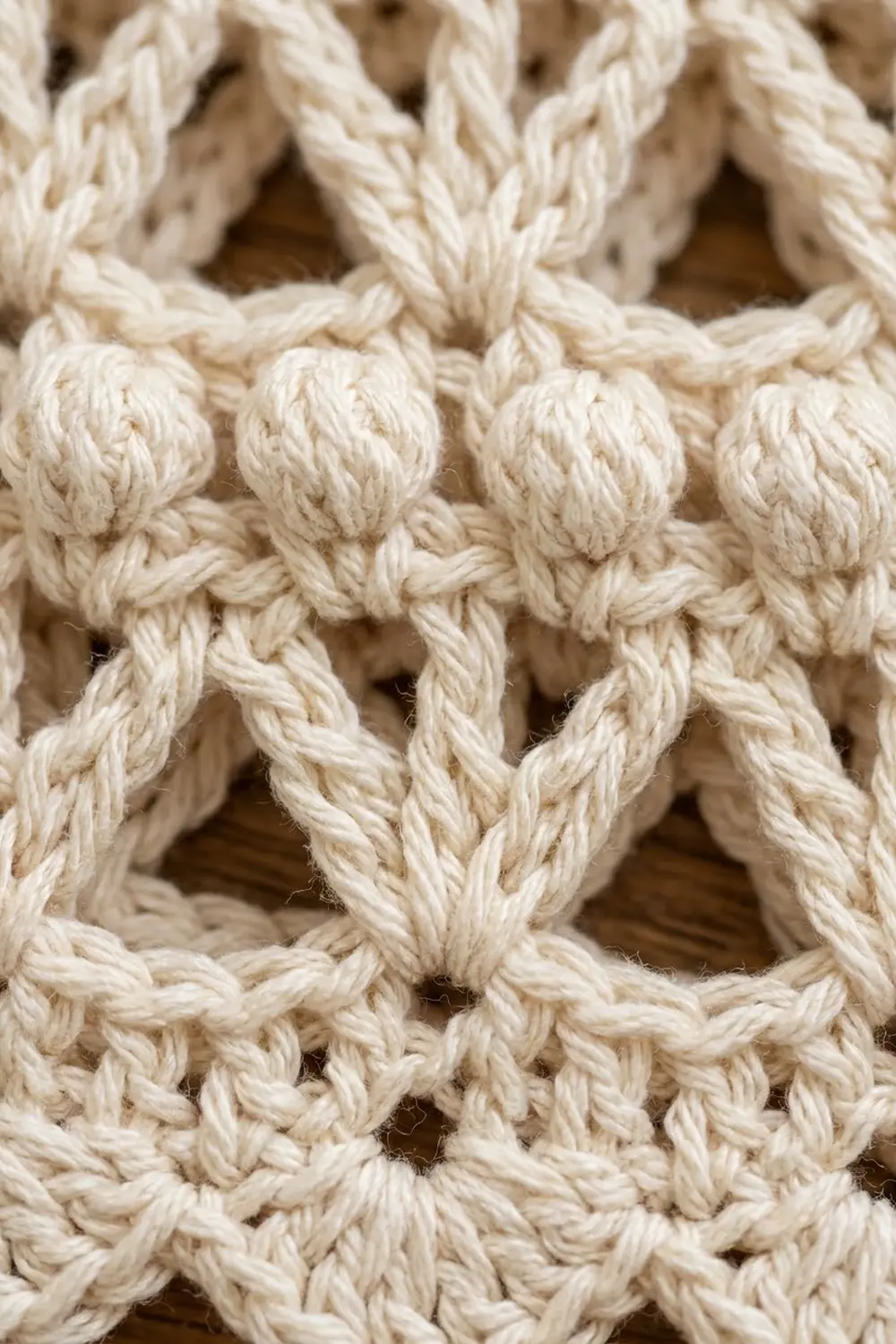
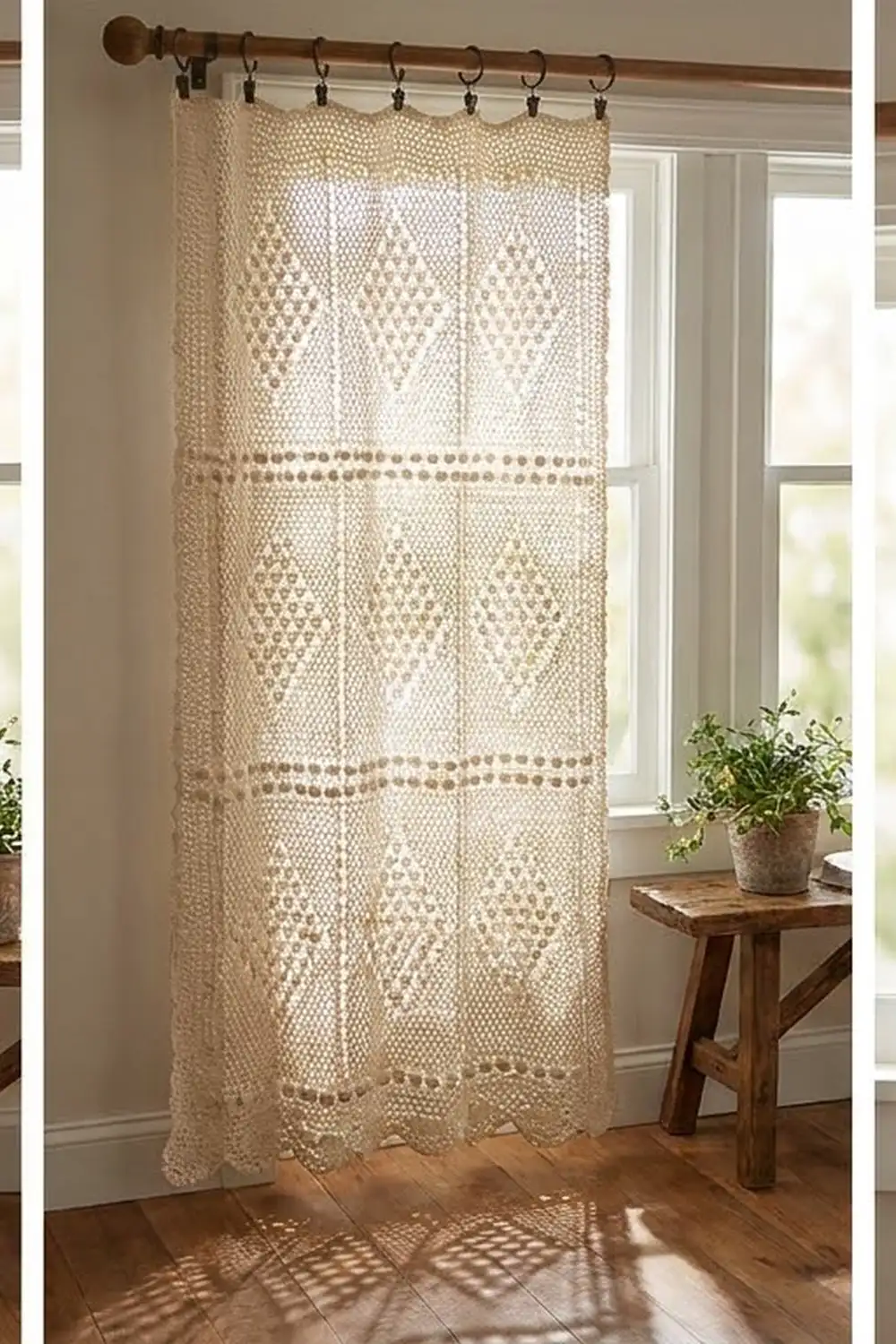
The Linen Light Tulip Lace Curtain Panel is a single rectangle of airy cream lace. Columns of open fans rise into tall clusters, so every repeat forms a small tulip-shaped window that glows when the sun is behind it. Every few inches, a band of round bobbles adds a soft, textured stripe across the panel.
The panel uses one color, a natural cream cotton. This keeps the look calm and cottage-style and lets the texture do the work. The bottom edge has a row of lacy shell scallops, and the sides and top have a neat two-round single crochet edging.
This pattern uses US crochet terms. After blocking, the panel measures 40.25 in x 82.25 in (102.2 cm x 208.9 cm), which suits a standard window when hung from clip rings. For a pair like the one in the photos, make two identical panels. The panels are not joined.
The construction is simple. Chain a foundation, then work the body flat in rows, back and forth, using a 6-row repeat of fans, clusters, and bobbles. Then work a border all the way around. On the bottom edge, the second border round makes the scallops.
Finished Size and Construction
- Finished size: 40.25 in x 82.25 in (102.2 cm x 208.9 cm)
- Skill level: Intermediate
- Terminology: US crochet terms
- Yarn weight: DK (light worsted, category 3) cotton
- Hook: 4.0 mm (US G-6)
- Number of pieces: 1 panel per curtain (make 2 for a pair)
- Layout: one rectangle worked flat in rows, bottom to top
- Piece size before border: 39.25 in x 80.5 in (99.7 cm x 204.5 cm)
- Border depth: 0.5 in (1.3 cm) on the sides and top; 1.25 in (3.2 cm) on the bottom, including the scallops
Materials
Choose a smooth, mercerized or combed DK-weight cotton. Cotton holds the lace open, resists stretching on the rod, and washes well. Avoid fuzzy or very stretchy yarns, because the openwork will lose its crisp shape.
- Cream (natural/ecru): 1,300 g, about 3,120 m (26 balls of 50 g / 120 m) per panel. For a pair, buy 2,600 g, about 6,240 m.
These amounts include a margin of about 10% for your gauge swatch and small differences in tension. Buy all the yarn from the same dye lot.
Tools:
- 4.0 mm (US G-6) crochet hook
- Tapestry needle
- Locking stitch markers (at least 6)
- Measuring tape
- Scissors
- Rust-proof pins and a large blocking surface (foam mats, or a clean bed covered with towels)
- Spray bottle
- Clip curtain rings for hanging
Abbreviations (US Terms)
- ch – chain
- sc – single crochet
- dc – double crochet
- tr – treble crochet
- st(s) – stitch(es)
- sl st – slip stitch
- yo – yarn over
- RS / WS – right side / wrong side
- rep – repeat
Special stitches:
- Fan: (dc, ch 1, dc, ch 1, dc) all in the same st. A fan counts as 5 sts (3 dc + 2 ch).
- tr2tog: *Yo twice, insert hook in the next indicated st, pull up a loop, (yo, pull through 2 loops) twice; rep from * once more in the next indicated st, yo, pull through all 3 loops.
- tr3tog: Work like tr2tog, but over 3 indicated sts, then yo and pull through all 4 loops.
- Bobble: *Yo, insert hook in st, pull up a loop, yo, pull through 2 loops; rep from * 4 more times in the same st (6 loops on hook), yo, pull through all 6 loops. Bobbles are worked on WS rows so they pop out to the RS.
- Shell: (dc, ch 1) 4 times, dc, all in the same st.
Gauge and Checkpoints
Gauge: 16 sts = 4 in (10.2 cm) in pattern, so one 6-st repeat = 1.5 in (3.8 cm). One full 6-row repeat (Rows 2–7) = 3.5 in (8.9 cm) tall.
Make a test swatch first. Ch 26 and work Row 1 (25 sts). Then work Rows 2–7 twice. After a light steam, the swatch should measure 6.25 in (15.9 cm) wide and 7.25 in (18.4 cm) tall. That is 4 fans across and 13 rows.
Checkpoints for the panel:
- After Row 1: 39.25 in (99.7 cm) wide.
- After Row 7: 3.75 in (9.5 cm) tall.
- After Row 37 (6 repeats): 21.25 in (54.0 cm) tall.
- After Row 73 (12 repeats): 42.25 in (107.3 cm) tall.
- After Row 133 (22 repeats): 77.25 in (196.2 cm) tall.
- After Row 138: 80.5 in (204.5 cm) tall.
If your swatch is too big, go down one hook size. If it is too small, go up one hook size. As a rule, if your swatch is off by 0.5 in (1.3 cm) over 4 in (10.2 cm), change by a full hook size. Measure the lace lying flat and relaxed, never stretched.
The Panel
The body is a multiple of 6 sts + 1, and every row has 157 sts. Always count chains as stitches. Work into the chains themselves, not into the spaces, unless the pattern says otherwise.
Foundation: Ch 158.
Row 1 (WS): Sc in 2nd ch from hook and in each ch across, turn. (157 sts)
Place a marker on the RS of the work so you can always tell which side is which.
Row 2 (RS, fan row): Ch 1, sc in first st, *skip 2 sts, Fan in next st, skip 2 sts, sc in next st; rep from * across, turn. (26 fans + 27 sc = 157 sts)
Each fan opens upward from a single point. These fans form the lower half of each tulip.
Row 3 (WS, cluster row): Ch 4 (counts as tr), *ch 2, sc in center dc of next fan, ch 2, tr3tog over the last dc of the same fan, the next sc, and the first dc of the next fan; rep from * 24 more times, ch 2, sc in center dc of last fan, ch 2, tr2tog over the last dc of that fan and the last sc, turn. (1 tr + 25 tr3tog + 1 tr2tog + 26 sc + 104 ch = 157 sts)
The cluster legs spread down into the fans and close the tops. The result is a row of diamond-and-tulip windows.
Row 4 (RS, fan row): Ch 1, sc in first st, *skip 2 ch, Fan in next sc, skip 2 ch, sc in next cluster; rep from * across, working the last sc in the tr2tog, turn. (26 fans + 27 sc = 157 sts)
Each fan sits directly above the fan below, so the tulips form neat vertical columns.
Row 5 (WS, cluster row): Rep Row 3. (157 sts)
Row 6 (RS, plain row): Ch 1, sc in each st across, working 1 sc in each tr, cluster, sc, and ch, turn. (157 sts)
Row 7 (WS, bobble row): Ch 1, sc in first st, *sc in next st, Bobble in next st, sc in next st; rep from * across, turn. (52 bobbles + 105 sc = 157 sts)
Check that the bobbles pop out on the RS. In the next row, each fan will sit in the sc between two bobbles.
Rows 8–133: Rep Rows 2–7 twenty-one more times (22 repeats in total). In each fan row worked over a bobble row, put the fans into the sc at the center of each repeat; the bobbles fall among the skipped sts. (157 sts in every row)
Rows 134–137: Rep Rows 2–5 once more. This matches the bottom of the panel, so the top band is lace, not bobbles.
Row 138 (RS): Rep Row 6. Do not fasten off. (157 sts)
The panel now measures 39.25 in x 80.5 in (99.7 cm x 204.5 cm).
Border
Border gauge: 4 sc = 1 in (2.5 cm) along every edge. On the sides, work 3 sc into the end of each fan row or cluster row, and 1 sc into the end of each sc row or bobble row. On the bottom, work into the free loops of the foundation chain.
Side row-end count: Row 1 (1) + 22 repeats x 14 (308) + Rows 134–137 (12) + Row 138 (1) = 322 sc. Each 6-row repeat gets 3 + 3 + 3 + 3 + 1 + 1 = 14 sc. At 4 sc per inch, that is 3.5 in (8.9 cm), which matches the height of the body repeat exactly.
Corner rule: Each corner gets 3 sc worked in one st. The middle sc is the corner stitch, and it is counted in both of the sides it touches.
Round 1 (RS): Do not turn. Ch 1, 3 sc in the last st of Row 138 (corner), work 322 sc evenly down the side, 3 sc in the first foundation ch (corner), 1 sc in each of the next 155 foundation ch, 3 sc in the last foundation ch (corner), work 322 sc evenly up the other side, 3 sc in the first st of Row 138 (corner), 1 sc in each of the next 155 sts across the top, join with sl st to first sc.
Counts per side, from corner to corner, including both corner sts:
- Top: 159 sc
- Bottom: 159 sc
- Each side: 326 sc
- Total for the round: 966 sc
The top and bottom each have 155 + 4 = 159 sc, which is the 157 sts of that edge plus 1 extra sc from each corner group.
Round 2: Ch 1. Along the top and both sides, sc in each st and 3 sc in each corner st. On the bottom edge, make the scallops: 3 sc in the bottom corner st, sc in next st, *skip 2 sts, Shell in next st, skip 2 sts, sc in next st; rep from * 25 more times (26 shells), then 3 sc in the next corner st. Continue around, join with sl st to first sc, and fasten off.
Counts per side, from corner to corner, including both corner sts:
- Top: 161 sc
- Each side: 328 sc
- Bottom: 31 sc + 26 shells
Why the math works: On the bottom edge there are 157 sts between the two corner sts, and 157 = 6 x 26 + 1. Each scallop uses 6 sts, and the extra 1 is the final sc, so the 26 scallops land evenly, one under each fan column. On the other edges, each side gains 2 sc per round, one from each corner group.
Weave in all ends inside the border sc, not through the open lace, where they would show against the light.
Final Blocking
- Soak the panel in cool water with a little gentle wash for 15 minutes.
- Press the water out gently. Do not wring. Roll the panel in towels to remove more moisture.
- Lay the panel flat on your blocking surface, RS up.
- Pin the top edge straight to 40.25 in (102.2 cm).
- Pin both sides straight to 82.25 in (208.9 cm), measuring at the center and at both edges.
- Pin the tip of each scallop so the shells spread out evenly.
- Use your fingers to open each tulip window, so the fans and clusters sit straight and the columns run vertically.
- Let the panel dry completely, for at least 24 hours, before unpinning.
Final Quality-Control Checklist
- Every row has 157 sts and 26 fan columns.
- The bobbles are on the RS in all 22 bobble bands.
- The top band is lace, not bobbles.
- The side edges are straight, not wavy or pulled in.
- Round 1 has 966 sc.
- There are 26 scallops along the bottom, centered under the fan columns.
- The blocked size is 40.25 in x 82.25 in (102.2 cm x 208.9 cm).
- All ends are hidden in the border.
Troubleshooting
The panel is getting narrower. You may be skipping the first or last st. Count to 157 every few rows, and mark the edge sts.
The fans don’t line up. Each fan should go into the center sc of the cluster row, or into the sc between two bobbles, so that it sits directly above the fan below.
The bobbles are on the wrong side. Bobble rows must be WS rows. Check your RS marker.
The side edges ruffle. You are working too many sc into the row ends. Go back to 14 sc per repeat.
The side edges pull in. Work the border more loosely, or go up a hook size for the border only.
The scallops are uneven. Recount the bottom edge of Round 1. You need 157 sts between the corner sts.
The panel is too long after hanging. Cotton can relax over time. Block it again and let it dry flat. For your next panel, you can leave out one repeat.
Care
Hand wash in cool water and dry flat. Do not tumble dry, and do not hang the panel while it is wet. Wash both panels of a pair together so they relax by the same amount.
Final Notes
Here is how the measurements fit together. A 6-st repeat is 1.5 in (3.8 cm), so 26 repeats plus 1 edge st make a body 39.25 in (99.7 cm) wide. A 6-row repeat is 3.5 in (8.9 cm), so 22 repeats plus 6 extra rows (Row 1 and Rows 134–138) make a body 80.5 in (204.5 cm) long. The two border rounds add 0.5 in (1.3 cm) on the sides and top and 1.25 in (3.2 cm) on the bottom. That brings the finished panel to 40.25 in x 82.25 in (102.2 cm x 208.9 cm). Check your swatch, trust your counts, and the panel will hang straight and bright.
Happy crocheting!