

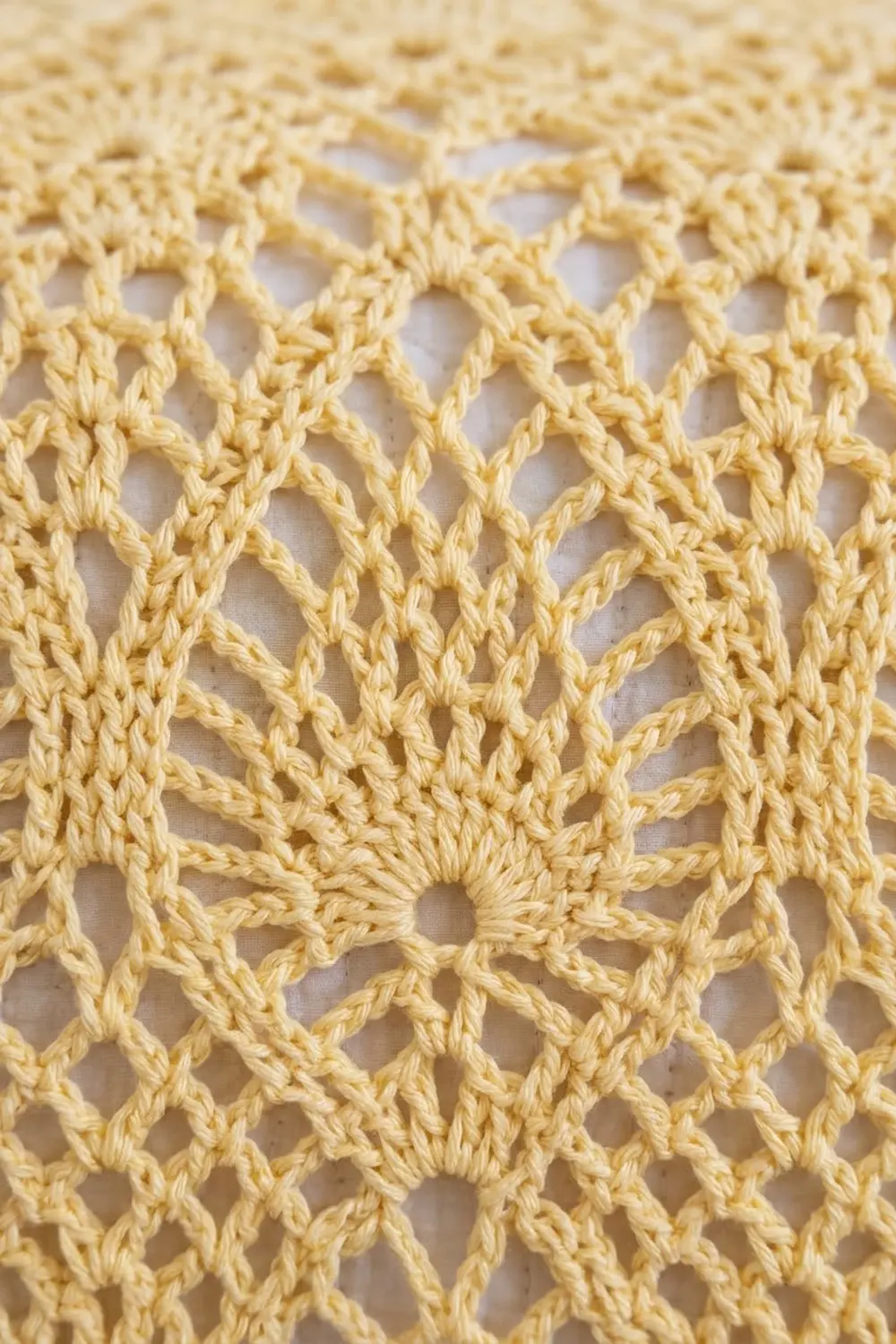
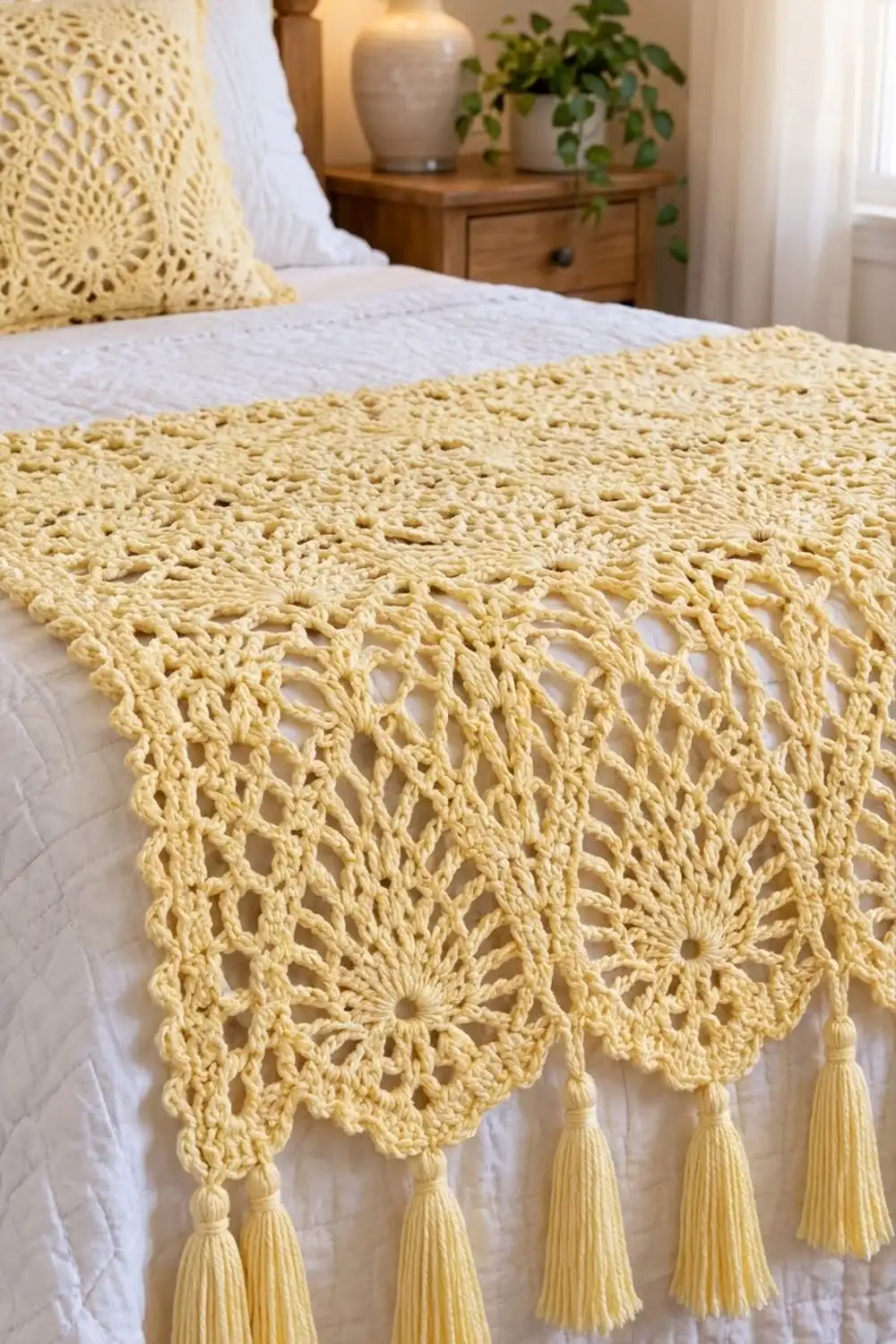
This bed runner is one long lace panel in a soft butter-yellow cotton. A row of 14 classic pineapples runs along its length. Each pineapple rises from a round fan of double crochets, narrows to a point, and sits between open V-stitch columns. Above the pineapples, a calm band of ch-5 mesh leads to a straight top edge.
The bottom edge has 14 rounded scallops, one under each pineapple. A chunky 4 in (10.2 cm) tassel hangs from the lowest point of every scallop. Laid across the foot of a bed with the scallops hanging over the side, it looks vintage and relaxed, and still fresh.
The pattern uses US crochet terms. The finished runner measures about 71.5 in x 18 in (181.6 cm x 45.7 cm), not counting tassels. It is one piece, and nothing needs joining.
You work the body in rows from the bottom edge up, starting with a foundation single crochet row. The pineapples come first, then the mesh band, then a dc row to square the top. A three-round border goes all the way around: plain sc on the top and sides, scallops on the bottom. Tassels go on last.
Finished Size and Construction
- Finished size: about 71.5 in x 18 in (181.6 cm x 45.7 cm), plus 4 in (10.2 cm) tassels
- Skill level: Intermediate
- Terminology: US
- Yarn weight: DK (light worsted, #3) cotton or cotton blend
- Hook: 4.0 mm (US G-6)
- Number of pieces: 1 (single panel)
- Layout: 14 pineapple repeats side by side along the length
- Pineapple repeat width: 24 sts = 5 in (12.7 cm)
- Size before border: about 70 in x 16 in (177.8 cm x 40.6 cm)
- Border depth: 0.75 in (1.9 cm) on the top and sides; 1.25 in (3.2 cm) on the scalloped bottom
Materials
Yarn: Pick a smooth, mercerized or combed DK cotton. It gives crisp stitch definition and a bit of drape, and the pineapples and scallops block flat without stretching too far. Avoid fuzzy or very stretchy yarns, because they blur the lace.
- Butter yellow (only color): 850 g / about 1,955 m total
- Body and border: 800 g / about 1,840 m
- Tassels: 50 g / about 115 m
These amounts include a margin of roughly 10% for your gauge swatch and for differences in tension.
Tools:
- 4.0 mm (US G-6) crochet hook
- Tapestry needle
- Scissors
- Stiff card 4.5 in (11.4 cm) tall, for tassels
- Tape measure
- Rust-proof pins and a blocking surface big enough for 72 in x 18 in (182.9 cm x 45.7 cm), such as foam mats or a bed covered with towels
- Spray bottle
- 14 locking stitch markers (optional, for marking repeats)
Abbreviations (US Terms)
- ch – chain
- sl st – slip stitch
- sc – single crochet
- hdc – half double crochet
- dc – double crochet
- fsc – foundation single crochet
- sk – skip
- sp(s) – space(s)
- st(s) – stitch(es)
- RS / WS – right side / wrong side
- rep – repeat
Special stitches:
- V-st (V): (dc, ch 1, dc) in the stitch or space given.
- Double V (dV): (dc, ch 1, dc, ch 2, dc, ch 1, dc) in the same space. That is two V-sts joined by ch 2.
- Edge V: at the start of a row, sl st across to the ch-1 sp of the edge V, ch 4 (counts as dc and ch 1), dc in the same sp.
Gauge and Checkpoints
Foundation gauge: 24 fsc = 5 in (12.7 cm).
Mesh gauge: 12 rows of ch-5 mesh = 6 in (15.2 cm), so each row is about 0.5 in (1.3 cm).
Test piece first. Make 49 fsc (1 + 2 x 24) and work Rows 1–11 with 2 pineapples. Your swatch should measure 10 in (25.4 cm) wide and 9 in (22.9 cm) tall after a light steam. One repeat is 5 in (12.7 cm). If your swatch matches, the full runner will too.
- Too big: go down a hook size, to 3.75 mm.
- Too small: go up a hook size, to 4.5 mm.
- Width right but pineapples too tall: you are pulling up long loops. Snug the dc stitches; don’t change the hook.
Checkpoints for the full runner:
- Foundation: 70 in (177.8 cm)
- After Row 11 (pineapple tips): 9 in (22.9 cm) tall
- After Row 13: 10 in (25.4 cm) tall
- After Row 25: 16 in (40.6 cm) tall, 70 in (177.8 cm) wide
Body
Foundation (RS): Make 337 fsc. That is 1 + 14 repeats of 24. Turn.
(337 sts)
Placing a marker every 24 sts makes the next rows much easier.
Pineapple Section
Row 1 (RS): Ch 1, sc in first st, ch 5, sk 5, sc in next st; rep from * across. Turn.
(57 sc, 56 ch-5 sps; 4 sps per repeat)*
Row 2 (WS): Ch 4 (counts as dc, ch 1), dc in first sc (edge V made). Ch 3, sc in next ch-5 sp, ch 3, sk next sc and next ch-5 sp, 9 dc in next sc, ch 3, sk next ch-5 sp and next sc, sc in next ch-5 sp, ch 3, V in next sc; rep from * 13 more times. The last V lands in the last sc. Turn.
(15 V: 2 edge V and 13 column V; 14 fans of 9 dc)*
Row 3 (RS): Edge V. Ch 3, sk next 2 ch-3 sps, dc in first dc of fan, [ch 1, dc in next dc] 8 times, ch 3, sk next 2 ch-3 sps, V in ch-1 sp of next V; rep from * across. Turn.
(each fan: 9 dc, 8 ch-1 sps)*
Row 4 (WS): Edge V. Ch 3, sc in first ch-1 sp of fan, [ch 3, sc in next ch-1 sp] 7 times, ch 3, V in next V; rep from * across. Turn.
(each pineapple: 8 sc, 7 ch-3 loops)*
From here, each pineapple works into its own loops only. The ch-3 on each side of a pineapple is always skipped.
Row 5 (RS): Edge V. Ch 3, sc in first pineapple loop, [ch 3, sc in next loop] 6 times, ch 3, dV in next column V; rep from * 12 more times. Ch 3, work the last pineapple, ch 3, V in edge V. Turn.
(each pineapple: 7 sc, 6 loops; 13 dV)*
Row 6 (WS): Edge V. Ch 3, sc in first loop, [ch 3, sc in next loop] 5 times, ch 3, V in first V of column, ch 2, V in second V of column; rep across, ending ch 3, V in edge V. Turn.
(each pineapple: 6 sc, 5 loops)*
Edge note for Rows 7–11: On each row, make the side chain between the edge V and the first or last pineapple a little longer: ch 4 on Row 7, ch 5 on Row 8, and ch 6 on Rows 9, 10 and 11. Without this, the edges pull in. Inner side chains stay ch 3 unless stated.
Row 7: Pineapples: 5 sc, 4 loops. Columns: V, ch 3, V.
Row 8: Pineapples: 4 sc, 3 loops. Columns: V, ch 4, V.
Row 9: Pineapples: 3 sc, 2 loops. Columns: V, ch 5, V.
Row 10: Pineapples: 2 sc, 1 loop. Columns: V, ch 3, sc in ch-5 sp, ch 3, V.
Row 11 (RS, tips): Edge V. *Ch 4, sc in the single pineapple loop, ch 4. Then work the column: V in next V, ch 3, sc in next ch-3 sp, ch 3, sc in next ch-3 sp, ch 3, V in next V; rep across. Use ch 6 instead of ch 4 on the outer side of the first and last pineapple. Turn.
The pineapples are now pointed tips. Checkpoint: 9 in (22.9 cm) tall.
Transition and Mesh Band
Row 12 (WS): Ch 1, sc in edge V sp, ch 5, sc in edge ch-6 sp, ch 5, sc in first tip sc. Ch 5, sc in V sp of next V, ch 5, sc in center ch-3 sp of column, ch 5, sc in V sp of next V, ch 5, sc in next tip sc; rep from * 12 more times. Ch 5, sc in edge ch-6 sp, ch 5, sc in edge V sp. Turn.
(3 + 13 x 4 + 2 = 57 sc, 56 ch-5 sps)*
Row 13 (RS): Ch 3 (counts as dc), 5 dc in next ch-5 sp, dc in next sc; rep from * across. Turn.
(1 + 56 x 6 = 337 dc) Checkpoint:* 10 in (25.4 cm).
Row 14 (WS): Ch 1, sc in first dc, ch 5, sk 5, sc in next dc; rep from * across. Turn.
(57 sc, 56 ch-5 sps)*
Row 15 (RS): Ch 5 (counts as dc, ch 2), sc in first ch-5 sp, ch 5, sc in next ch-5 sp; rep from * 54 more times, ch 2, dc in last sc. Turn.
(56 sc, 55 ch-5 sps, plus 2 half sps)*
Row 16 (WS): Ch 1, sc in first dc, ch 5, sc in next ch-5 sp; rep from * 54 more times, ch 5, sc in 3rd ch of beg ch-5. Turn.
(57 sc, 56 ch-5 sps)*
Rows 17–24: Rep Rows 15–16 four more times.
Row 25 (RS): Ch 3 (counts as dc), 5 dc in next ch-5 sp, dc in next sc; rep from * across. Do not turn and do not fasten off.
(337 dc) Checkpoint:* 70 in x 16 in (177.8 cm x 40.6 cm).
Border
Border gauge: along the side edges (row ends), work 4 sc per inch, which is 4 sc per 2.5 cm. Along the top and bottom edges, work 1 sc in each stitch.
In this border, “sts per side” means the stitches between the corner groups. Corner groups are counted separately.
Rnd 1 (RS): Ch 1. Top edge: 3 sc in first dc (corner), sc in each of next 335 dc, 3 sc in last dc (corner). Side: work 64 sc evenly down the row ends. Bottom edge (back of foundation): 3 sc in first fsc, sc in each of next 335, 3 sc in last fsc. Side: work 64 sc evenly. Join with sl st to the first sc.
(Top 335, bottom 335, sides 64 each, plus 4 corners of 3 = 810 sc)
Rnd 2: Ch 1. Work 3 sc in the center sc of each corner and sc in every sc along the top and both sides. That makes 337 sts on the top and 66 on each side. Along the bottom, between corner centers (337 sts): sc in next st, ch 5, sk 5, sc in next st; rep from * 55 more times. Join.
(Bottom: 57 sc, 56 ch-5 sps; top 337, sides 66 each, 4 corners of 3)*
Rnd 3: Ch 1. On the top and sides, sc in each sc with 3 sc in each corner center. That makes 339 on the top and 68 on each side. Bottom: sc in the sc next to the corner. Then sc in next sc, 3 hdc in next ch-5 sp, sk next sc, 5 dc in next ch-5 sp, (dc, ch 3, dc) in next sc, 5 dc in next ch-5 sp, sk next sc, 3 hdc in next ch-5 sp; rep from * 13 more times. Sc in last sc, then sc in the sc before the corner. Join and fasten off.
(Bottom: 1 + 15 dividing sc + 14 scallops of 18 sts + 1 = 269 sts and 14 ch-3 loops)*
Why the math works: 337 = 1 + 14 x 24, and also 1 + 56 x 6. So every row and border round divides evenly into ch-5 spaces or pineapple repeats. Each scallop uses exactly 4 ch-5 spaces, which is 24 stitches, and centers under one pineapple fan. The sides use 4 sc per inch over 16 in, giving 64 sc, so they lie flat with no ruffling.
Tassels (make 14)
- Wrap yarn 30 times around the 4.5 in (11.4 cm) card.
- Slide a 12 in (30.5 cm) tie strand under the wraps at the top and knot tightly.
- Cut the wraps along the bottom edge.
- About 0.75 in (1.9 cm) below the top, wrap a separate strand 6 times around the bundle, knot it, and bury the ends inside the tassel.
- Trim to 4 in (10.2 cm).
- Thread the tie strands through a ch-3 scallop loop, knot them on the WS, and weave in the ends.
Final Blocking
- Weave in all ends before blocking. Leave the yarn tails long until the runner is dry.
- Soak the runner in cool water with a little wool wash for 15 minutes.
- Press out the water gently. Roll the runner in towels; don’t wring it.
- Lay it flat and pin the top edge straight to 71.5 in (181.6 cm).
- Pin the sides square to 18 in (45.7 cm).
- Pin each scallop at its ch-3 point. Then open each pineapple so its loops sit evenly.
- Let it dry completely. Then fluff the tassels with steam from a few inches away and trim them evenly.
Final Quality-Control Checklist
- 14 pineapples, each with 9 fan dc and a single pointed tip
- 13 V-st columns and 2 edge V columns
- Rows 13 and 25 each have 337 dc
- Border Rnd 1 has 810 sc
- 14 scallops, each with a ch-3 point and a tassel
- Top edge straight; sides 18 in (45.7 cm)
- Width 71.5 in (181.6 cm)
- All tassels 4 in (10.2 cm) and evenly trimmed
- No visible ends on the RS
Troubleshooting
- Pineapples lean to one side: check that you skip the side ch-3 sps each row and work only into the pineapple loops.
- Edges curve inward: lengthen the edge side chains on Rows 7–11 as noted.
- Row 12 count is off: recount column spaces. You need one sc in each V sp and one in the center ch-3 of each column.
- Top edge ruffles: your mesh rows may be loose. Use ch 4 instead of ch 5, but keep the same stitch counts.
- Scallops cup: block more firmly, or change the 5 dc to 4 dc in each scallop.
- Tassels look thin: add 5–10 more wraps.
Care
Hand wash in cool water and dry flat, reshaping the scallops while the runner is damp. Smooth the tassels with your fingers, or give them a light steam.
Final Notes
The measurement chain is simple. 24 fsc measure 5 in (12.7 cm), so 14 repeats make a 70 in (177.8 cm) foundation. The pineapples reach 9 in (22.9 cm), and the mesh band brings the body to 16 in (40.6 cm). The border adds 0.75 in (1.9 cm) to the top and sides and 1.25 in (3.2 cm) to the scalloped bottom, for a finished 71.5 in x 18 in (181.6 cm x 45.7 cm). Check your swatch and the counts at each checkpoint, and the runner will come out square and even.
Happy crocheting!