

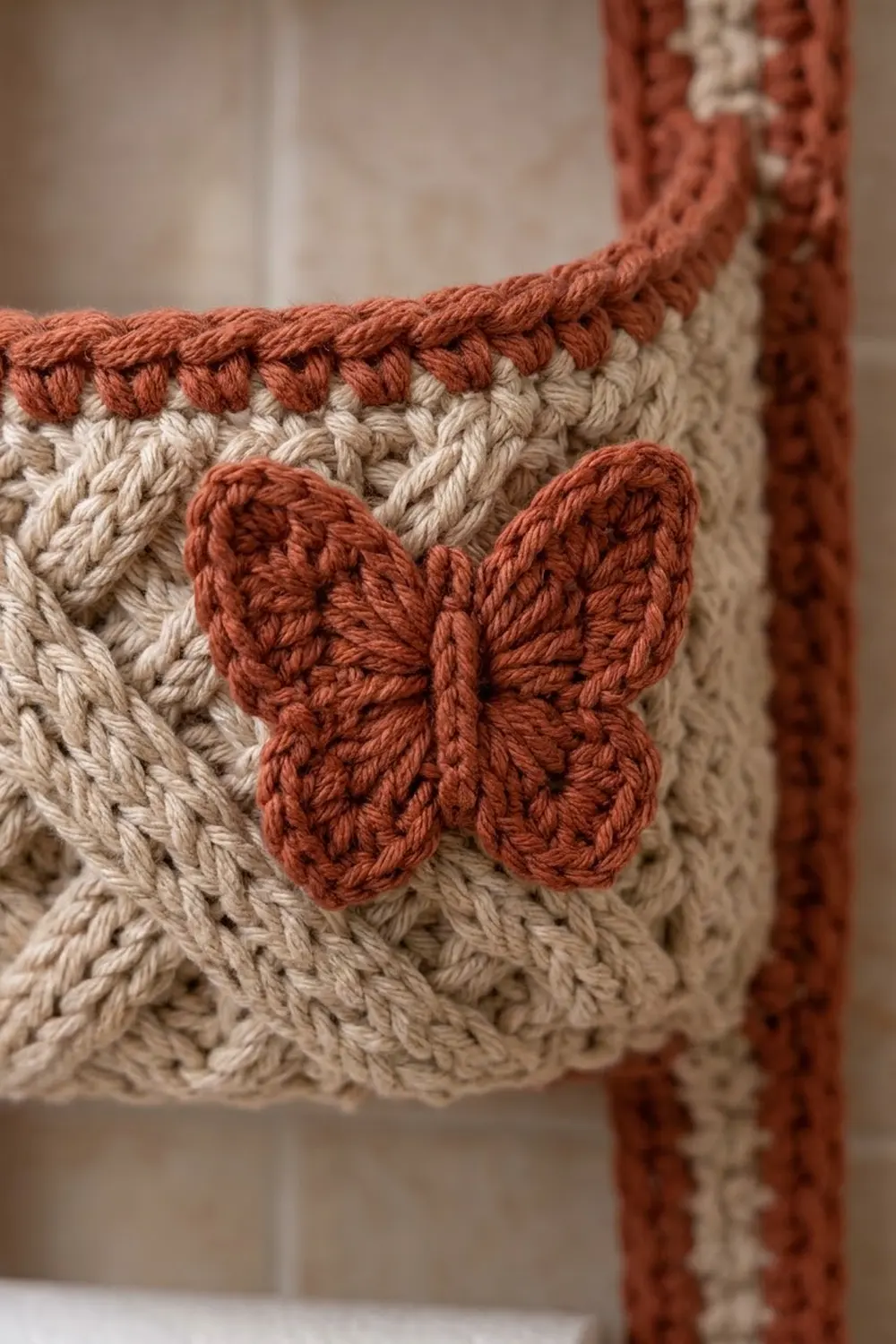
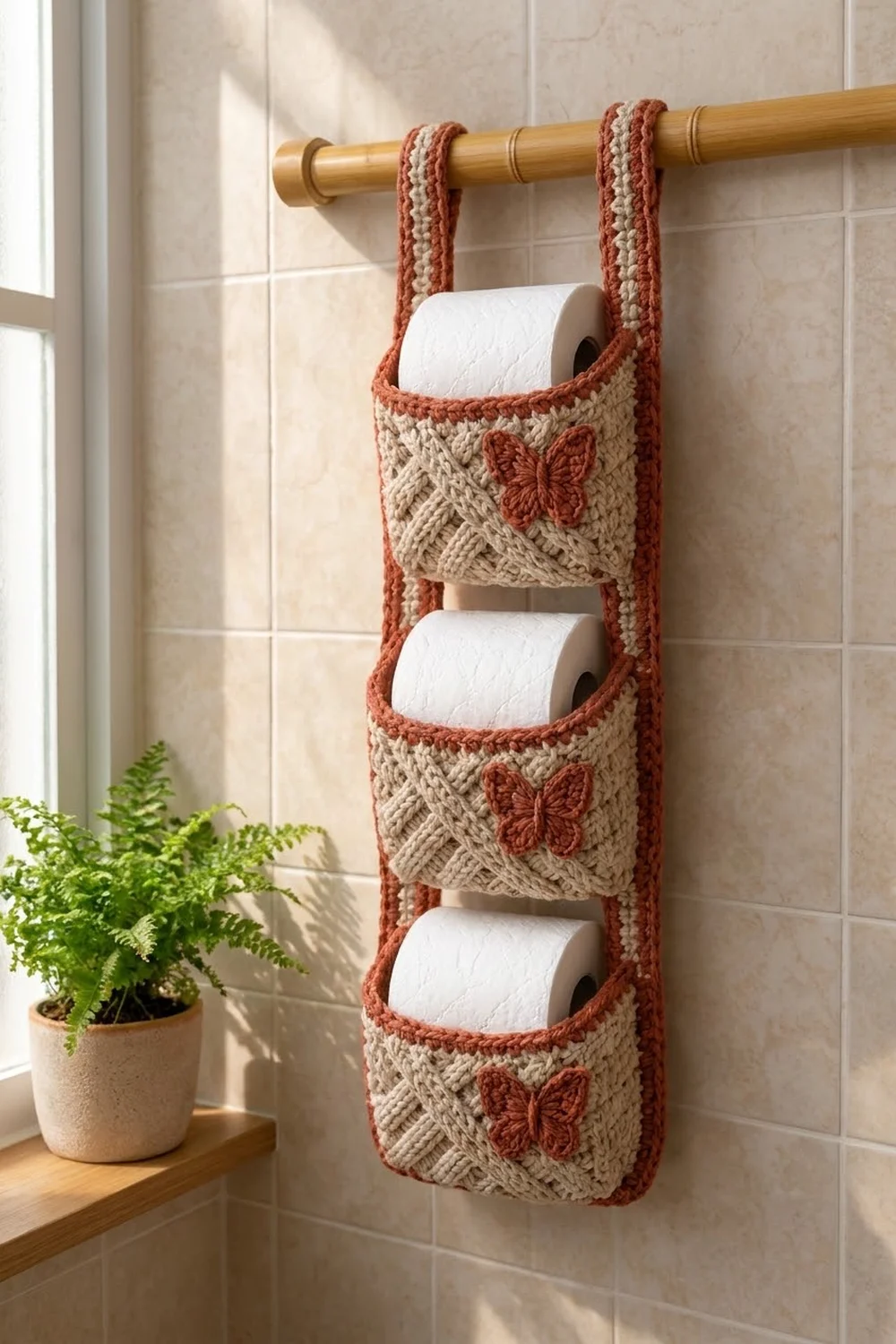
This hanging holder stores three spare rolls in a neat vertical column. Each pocket has a raised lattice texture in warm oatmeal, a rust base and rope-edged rim, and a small rust butterfly on the front.
The look is calm and a little rustic, so it suits a bathroom with natural wood, plants and soft neutral tiles. Every piece uses the same two colors: oatmeal for the textured walls and strap centers, and rust for all trims and the butterflies.
The pattern uses US crochet terms. The finished holder hangs about 22 in (55.9 cm) from the rod to the bottom edge and is 5.5 in (14.0 cm) wide. Each pocket measures 5.5 in (14.0 cm) wide, 4 in (10.2 cm) deep and 4.25 in (10.8 cm) tall.
Construction is simple. You crochet a flat rust base for each pocket, then work the walls upward in joined rounds. Next you make three butterflies and two straps. You sew on the butterflies, sew the pockets to the straps, and finish each pocket with a rust rim and front-corner trims.
Finished Size and Construction
- Finished size: 5.5 in (14.0 cm) wide × about 22 in (55.9 cm) long, hanging
- Skill level: Intermediate (front-post cables, working in rounds, sewing)
- Terminology: US
- Yarn weight: Medium / worsted (#4), cotton or cotton blend
- Hook: 5.0 mm (H-8)
- Number of pieces: 8 (3 pockets, 2 straps, 3 butterflies)
- Layout: 1 column of 3 pockets, 1.25 in (3.2 cm) apart
- Pocket size: 5.5 in × 4 in × 4.25 in (14.0 cm × 10.2 cm × 10.8 cm)
- Pocket height before rim: 3.75 in (9.5 cm)
- Rim (border) depth: 0.5 in (1.3 cm)
Materials
Choose a smooth worsted cotton or cotton blend. Cotton holds the box shape, shows the cables clearly and copes with bathroom humidity. Avoid fuzzy yarns, which blur the lattice.
- Oatmeal/beige: 150 g (about 285 m)
- Rust/terracotta: 120 g (about 228 m)
These quantities include a margin for swatching and sewing.
Tools:
- 5.0 mm (H-8) crochet hook
- Tapestry needle
- 8 locking stitch markers
- Scissors
- Tape measure
- Rustproof pins and a blocking mat or towel
- A roll of toilet paper for test-fitting
Abbreviations (US Terms)
- ch – chain
- sl st – slip stitch
- sc – single crochet
- hdc – half double crochet
- dc – double crochet
- tr – treble crochet
- BLO – back loop only
- FPtr – front post treble: yo twice, insert hook from front to back to front around the post of the indicated stitch, complete as a tr
- rev sc – reverse single crochet (crab stitch): sc worked from left to right
- st(s) – stitch(es); sp – space; rnd – round
Special stitches:
- Front Cross (FC): skip 2 sts, FPtr around each of next 2 sts, then working in front of the sts just made, FPtr around each of the 2 skipped sts. Uses 4 sts, makes 4 sts.
- Back Cross (BC): skip 2 sts, FPtr around each of next 2 sts, then working behind the sts just made, FPtr around each of the 2 skipped sts. Uses 4 sts, makes 4 sts.
The interwoven diagonal lattice comes from alternating FC and BC rounds, with the BC rounds shifted 2 sts over.
Gauge and Checkpoints
- sc gauge: 16 sts × 18 rows = 4 in (10.2 cm)
- Lattice gauge: 16 sts × 10 rnds = 4 in (10.2 cm)
Make one complete pocket before starting the others. It works as your real swatch.
Checkpoints:
- Base after Row 18: 5.5 in × 4 in (14.0 cm × 10.2 cm).
- Base edging round: 76 sts, perimeter 19 in (48.3 cm).
- Walls after Rnd 10: 3.75 in (9.5 cm) tall.
- After rim: 4.25 in (10.8 cm) tall.
- Strap before edging: 26 in (66.0 cm) long.
If the base is too big, go down 0.5 mm. If it is too small, go up 0.5 mm. Fix the base first. The walls keep the base’s stitch count, so a correct base usually gives correct walls. If only the walls come out too tall, work the hdc rounds a little tighter instead of changing hooks.
Pocket Base (Make 3)
With rust, ch 23.
Row 1: Sc in 2nd ch from hook and in each ch across, turn. (22 sts)
Rows 2–18: Ch 1, sc in each st across, turn. (22 sts)
Checkpoint: 5.5 in × 4 in (14.0 cm × 10.2 cm).
Edging Rnd: Ch 1, do not turn. Sc in each st of Row 18 (22 sc). Working down the side, skip the end of Row 18, sc in the end of each of Rows 17–2 (16 sc), skip the end of Row 1. Working into the opposite side of the foundation ch, sc in each ch (22 sc). Skip the end of Row 1, sc in the end of each of Rows 2–17 (16 sc). Sl st to first sc.
Count: 22 + 16 + 22 + 16 = 76 sts. The 22 sts along Row 18 form the back and the foundation side forms the front. Place markers in st 39 and st 60; these are the two front corners.
Why skip the end rows? The first and last st of each long side already sit at those corners. Skipping them keeps each short side at 16 sts for 4 in (10.2 cm), which matches the sc gauge.
Pocket Walls
Work the walls in joined rounds with the outside facing you. Do not turn. The beginning ch never counts as a stitch. Join every round with a sl st to the first st.
Rnd 1: Fasten off rust. Join oatmeal in BLO of first sc. Ch 1, sc BLO in each st around. (76 sts)
Working through the back loop leaves the rust front loops as a crisp outline along the base and turns the wall upward.
Rnd 2: Ch 2, hdc in each st around. (76 sts)
Rnd 3 (FC round): Ch 2, work FC 19 times around, with all post sts worked around the hdc of Rnd 2. (76 sts)
Rnd 4: Ch 2, hdc in each st around. (76 sts)
Rnd 5 (BC round): Ch 2, FPtr around each of next 2 sts, work BC 18 times, FPtr around each of last 2 sts. (2 + 72 + 2 = 76 sts)
The 2-st offset makes each crossed pair travel diagonally into the next cross. The small break in the pattern falls at the back left corner, where the strap covers it.
Rnd 6: Ch 2, hdc in each st around. (76 sts)
Rnd 7: Repeat Rnd 3. (76 sts)
Rnd 8: Ch 2, hdc in each st around. (76 sts)
Rnd 9: Repeat Rnd 5. (76 sts)
Rnd 10: Ch 2, hdc in each st around. (76 sts) Fasten off.
Checkpoint: the walls stand 3.75 in (9.5 cm) above the base. Push the sides into a box shape. The pocket should be 5.5 in (14.0 cm) wide and 4 in (10.2 cm) deep.
Butterfly (Make 3)
With rust, make a magic ring.
Rnd 1: Into the ring work: [ch 3, 3 tr, ch 3, sl st] for upper wing, [ch 2, 3 dc, ch 2, sl st] for lower wing, [ch 2, 3 dc, ch 2, sl st] for second lower wing, [ch 3, 3 tr, ch 3, sl st] for second upper wing. Pull the ring tight. (4 wings)
Rnd 2: Sl st into the first ch-3 sp.
- Upper wing: 3 sc in ch-3 sp, 2 sc in each of 3 tr, 3 sc in next ch-3 sp. (12 sc)
- Sl st in the sl st between wings.
- Each lower wing: 2 sc in ch-2 sp, 2 sc in each of 3 dc, 2 sc in next ch-2 sp. (10 sc each)
- Sl st between wings.
- Second upper wing: as first upper wing. (12 sc)
Sl st to first sc. Total: 12 + 10 + 10 + 12 = 44 sc. Fasten off, leaving a 24 in (61.0 cm) tail.
Body: Wrap the tail firmly around the center 8 times, front to back, to make a raised body. Keep the rest of the tail for sewing.
Checkpoint: wingspan 2.5 in (6.4 cm), height 1.75 in (4.4 cm).
Strap (Make 2)
With oatmeal, ch 105.
Row 1: Sc in 2nd ch from hook and in each ch across, turn. (104 sts)
Rows 2–4: Ch 1, sc in each st across, turn. (104 sts) Fasten off.
Checkpoint: 26 in (66.0 cm) long, about 0.9 in (2.3 cm) wide.
Edging Rnd: Join rust in the first st of Row 4. Ch 1, 3 sc in first st, sc in next 102 sts, 3 sc in last st. Sc in the end of each of the 4 rows (4 sc). Working into the foundation ch, 3 sc in first ch, sc in next 102 ch, 3 sc in last ch. Sc in the end of each of the 4 rows (4 sc). Sl st to first sc. Fasten off.
Count: each long side is 3 + 102 + 3 = 108 sts, including its corner groups. Each short end is 4 sts between the corner groups. Total: 108 + 4 + 108 + 4 = 224 sts. The strap now measures about 1.3 in (3.3 cm) wide.
Make All Pieces
- Rust: 3 bases, 3 butterflies, 2 strap edgings, plus all rims and trims
- Oatmeal: 3 sets of walls, 2 strap centers
Sew one butterfly to the front of each pocket before joining. Center it between the front-corner markers: horizontally between st 49 and st 50, and vertically over Rnds 4–8. Use small backstitches just inside the sc outline, plus a few stitches through the body.
Layout (front view):
 [rod loop]                [rod loop]
  |Strap|                    |Strap|
  |Strap| [ Pocket 3 + bfly ]|Strap|
  |Strap|   gap 1.25 in      |Strap|
  |Strap| [ Pocket 2 + bfly ]|Strap|
  |Strap|   gap 1.25 in      |Strap|
  |Strap| [ Pocket 1 + bfly ]|Strap|
  |end  |   0.5 in below     |end  |
The straps run down the back wall of each pocket, flush with its back corners.
Joining
Lay both straps flat, wrong side up, parallel and 2.9 in (7.4 cm) apart. Measure up from the bottom end of the straps:
- Pocket 1 base: 0.5 in (1.3 cm)
- Pocket 2 base: 6 in (15.2 cm)
- Pocket 3 base: 11.5 in (29.2 cm)
Place each pocket with its back wall against the straps, so each strap’s outer edge lines up with a back corner. Pin.
Method: With rust and a tapestry needle, whipstitch both long edges of each strap to the back wall from Rnd 1 through Rnd 10.
Stitch logic: The strap edge has 4 sts per inch and the wall has 2.5 rounds per inch. Over the 3.75 in (9.5 cm) wall, that is 15 strap sts to 10 wall rounds. Sew 3 strap sts to every 2 wall rounds.
Tension: Pull each stitch just snug. Seams that are too tight pucker the strap, and seams that are too loose let a full pocket sag forward.
Rod loop: Fold the top 4 in (10.2 cm) of each strap to the back around your rod. Sew down only the last 1 in (2.5 cm) of the end. This loop fits rods up to 1.5 in (3.8 cm) across. If your rod is fixed to the wall, sew the loop closed around it.
Checkpoint: The distance from the fold to the bottom of the strap is about 22 in (55.9 cm). Once the rims are added, the top of Pocket 3 sits 15.75 in (40.0 cm) above the strap end.
Border
Each pocket gets a rust rim and front-corner trims. Work the rim after joining so the strap seams end neatly beneath it. Keep the straps folded out of the way.
Border gauge: 2 rounds = 0.5 in (1.3 cm).
Rnd 11: Join rust in the first st of Rnd 10, at the back left corner. Ch 1, sc in each st around. Sl st to first sc. (76 sts: back 22, side 16, front 22, side 16)
Rnd 12: Ch 1, rev sc in each st around. Sl st to first st. (76 sts: back 22, side 16, front 22, side 16) Fasten off.
Why the math works: The rim is worked 1 st per st, with no increases or decreases. Each side keeps the same count as the base edging, so the opening stays 5.5 in × 4 in (14.0 cm × 10.2 cm) and the walls stay straight. The rev sc makes the chunky, rope-like edge.
Front-corner trims: With the rust yarn held behind the work, surface sl st up the st column at each marker (st 39 and st 60) from Rnd 1 to Rnd 10. Work 1 sl st per round, for 10 sl sts per corner. Fasten off and weave in. With these trims, the front panel is framed in rust on all four sides.
Final Blocking
- Weave in all ends along stitches of the same color.
- Lightly mist the whole holder with water.
- Stuff each pocket with a roll or a folded towel to set the box shape.
- Lay it flat with the straps straight and the pockets squared.
- Pin the straps straight and the rims level.
- Shape each butterfly flat with your fingers, lifting the body slightly.
- Let it dry completely, then remove the pins and stuffing.
Final Quality-Control Checklist
- Each base has 76 edging sts and measures 5.5 in × 4 in (14.0 cm × 10.2 cm).
- Every wall round has 76 sts.
- The lattice crosses alternate front and back on Rnds 3, 5, 7 and 9.
- Each pocket stands 4.25 in (10.8 cm) tall with its rim.
- Each strap edging has 224 sts and each strap is 26 in (66.0 cm) long.
- Each butterfly has 44 sc and is centered on the front.
- Pockets are spaced 1.25 in (3.2 cm) apart.
- Both rod loops are secure and the same size.
Troubleshooting
The walls flare out. Your hdc rounds are too loose. Go down 0.5 mm for the hdc rounds only.
The walls pull in. The FPtr sts are too tight. Pull up the first loop of each FPtr a little taller.
The lattice looks like plain ribbing. Check that Rnd 5 and Rnd 9 each begin with 2 plain FPtr; these create the offset.
The pockets tip forward. Add a second line of whipstitches across the strap at Rnd 1, just above the base.
The butterfly curls. Steam it lightly and sew around the whole outline, not just the body.
The straps twist. Block them flat again, pinning every 2 in (5.1 cm).
Care
Hand wash in cool water with mild soap and dry flat in shape. Take out the rolls before washing and reshape the pockets while damp.
Final Notes
Every measurement follows from the one before it. A 22-st base at 16 sts per 4 in (10.2 cm) gives 5.5 in (14.0 cm). The 76-st edging carries straight up through ten wall rounds to 3.75 in (9.5 cm). The 2-round rim brings each pocket to 4.25 in (10.8 cm). Three pockets with 1.25 in (3.2 cm) gaps on 26 in (66.0 cm) straps give a hanger of about 22 in (55.9 cm). Check each measurement as you go, and the finished holder will hang straight and hold your rolls neatly.
Happy crocheting!