

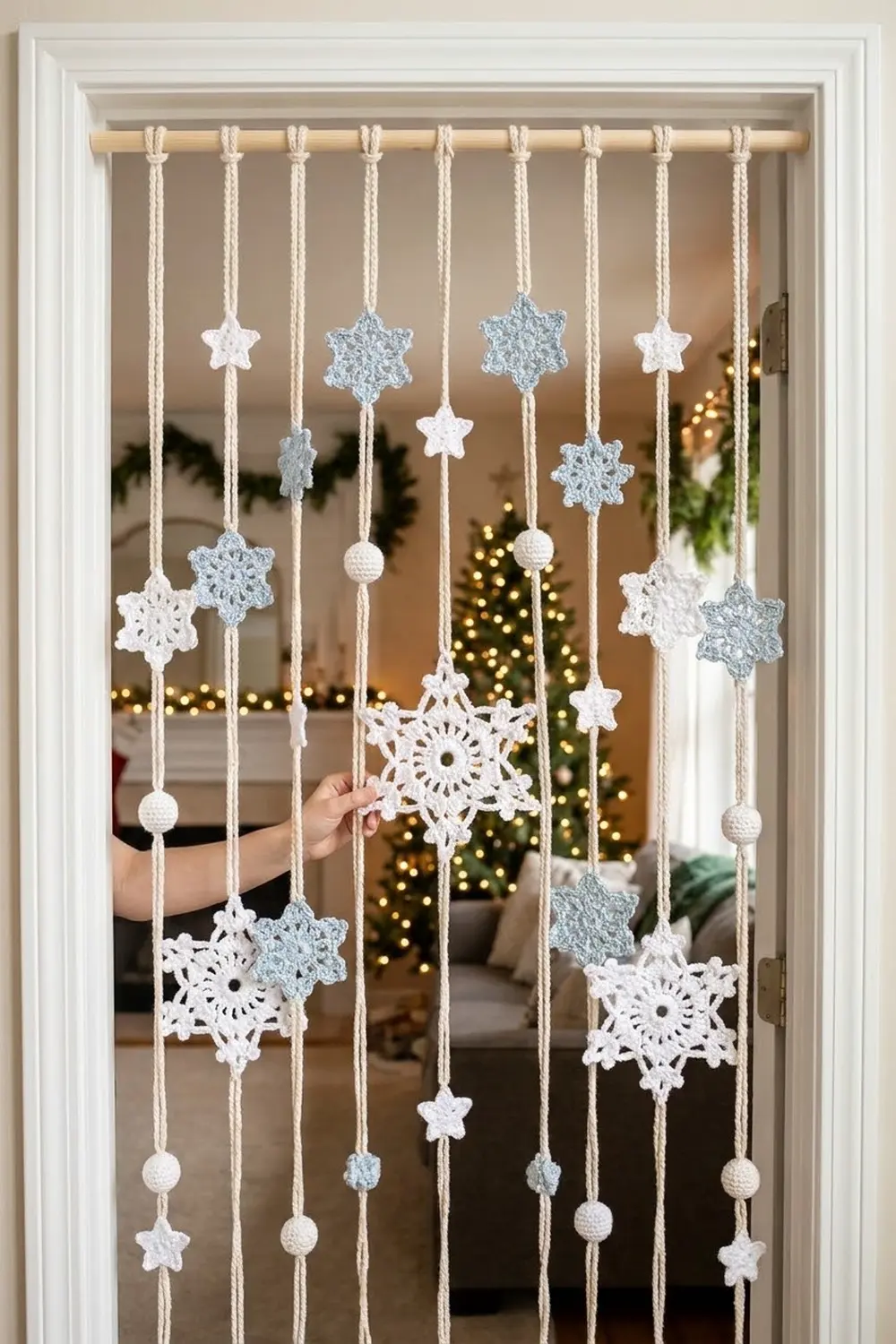
This snowflake door curtain turns an ordinary doorway into a soft, wintry entrance. Eight crochet cords hang from a wooden dowel, each one dotted with lacy snowflakes, tiny stars and round white balls. The colors are kept simple, crisp white and pale powder blue, so it suits both Scandinavian and cozy farmhouse holiday decor.
Each motif is small and quick, which makes this a great project to pick up in short sessions. You’ll make three motif sizes: a large white snowflake, a medium snowflake in white or blue, and a tiny five-pointed star. Small stuffed balls fill the spaces between them.
The pattern uses US crochet terms. The finished curtain hangs 72 in (182.9 cm) below the dowel, and the outer strands sit 28 in (71.1 cm) apart on a 36 in (91.4 cm) dowel.
For construction, you crochet every motif and ball first, then make eight slip-stitch cords. Next you sew the motifs and balls onto the cords at measured chain counts. Last, you tie each cord to the dowel.
Finished Size and Construction
- Finished size: 36 in (91.4 cm) wide at the dowel × 72 in (182.9 cm) drop
- Skill level: Easy-intermediate
- Terminology: US crochet terms
- Yarn weight: DK (#3), cotton or cotton blend
- Hook: 4.0 mm (G-6)
- Number of pieces: 8 cords, 3 large snowflakes, 20 medium snowflakes, 25 mini stars and 48 balls (104 pieces in total)
- Layout: 8 strands × 6 motif slots
- Piece sizes: Large 6 in (15.2 cm), medium 4 in (10.2 cm), mini 1.75 in (4.4 cm), ball 1 in (2.5 cm)
- Size before border: 28 in (71.1 cm) across the strands × 72 in (182.9 cm)
- Border depth: No stitched border. The dowel ties add about 0.5 in (1.3 cm) above each cord.
Materials
Use a smooth, tightly plied DK cotton or cotton blend. It gives crisp stitch definition and keeps the points sharp after blocking. Avoid fuzzy yarns, because they blur the picot loops. The amounts below assume about 2.2 m per gram.
- White: 200 g / 440 m (for the cords, large and medium white snowflakes, mini stars and balls)
- Pale blue: 40 g / 88 m (for the medium blue snowflakes; one 50 g ball is enough)
The quantities include a margin of about 15% for gauge differences and swatching.
Tools:
– 4.0 mm (G-6) crochet hook
– Wooden dowel, 36 in (91.4 cm) long and about 0.75 in (1.9 cm) thick
– Tapestry needle
– Small amount of fiberfill or white yarn scraps for the balls
– Stitch markers
– Tape measure
– Blocking mats, rustproof pins and spray starch (optional)
– 2 cup hooks or curtain brackets for mounting
Abbreviations (US Terms)
- ch – chain
- sl st – slip stitch
- sc – single crochet
- hdc – half double crochet
- dc – double crochet
- sc2tog – single crochet 2 together
- sp – space
- st(s) – stitch(es)
- rep – repeat
Special stitch: back-bump slip stitch. Turn the chain over and insert the hook under the single bump on its back. Yarn over and pull through both the bump and the loop on the hook. This makes a firm, round cord that won’t stretch much.
Gauge and Checkpoints
Make one large snowflake and one cord sample before anything else.
- Cord gauge: 18 back-bump slip stitches = 4 in (10.2 cm), lightly stretched
- Large snowflake: Rnd 1 = 1.25 in (3.2 cm), Rnd 2 = 2 in (5.1 cm), Rnd 3 = 3.5 in (8.9 cm), Rnd 4 = 4.75 in (12.1 cm), Rnd 5 = 6 in (15.2 cm) point to point after blocking
- Medium snowflake: Rnd 2 = 1.5 in (3.8 cm), Rnd 3 = 3 in (7.6 cm), Rnd 4 = 4 in (10.2 cm)
- Mini star: Rnd 1 = 0.75 in (1.9 cm), Rnd 2 = 1.75 in (4.4 cm)
- Ball: 1 in (2.5 cm) across
If your large snowflake is bigger than 6.25 in (15.9 cm), go down to a 3.75 mm hook. If it’s smaller than 5.75 in (14.6 cm), go up to a 4.5 mm hook. For the cord, it’s the length that matters, so check the chain count against a tape measure before you sew anything on.
Large Snowflake (make 3, white)
Rnd 1: Make a magic ring. Ch 3 (counts as dc), 17 dc in the ring, then sl st to the top of the ch-3. Pull the ring closed. (18 dc)
Rnd 2: Ch 3 (counts as dc), dc in next 2 sts, ch 3. Dc in next 3 sts, ch 3. Rep from * 4 more times, then sl st to the top of the ch-3. (18 dc in 6 groups of 3; 6 ch-3 sps)
Rnd 3: Sl st in next 2 dc and into the ch-3 sp. Ch 3 (counts as dc), then work (2 dc, ch 3, 3 dc) in the same sp. Ch 2, sc in the center dc of the next 3-dc group, ch 2. Work (3 dc, ch 3, 3 dc) in the next ch-3 sp, ch 2, sc in the center dc of the next group, ch 2. Rep from * 4 more times, then sl st to the top of the ch-3. (36 dc, 6 sc, 6 ch-3 tip sps, 12 ch-2 sps)
Rnd 4 (points): Sl st in next 2 dc and into the ch-3 tip sp. Ch 1. Work (sc, ch 3, sc, ch 5, sc, ch 3, sc) in the tip sp. Ch 3, skip the next 3 dc and the ch-2 sp, sc in the next sc. Ch 3, skip the next ch-2 sp and 3 dc. Rep from * 5 more times, then sl st to the first sc. (30 sc; 12 tip ch-3 loops; 6 ch-5 loops; 12 valley ch-3 loops)
Rnd 5 (picot clusters): Sl st into the first tip ch-3 loop. Ch 1. Work (sc, ch 3, sc) in this ch-3 loop. Work (sc, ch 3, sc, ch 5, sc, ch 3, sc) in the ch-5 loop. Work (sc, ch 3, sc) in the next tip ch-3 loop. Ch 2, skip the valley ch-3 loop, sc in the valley sc, ch 2, skip the next valley ch-3 loop. Rep from * 5 more times, then sl st to the first sc. Fasten off. (54 sc; 30 picot loops [24 ch-3 + 6 ch-5]; 12 ch-2 sps)
Each point now ends in five small loops, which gives the snowflake its frosted cluster tips.
Medium Snowflake (make 9 white, 11 pale blue)
Rnd 1: Make a magic ring. Ch 3 (counts as dc), 11 dc in the ring, then sl st to the top of the ch-3. (12 dc)
Rnd 2: Ch 3 (counts as dc), dc in next st, ch 3. Dc in next 2 sts, ch 3. Rep from * 4 more times, then sl st to the top of the ch-3. (12 dc in 6 pairs; 6 ch-3 sps)
Rnd 3 (points): Sl st in the next dc and into the ch-3 sp. Ch 1. Work (sc, ch 3, sc, ch 5, sc, ch 3, sc) in the sp. Ch 3, sc in the space between the 2 dc of the next pair, ch 3. Rep from * 5 more times, then sl st to the first sc. (30 sc; 12 tip ch-3 loops; 6 ch-5 loops; 12 valley ch-3 loops)
Rnd 4: Work as Large Snowflake Rnd 5. Fasten off. (54 sc; 30 picot loops; 12 ch-2 sps)
Mini Star (make 25, white)
Rnd 1: Make a magic ring. Ch 1, 10 sc in the ring, then sl st to the first sc. (10 sc)
Rnd 2: Ch 5, sl st in 2nd ch from hook, sc in next ch, hdc in next ch, dc in next ch, skip next sc, sl st in next sc. Rep from * 4 more times. The last sl st lands in the joining st. Fasten off. (5 points, 4 sts each)
Ball (make 48, white)
Rnd 1: Magic ring, 6 sc in the ring. (6 sc)
Rnd 2: 2 sc in each st around. (12 sc)
Rnds 3–4: Sc in each st around. (12 sc)
Stuff the ball firmly with fiberfill or scraps.
Rnd 5: Sc2tog 6 times. (6 sc)
Fasten off and leave a 10 in (25.4 cm) tail. Weave it through the last 6 sts, pull it closed, and keep the tail for sewing.
Cords (make 8, white)
Leave a 10 in (25.4 cm) starting tail. Ch 325. Starting in the 2nd ch from the hook, work a back-bump sl st in each ch across. (324 sl sts)
Fasten off with a 10 in (25.4 cm) tail. At 18 sts per 4 in (10.2 cm), 324 sts = 72 in (182.9 cm).
Checkpoint: Hang the cord and let it settle for an hour, then measure it. It should be 72 in (182.9 cm), give or take 1 in (2.5 cm). If it’s off by more than that, add or remove chains in groups of 9. Each 9 sts = 2 in (5.1 cm).
Make All Pieces
Here’s the total per color:
- White: 8 cords, 3 large, 9 medium, 25 mini stars, 48 balls
- Pale blue: 11 medium
Layout grid (L = large white, MW = medium white, MB = medium blue, S = mini star). Columns are strands 1–8 from left to right. Rows are motif slots from top to bottom:
        1   2   3   4   5   6   7   8
Row 1:  S   MB  S   L   S   MB  S   S
Row 2:  MW  S   MB  S   MW  S   MW  S
Row 3:  S   MW  S   MB  S   L   S   MB
Row 4:  MB  S   L   S   MB  S   MW  S
Row 5:  S   MB  S   MW  S   MB  S   MW
Row 6:  MW  S   MW  S   MB  S   S   MB
To check the grid, count the letters: there are 3 L, 9 MW, 11 MB and 25 S, which makes 48 slots (8 strands × 6 rows). In every row, the medium and large motifs sit next to mini stars, never next to each other. That way the 4 in (10.2 cm) strand spacing never makes neighboring motifs overlap.
Joining
Method: Whipstitch each motif onto its cord with the yarn tail or a separate 12 in (30.5 cm) length of matching yarn. The cord runs vertically behind the motif and passes straight through the center.
Stitch-to-stitch logic: Count sl sts down from the top of each cord, and mark each position before you sew:
- Motif centers: sts 27, 81, 135, 189, 243 and 297. These fall at 6, 18, 30, 42, 54 and 66 in (15.2, 45.7, 76.2, 106.7, 137.2 and 167.6 cm) from the top.
- Ball centers: sts 54, 108, 162, 216, 270 and 324. These fall at 12, 24, 36, 48, 60 and 72 in (30.5, 61.0, 76.2+15.2 = 91.4, 121.9, 152.4 and 182.9 cm). The last ball caps the cord’s end.
Motifs are 12 in (30.5 cm), or 54 sts, apart. Each ball sits exactly halfway between two motifs.
Attaching a motif: Line up one point straight up and the opposite point straight down along the cord. Make 3 small stitches through the center ring and the cord. Then tack the top and bottom points to the cord with 2 stitches each. On mini stars, tack the center plus one point.
Attaching a ball: Sew through the ball’s center and the cord, passing back and forth 3 times so the ball sits centered over the cord.
Tension: Keep your stitches snug but don’t pull the cord into puckers. After sewing, the cord should still hang straight and measure 72 in (182.9 cm).
Size checkpoint: Lay all 8 finished strands side by side. Every Row 1 motif should sit 6 in (15.2 cm) below the top, and every bottom ball should sit at 72 in (182.9 cm).
Border: Top Finish on the Dowel
This curtain has no stitched border. The dowel ties do the job of a border by setting the width and squaring the top edge.
Border gauge (strand spacing): 4 in (10.2 cm) between strands.
- Top side: 8 ties, one per strand
- Left and right sides: 1 strand each, carrying 6 motifs and 6 balls, with no extra edging
- Bottom: 8 balls, one per strand
The math: 8 strands make 7 gaps. 7 × 4 in = 28 in (71.1 cm) between the outer strands. On a 36 in (91.4 cm) dowel, that leaves (36 − 28) ÷ 2 = 4 in (10.2 cm) of dowel past each outer strand for the brackets.
Tying: Mark the dowel at 4 in (10.2 cm) from one end, and then every 4 in (10.2 cm). Wrap the top tail of each cord twice around the dowel at its mark. Tie it to the cord with a square knot so the first sl st sits just under the dowel, then weave the tail down into the cord.
Final Blocking
- Wet-block all the snowflakes and stars before sewing. Soak them in cool water and press out the excess in a towel.
- Pin each snowflake to a 6 in (15.2 cm) or 4 in (10.2 cm) circle drawn on the mat. Put a pin in every ch-5 loop and open the picot clusters.
- Pin each mini star’s 5 points evenly to a 1.75 in (4.4 cm) circle.
- Mist everything with spray starch for crisp points, and let it dry completely.
- Steam the cords lightly while they hang with a small weight, so they straighten without stretching.
- Once everything is assembled, hang the curtain and steam out any twists.
Final Quality-Control Checklist
- 3 large, 20 medium (9 white, 11 blue), 25 mini stars, 48 balls and 8 cords are finished
- Every large snowflake is 6 in (15.2 cm) and every medium is 4 in (10.2 cm)
- Every cord has 324 sts and measures 72 in (182.9 cm)
- The motif colors match the layout grid
- All motifs are centered on the cord with points vertical
- The strands are 4 in (10.2 cm) apart, with 4 in (10.2 cm) of dowel at each end
- All tails are woven in and the knots are secure
Troubleshooting
- Snowflake cups or ruffles: Your Rnd 3 tension is too tight or too loose. Re-block it, or go up or down 0.25 mm and redo the round.
- Points look uneven: Check that each tip has exactly 4 sc in Rnd 4 (large) or Rnd 3 (medium).
- Cord stretches over time: Work tighter back-bump sl sts, or knot through the bottom ball to secure it.
- Motifs spin around: Add the top and bottom point tacks. A center stitch alone lets the motif rotate.
- Strands twist: Steam them while they hang, and check that every cord is the same length.
Care
Spot clean or hand wash in cool water, then lay flat to dry and re-starch if needed. Store the curtain rolled around its dowel in a cloth bag.
Final Notes
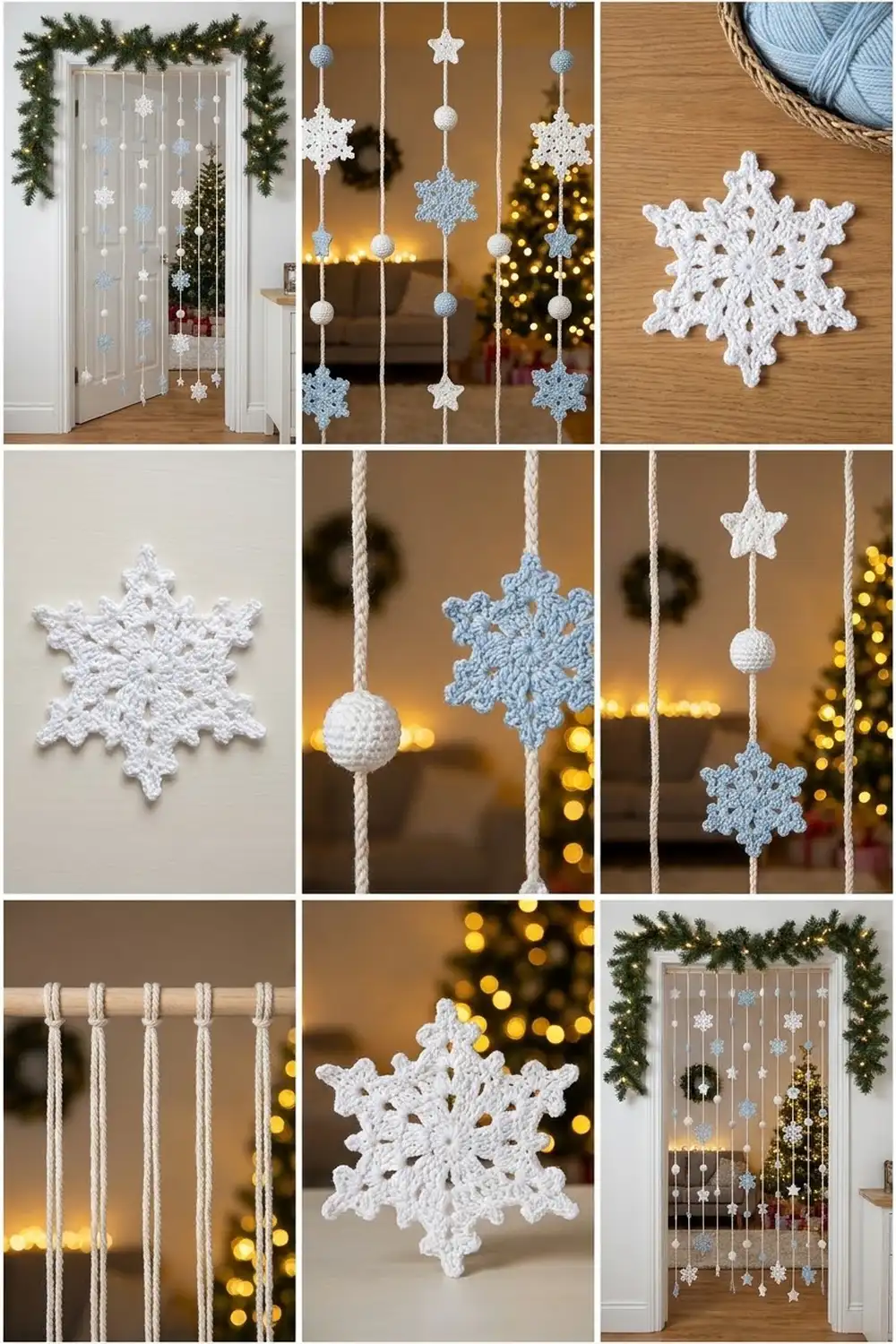
The measurement chain is simple. A cord gauge of 18 sts = 4 in (10.2 cm) gives a 324-st cord of 72 in (182.9 cm). Motifs go every 54 sts, which is 12 in (30.5 cm), starting at st 27, with a ball halfway between each pair. Eight strands at 4 in (10.2 cm) spacing cover 28 in (71.1 cm), centered on a 36 in (91.4 cm) dowel. If you check each of these numbers as you go, the curtain will hang straight and evenly frosted from top to bottom.
Happy crocheting!