

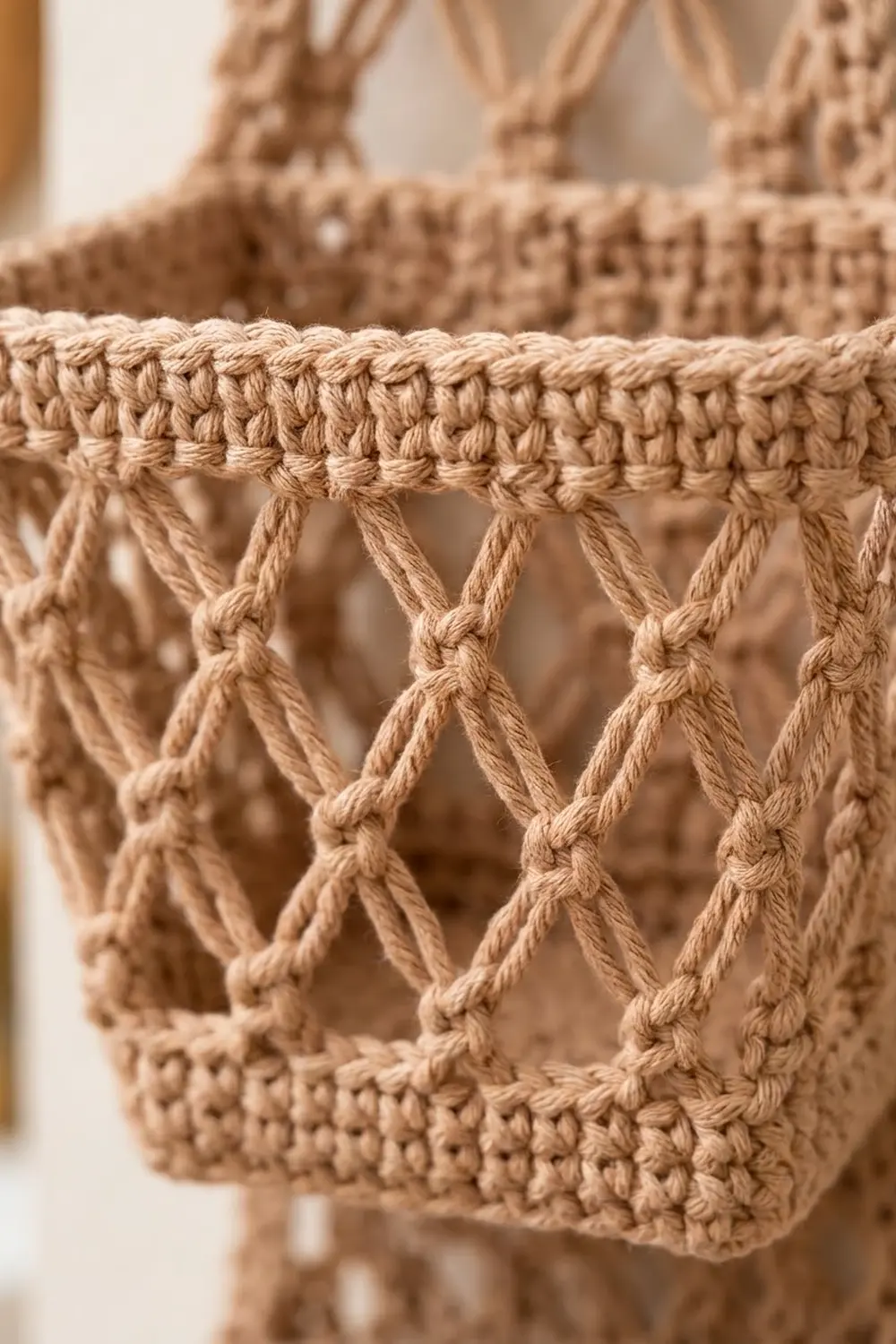
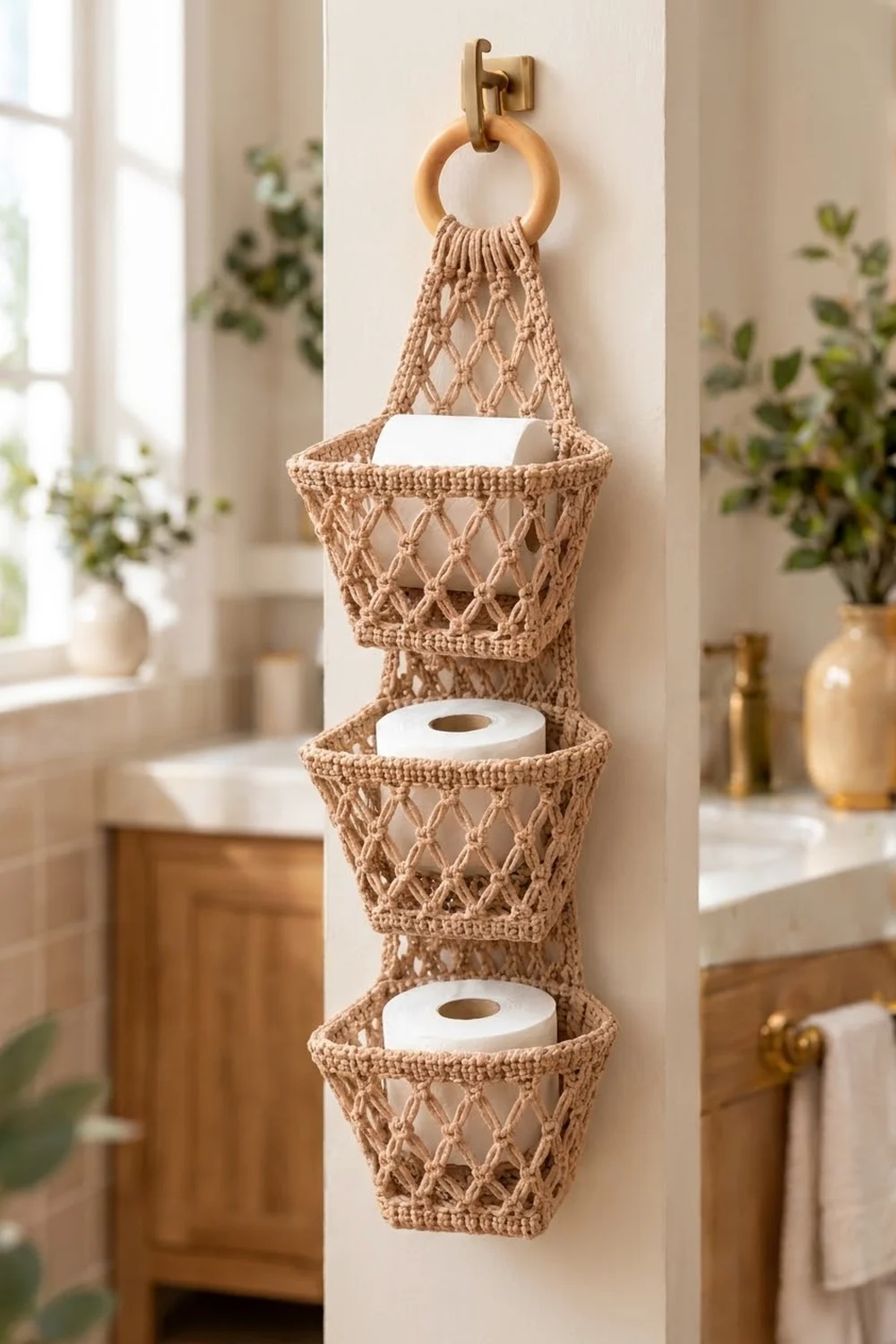
This hanging holder stores three spare rolls. It has three square baskets, a long mesh back panel and a wooden ring at the top. Each basket has a solid base, a diamond-mesh middle and a firm, rolled rim. The walls flare out so the top is wider than the base. The back panel continues the same mesh and narrows into a strap that wraps the ring.
The whole piece is made in one warm latte-beige cotton cord. Wood and brass bathroom fittings suit it well. It looks like macramé but is fully crocheted, and the open mesh lets you see at a glance how many rolls are left.
The pattern uses US crochet terms. Including the ring, the holder measures about 6 in (15.2 cm) wide and 28.6 in (72.6 cm) tall. Each basket is 6 in (15.2 cm) square at the rim, 5 in (12.7 cm) square at the base and 5 in (12.7 cm) tall. That fits a standard roll about 4.5 in (11.4 cm) across.
You crochet each basket from the base up. The base is worked in rows, then the walls are worked in the round: two solid edge rounds, four mesh rounds with longer chains in each round, and a solid band. The back panel is worked flat in mesh rows and narrows into a strap. Finally, you add the rims and a single crochet edging, sew the baskets to the panel and fold the strap around the ring.
Finished Size and Construction
- Finished size: 6 in (15.2 cm) wide x 28.6 in (72.6 cm) tall with the ring
- Skill level: Intermediate
- Terminology: US
- Yarn weight: Bulky (#5) cotton cord
- Hook: 6.0 mm (US J-10)
- Number of pieces: 4 crocheted pieces (3 baskets, 1 back panel) plus 1 wooden ring
- Layout: 3 baskets stacked vertically on one panel, with 1 in (2.5 cm) of open mesh between them
- Basket size: 6 in (15.2 cm) square rim, 5 in (12.7 cm) square base, 5 in (12.7 cm) tall
- Panel size before border: 5.7 in (14.5 cm) wide, 17.8 in (45.2 cm) straight section
- Border depth: 1 row of single crochet on each long panel edge, 0.3 in (0.8 cm); 2 rim rounds on each basket, 0.6 in (1.5 cm)
Materials
Choose a smooth, firm cotton or cotton-blend cord in bulky (#5) weight, with roughly 100 m per 100 g. Stiff cord makes basket walls that stand up on their own. Soft, fluffy yarns will sag once a roll is inside. Twisted cord shows the diamond lattice most clearly.
- Latte beige: 250 g, about 250 m (273 yd)
The holder itself uses about 220 g. The quantity above includes a margin of about 15% for gauge swatches and sewing. Use yarn from a single dye lot so all the baskets match.
Tools:
– 6.0 mm (US J-10) crochet hook
– 1 wooden ring, 3 in (7.6 cm) across
– 12 locking stitch markers
– Tapestry needle with a large eye
– Scissors and a measuring tape
– A 5 in (12.7 cm) box or a block of rolled towels for blocking
– Rust-proof pins
Abbreviations (US Terms)
- ch: chain
- sc: single crochet
- dc: double crochet
- sl st: slip stitch
- sk: skip
- st(s): stitch(es)
- BLO: back loop only
- rev sc: reverse single crochet (crab stitch)
Special stitch: rev sc. Do not turn. Insert the hook in the next stitch to the right, yarn over and pull up a loop, then yarn over and pull through both loops. This gives a rolled, corded edge.
Mesh loop: a chain loop anchored with sc at both ends. In the next round or row, work sc into the center of each loop. Offsetting the anchors this way makes the diamond lattice, and each sc forms a small knot where 4 chains meet.
Gauge and Checkpoints
Gauge: 12 sc and 13 rows = 4 in (10.2 cm), so there are 3 sc per inch. Each mesh row or round worked with ch 5 adds about 0.7 in (1.8 cm) of height.
Make one basket before anything else, since it is your gauge test. Check these points:
- Base after Row 16: 5 x 4.9 in (12.7 x 12.4 cm).
- After Rnd 1: each side is about 5.25 in (13.3 cm).
- After Rnd 6: the basket is about 3.5 in (8.9 cm) tall and the walls lean outward.
- After Rnd 11: the basket is 5 in (12.7 cm) tall and each rim side is 6 in (15.2 cm).
If your base is larger, go down 0.5 mm. If it is smaller, go up 0.5 mm. Don’t change the stitch counts, because the rim size, the joining and the panel width all depend on them.
Basket (Make 3)
Base
Row 1: Ch 16. Sc in the 2nd ch from the hook and in each ch across. Turn. (15 sc)
Rows 2–16: Ch 1, sc in each st across. Turn. (15 sc)
The base should be square, about 5 in (12.7 cm) per side.
Walls
Rnd 1 (edge conversion): Ch 1. Work around the base: 15 sc along each of the 4 sides, plus 1 extra sc in each of the 4 corners. Along the row-end sides, work 15 sc across 16 row ends by skipping 1 row end near the middle. Sl st to the first sc. (15 x 4 = 60) + 4 corner sc = 64 sts. Each side now has 16 sts, counting its corner st.
Rnd 2: Ch 1, sc in BLO of each st around. Sl st to the first sc. (64 sc) The unworked front loops make a fold line, so the walls rise from here.
Rnd 3 (mesh): Ch 1, sc in the first st. Ch 5, sk 3, sc in the next st. Repeat from * 14 more times. Ch 2, dc in the first sc. (16 loops: 15 ch-5 loops plus the closing ch-2/dc loop) The dc puts you in the center of the last loop.
Rnd 4: Ch 1, sc around the dc post. Ch 6, sc in the next loop. Repeat from * 14 more times. Ch 3, dc in the first sc. (16 loops)
Rnd 5: Repeat Rnd 4. (16 loops)
Rnd 6: Ch 1, sc around the dc post. Ch 7, sc in the next loop. Repeat from * 14 more times. Ch 7, sl st to the first sc. (16 ch-7 loops)
The chains get longer from round to round, so the walls flare out without any increases. Count loops after every round, because one missed loop will throw off the rim.
Rnd 7 (band conversion): Ch 1. Work 5 sc in the next loop, 4 sc in each of the next 2 loops, and 5 sc in the next loop. Repeat from * 3 more times. Sl st to the first sc. (16 loops x 4 sc = 64) + 8 extra sc = 72 sts. Each side has 5 + 4 + 4 + 5 = 18 sts. Put a marker in the first st of each 18-st side.
Rnds 8–9: Ch 1, sc in each st around. Sl st to the first sc. (72 sc)
Don’t fasten off. Go straight on to the rim rounds in the Border section, then fasten off and weave in the ends. Make two more baskets the same way.
Back Panel (Make 1)
Row 1: Ch 18. Sc in the 2nd ch from the hook and in each ch across. Turn. (17 sc)
Row 2 (B-row): Ch 1, sc in the first st. Ch 5, sk 3, sc in the next st. Repeat from * 3 more times. Turn. (4 loops)
Row 3 (A-row): Ch 5 (counts as dc + ch 2). Sc in the first loop. Ch 5, sc in the next loop. Repeat from * 2 more times. Ch 2, dc in the last sc. Turn. (3 full loops + 2 half loops)
Row 4 (B-row): Ch 1, sc in the dc. Ch 5, sc in the next full loop. Repeat from * 2 more times. Ch 5, sc in the 3rd ch of the turning ch. Turn. (4 loops)
Rows 5–26: Work A-rows and B-rows alternately, starting with an A-row and ending with Row 26 as a B-row. (4 loops)
Checkpoint: the panel is 0.3 in + (25 x 0.7 in) = 17.8 in (45.2 cm) long and 5.7 in (14.5 cm) wide.
Taper
D-row (decrease): Ch 1, sc in the first loop. Ch 5, sc in the next loop. Repeat from * across. Turn. This makes 1 fewer loop than the row before it.
Repeating D, A and B rows narrows the panel by 1 loop every 3 rows.
- Row 27 (D): (3 loops)
- Row 28 (A): (2 full + 2 half loops)
- Row 29 (B): (3 loops)
- Row 30 (D): (2 loops)
- Row 31 (A): (1 full + 2 half loops)
- Row 32 (B): (2 loops)
- Row 33 (D): (1 loop)
- Row 34 (A): Ch 5, sc in the loop, ch 2, dc in the last sc. Turn. (2 half loops)
- Row 35 (B): Ch 1, sc in the dc, ch 5, sc in the 3rd ch of the turning ch. Turn. (1 loop)
The taper is 9 x 0.7 in = 6.3 in (16.0 cm) long.
Strap
Row 36: Ch 1, work 5 sc in the loop. Turn. (5 sc)
Rows 37–47: Ch 1, sc in each st across. Turn. (5 sc)
The strap is about 3.75 in (9.5 cm) long. Leave a 12 in (30.5 cm) tail when you fasten off.
Make All Pieces
All 4 pieces are latte beige:
- Baskets: 3, about 50 g (50 m) each, rims included
- Back panel: 1, about 45 g (45 m)
- Edging and sewing: about 25 g (25 m)
Layout, top to bottom:
        ( RING )
       /  strap \
      / mesh taper \
  [    TOP BASKET    ]   panel 12–17 in
  [ open mesh 1 in  ]
  [  MIDDLE BASKET   ]   panel 6–11 in
  [ open mesh 1 in  ]
  [  BOTTOM BASKET   ]   panel 0–5 in
Border
Border gauge: at 3 sc per inch, each 0.7 in (1.8 cm) mesh row end needs 2.1 sc. Working 2 sc per row end keeps the mesh slightly taut, so the edges stay straight and don’t ruffle.
Basket rim (each basket)
Rnd 10: Ch 1, sc in each st around. Sl st to the first sc. (72 sc; 18 per side)
Rnd 11: Ch 1, rev sc in each st around. Sl st to the first st. (72 rev sc; 18 per side)
Each side’s 18 stitches include the corner stitch. With 18 sts at 3 per inch, each side is 6 in (15.2 cm). No corner increases are used, so the rim stays straight and the corners come from blocking.
Panel side edging
With the right side facing, join the yarn at the bottom right corner. Work up the long edge: 1 sc in the end of Row 1, then 2 sc in each row end from Row 2 to Row 35. Fasten off. Repeat on the left edge, working from the top down.
Per side: 1 + (34 x 2) = 69 sc
The first 51 sc run along the straight section, Rows 1–26: 1 + (25 x 2) = 51. The other 18 sc run along the taper, Rows 27–35: 9 x 2 = 18. The strap edges are already solid and are not edged. With edging, the panel is 5.7 + 0.3 + 0.3 = 6.3 in (16.0 cm) wide. That is a little wider than the basket rims, so the edging frames the baskets.
Joining
Method: whipstitch with the tapestry needle and matching cord.
- Pin the panel flat with the wrong side up. Mark the panel edge at 0, 5, 6, 11, 12 and 17 in (0, 12.7, 15.2, 27.9, 30.5 and 43.2 cm) from the bottom.
- Place the bottom basket so the back of its base is at 0 in. Sew the 16 back sts of Rnd 2 to the 17 foundation sc of the panel, 1 basket st to 1 panel st. Catch 2 panel sts with the final basket st.
- Sew the back rim at the 5 in (12.7 cm) mark: whipstitch the 18 back sts of Rnd 10 (just under the rev sc) to the panel. Go through the edging sc at each end and through each mesh knot between them.
- Repeat for the middle basket at 6 and 11 in, and for the top basket at 12 and 17 in.
Tension: keep the stitches snug but not tight. If they are pulled hard, the mesh bunches and the basket tips forward. If they are too loose, the rim pulls away from the panel when you take a roll out.
Checkpoint: each gap is 1 in (2.5 cm), and the top basket’s rim is 0.8 in (2.0 cm) below the start of the taper.
Ring: Leave Rows 36–40, the bottom 1.5 in (3.8 cm) of the strap, below the ring. Wrap the remaining 2.25 in (5.7 cm) of the strap from front to back around the 3 in (7.6 cm) ring. Whipstitch Row 47 to the back of Row 41 with the 12 in (30.5 cm) tail.
Final Blocking
- Mist each basket until it is damp, not dripping.
- Slide a 5 in (12.7 cm) box into each basket, or pack it with a rolled towel, and pull the rim out to 6 in (15.2 cm) square.
- Pinch each corner of the rim into shape, lining it up with the markers.
- Pin the panel flat between the baskets so the diamonds open evenly and the edges run straight.
- Allow 24 hours to dry. Then take out the forms and markers.
Final Quality-Control Checklist
- [ ] Every basket has 72 sts in Rnds 7–11 and 16 mesh loops in each mesh round
- [ ] Each rim side is 6 in (15.2 cm), and each base is 5 in (12.7 cm)
- [ ] The panel is 6.3 in (16.0 cm) wide with edging, with 69 sc along each long edge
- [ ] Gaps between baskets are 1 in (2.5 cm)
- [ ] The strap is centered and the ring hangs level
- [ ] All tails are woven in through solid sc, not the mesh
Troubleshooting
- Walls don’t flare: the chains are too tight. Chain more loosely, or go up 0.5 mm for Rnds 4–6 only.
- Base is rectangular: count the rows again. You need 16 rows of 15 sc.
- Rim waves: there are too many sts. Count 18 per side and work Rnd 7 again.
- Rim pulls in: Rnd 7 is short of stitches. Check that each corner loop has 5 sc.
- Diamonds lean to one side: you worked into the anchor sc instead of the loop center. Rework the round.
- Panel edge ruffles: you worked 3 sc into a row end. Stick to 2.
- Baskets tilt forward: add a second line of whipstitch at the base, or sew the side walls 0.5 in (1.3 cm) onto the panel edging.
- Holder twists: the strap is off-center. Unpick it and fold it straight.
Care
Hand wash in cool water, press the water out in a towel, and dry the holder flat over the blocking forms. Avoid tumble drying, which softens the walls.
Final Notes
Each measurement leads to the next. A 5 in (12.7 cm) base gives 64 sts and 16 sts per side. Four mesh rounds flare the walls to 72 sts, or 18 per side, which makes a 6 in (15.2 cm) rim. A 17-st panel, 5.7 in (14.5 cm) wide, becomes 6.3 in (16.0 cm) after edging. The baskets sit at 0, 6 and 12 in (0, 15.2 and 30.5 cm). Check your gauge on the first basket and the rest of the holder will come out the right size.
Happy crocheting!