

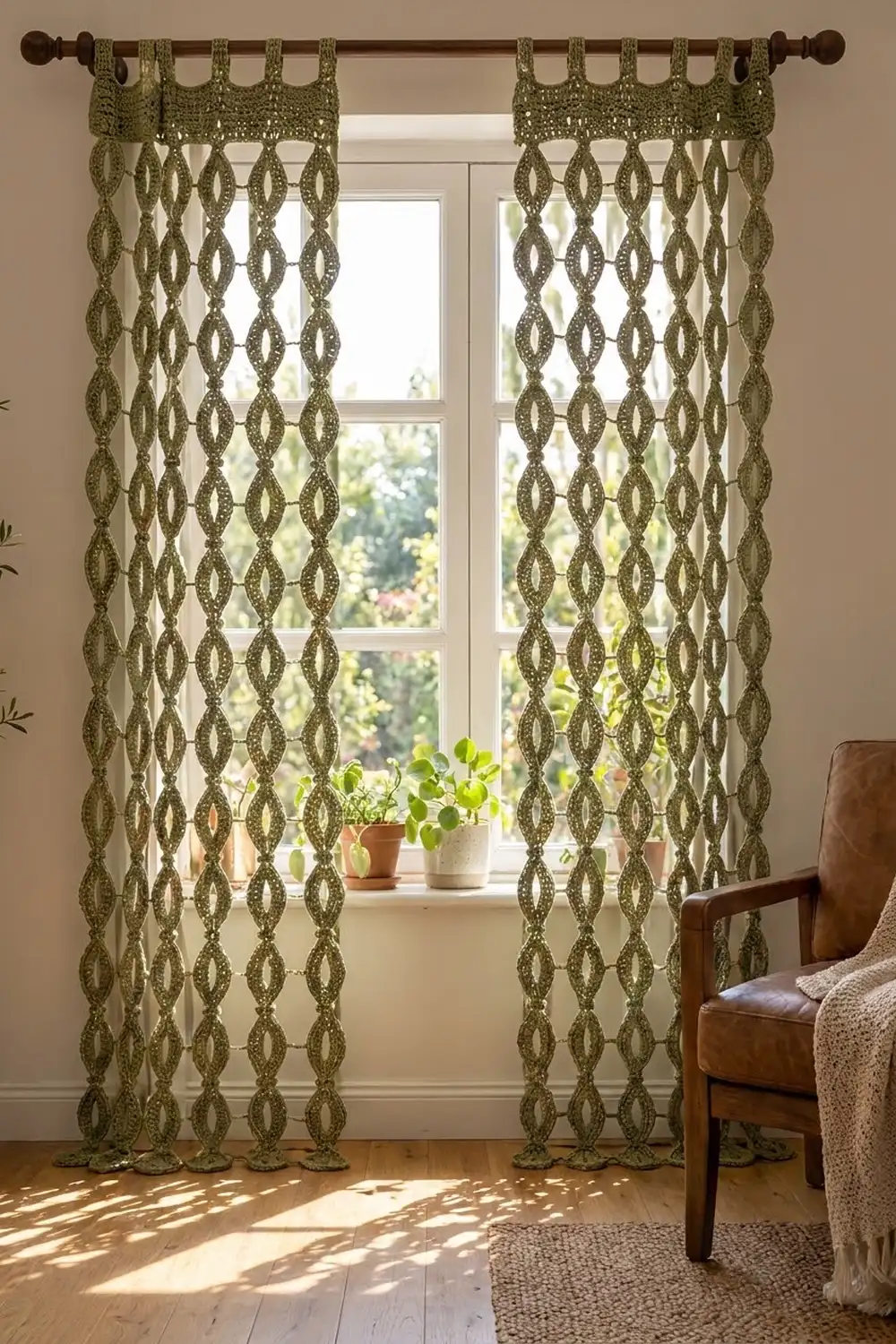
These curtain panels hang in long, airy columns of open almond-shaped motifs, joined tip to tip with small wrapped knots. Thin chain links run sideways between the columns at every knot. A solid header band with tab loops sits across the top and slides onto a curtain rod.
Everything is worked in one soft olive green. A single color lets the shapes stand out: each almond is a thick, textured ring around a narrow open center, and light from the window shows through every gap. The style is boho and a little macramé-like, but every part is crocheted except the wrapped knots.
This pattern uses US crochet terms. Each finished panel measures 20.25 in (51.4 cm) wide at the header and 82 in (208.3 cm) long from the top of the header to the lowest tip, not counting the tabs. The pattern makes a matching pair, as shown.
Construction overview: crochet 65 separate almond motifs per panel. Join them into 5 vertical strands of 13 motifs with wrapped knots. Then work the header band across the strand tops, add 5 tabs, and finish with chain links between the strands at every knot level.
Finished Size and Construction
- Finished panel size: 20.25 in x 82 in (51.4 cm x 208.3 cm), tabs not included
- Skill level: Intermediate
- Terminology: US
- Yarn weight: Worsted (#4)
- Hook: 5.0 mm (H-8)
- Number of pieces: 65 motifs + 1 header per panel; 130 motifs + 2 headers for the pair
- Layout: 5 strands across x 13 motifs down per panel
- Motif size: 6 in long x 2.75 in wide (15.2 cm x 7.0 cm)
- Size before header: 13 motifs x 6 in = 78 in (198.1 cm) per strand
- Header depth: 4 in (10.2 cm), plus tab loops about 2.5 in (6.4 cm) tall
Materials
Choose a smooth worsted-weight cotton or cotton blend. Cotton holds the almond shape and hangs straight without stretching too much over time. Avoid very fuzzy yarn, because it fills the open centers.
- Olive green: 750 g, about 1,350 m (1,476 yd) for the pair of panels; 375 g, about 675 m (738 yd) per panel
Quantities include a margin of roughly 10% for swatching, wrapping, and weaving in ends.
Tools:
– 5.0 mm (H-8) crochet hook
– Tapestry needle
– Scissors
– Measuring tape
– Rust-proof pins and a blocking surface
– Spray bottle
– Curtain rod, up to 1.25 in (3.2 cm) diameter
Abbreviations (US Terms)
- ch – chain
- sl st – slip stitch
- sc – single crochet
- hdc – half double crochet
- dc – double crochet
- sp – space
- st(s) – stitch(es)
- rnd – round
Special technique – Wrapped knot: Cut 24 in (61.0 cm) of yarn. Pull a loop through both tip ch-1 spaces you are joining, ch 1, and pull the tail end through to lock it. Wrap the long end firmly 6 times around both tips together, covering about 0.75 in (1.9 cm). Thread the end onto a needle, pass it upward under all 6 wraps, then weave it into a motif.
Gauge and Checkpoints
- 16 dc and 8 rows = 4 in (10.2 cm)
- 16 sc and 18 rows = 4 in (10.2 cm)
- 9 ch = 2 in (5.1 cm), worked loosely
Make one motif first and block it before making the rest. With 130 motifs, a small error multiplies quickly.
Checkpoints:
– After motif Rnd 1: about 5.25 in x 1.75 in (13.3 cm x 4.4 cm)
– After motif Rnd 2 and blocking: 6 in x 2.75 in (15.2 cm x 7.0 cm)
– Open center: about 3.75 in x 0.75 in (9.5 cm x 1.9 cm)
– After joining 2 motifs: 12 in (30.5 cm) tip to tip
If your motif is longer than 6.25 in (15.9 cm), go down a hook size. If it is shorter than 5.75 in (14.6 cm), go up a hook size. If length is right but the center closes up, your foundation chain is too tight; chain more loosely or use a hook one size larger for the ring only.
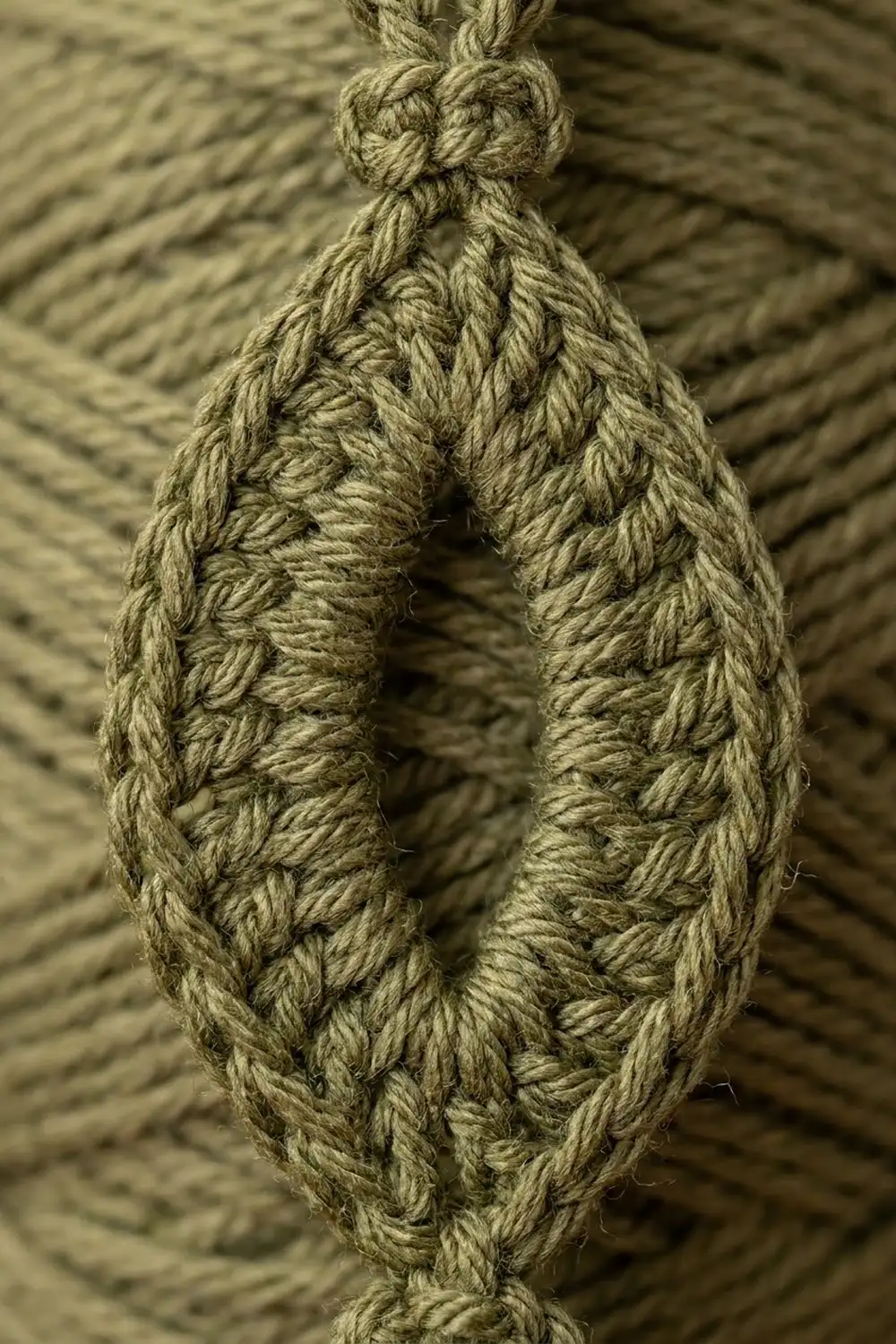
Almond Motif
Make 65 per panel (130 total).
Ring: Ch 36, sl st in first ch to form a ring, taking care not to twist the chain.
Rnd 1: Ch 1 (does not count as a st), sc in same ch as join and in next 2 ch (top tip), hdc in next 2 ch, dc in next 11 ch, hdc in next 2 ch, sc in next 3 ch (bottom tip), hdc in next 2 ch, dc in next 11 ch, hdc in next 2 ch. Join with sl st to first sc. (36 sts)
The sc groups sit at the tips and the dc groups sit along the sides. That height difference is what pulls the ring into an almond shape.
Rnd 2 (growth round): Ch 1, sc in first sc, (sc, ch 1, sc) in next sc, sc in next sc, hdc in next 2 hdc, dc in next 2 dc, 2 dc in next dc, dc in next 5 dc, 2 dc in next dc, dc in next 2 dc, hdc in next 2 hdc; sc in next sc, (sc, ch 1, sc) in next sc, sc in next sc, hdc in next 2 hdc, dc in next 2 dc, 2 dc in next dc, dc in next 5 dc, 2 dc in next dc, dc in next 2 dc, hdc in next 2 hdc. Join with sl st to first sc. (42 sts plus 2 tip ch-1 sps)
Count check per half: 4 sc at the tip + 17 side sts (2 hdc + 13 dc + 2 hdc) = 21 sts. Two halves = 42 sts.
The 2 extra dc on each side curve the outer edge, and the ch-1 sps sharpen each tip into a point. Fasten off, leaving a 4 in (10.2 cm) tail, and weave in ends.
Make All Pieces
Per panel: 65 almond motifs in olive green. For the pair: 130 motifs.
Block the motifs in batches before joining (see Final Blocking). Flat, even motifs make straight strands.
Layout grid (one panel, viewed from the front):
        Header band with 5 tabs
  S1     S2     S3     S4     S5
  M1     M1     M1     M1     M1
  K -----K -----K -----K -----K     (knot level 1 + chain links)
  M2     M2     M2     M2     M2
  K -----K -----K -----K -----K
  ...    ...    ...    ...    ...
  M13    M13    M13    M13    M13
  k      k      k      k      k     (single bottom knots)
S = strand, M = motif, K = wrapped knot joining two motifs, k = bottom finishing knot. There are 12 knot levels with links between M1 and M13.
Joining
Strands: Lay 13 motifs in a line, tip to tip. For each pair, the bottom ch-1 sp of the upper motif meets the top ch-1 sp of the lower motif. Join them with a wrapped knot. That is 12 wrapped knots per strand and 60 per panel.
Stitch-to-stitch logic: Only the tip ch-1 sps are joined. The tips butt together and do not overlap, so each motif adds exactly 6 in (15.2 cm) to the strand.
Tension: Wrap firmly enough to pinch the tips into a neat bead. If you pull too hard, the tip sc fold inward and the strand loses length.
Bottom knot: At the bottom tip of each M13, make a wrapped knot around that single tip so it matches the others.
Checkpoint: Each strand measures 78 in (198.1 cm), give or take 1 in (2.5 cm). Hang all 5 strands next to each other to compare. If one is longer, re-wrap its knots a little tighter.
Make 5 strands for each panel. The chain links between strands come after the header is done (see the end of the next section).
Header Band and Tabs (Border)
The header acts as this project’s border, so it follows the border gauge: 16 dc = 4 in (10.2 cm).
Row 1 (setup row): Lay the 5 strands side by side, right side up. Ch 6, sc in top ch-1 sp of S1, [ch 16, sc in top ch-1 sp of next strand] 4 times, ch 8, turn.
Count: 6 ch + (5 strands x 1 sc) + (4 gaps x 16 ch) + 6 ch = 81 sts. The last 2 of the 8 end chains are the turning chain and are not counted.
Row 2: Dc in 3rd ch from hook and in each ch and sc across. (81 dc) Ch 2, turn. The ch 2 does not count as a st in this row or later rows.
Rows 3–8: Dc in each st across. (81 dc) Ch 1, turn after Row 8.
Row 9: Sc in each st across. (81 sc) Do not fasten off.
Header checkpoint: 20.25 in x 4 in (51.4 cm x 10.2 cm). The height comes from Row 1 at 0.25 in (0.6 cm), Rows 2–8 at 3.5 in (8.9 cm), and Row 9 at 0.25 in (0.6 cm).
Why the math works: Strand centers are 17 sts apart (1 sc + 16 ch), and 17 sts at 4 sts per inch is 4.25 in (10.8 cm). A motif is 2.75 in (7.0 cm) wide, which leaves a 1.5 in (3.8 cm) gap at the widest point. The 6 edge sts put the outer strand centers 1.625 in (4.1 cm) in from each side. Since half a motif is 1.375 in (3.5 cm), the outer motifs stop 0.25 in (0.6 cm) inside the header edges.
Tabs: The 81 sts of Row 9 split evenly into 9 groups of 9 sts: tab, gap, tab, gap, tab, gap, tab, gap, tab. That is 5 tabs x 9 = 45 sts plus 4 gaps x 9 = 36 sts, for 81 sts.
Tab rows: Ch 1, turn, sc in first 9 sts. Work 21 more rows of sc on these 9 sts. (22 rows, 9 sc each, about 5 in / 12.7 cm) Fasten off, leaving a 12 in (30.5 cm) tail. Skip the next 9 sts, rejoin yarn, and repeat for the remaining 4 tabs.
Fold each tab to the back and sew its last row to the top of header Row 6. This makes a loop about 2.5 in (6.4 cm) tall that fits a rod up to 1.25 in (3.2 cm) across.
Chain links: Lay the panel flat with the header pinned in place. At knot level 1, sl st under the wraps of the knot on S1, [ch 19, sl st under the wraps of the matching knot on the next strand] 4 times, then fasten off. (4 links, 76 ch per level) Repeat for all 12 knot levels. (48 links per panel)
Nineteen chains at the chain gauge measure about 4.25 in (10.8 cm), which matches the 17-st spacing in the header. That keeps the strands parallel from top to bottom.
Final Blocking
- Weave in all ends before blocking.
- Lay the panel face down on a clean floor or bed covered with towels. If space is limited, block it in two halves.
- Pin the header to 20.25 in x 4 in (51.4 cm x 10.2 cm).
- Pin the strand centers 4.25 in (10.8 cm) apart, measured at every 2nd or 3rd knot level.
- Open each almond’s center with a pin so it is about 0.75 in (1.9 cm) wide.
- Mist evenly until damp, without soaking.
- Let it dry completely, at least 24 hours.
- Hang the panel on the rod for one more day. Gravity sets the final drape.
Final Quality-Control Checklist
- Every motif has 42 sts plus 2 tip ch-1 sps.
- Every motif measures 6 in x 2.75 in (15.2 cm x 7.0 cm).
- Each strand has 13 motifs and 12 joining knots plus 1 bottom knot.
- The header has 81 sts in every row.
- There are 5 tabs, each with 9 sts and 22 rows.
- Each of the 12 knot levels has 4 chain links of 19 ch each.
- All strands hang to the same length, 82 in (208.3 cm) including the header.
- All ends are woven in securely.
Troubleshooting
Motifs look round instead of almond-shaped: Check that the 3 sc sit exactly at the tips in Rnd 1. If the dc are shifted, the points move off-center.
Open center closes up: Chain the ring more loosely, or block with a pin through the center.
Strand twists when hanging: One motif was joined back side out. Undo that knot, flip the motif, and re-wrap it.
Header ruffles: Your Row 1 ch-16 gaps are looser than the dc gauge. Re-chain them a little tighter or use a hook one size smaller for Row 1.
Chain links sag: Remove 1 ch from each link. If they pull the strands together, add 1 ch.
Knots slide: Add 2 more wraps and pass the end under the wraps twice.
Care
Hand wash cool and lay flat to dry, re-pinning the header if needed. Never wring the panels or hang them wet, because the strands will stretch.
Final Notes
The measurement chain is simple: a 6 in (15.2 cm) motif, 13 motifs to make a 78 in (198.1 cm) strand, a 4 in (10.2 cm) header for a total of 82 in (208.3 cm), and 81 header sts at 4 per inch for a 20.25 in (51.4 cm) width. Strands sit 17 sts and 19 ch apart, both 4.25 in (10.8 cm). If your first motif hits gauge, everything after it falls into place.
Happy crocheting!