

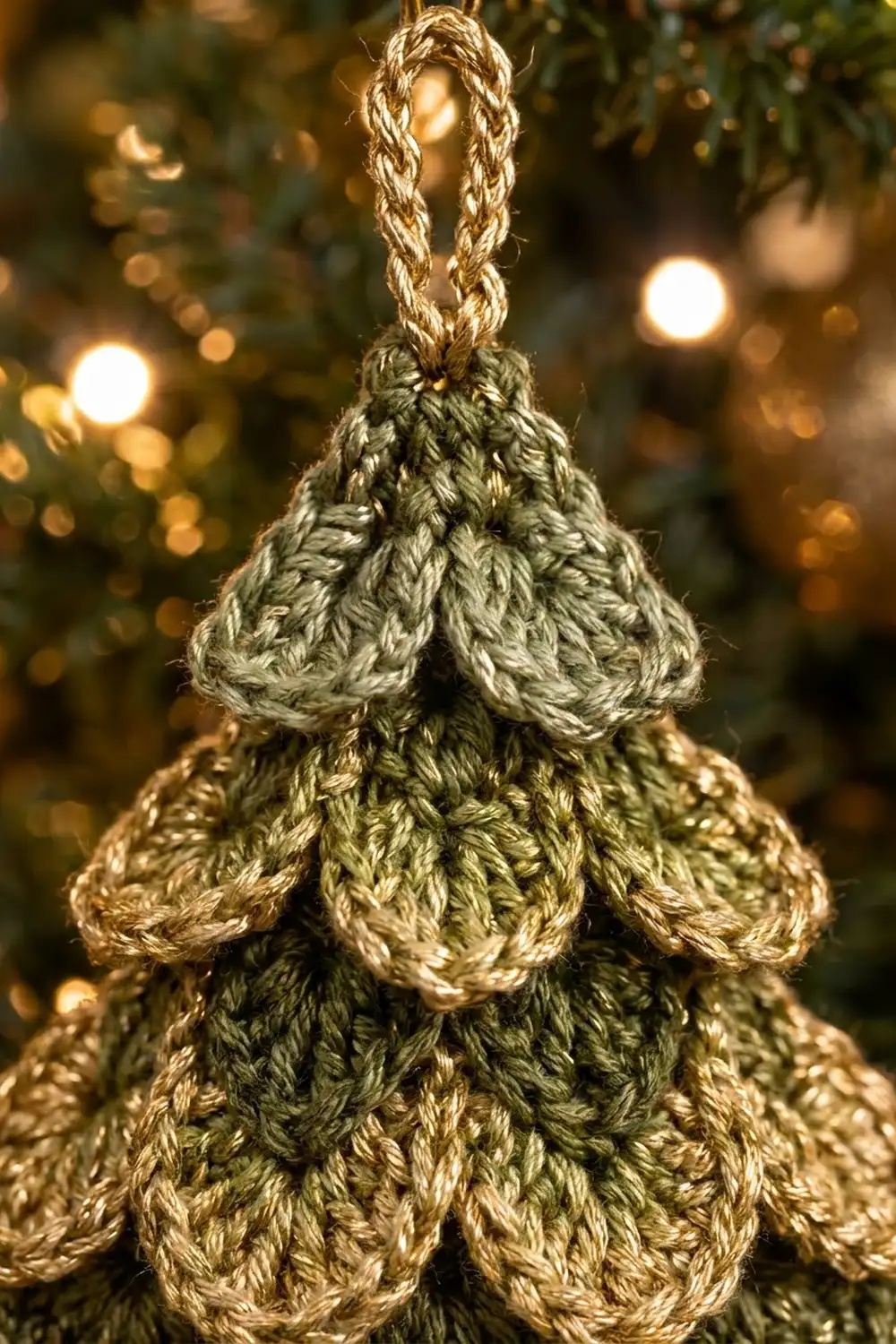
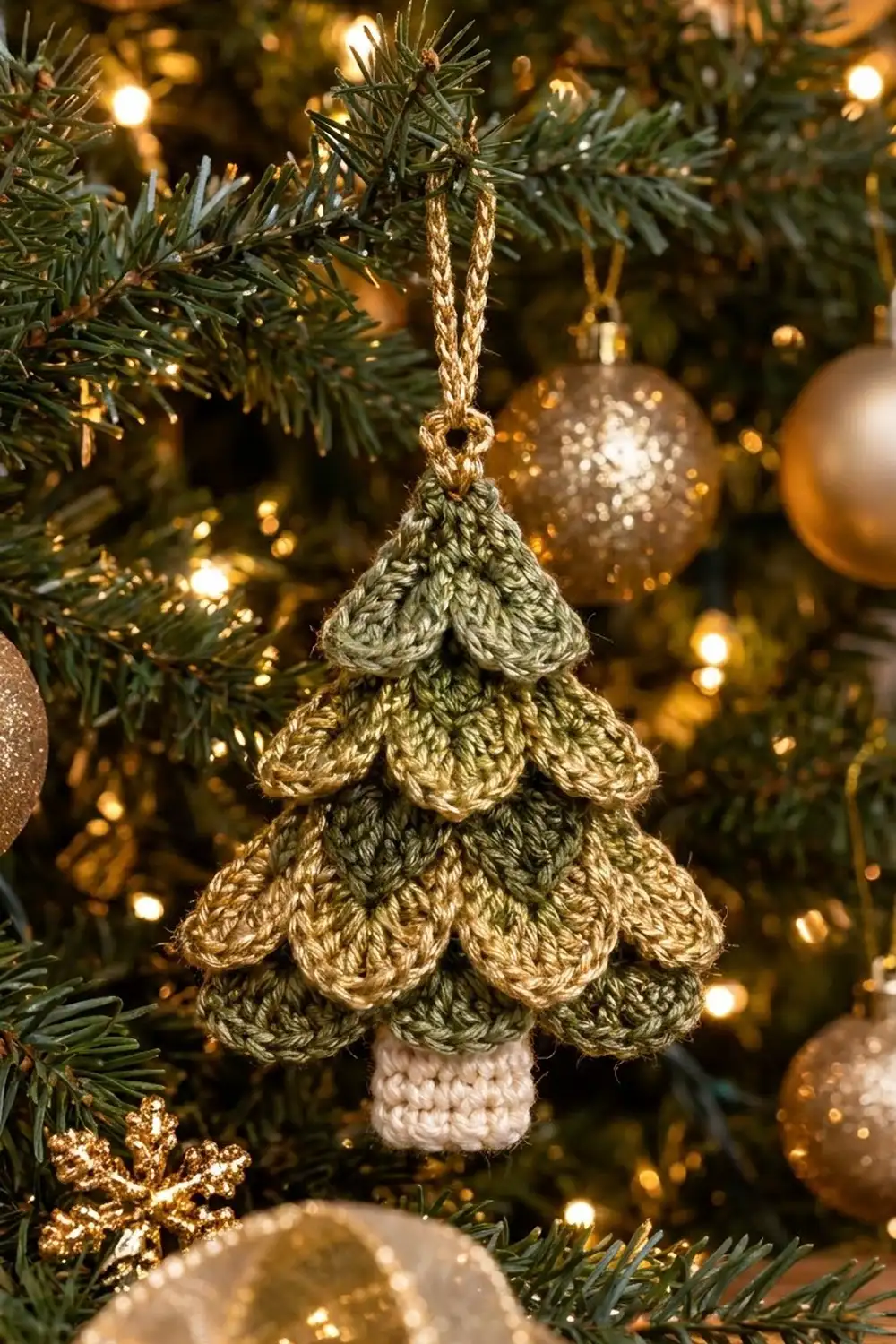
This little tree is made from layers of rounded crocodile-stitch scales stacked into a neat triangle. Each tier overlaps the one below like the needles of a real fir. The finished ornament is small enough to sit in your palm but has plenty of texture and shine.
The colors are deep olive green, soft sage green and metallic gold, which alternate by tier. A cream single-crochet trunk and a twisted gold hanging loop finish the design. It looks lovely alone on a branch or hung in groups on a tree.
The pattern uses US crochet terms. The finished tree is 3 1/8 in (7.9 cm) wide and 3.5 in (8.9 cm) tall from the tip to the bottom of the trunk. With the hanging loop it is 4.5 in (11.4 cm) tall overall.
You work the tree flat in rows from the bottom up, starting with a single-crochet base row and a row of double-crochet pairs. Each tier is a row of scales worked around those pairs. Each new tier has one scale fewer than the tier below, so the triangle shape builds itself. Last, you add the trunk to the foundation chain and the loop to the tip.
Finished Size and Construction
- Finished size: 3 1/8 in (7.9 cm) wide × 3.5 in (8.9 cm) tall; 4.5 in (11.4 cm) with the loop
- Skill level: Intermediate (crocodile stitch)
- Terminology: US crochet terms
- Yarn weight: Fingering (#1 Super Fine)
- Hook: 2.5 mm (between US B-1 and C-2)
- Number of pieces: 1 (single ornament, no joining)
- Layout: 5 tiers of scales: 5, 4, 3, 2 and 1
- Piece size: tree body 3 1/8 in × 2.75 in (7.9 × 7.0 cm), trunk 7/8 in × 3/4 in visible (2.2 × 1.9 cm)
- Size before border: 3 1/8 in × 3.5 in (7.9 × 8.9 cm)
- Border depth: 0 in (0 cm). The scale tips are the finished edge, so there is no separate border round.
Materials
Use a smooth, tightly twisted fingering-weight cotton or cotton blend for the green and cream yarns, so the scales keep a crisp outline. For the gold, use a soft metallic fingering yarn, or a metallic blend that isn’t stiff. Very wiry metallic yarn makes the scales hard to curve.
- Olive green (Color A): 2 g, about 7 m
- Sage green (Color B): 2 g, about 7 m
- Metallic gold (Color C): 3 g, about 10 m (includes the doubled loop)
- Cream (Color D): 1 g, about 4 m
These quantities include a generous margin for tails and a practice tier.
Tools:
– 2.5 mm crochet hook
– Tapestry needle
– Scissors
– Stitch marker
– Rustproof pins and a foam blocking mat
– Ruler or tape measure
Abbreviations (US Terms)
- ch: chain
- sl st: slip stitch
- sc: single crochet
- dc: double crochet
- sk: skip
- sp: space
- st(s): stitch(es)
- RS / WS: right side / wrong side
Special stitches:
- Pair: 2 dc worked into the same stitch or space. Each dc in a pair is called a “post.”
- Scale: Turn the work so the pair lies sideways in front of you. Work 5 dc around the post of the first dc of the pair, starting at the top of the post and moving down toward its base. Ch 1. Then work 5 dc around the post of the second dc of the pair, moving from its base up to its top. Each scale has 10 dc and 1 ch, and makes a rounded petal that hangs down over the rows below.
Gauge and Checkpoints
Gauge: 8 sc and 9 sc rows = 1 in (2.5 cm). For a quick check, 16 sc = 2 in (5.1 cm).
The ornament is so small that it works as its own test piece. Work Rows 1–3 and measure before going further. If your gauge is off, it is much quicker to start over at this point than after five tiers.
Checkpoints:
- After Row 1: 25 sc measure 3 1/8 in (7.9 cm).
- After Row 3: Each scale is about 3/4 in (1.9 cm) long and 3/4 in (1.9 cm) wide. The bottom tier spans 3 1/8 in (7.9 cm).
- After Row 5: The second tier sits about 1/2 in (1.3 cm) above the first. The body is now about 1.25 in (3.2 cm) tall.
- After Row 11: The body is 2.75 in (7.0 cm) tall, from the bottom scale tips to the top of the tip scale.
- After the trunk: The tree is 3.5 in (8.9 cm) tall overall.
If your piece is too big: Go down to a 2.25 mm hook, or tighten the dc in your scales. If it is too small: Go up to a 2.75 mm hook. Scales that are crowded together or ruffled usually mean the dc are too tight around the posts. Loosen your grip rather than changing the stitch count.
Pattern
Tier 1 Base (Color A, olive)
Row 1 (RS): Ch 26. Sc in the 2nd ch from the hook and in each ch across. Turn. (25 sc)
Row 2: Ch 3 (counts as dc), dc in the first sc. This is the first pair. Ch 1, sk 2 sc, 2 dc in the next sc; repeat from * 7 more times. The last pair lands in sc 25. Turn. (9 pairs = 18 dc, 8 ch-1 sps)*
Check: The pairs sit on sc 1, 4, 7, 10, 13, 16, 19, 22 and 25. That is 1 + (3 × 8) = 25, so both ends are symmetrical.
Tier 1 Scales (Color A)
Number the pairs 1–9 from the end where you are now working.
Row 3: Do not chain. Work a scale over pair 1. *Sl st between the 2 dc of the next pair (this pair is skipped and becomes a spacer). Work a scale over the next pair. Repeat from * 3 more times. Sl st into the top of the last dc. Fasten off.
(5 scales on pairs 1, 3, 5, 7, 9 = 50 dc, 5 ch; 4 spacer sl sts on pairs 2, 4, 6, 8)
The 5 scales hang down in front of Rows 1–2. Their tips sit about 3/8 in (1.0 cm) below the foundation chain.
Tier 2 (Color C, gold)
Row 4: With the RS facing, join gold with a sl st between the dc of pair 2 (the first spacer). Ch 3 (counts as dc), dc in the same sp. This is new pair 1.
Then *ch 1, 2 dc in the center of the next scale (between its 5th and 6th dc). Ch 1, 2 dc between the dc of the next spacer pair. Repeat from * 2 more times. Turn.
(7 pairs = 14 dc, 6 ch-1 sps)
The new pairs sit on old spacers 2, 4, 6 and 8 and on the centers of old scales 2, 3 and 4. The two outer scales of Tier 1 are not worked into. They stay free and form the widest points of the tree.
Row 5: Work a scale over pair 1. *Sl st between the dc of the next pair, then work a scale over the next pair. Repeat from * 2 more times. Sl st into the top of the last dc. Fasten off.
(4 scales = 40 dc, 4 ch; 3 spacer sl sts)
Each gold scale sits over a gap in Tier 1, so the tiers are staggered.
Tier 3 (Color B, sage)
Row 6: Join sage between the dc of the first spacer pair of Row 5. Ch 3, dc in the same sp. *Ch 1, 2 dc in the center of the next scale. Ch 1, 2 dc in the next spacer pair. Repeat from * once more. Turn.
(5 pairs = 10 dc, 4 ch-1 sps)
Row 7: Scale over pair 1. *Sl st in the next pair, scale over the next pair. Repeat from * once more. Sl st into the last dc. Fasten off.
(3 scales = 30 dc, 3 ch; 2 spacer sl sts)
Tier 4 (Color C, gold)
Row 8: Join gold in the first spacer pair of Row 7. Ch 3, dc in the same sp. Ch 1, 2 dc in the center of the middle scale. Ch 1, 2 dc in the next spacer pair. Turn.
(3 pairs = 6 dc, 2 ch-1 sps)
Row 9: Scale over pair 1, sl st in pair 2, scale over pair 3. Sl st into the last dc. Fasten off.
(2 scales = 20 dc, 2 ch; 1 spacer sl st)
Tier 5 (Color B, sage)
Row 10: Join sage in the spacer pair of Row 9. Ch 3, dc in the same sp. Do not turn the work yet.
(1 pair = 2 dc)
Row 11: Work a scale over this pair, then sl st at the base of the pair. Fasten off, leaving a 6 in (15.2 cm) tail.
(1 scale = 10 dc, 1 ch)
Tier summary: 5, 4, 3, 2, 1 scales. In each tier, the pair count is (scales × 2) − 1: 9, 7, 5, 3, 1.
Trunk (Color D, cream)
Row 1: With the RS facing, turn the tree upside down. Count 9 chains in from either end of the foundation chain. Join cream with a sl st in the 10th ch (the base of sc 10). Ch 1, sc in the same ch and in the next 6 ch. Turn. (7 sc, centered on sts 10–16)
Rows 2–10: Ch 1, sc in each sc across. Turn. (7 sc each row)
Fasten off. The trunk is 7/8 in (2.2 cm) wide and 1 1/8 in (2.9 cm) long. The top 3/8 in (1.0 cm) hides behind the bottom scales, which leaves 3/4 in (1.9 cm) showing.
Hanging Loop (Color C, held double)
Hold two strands of gold together. Ch 18. Sl st into the back bump of the 2nd ch from the hook and of each ch across. This makes 17 sl sts and a firm cord about 2.25 in (5.7 cm) long.
Fold the cord in half. Sew both ends to the WS of the tip, just behind the base of the Tier 5 scale. The loop stands 1 in (2.5 cm) above the tip. Twist the cord gently 2–3 times before sewing it on to get the rope-like look.
Border
This ornament has no separate border round. The rounded scale tips are the finished edge, so the border depth is 0 in (0 cm).
Why the math works without a border:
- Width: The bottom tier is set by Row 1. Pairs every 3 sts on 25 sc give 9 pairs, and alternating scales and spacers gives 5 scales. At 8 sc per inch, 25 sc = 3 1/8 in (7.9 cm). The free outer scales of every tier make a soft, scalloped edge that needs no trim.
- Height: Tier 1 scales are 3/4 in (1.9 cm) long, and each of the 4 tiers above adds 1/2 in (1.3 cm). That gives 0.75 + 2.0 = 2.75 in (7.0 cm) for the body. Adding the 3/4 in (1.9 cm) of visible trunk makes 3.5 in (8.9 cm).
- Trunk placement: There are 9 unworked chains on each side of the trunk, and 9 + 7 + 9 = 25, so the trunk is centered.
If you would like a crisper outline, you can work a sl st edge in gold around the trunk only, 1 sl st per row-end and per st. This adds less than 1/8 in (0.3 cm) and doesn’t change the stated size.
Final Blocking
- Weave in all ends on the WS. Hide each tail behind the scales of its own color.
- Lay the tree face up on a foam mat.
- Pin the base to 3 1/8 in (7.9 cm) wide, using the two outermost Tier 1 scales.
- Pin the tip so the total height to the trunk bottom is 3.5 in (8.9 cm).
- Gently curve each scale with your fingertip so that it lies over the gap below it.
- Hold a steam iron 1 in (2.5 cm) above the piece and steam it lightly. Don’t touch the metallic yarn with the iron.
- Leave the tree pinned until it is completely dry, at least 2 hours.
- Unpin it and check that the loop hangs straight up from the center.
Final Quality-Control Checklist
- 5 tiers with 5, 4, 3, 2 and 1 scales, each tier centered over the one below
- Each scale has 10 dc and lies flat, with no ruffling
- Colors in order from the bottom: olive, gold, sage, gold, sage
- Width is 3 1/8 in (7.9 cm) and height is 3.5 in (8.9 cm)
- Trunk is 7 sc wide, centered, with 3/4 in (1.9 cm) showing
- Loop stands 1 in (2.5 cm) above the tip and is firmly sewn
- No ends showing on the RS
Troubleshooting
- Scales cup or ruffle: The dc are too tight around the posts. Rework them with looser loops, keeping 5 dc per post.
- The tree leans to one side: You probably joined a new tier in the wrong spacer. Each Tier 2–5 join must go into the first spacer pair, not into an outer scale.
- The pair count is off: Recount the pairs against (scales below × 2) − 1. If a tier has the wrong number of pairs, you have missed a scale center.
- Gaps between tiers: The new-tier pairs should go in the exact center of each scale, between its 5th and 6th dc.
- The trunk is off-center: Count 9 chains from each edge before joining.
- Metallic yarn splits: Use a hook with a rounded head and work more slowly.
Care
Spot clean with cool water and mild soap, then lay flat to dry. Store the ornament flat in tissue so the scales keep their shape.
Final Notes
The measurement chain for this tree is: 25 sc = 3 1/8 in (7.9 cm) → 9 pairs → 5 scales in the bottom tier → one scale fewer in each of the 4 tiers above. Each tier adds 1/2 in (1.3 cm), which gives a 2.75 in (7.0 cm) body. The trunk adds 3/4 in (1.9 cm) to reach 3.5 in (8.9 cm), and the loop adds 1 in (2.5 cm) for 4.5 in (11.4 cm) overall. If you check your gauge at Row 1 and count your pairs at every tier, each tree you make should come out the same.
Happy crocheting!