

The Greige Garden Lace Bedspread is a romantic, heirloom-style coverlet made of large eight-petal flowers set into an airy chain-loop mesh. Each flower has a domed center of bobbles, fanned petals with radiating stitch lines, and a crisp single crochet rim. Smaller bobble-center flowers sit over every point where four squares meet, and a petal-scallop border finishes all four edges.
The whole bedspread is worked in one soft light greige (warm gray), so the texture does the work: raised bobbles, shadowy open mesh, and a scalloped drop over the sides of the bed. It looks lovely over a white sheet, which shows through the lace.
This pattern uses US crochet terms. The finished bedspread measures 84 x 94 in (213.4 x 238.8 cm) after blocking, which suits a queen bed as a coverlet.
Construction is modular. You make 72 large flower squares and join them as you go on their last round into a grid 8 squares wide and 9 squares long. Then you make 56 small flowers and sew them over the interior junctions. Finally, you work a three-round border straight onto the joined edge.
Finished Size and Construction
- Finished size: 84 x 94 in (213.4 x 238.8 cm)
- Skill level: Intermediate
- Terminology: US crochet terms
- Yarn weight: Worsted (#4)
- Hook: 5.0 mm (US H-8)
- Number of pieces: 72 large flower squares + 56 small flowers
- Layout: 8 squares wide x 9 squares long
- Large square size: 10 x 10 in (25.4 x 25.4 cm), blocked
- Small flower size: 3.5 in (8.9 cm) across
- Size before border: 80 x 90 in (203.2 x 228.6 cm)
- Border depth: 2 in (5.1 cm), measured to the scallop tips
Materials
Choose a smooth worsted-weight cotton or cotton blend with good stitch definition. Fuzzy yarn hides the bobbles and petal lines. A plant fiber blocks flat and holds lace open.
- Light Greige: 2,900 g, about 5,500 m
Tools:
- 5.0 mm (US H-8) crochet hook
- Tapestry needle
- Locking stitch markers
- Tape measure
- Blocking mats, rust-proof pins, and a spray bottle
- Scissors
The yarn amount includes a margin of roughly 12% for gauge differences and a test square.
Abbreviations (US Terms)
- ch – chain
- sl st – slip stitch
- sc – single crochet
- hdc – half double crochet
- dc – double crochet
- tr – treble crochet
- BLO – back loop only
- sk – skip
- sp – space
- st(s) – stitch(es)
- rep – repeat
Bobble: (Yarn over, insert hook in stitch, yarn over and pull up a loop, yarn over and pull through 2 loops) 5 times in the same stitch, then yarn over and pull through all 6 loops on hook. Bobbles pop toward the back, so push each one to the right side with a fingertip.
Dip: the gap between two petals on Round 8. Stitches worked “in the dip” go into the skipped Round 7 separator sc at the base of that gap.
Gauge and Checkpoints
Make one complete large square first. It is your gauge swatch, and it becomes part of the bedspread if it matches.
- Base gauge: 16 sc = 4 in (10.2 cm)
- After Round 5: center measures 2.25 in (5.7 cm) across
- After Round 8: flower measures 6.5 in (16.5 cm) tip to tip
- After Round 9: 8 in (20.3 cm) across, side to side
- After Round 10: 9 in (22.9 cm) across
- After Round 11: 10 x 10 in (25.4 x 25.4 cm) after light blocking
If your square is more than 0.25 in (0.6 cm) too big, go down one hook size. If it is more than 0.25 in (0.6 cm) too small, go up one hook size. Check the flower at Round 8 first. If the flower is right but the square is off, change only your chain tension on Rounds 9–11.
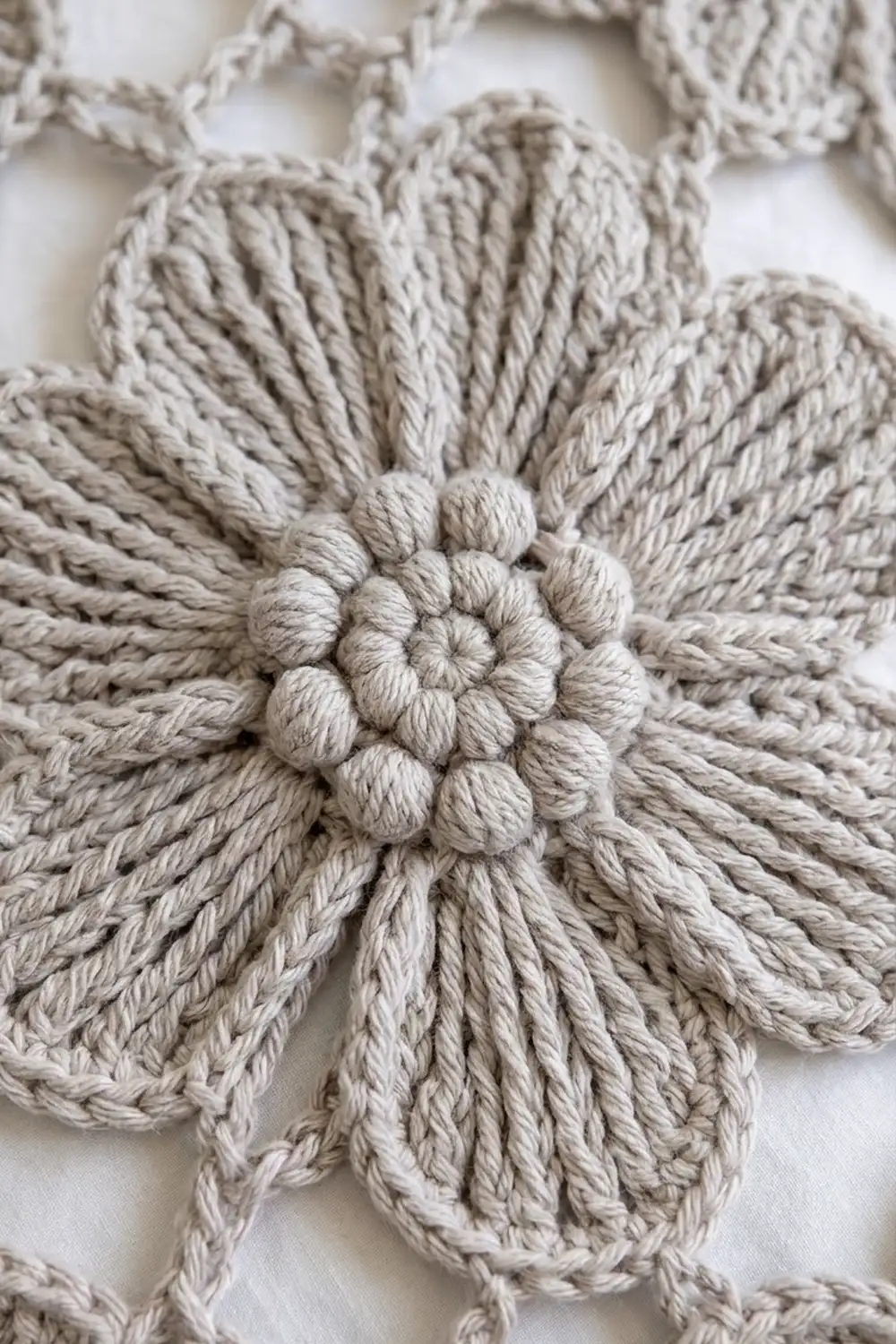
Large Flower Square (make 72)
Begin with a magic ring. Join every round with a sl st to the first st. The beginning ch 1 never counts as a stitch.
The Bobble Center
Round 1: Ch 1, 8 sc in ring. Pull ring closed. (8 sc)
Round 2: Ch 1, *bobble in next sc, sc in same sc; rep from * around. (16 sts: 8 bobbles, 8 sc)
Round 3: Ch 1, *sc in next bobble, 2 sc in next sc; rep from * around. (24 sc)
Round 4: Ch 1, *bobble in next st, sc in next 2 sts; rep from * around. (24 sts: 8 bobbles, 16 sc)
Round 5: Ch 1, *sc in next 2 sts, 2 sc in next st; rep from * around. (32 sc)
The two rings of 8 bobbles make the dense, domed center.
The Petals
Round 6: Ch 1, *sc in next st, ch 5, sk next 3 sts; rep from * around. (8 sc, 8 ch-5 sps)
Round 7: Ch 1, *sc in next sc, (hdc, 3 dc, 4 tr, ch 2, 4 tr, 3 dc, hdc) in next ch-5 sp; rep from * around. (136 sts: 8 separator sc + 8 petals of 16 sts; plus 8 ch-2 tips)
The fanned dc and tr make the radiating lines on each petal, and the ch-2 gives each petal a softly pointed tip.
Round 8 (petal rim): Ch 1, *sk separator sc, sc BLO in next 8 sts, (sc, ch 2, sc) in ch-2 tip, sc BLO in next 8 sts; rep from * around. (144 sc: 18 per petal; plus 8 ch-2 tips)
Skipping the separator sc separates the petals. The free front loops leave a fine line just inside the rim.
The Mesh Frame
Sl st in next 7 sc and into the ch-2 tip. This petal is a corner petal. From here the petals alternate: corner, side, corner, side.
Round 9: Ch 1, *(sc, ch 9, sc) in corner tip, ch 7, sc in dip, ch 5, sc in side tip, ch 5, sc in dip, ch 7; rep from * 3 more times. (20 sc; 4 ch-9 corner loops, 8 ch-7 loops, 8 ch-5 loops)
The longer ch-7 loops beside each corner push the corners outward, so the circle becomes a square.
Round 10: Sl st into ch-9 corner loop. Ch 1, *(sc, ch 7, sc) in corner loop, [ch 5, sc in next loop] 4 times, ch 5; rep from * around. (24 sc; 4 ch-7 corner loops, 20 ch-5 loops: 5 per side)
Round 11: Sl st into ch-7 corner loop. Ch 1, *(sc, ch 5, sc) in corner loop, [ch 5, sc in next ch-5 loop] 5 times, ch 5; rep from * around. (28 sc; 4 ch-5 corner loops, 24 ch-5 side loops: 6 per side)
Fasten off and weave in ends. Only the first square is worked plain. Every other square joins on Round 11.
Small Flower (make 56)
Round 1: Magic ring, ch 1, 8 sc in ring. (8 sc)
Round 2: Ch 1, *bobble in next sc, sc in same sc; rep from * around. (16 sts)
Round 3: Ch 1, *sc in next st, ch 3, sk next st; rep from * around. (8 sc, 8 ch-3 sps)
Round 4: Ch 1, *sc in next sc, (hdc, 2 dc, ch 1, 2 dc, hdc) in next ch-3 sp; rep from * around. (56 sts: 8 sc + 8 petals of 6 sts; plus 8 ch-1 tips)
Round 5: Ch 1, *sk sc, sc BLO in next 3 sts, (sc, ch 1, sc) in ch-1 tip, sc BLO in next 3 sts; rep from * around. (64 sc: 8 per petal)
Fasten off and leave a 12 in (30.5 cm) tail for sewing. The flower measures 3.5 in (8.9 cm) across.
Make All Pieces
All pieces use Light Greige.
- 72 large flower squares: about 28 g each, 2,016 g total
- 56 small flowers: about 5 g each, 280 g total
- Border: about 300 g
Layout (L = large square, + = small flower over an interior junction):
L L L L L L L L
 + + + + + + +
L L L L L L L L
 + + + + + + +
L L L L L L L L
 + + + + + + +
L L L L L L L L
 + + + + + + +
L L L L L L L L
 + + + + + + +
L L L L L L L L
 + + + + + + +
L L L L L L L L
 + + + + + + +
L L L L L L L L
 + + + + + + +
L L L L L L L L
That makes 9 rows of 8 squares, with 7 x 8 = 56 interior junctions.
Joining
Join as you go on Round 11. Work Rounds 1–10 of a new square. Then work Round 11 until you reach the first corner that touches a finished square.
Joined corner: In the corner loop work sc, ch 2, sl st in the neighbor’s corner loop, ch 2, sc in same corner loop of the current square.
Joined side loop: Ch 2, sl st in the matching ch-5 loop of the neighbor, ch 2, sc in next Round 10 loop.
Each side has 6 side loops, so each joined side has 6 side joins plus a corner join at each end. The joins match one-to-one: loop 1 joins loop 1 and loop 6 joins loop 6. Nothing is skipped or doubled.
Four-way junctions: When the third and fourth squares reach a shared corner, sl st into the same sl st that already joins the first two corners. All four corners then meet at one point.
Tension: Keep the ch-2 halves relaxed. A ch-2 + sl st + ch-2 should be the same length as an unjoined ch-5. Tight joins pucker the mesh, and loose ones make squares sag.
Size checkpoint: After the first row of 8 squares, lay it flat. It should measure 80 in (203.2 cm) wide, within 1 in (2.5 cm). After all 9 rows, the panel measures 80 x 90 in (203.2 x 228.6 cm).
Sew a small flower centered over each interior junction. Stitch through its Round 3 sc and catch the joining sl st underneath. Leave the petals free.
Border
Border gauge: 16 sc = 4 in (10.2 cm), the same as the base gauge. One 10 in (25.4 cm) square side takes 40 sc.
Round 1: With right side facing, join yarn in any bedspread corner loop. Work 2 sc in each square corner loop along the edge and 6 sc in each ch-5 side loop. In each of the 4 bedspread corner loops, work (2 sc, ch 2, 2 sc).
Per square side: 2 + (6 x 6) + 2 = 40 sc. At a seam, the two neighboring corner loops each take their own 2 sc. Those are already counted in each square’s 40. At a bedspread corner, the first 2 sc finish one side and the last 2 sc begin the next, so each is counted once.
- Short sides: 8 x 40 = 320 sc each
- Long sides: 9 x 40 = 360 sc each
- Total: 1,360 sc, plus 4 ch-2 corner sps
Round 2 (petal scallops): Ch 1. On each side, *sc in next st, sk 3 sts, (dc, 2 tr, ch 2, 2 tr, dc) in next st, sk 3 sts; rep from * across. Then work (dc, 2 tr, ch 2, 2 tr, dc) in the corner ch-2 sp.
Each repeat uses 8 sts. Short sides: 320 / 8 = 40 scallops. Long sides: 360 / 8 = 45 scallops. With the 4 corner scallops, that makes 174 scallops in total.
Round 3 (scallop rim): Ch 1, *sc in sc, sc BLO in next 3 sts, (sc, ch 1, sc) in ch-2 tip, sc BLO in next 3 sts; rep from * around. Work the corner scallops the same way but without the leading sc. (9 sc per side scallop, 8 sc per corner scallop)
Why the math works: Every square side is the same 10 in (25.4 cm) with 6 side loops, so every side gives exactly 40 sc. Because 40 divides evenly by 8, each square side carries exactly 5 scallops. Both bedspread sides divide evenly, with no stitches left over. The border adds 2 in (5.1 cm) per side: 80 + 4 = 84 in (213.4 cm) and 90 + 4 = 94 in (238.8 cm).
Final Blocking
- Weave in all remaining ends along stitch lines, never across open mesh.
- Lay the bedspread on blocking mats in sections, right side up.
- Mist each section until it is damp but not soaked.
- Pin the outer corners first, to 84 x 94 in (213.4 x 238.8 cm).
- Pin each square junction along the edges every 10 in (25.4 cm) so the grid stays straight.
- Open the mesh with your fingers and pin each border scallop tip.
- Gently press the bobble centers and small flowers upward so they stay domed.
- Let each section dry completely before moving on.
Final Quality-Control Checklist
- 72 large squares and 56 small flowers are in place
- Every large flower has 8 petals and 16 bobbles
- Every square measures 10 in (25.4 cm) per side
- Each joined side has 6 side joins, none skipped or doubled
- Four-way junctions meet at a single point
- Border Round 1 has 320 and 360 sc per side
- There are 174 scallops in total, with matching corner scallops
- Finished size is 84 x 94 in (213.4 x 238.8 cm)
Troubleshooting
Bobbles sink to the back: Push them forward after each round and keep the sc beside them snug.
Petals ruffle: Your tr are too tall. Tighten your yarn-overs or go down a hook size for Round 7 only.
Squares stay round: Check that the ch-7 loops on Round 9 sit beside the corners, then block the corners firmly.
Mesh puckers along seams: The joining ch-2s are too tight. Rework them more loosely.
Border ripples: You worked extra sc in some loops. Recount to 40 per square side.
Border cups inward: You worked too few sc, or your border tension is tighter than your square tension.
Care
Hand wash in cool water with gentle soap, roll in a towel to remove water, and dry flat. Do not hang it, because the weight of the lace will stretch it.
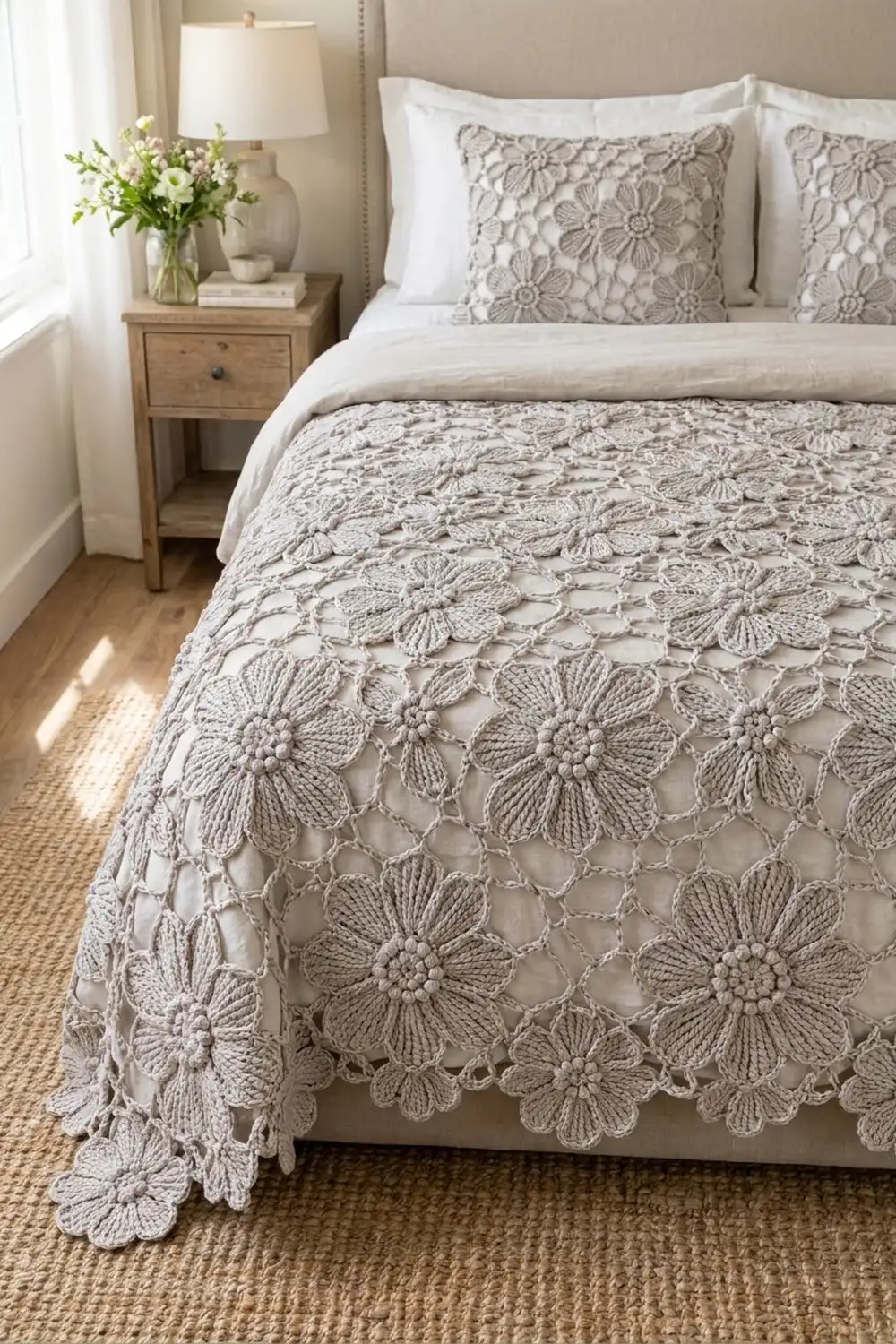
Final Notes
The measurements build in a simple chain. A 6.5 in (16.5 cm) flower grows to a 10 in (25.4 cm) square. 8 x 9 squares make an 80 x 90 in (203.2 x 228.6 cm) panel. A 2 in (5.1 cm) border brings the bedspread to 84 x 94 in (213.4 x 238.8 cm). Check your first square carefully, count your loops, and the rest follows.
Happy crocheting!