

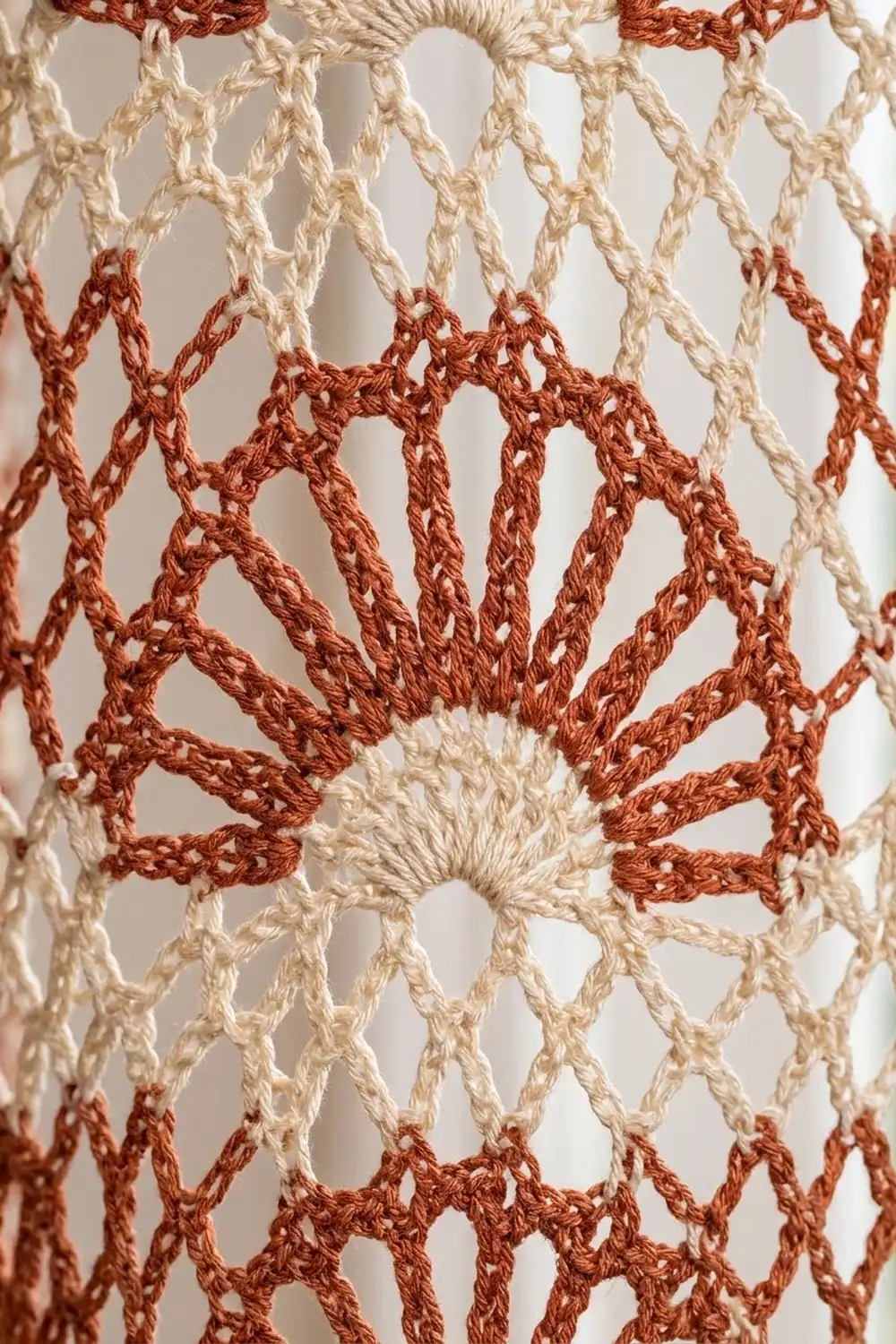
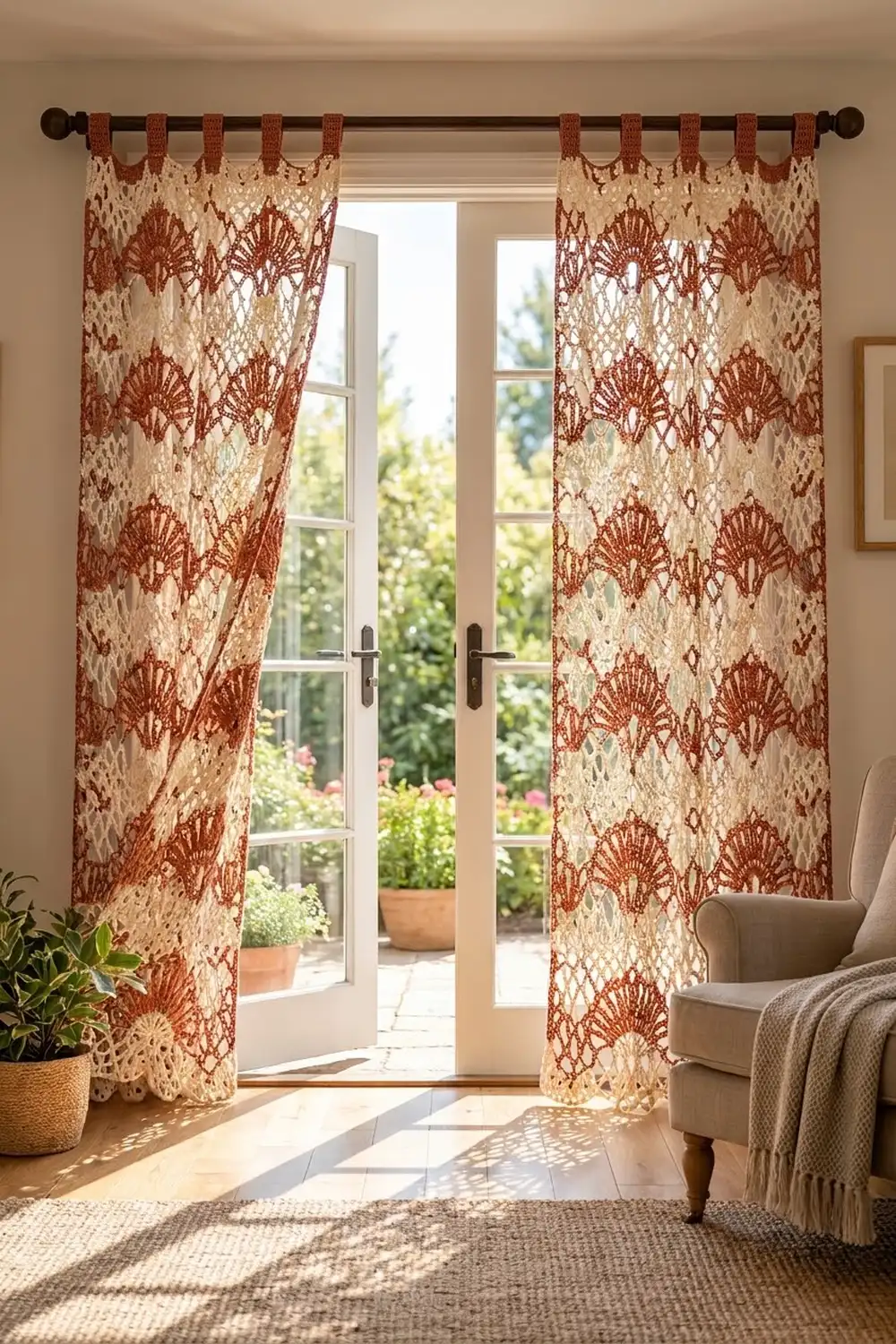
These tab-top curtains bring warm, sunlit texture to a doorway. Each panel is an airy cream mesh with rows of terracotta fans that open upward and are staggered from one band to the next, so the eye moves across the lace instead of straight down it.
Two colors carry the design. Cream forms the net and the solid core of every fan. Rust forms the fan spokes, the scalloped arch above them, the bottom scallops, and the rod tabs. The look is relaxed and boho, but the stitch structure is tidy and easy to count.
The pattern uses US terms. Each finished panel measures 32¾ in (83.2 cm) wide by 77 in (195.6 cm) long without the tabs, and hangs about 80 in (203.2 cm) from the rod.
Each panel is worked in one piece from the bottom up in rows, with the fans built into the mesh. A three-round border goes around the panel, and the tabs are worked straight off the top edge. You make two panels, and they are never joined.
Finished Size and Construction
- Finished panel size: 32¾ in × 77 in (83.2 cm × 195.6 cm), plus 3 in (7.6 cm) tab loops
- Skill level: Intermediate
- Terminology: US
- Yarn weight: DK (light #3) cotton
- Hook: 4.0 mm (G-6)
- Number of pieces: 2 separate panels (not joined)
- Layout: 10 fan bands per panel, alternating 3 fans and 2 fans
- Body size before border: 31¼ in × 75 in (79.4 cm × 190.5 cm)
- Border depth: ¾ in (1.9 cm) on the sides and top; 1¼ in (3.2 cm) at the scalloped bottom
Materials
Choose a smooth mercerized or combed DK cotton, or a cotton-linen blend. These drape well, hold their shape in sunlight, and show the fan spokes clearly. The amounts below assume about 230 m per 100 g.
- Cream (MC): 450 g / about 1,035 m for the pair (225 g / about 518 m per panel)
- Rust/terracotta (CC): 150 g / about 345 m for the pair (75 g / about 173 m per panel)
- 4.0 mm (G-6) crochet hook
- Tapestry needle
- Stitch markers
- Rust-proof pins, blocking mats or a clean carpet, and a measuring tape
These quantities include a margin of about 10% for the gauge swatch and tension differences.
Abbreviations (US Terms)
- ch – chain
- sc – single crochet
- dc – double crochet
- sk – skip
- sp(s) – space(s)
- tch – turning chain
- st(s) – stitch(es)
Special stitch – Fan base: 9 dc worked into one ch-5 sp.
Gauge and Checkpoints
- Mesh gauge: 4 ch-5 loops = 5 in (12.7 cm) wide, and 16 rows = 10 in (25.4 cm) tall, after blocking.
- Border gauge: 16 sc = 5 in (12.7 cm).
Test one piece first. Ch 38 and work Row 1 (you will have 9 loops). Then work one fan band with a single fan in sp 5, plus 8 mesh rows. To do this, follow the first and last fan of Band A below, with 3 loops on each side of the fan. Block the swatch.
- Checkpoint 1: The swatch is 11¼ in (28.6 cm) wide.
- Checkpoint 2: After you finish Row 25 of the panel (two repeats), Rows 2–25 measure 15 in (38.1 cm).
- Checkpoint 3: Before the border, the body measures 31¼ in × 75 in (79.4 cm × 190.5 cm).
If your swatch is too big, go down half a hook size. If it’s too small, go up half a size. If only the height is off, change how tall you pull up your dc and how loose your ch-5 loops are, but keep the loop count.
Mesh Rows
The panel switches between two kinds of mesh row:
Offset Row (O): Ch 5 (counts as dc + ch 2), turn. Sc in first ch-5 sp, [ch 5, sc in next ch-5 sp] 24 times, ch 2, dc in last sc. (24 ch-5 sps + 2 half sps)
Full Row (F): Ch 1, turn. Sc in first dc, [ch 5, sc in next ch-5 sp] 24 times, ch 5, sc in 3rd ch of tch. (25 ch-5 sps)
Panel Body (make 2)
Foundation: With cream, ch 102.
Row 1 (Full): Sc in 2nd ch from hook, [ch 5, sk 3 ch, sc in next ch] 25 times. (25 ch-5 sps, 26 sc)
The pattern repeat is 12 rows. Band A has 3 fans and Band B has 2 fans, placed halfway between Band A’s fans, which gives the staggered layout.
Band A (3 fans)
Row 1 (cream): Ch 5 (counts as dc + ch 2), turn. Sc in first ch-5 sp, [ch 5, sc in next ch-5 sp] 3 times. Ch 2, 9 dc in next ch-5 sp (fan base), ch 2, sc in next ch-5 sp, [ch 5, sc in next ch-5 sp] 6 times; rep from * once more. Ch 2, 9 dc in next sp, ch 2, sc in next sp, [ch 5, sc in next sp] 3 times, ch 2, dc in last sc. Finish the last dc with rust. (3 fans = 27 dc, 18 ch-5 sps, 6 ch-2 sps, 2 half sps)*
The fans sit in sps 5, 13, and 21, so they are placed evenly across the 25-loop width. Each 9-dc fan base is the cream half-circle core.
Row 2 (rust): Ch 1, turn. Sc in first dc, [ch 5, sc in next ch-5 sp] 3 times. Ch 2, sk ch-2 sp, dc in first dc of fan, [ch 1, dc in next dc] 8 times, ch 2, sk ch-2 sp, sc in next ch-5 sp, [ch 5, sc in next ch-5 sp] 5 times; rep from * once. Work the spokes over the third fan, sc in next ch-5 sp, [ch 5, sc in next ch-5 sp] twice, ch 5, sc in 3rd ch of tch. (16 ch-5 sps; per fan: 9 dc spokes, 8 ch-1 sps)*
Row 3 (rust): Ch 5, turn. Sc in first ch-5 sp, [ch 5, sc in next ch-5 sp] twice. Ch 3, sk ch-2 sp, sc in next ch-1 sp, [ch 3, sc in next ch-1 sp] 7 times, ch 3, sk ch-2 sp, sc in next ch-5 sp, [ch 5, sc in next ch-5 sp] 4 times; rep from * once. Work the arch over the third fan, sc in next ch-5 sp, [ch 5, sc in next ch-5 sp] twice, ch 2, dc in last sc. Finish the last dc with cream. (12 ch-5 sps; 3 arches of 9 ch-3 sps each)*
The ch-3 loops form the rust arch rim on top of the spokes.
Row 4 (cream, conversion row): Ch 1, turn. Sc in first dc, [ch 5, sc in next ch-5 sp] twice. [Ch 5, sk next ch-3 sp, sc in next ch-3 sp] 4 times, ch 5, sk last ch-3 sp, sc in next ch-5 sp, [ch 5, sc in next ch-5 sp] 3 times; rep from * once. Work the arch conversion over the third arch, ch 5, sc in next ch-5 sp, ch 5, sc in 3rd ch of tch. (2 + 5 + 3 + 5 + 3 + 5 + 2 = 25 ch-5 sps)*
Each 9-loop arch turns back into 5 mesh loops, so the full mesh count of 25 is restored.
Rows 5–12 (cream): Work [Row O, Row F] 4 times. (25 ch-5 sps after Row 12)
Band B (2 fans)
Work the same four fan rows as Band A, using these groups:
- Row 1: Sc in first sp, [ch 5, sc] 7 times, fan in sp 9, sc in sp 10, [ch 5, sc] 6 times, fan in sp 17, sc in sp 18, [ch 5, sc] 7 times, ch 2, dc. (20 ch-5 sps, 2 fans)
- Row 2: Sc in dc, [ch 5, sc] 7 times, spokes, sc, [ch 5, sc] 5 times, spokes, sc, [ch 5, sc] 6 times, ch 5, sc in tch. (19 ch-5 sps)
- Row 3: Ch 5, sc, [ch 5, sc] 6 times, arch, sc, [ch 5, sc] 4 times, arch, sc, [ch 5, sc] 6 times, ch 2, dc. (16 ch-5 sps)
- Row 4: Sc in dc, [ch 5, sc] 6 times, conversion, [ch 5, sc] 3 times, conversion, [ch 5, sc] 5 times, ch 5, sc in tch. (6 + 5 + 3 + 5 + 6 = 25 ch-5 sps)
- Rows 5–12: [Row O, Row F] 4 times.
Color handling: Rust always joins and leaves at the same side edge. Carry the yarn not in use up that edge, twisting it with the working yarn every 2 rows. The border will cover it.
Panel rows:
– Rows 2–13: Band A
– Rows 14–25: Band B
– Repeat these 24 rows until 10 bands are complete, ending with Row 121 (a Full Row).
Don’t fasten off cream.
Make Both Panels
Make 2 identical panels. Each one uses about 225 g cream and 75 g rust.
Per panel: 25 fans (5 bands × 3 + 5 bands × 2).
Layout per panel (F = fan, · = mesh only), read from the top:
Rows 110–121  B:  ·  F  ·  F  ·
Rows  98–109  A:  F  ·  F  ·  F
Rows  86–97   B:  ·  F  ·  F  ·
Rows  74–85   A:  F  ·  F  ·  F
Rows  62–73   B:  ·  F  ·  F  ·
Rows  50–61   A:  F  ·  F  ·  F
Rows  38–49   B:  ·  F  ·  F  ·
Rows  26–37   A:  F  ·  F  ·  F
Rows  14–25   B:  ·  F  ·  F  ·
Rows   2–13   A:  F  ·  F  ·  F
Row    1      foundation mesh
The panels hang side by side, as in the photo, and are not joined.
Border
Border gauge: 16 sc = 5 in (12.7 cm), which is 3.2 sc per inch. Side counts below include both corner center stitches.
Rnd 1 (cream): Ch 1. Work 3 sc in the last sc of Row 121 (corner).
– Down the side: 2 sc in each row end of Rows 120–2.
– Bottom corner: 3 sc in the foundation ch at the base of the end sc.
– Bottom: working in the foundation ch, 3 sc in each ch-3 group and 1 sc in the base of each of the 24 interior sc.
– Second bottom corner: 3 sc in the last foundation ch.
– Up the side: 2 sc in each row end of Rows 2–120.
– Top corner: 3 sc in the first sc of Row 121.
– Top: 3 sc in each ch-5 sp and 1 sc in each of the 24 interior sc.
Join to the first sc.
Count: top and bottom 103 sts each; sides 242 sts each; 686 sts total.
Rnd 2 (cream): Ch 1. Sc in each st, working 3 sc in each corner center st. Join.
Count: top and bottom 105; sides 244; 694 total.
Rnd 3 (rust): Join rust.
– Top and sides: sc in each st, working 3 sc in each corner center.
– Bottom: between the corner centers, sc in first st, [sk 2, 5 dc in next st, sk 2, sc in next st] 17 times. This uses exactly 103 sts.
Join and fasten off.
Count: top 107; sides 246; bottom 17 scallops (85 dc + 18 sc between corner centers); 708 total.
Why the math works: Each ch-5 loop is 1¼ in (3.2 cm) wide and gets 4 sc (3 in the loop and 1 at its anchor). That is 3.2 sc per inch. Each row is ⅝ in tall and gets 2 sc, which is also 3.2 sc per inch. So the edges lie flat. The bottom has 6 × 17 + 1 = 103 sts, so the scallops are centered.
Tabs
Count the sts across the top of Rnd 3, not counting corner sts: there are 105. Mark sts 8–14, 29–35, 50–56, 71–77, and 92–98. That leaves 7 sts at each edge and 14 sts in each gap.
For each tab, join rust in the first marked st, then:
– Row 1: Sc in each of the 7 marked sts.
– Rows 2–20: Ch 1, turn, sc across. (7 sc)
The tab measures about 2¼ in × 6 in (5.7 cm × 15.2 cm), using a tab gauge of 10 rows = 3 in (7.6 cm).
Fold the tab to the wrong side and whipstitch Row 20 to the back of Rnd 1. This makes a 3 in (7.6 cm) loop.
Final Blocking
- Weave in all ends along the border, not through the open mesh.
- Soak the panel in cool water for 15 minutes, then press out the water in a towel. Don’t wring.
- Lay it flat on mats or a clean carpet.
- Pin it to 32¾ in × 77 in (83.2 cm × 195.6 cm).
- Pin each bottom scallop tip, and put one pin in each fan arch to open the spokes.
- Let it dry completely. Repeat for the second panel and match the sizes.
Final Quality-Control Checklist
- Every Full Row has 25 ch-5 sps.
- Band A has 3 fans and Band B has 2, and they are staggered.
- Every fan has 9 cream dc, 9 rust spokes, and 9 rust arch loops.
- The body measures 31¼ in × 75 in (79.4 cm × 190.5 cm) before the border.
- The border counts are 686, 694, and 708.
- There are 17 bottom scallops.
- There are 5 evenly spaced tabs.
- Both panels are the same size within ½ in (1.3 cm).
Troubleshooting
- The fans are cupping: Your dc are too tight. Loosen them, or use ch 2 between spokes only when blocking won’t flatten them.
- The mesh slants: Check that each row starts with the correct turning chain: ch 5 for Offset rows, ch 1 for Full rows.
- Wrong loop count after Row 4: Recount the arch conversion. You should sc in arch sps 2, 4, 6, and 8 only.
- The side edges ripple: Use 2 sc per row end, not 3.
- The rust floats show: Twist the carried yarn more often.
Care
Hand wash in cool water with mild soap, roll in a towel, and dry flat. Re-pin if needed. Avoid hot dryers, which can shrink cotton and distort the mesh.
Final Notes
The measurements build on each other:
– 4 loops = 5 in (12.7 cm), and 16 rows = 10 in (25.4 cm).
– The 25-loop body is 31¼ in × 75 in (79.4 cm × 190.5 cm).
– The 3-round border brings each panel to 32¾ in × 77 in (83.2 cm × 195.6 cm).
– The 3 in (7.6 cm) tabs give a hanging length of about 80 in (203.2 cm).
Check your gauge on the swatch and you’ll have a matching pair of terracotta fan curtains.
Happy crocheting!