

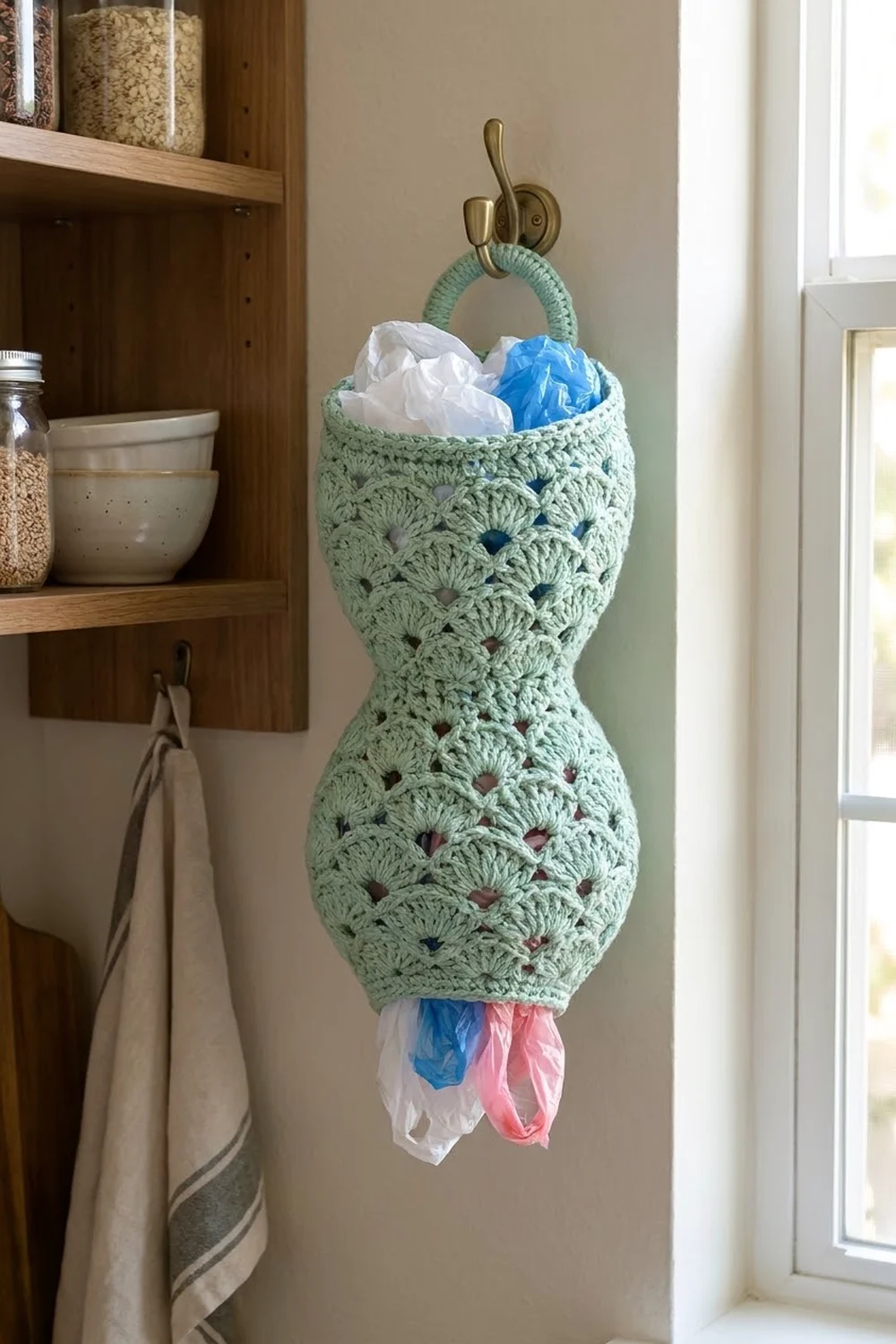
This plastic-bag holder has an hourglass shape and an open shell texture, so it looks good hanging in a kitchen or pantry. You push bags in through the wide top and pull them out one at a time through the narrower bottom band.
The sample is in a soft seafoam mint. Coral is a cheerful alternative, and any solid cotton color will work. The open fans make the shell rounds look lacy, while the dense single crochet bands at the top and bottom keep the openings firm.
The pattern uses US crochet terms. The finished body measures 15.5 in (39.4 cm) long and 7.5 in (19.1 cm) wide at the rim when laid flat. With the ring hanger, it hangs about 18.5 in (47.0 cm) tall.
You work the holder top-down in joined rounds, all in one piece. The hourglass shape comes from changing the shell size, not the number of repeats: 5-dc shells for the upper section, 3-dc shells at the waist, 7-dc shells in the bulb, and 3-dc shells again for the taper. A covered plastic ring is attached last with a short tab.
Finished Size and Construction
- Finished size: 15.5 in (39.4 cm) long body; about 18.5 in (47.0 cm) including the hanger
- Skill level: Easy+ (confident beginner)
- Terminology: US
- Yarn weight: Worsted (#4) cotton
- Hook: 5.0 mm (H-8)
- Number of pieces: 1 body tube plus 1 covered ring hanger, attached
- Layout: Single tube, no joining
- Piece size (flat): Rim 7.5 in (19.1 cm), waist 5.5 in (14.0 cm), bulb 8.5 in (21.6 cm), bottom band 5 in (12.7 cm)
- Size before border: 14.3 in (36.3 cm) long after Rnd 22
- Border depth: Bottom band 1 in (2.5 cm); top edge round 0.2 in (0.5 cm)
Materials
Use a smooth worsted-weight cotton or cotton blend. Cotton keeps its shape, holds stitch definition, and won’t stretch out under the weight of the bags. Avoid fuzzy yarns, because they hide the eyelets.
- Main color (Seafoam Mint): 150 g / about 255 m (three 50 g / 85 m balls)
- Optional colorway (Coral): the same amount, used instead of mint
These amounts include a margin of about 30 percent. The sample used about 115 g.
Tools:
– 5.0 mm (H-8) crochet hook
– One 2.5 in (6.4 cm) plastic or metal ring for the hanger
– Stitch marker
– Tapestry needle
– Scissors
– Tape measure
– Rust-proof pins and a rolled towel for blocking
Abbreviations (US Terms)
- ch – chain
- sl st – slip stitch
- sc – single crochet
- dc – double crochet
- sk – skip
- st(s) – stitch(es)
- sp – space
- rnd – round
Special stitches
- 3-Shell: 3 dc in the same stitch. The center dc is the 2nd dc.
- 5-Shell: 5 dc in the same stitch. The center dc is the 3rd dc.
- 7-Shell: 7 dc in the same stitch. The center dc is the 4th dc.
Gauge and Checkpoints
Single crochet gauge: 16 sc and 20 rnds = 4 in (10.2 cm).
Shell gauge:
– One 5-Shell repeat (shell, ch-1, sc, ch-1) = 1.5 in (3.8 cm) wide.
– 4 shell rnds = 3 in (7.6 cm), so each shell rnd is 0.75 in (1.9 cm) tall.
Test first: Work Rnds 1–9 and measure before going further. This is your test piece. If it is right, keep going. If not, pull it out and change hooks.
Measurement checkpoints (laid flat, measured from the foundation edge):
– After Rnd 4: 0.8 in (2.0 cm) tall, 7.5 in (19.1 cm) wide
– After Rnd 9: 4.55 in (11.6 cm) tall, about 7.5 in (19.1 cm) wide
– After Rnd 13: 7.55 in (19.2 cm) tall, about 5.5 in (14.0 cm) wide at the waist
– After Rnd 20: 12.8 in (32.5 cm) tall, about 8.5 in (21.6 cm) wide at the bulb
– After Rnd 22: 14.3 in (36.3 cm) tall
– After Rnd 27: 15.3 in (38.9 cm) tall, 5 in (12.7 cm) wide at the bottom band
– After the top edge round: 15.5 in (39.4 cm) tall
If your piece is too big: go down to a 4.5 mm hook. If it is too small: go up to a 5.5 mm hook. Width matters most at the rim and the bottom band. The bottom band must stay snug enough to hold the bags in, but loose enough to pull them through.
Part 1: Top Band
Ch 60 and join with a sl st to the first ch to form a ring. Don’t twist the chain.
Rnd 1: Ch 1, sc in each ch around, join with a sl st to the first sc. (60 sc)
Rnds 2–4: Ch 1, sc in each st around, join. (60 sc)
Checkpoint: 0.8 in (2.0 cm) tall and 7.5 in (19.1 cm) wide when flat.
Part 2: Shell Body
How the rounds work: Every shell round has 10 repeats. In each round, the sc sits on the center dc of a shell from the round below, and each new shell is worked into a sc from the round below. This offsets the fans like bricks.
The ch-1 on each side of every shell makes the small eyelets under the fans. Join every round with a sl st to its first sc, and don’t turn.
Starting each round from Rnd 6 on: Sl st into the next ch-1 sp. Then sl st in each dc up to (but not into) the center dc of the first shell. That is 1 dc after a 3-Shell round, 2 dc after a 5-Shell round, or 3 dc after a 7-Shell round.
Standard shell round, used from Rnd 6 on: Ch 1. Sc in the center dc of the next shell, ch 1, [Shell] in the next sc, ch 1. Repeat from * 9 more times (10 repeats), then join.
Upper Section (5-Shells)
Rnd 5 (set-up): Ch 1. Sc in the next st, ch 1, sk 2 sts, 5-Shell in the next st, ch 1, sk 2 sts. Repeat from * 9 more times, then join.
(10 shells = 50 dc, plus 10 sc = 60 sts, plus 20 ch-1 sps. Each repeat uses 6 sts of Rnd 4, and 10 × 6 = 60.)
Rnds 6–9: Work the standard shell round with 5-Shells. (Each round: 50 dc + 10 sc = 60 sts, plus 20 ch-1 sps)
Checkpoint: 4.55 in (11.6 cm) tall, about 7.5 in (19.1 cm) wide. The circumference is 10 repeats × 1.5 in = 15 in (38.1 cm).
Waist (3-Shells)
Rnds 10–13: Work the standard shell round with 3-Shells. (Each round: 30 dc + 10 sc = 40 sts, plus 20 ch-1 sps)
With fewer dc per shell, the fabric draws in. Each repeat is now about 1.1 in (2.8 cm), so the circumference is 11 in (27.9 cm).
Checkpoint: 7.55 in (19.2 cm) tall, about 5.5 in (14.0 cm) wide.
Lower Bulb (5-Shells and 7-Shells)
Rnd 14: Work the standard shell round with 5-Shells. (50 dc + 10 sc = 60 sts, plus 20 ch-1 sps)
Rnds 15–19: Work the standard shell round with 7-Shells. (Each round: 70 dc + 10 sc = 80 sts, plus 20 ch-1 sps)
Rnd 20: Work the standard shell round with 5-Shells. (50 dc + 10 sc = 60 sts, plus 20 ch-1 sps)
At the widest point, each repeat is about 1.7 in (4.3 cm), so the circumference is 17 in (43.2 cm).
Checkpoint: 12.8 in (32.5 cm) tall, about 8.5 in (21.6 cm) wide across the bulb.
Taper (3-Shells)
Rnds 21–22: Work the standard shell round with 3-Shells. (Each round: 30 dc + 10 sc = 40 sts, plus 20 ch-1 sps)
Checkpoint: 14.3 in (36.3 cm) tall. This is the size before the border. Don’t fasten off.
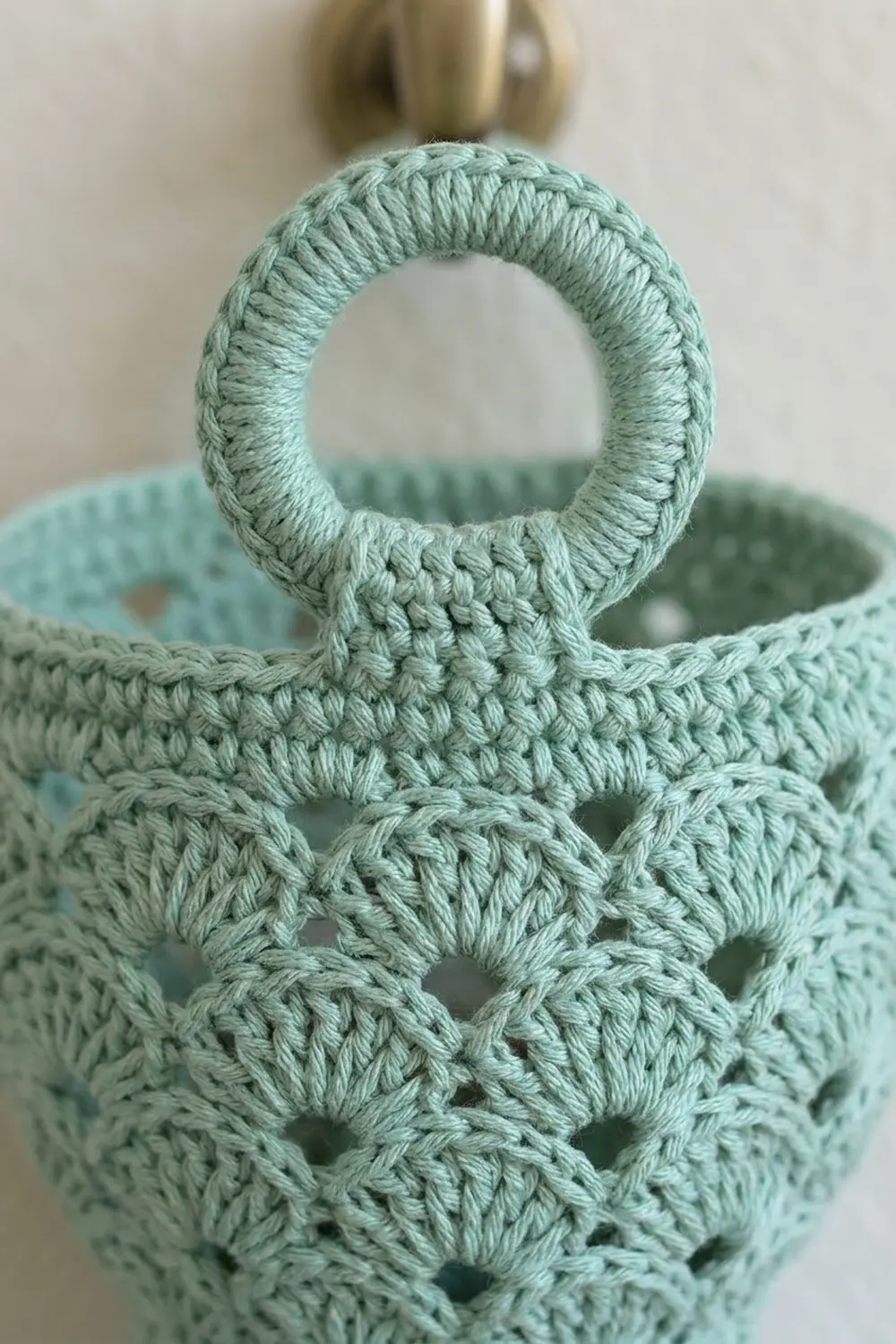
Part 3: Covered Ring Hanger
Make a slip knot and pull up a loop. Work sc around the 2.5 in (6.4 cm) ring, about 50 sc, packing them tightly until no ring shows. Add or remove stitches one at a time until the cover lies smooth with no gaps and no ruffling.
Join with a sl st to the first sc and fasten off, leaving an 8 in (20.3 cm) tail. Weave the tail in. The covered ring measures about 3 in (7.6 cm) across. Set it aside until the border is done.
Border
Border gauge: 16 sc = 4 in (10.2 cm), so 4 sc per inch. All border rounds are plain sc, so the gauge alone sets the opening sizes.
Bottom Band (Continue From Rnd 22)
Rnd 23 (conversion): Do not sl st across this round. Ch 1. Sc in the next sc, sc in the ch-1 sp, sc in the center dc of the shell (skip the 2 outer dc), sc in the next ch-1 sp. Repeat from * 9 more times, then join.
Count: (10 sc into sc + 10 sc into center dc = 20 sts worked one per existing stitch) + (20 sc worked into ch-1 sps) = 40 sc.
Rnds 24–27: Ch 1, sc in each st around, join. (40 sc)
Fasten off and weave in the end.
Why the math works: 40 sc ÷ 4 sc per inch = 10 in (25.4 cm) around, or 5 in (12.7 cm) flat. That matches the 3-Shell taper above it, which is 40 stitches around, so the band sits flat without flaring or pulling in. The opening is about 3.2 in (8.1 cm) across, small enough to hold the bags and big enough to pull one out.
Top Edge Round
With the top edge facing you, join yarn at the foundation-chain join. This spot is the center back.
Edge Rnd: Ch 1. Work 1 sc into the free loop of each foundation ch, join.
Count: 60 sts worked one per existing stitch + 0 added = 60 sc.
Don’t fasten off.
Why the math works: 60 sc ÷ 4 sc per inch = 15 in (38.1 cm) around, or 7.5 in (19.1 cm) flat. That matches Rnds 1–4 exactly, so the rim stays round and doesn’t ruffle. The edge round makes the top 0.2 in (0.5 cm) taller, bringing the body to 15.5 in (39.4 cm), and it gives the rim the same firm finish as the bottom band.
Hanger Tab
Continue from the Edge Rnd at center back.
Row 1: Sc in the next 6 sts. (6 sc)
Rows 2–7: Ch 1, turn, sc in each st across. (6 sc)
The tab measures 1.5 in (3.8 cm) wide and 1.4 in (3.6 cm) long. Slide the covered ring onto the tab, fold the tab toward the inside, and whipstitch Row 7 to the inside of the top band at the level of Rnd 2.
The ring now stands about 3 in (7.6 cm) above the rim, for a total hanging height of about 18.5 in (47.0 cm).
Final Blocking
- Weave in all the ends along the sc bands, where the fabric is densest.
- Soak the holder in cool water for 10 minutes, then press out the water gently. Don’t wring it.
- Roll it in a towel to remove more moisture.
- Stuff the upper section and the bulb lightly with plastic bags or a rolled towel until the rim is 7.5 in (19.1 cm) wide and the bulb is 8.5 in (21.6 cm) wide when flat.
- Pinch the waist in to 5.5 in (14.0 cm) and nudge the fans so they line up in columns.
- Hang it from the ring and let it dry completely. Gravity sets the length at 15.5 in (39.4 cm).
Final Quality-Control Checklist
- [ ] Every shell round has 10 shells and 10 sc.
- [ ] The rim measures 60 sc and 7.5 in (19.1 cm) flat.
- [ ] The bottom band measures 40 sc and 5 in (12.7 cm) flat.
- [ ] The fans are offset like bricks, with no two shells stacked directly.
- [ ] The eyelets show clearly under each fan.
- [ ] The ring is fully covered and the tab is sewn securely on the inside.
- [ ] The body measures 15.5 in (39.4 cm) long.
- [ ] All ends are woven in and invisible.
Troubleshooting
- The fans stack instead of offsetting: You put a shell into a center dc. Shells always go into the sc, and the sc always goes into the center dc.
- The round has 9 or 11 repeats: Recount Rnd 5 against 60 sts. Each repeat must use exactly 6 stitches.
- The waist isn’t narrow enough: Tighten your tension on the 3-Shell rounds, or work them with a hook 0.5 mm smaller.
- The bottom band flares: Make sure you skipped the 2 outer dc of each shell in Rnd 23 so the round totals 40.
- The join line drifts: This is normal with joined rounds. Keep the start of every round at the center back, under the tab.
- The ring shows through its cover: Add 2–4 more sc and pack them tightly.
Care
Hand wash in cool water and lay it flat or hang it to dry. Reshape it while damp, and don’t put it in the dryer, because cotton can shrink in length.
Final Notes
Each stage measures from the one before it. The 4 sc per inch gauge gives a 60-stitch rim of 7.5 in (19.1 cm). That becomes 10 shell repeats at 1.5 in (3.8 cm) each. Changing the shell size takes the body in to a 5.5 in (14.0 cm) waist and out to an 8.5 in (21.6 cm) bulb. It then tapers to 40 stitches for a 5 in (12.7 cm) bottom band. Eighteen shell rounds at 0.75 in (1.9 cm) each, plus the bands, give a 15.5 in (39.4 cm) body. If you check each checkpoint, the finished holder will match.
Happy crocheting!