

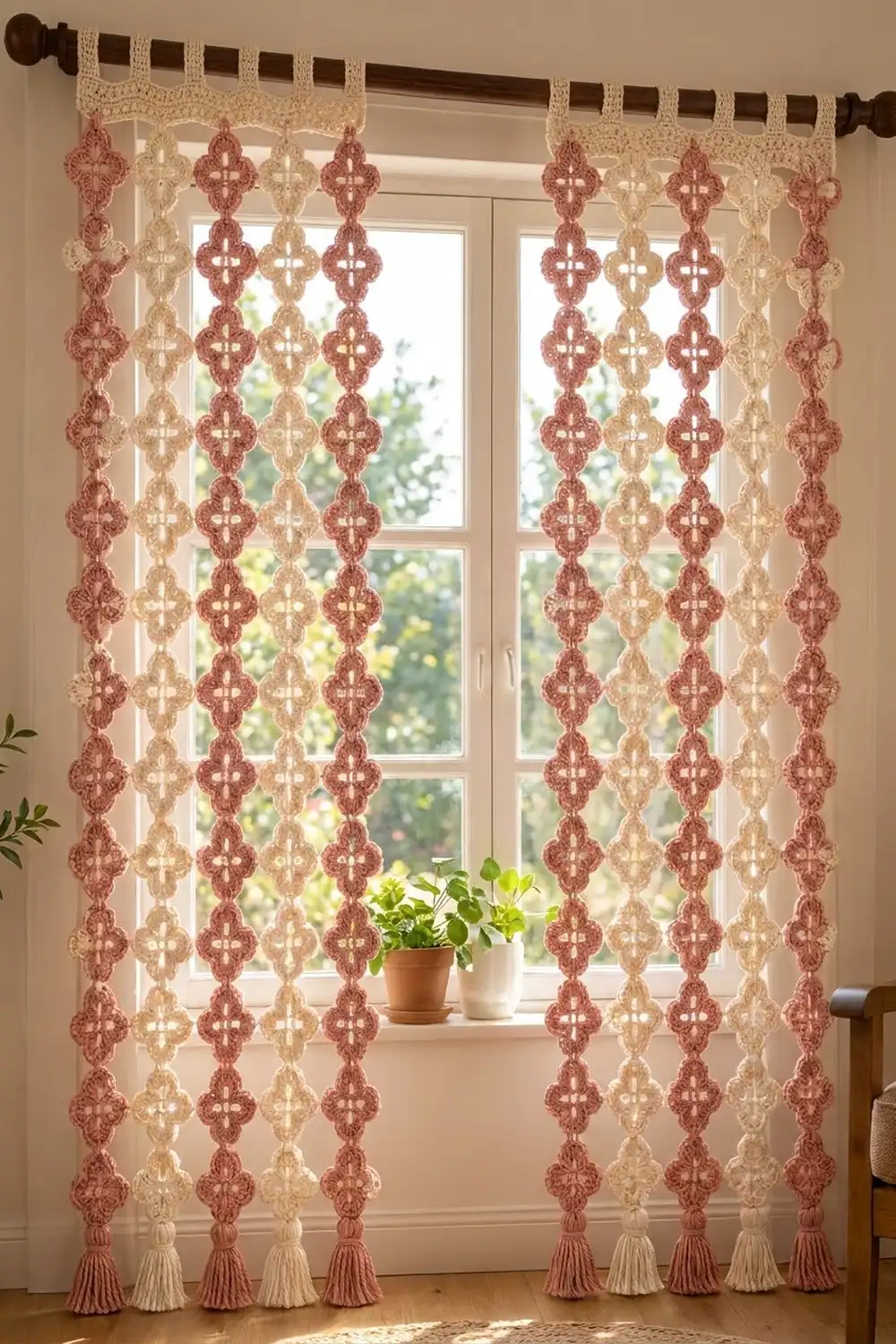
The Rosewindow Strand Curtain is a light, airy window hanging made from small four-lobed motifs. They are linked into long strands, and each strand ends in a soft tassel. Light passes through the open windows of every motif, so the curtain casts a delicate pattern on the floor on sunny days.
The palette is dusty rose and warm cream. The strands alternate color across the width, the tassels match their strands, and a solid cream header band with fabric tabs holds everything neatly on a rod. The look is boho and cottage, soft rather than busy.
This pattern uses US crochet terms. The finished curtain is 32 in (81.3 cm) wide and 49 in (124.5 cm) long from the top of the header band to the tassel tips. The tab loops add 1.5 in (3.8 cm) above the band.
You make each strand motif by motif, joining as you go with short chain bars. Next you make tassels and attach them. Last, you work a header band that catches the top loop of each strand in its first row, and you finish with eight rod tabs.
Finished Size and Construction
- Finished size: 32 in (81.3 cm) wide × 49 in (124.5 cm) long, plus 1.5 in (3.8 cm) tab loops
- Skill level: Easy–Intermediate
- Terminology: US crochet terms
- Yarn weight: Worsted (#4), cotton or cotton blend
- Hook: 5.0 mm (H-8)
- Number of pieces: 96 motifs (8 strands × 12 motifs), 8 tassels, 1 header band with 8 tabs
- Layout: 8 strands side by side; each strand is 12 motifs long
- Piece size: 3 in (7.6 cm) across, lobe tip to lobe tip
- Size before border: strand section is 32 in (81.3 cm) wide × 42.5 in (108.0 cm) long, including the top hanging loops
- Border depth: 2 in (5.1 cm) header band, plus 1.5 in (3.8 cm) tab loops
Materials
Choose a smooth, mercerized or combed worsted cotton. Cotton holds the rounded lobes crisply, does not stretch much when it hangs, and makes full, swingy tassels. Avoid fuzzy yarns, because they blur the windows.
- Dusty rose: 300 g, about 570 m (623 yd)
- Cream: 350 g, about 665 m (727 yd)
Tools:
- 5.0 mm (H-8) crochet hook
- Tapestry needle
- Scissors
- Stiff card 4 in (10.2 cm) tall, for tassels
- Stitch markers
- Measuring tape
- Blocking mats and rust-proof pins
The quantities include a margin of about 15% for swatching, tassel trimming, and differences between yarn brands.
Abbreviations (US Terms)
- ch – chain
- sl st – slip stitch
- sc – single crochet
- hdc – half double crochet
- dc – double crochet
- sp – space
- st(s) – stitch(es)
Special technique – Chain bar link: Ch 3, sl st into the specified gap on the previous motif, then sl st into each of the 3 ch back toward your current motif. This makes a firm bar about 0.5 in (1.3 cm) long that does not twist.
Gauge and Checkpoints
Make one complete motif before anything else, and measure it after a light steam.
- After Round 1: 1.25 in (3.2 cm) across
- After Round 3: 2.75 in (7.0 cm) lobe tip to lobe tip
- After Round 4: 3 in (7.6 cm) lobe tip to lobe tip
- Header band gauge: 16 sc and 16 rows = 4 in (10.2 cm)
If your motif is larger than 3.25 in (8.3 cm), go down to a 4.5 mm hook. If it is smaller than 2.75 in (7.0 cm), go up to a 5.5 mm hook. Motif size controls the strand length, and band gauge controls the width, so check both.
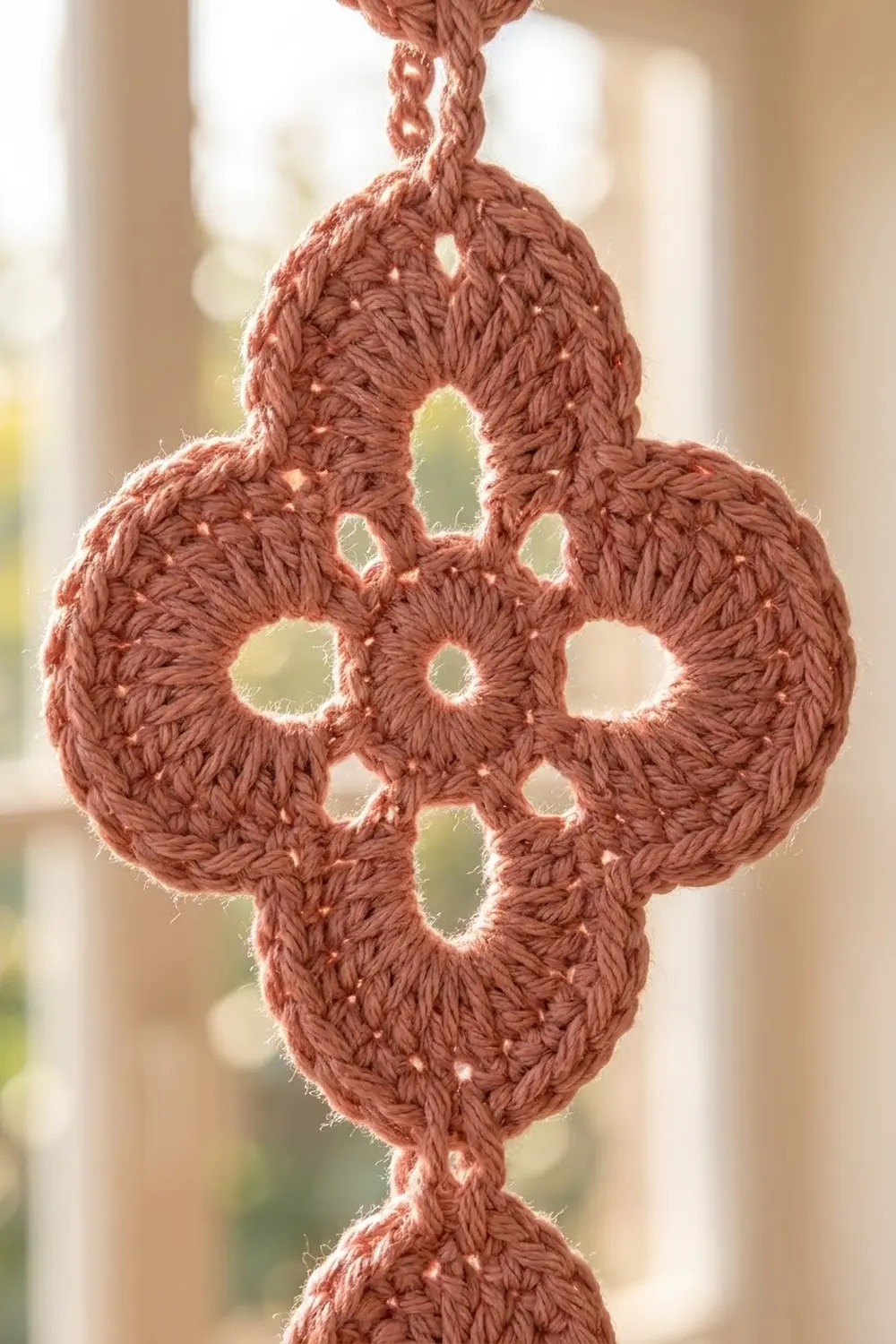
Motif Pattern
Each motif has 4 lobes. In Round 4 you’ll call the first lobe you work the top lobe and the third lobe the bottom lobe.
Round 1: Make a magic ring. Ch 3 (counts as dc), 15 dc in the ring. Join with a sl st to the top of the ch-3. Pull the ring tight. (16 dc)
Round 2: Ch 1, sc in the same st. Ch 5, skip 3 dc, sc in the next dc. Repeat from * 2 more times. Ch 5, skip 3 dc, then join with a sl st to the first sc. (4 sc, 4 ch-5 sps)
The ch-5 loops arch away from Round 1 and form the four open windows.
Round 3: Sl st into the first ch-5 sp. (Sc, hdc, 5 dc, hdc, sc) in the ch-5 sp, then sl st in the next sc. Repeat from * 3 more times. The final sl st lands in the joining sc of Round 2. (36 lobe sts + 4 sl sts = 40)
Round 4 (trim round): Ch 1. Sc in the sc, sc in the hdc, 2 sc in each of the next 5 dc, sc in the hdc, sc in the sc, then skip the sl st. Repeat from * 3 more times, and join with a sl st to the first sc. (36 sts worked once each + 20 extra sc = 56 sc; 14 sc per lobe)
Skipping the sl st pulls each dip inward, which shapes the four-lobed outline. In every lobe, sc 7 and sc 8 sit together in the center dc. The gap between them is the lobe’s center point.
Fasten off and weave in the ends. Use this plain motif as your gauge swatch.
Building a Strand
Motif 1 (top of strand): Work Rounds 1–3. In Round 4, after sc 7 of the top lobe, ch 10 and sl st into that same sc 7 to make a hanging loop. Continue with sc 8 and finish the round as written. Fasten off.
The ch-10 loop folds to about 1 in (2.5 cm) and is not counted in the 56.
Motifs 2–12: Work Rounds 1–3. In Round 4, after sc 7 of the top lobe, work a chain bar link into the gap between sc 7 and sc 8 of the previous motif’s bottom lobe. Continue with sc 8 and finish the round. Keep the right sides of both motifs facing you, so the strand doesn’t twist.
Strand checkpoint: After 4 motifs, hang the strand and measure. It should be 13.5 in (34.3 cm) from the top of Motif 1 to the bottom of Motif 4 (4 × 3 in + 3 × 0.5 in).
A full strand is 12 motifs plus 11 links: 36 in (91.4 cm) + 5.5 in (14.0 cm) = 41.5 in (105.4 cm). With the hanging loop it is 42.5 in (108.0 cm).
Tassels
Wrap matching yarn 30 times around the 4 in (10.2 cm) card. Slide a 12 in (30.5 cm) strand under the wraps at the top and tie it tightly. Cut the bottom loops.
Wrap a separate strand tightly around the tassel 0.75 in (1.9 cm) below the top, 6 times, and knot it. Hide the ends inside the tassel.
Thread the top tie ends through the gap between sc 7 and sc 8 of Motif 12’s bottom lobe. Tie the tassel so it hangs 0.5 in (1.3 cm) below the motif, then hide those ends in the tassel. Trim the tassel ends even at 4 in (10.2 cm).
Make All Pieces
- Dusty rose: 4 strands (48 motifs) and 4 rose tassels
- Cream: 4 strands (48 motifs) and 4 cream tassels, plus the header band and tabs
Layout from left to right (R = rose, C = cream):
[ ===== cream header band, 8 tabs ===== ]
  R   C   R   C   R   C   R   C   <- motif 1
  R   C   R   C   R   C   R   C
  ...  (12 motifs per strand)  ...
  R   C   R   C   R   C   R   C   <- motif 12
  T   T   T   T   T   T   T   T   <- tassels
Joining
The motifs inside each strand are already joined with chain bars. The strands are not joined to each other; they hang free and are joined only through the header band.
Each chain bar starts and ends at a lobe’s center gap, between sc 7 and sc 8. This keeps every motif centered on the strand line. Keep the bars at a medium tension: if they’re too loose the strand sags and grows, and if they’re too tight the lobes pucker.
Size checkpoint: Lay all 8 strands side by side. Each one should measure 42.5 in (108.0 cm) from the loop top to the bottom of Motif 12. If one strand is off by more than 0.5 in (1.3 cm), rework its loosest or tightest links before you attach the band.
Border: Header Band and Rod Tabs
Border gauge: 16 sc and 16 rows = 4 in (10.2 cm).
Each strand gets its own 16-st section of the band, which is 4 in (10.2 cm) wide. So the band’s starting count is 8 strands × 16 sts = 128 sts. No extra stitches are added between strands.
Foundation: With cream, ch 129.
Row 1 (joining row): Sc in the 2nd ch from the hook, and in each ch across. (128 sc)
As you work, sc 8 of every 16-st section (sts 8, 24, 40, 56, 72, 88, 104, and 120) is the joining stitch. Insert the hook into the chain and then through the tip of the strand’s ch-10 loop, and complete the sc. Attach the strands in order: R, C, R, C, R, C, R, C.
Rows 2–8: Ch 1, turn, sc in each st across. (128 sc each row)
The band is now 2 in (5.1 cm) deep. The top and bottom edges have 128 sts each, and each side edge is 8 rows.
Tabs (make 8): On Row 8, join cream at st 6 of a 16-st section. Ch 1 and sc in sts 6–11. (6 sc)
Then ch 1, turn, and sc 6. Repeat until the tab has 12 rows. It should measure 1.5 in (3.8 cm) wide × 3 in (7.6 cm) long.
Fold the tab to the back and whipstitch its end to the back of Row 8. This makes a 1.5 in (3.8 cm) loop centered over its strand. The loops fit rods up to 0.75 in (1.9 cm) in diameter.
Why the math works: The band is 128 sts at 4 sts per inch, so it is 32 in (81.3 cm) wide. Each 4 in (10.2 cm) section holds one 3 in (7.6 cm) motif. That leaves 1 in (2.5 cm) between strands and 0.5 in (1.3 cm) at each outer edge.
Final Blocking
- Lay the curtain face down on blocking mats.
- Pin the header band to 32 in × 2 in (81.3 cm × 5.1 cm).
- Straighten each strand and pin it so the strands are 4 in (10.2 cm) apart, center to center.
- Pin the lobes of several motifs into round shapes, and open the four windows.
- Steam lightly from above without touching the yarn, or spritz with water.
- Let it dry completely, at least 12 hours.
- Comb the tassels with damp fingers and trim them even at 4 in (10.2 cm).
Final Quality-Control Checklist
- [ ] Every motif measures 3 in (7.6 cm) across and has 56 sc in Round 4
- [ ] All four windows are open and even
- [ ] Each strand has 12 motifs and 11 untwisted chain bars
- [ ] Every strand measures 42.5 in (108.0 cm)
- [ ] The band measures 128 sts and 32 in (81.3 cm) wide
- [ ] The strands sit at sts 8, 24, 40, 56, 72, 88, 104, and 120
- [ ] All 8 tabs are centered over their strands
- [ ] The tassels are 4 in (10.2 cm) and match their strand color
- [ ] All ends are woven in securely
Troubleshooting
- Lobes look pointed: Make sure you put 2 sc in each of the 5 dc in Round 4.
- Motif cups or ruffles: Check that you have exactly 3 dc skipped per ch-5 in Round 2, and adjust your hook size.
- Strand twists: One motif was joined wrong side up. Undo that link and rejoin it with the right side facing you.
- Strands are different lengths: Your link tension varies. Rework the loose bars.
- Band wavy at the joins: The ch-10 loop tip was caught too deeply. Catch only the tip.
- Tassel slips: Tighten the neck wrap and double-knot it.
Care
Hand wash in cool water with mild soap, roll in a towel to remove the water, and dry flat. Reshape the lobes and comb the tassels while the curtain is damp.
Final Notes
The measurement chain is straightforward. A 3 in (7.6 cm) motif plus a 0.5 in (1.3 cm) link builds a 42.5 in (108.0 cm) strand. A 4.5 in (11.4 cm) tassel drop and a 2 in (5.1 cm) band bring the total length to 49 in (124.5 cm). Across the width, 8 strands × 16 sts gives 128 sts, which is 32 in (81.3 cm). Check each link in this chain as you go, and the curtain will hang straight and even.
Happy crocheting!