

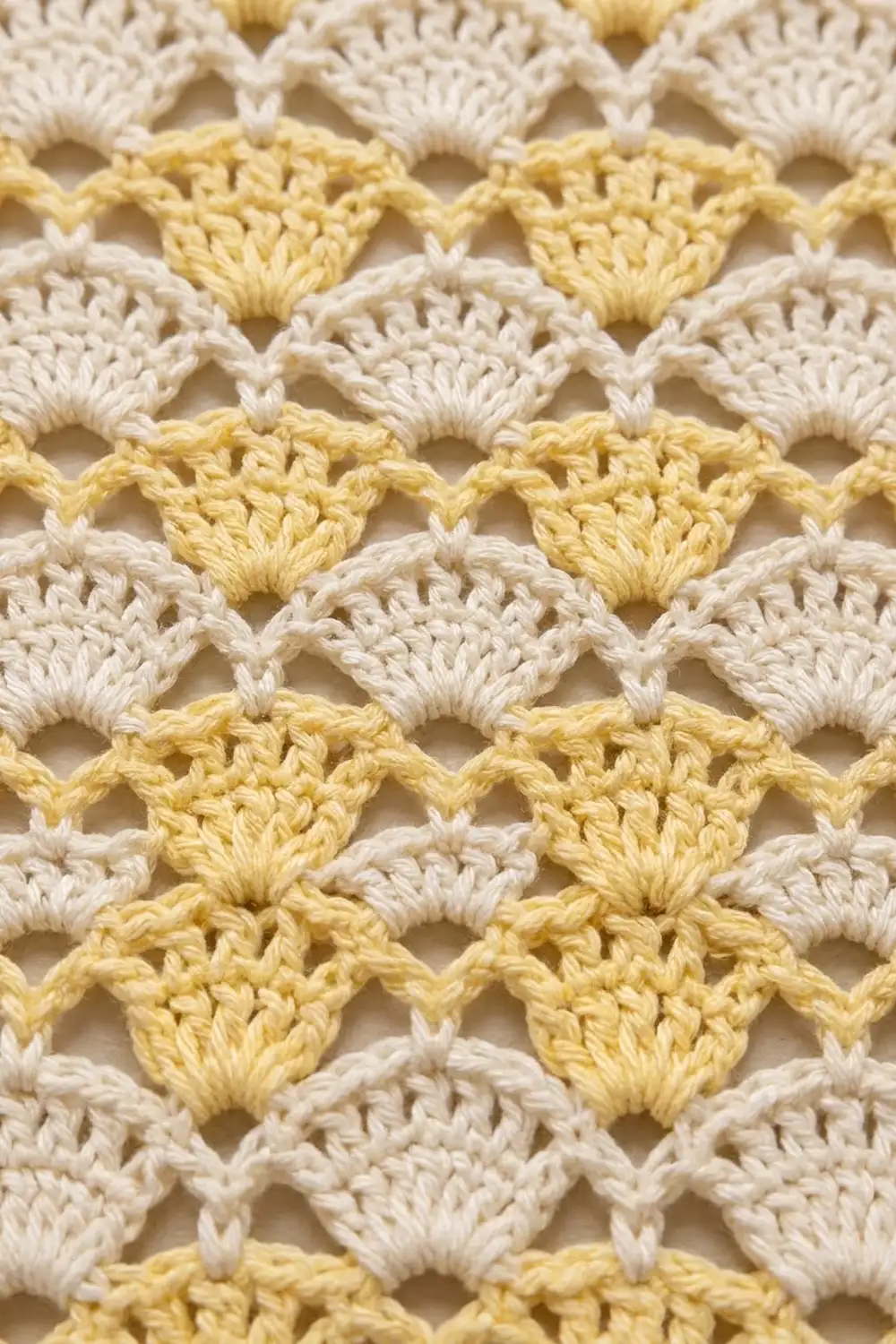
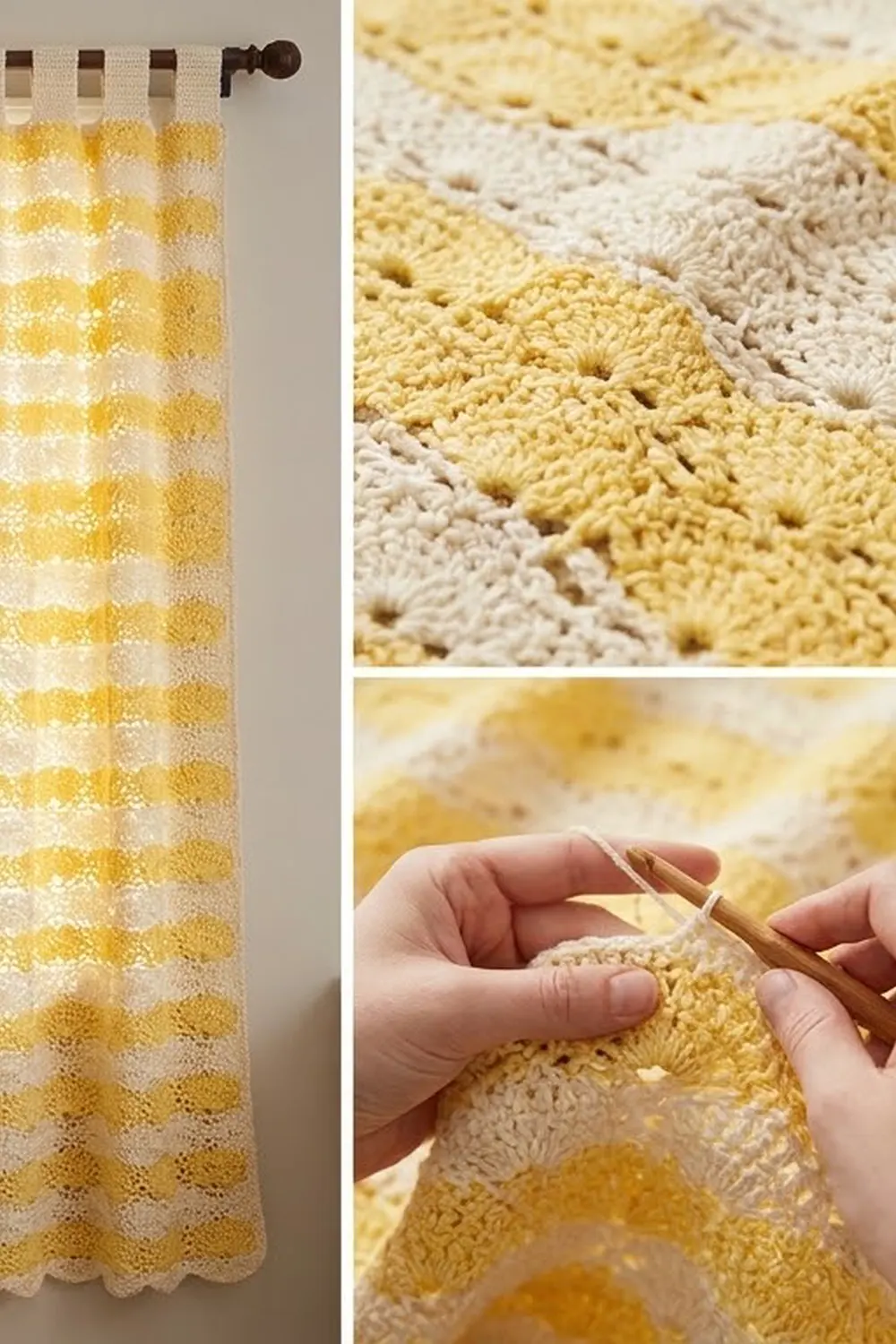
This curtain panel is a soft, airy lace in two colors. Rows of butter-yellow fans alternate with rows of cream fans, and open lattice rows separate them. Each fan row is shifted half a repeat from the one below, so the fans stack in a staggered scale pattern that lets daylight through.
The style is cottage and summery. A narrow cream single crochet edge frames the sides and top, a row of cream scallops finishes the bottom, and seven cream tabs hold the panel on a curtain rod. The pattern uses US crochet terms throughout.
The finished panel is 37 in (94.0 cm) wide and 83 in (210.8 cm) long, not counting the tabs. You work it flat in one piece from the bottom up. First crochet the body in rows, then add a two-round border, then work the tabs straight off the top edge and fold them to the back. Make two panels for a pair.
The stitches are simple: single crochet, double crochet and chains. The skill is in counting carefully and keeping the fans even over a long panel.
Finished Size and Construction
- Finished size: 37 in (94.0 cm) wide × 83 in (210.8 cm) long, plus tab loops
- Skill level: Intermediate
- Terminology: US crochet terms
- Yarn weight: DK / light (#3) cotton
- Hook: 4.5 mm (US 7)
- Number of pieces: 1 (the tabs are worked directly onto the panel)
- Layout: one rectangular panel, 18 fan repeats wide, 131 rows long
- Piece size before border: 36 in (91.4 cm) × 81.5 in (207.0 cm)
- Border depth: 0.5 in (1.3 cm) on the sides and top; 1 in (2.5 cm) at the scalloped bottom
- Tabs: 7 tabs, each 2.25 in (5.7 cm) wide, forming 3.5 in (8.9 cm) loops
Materials
Choose a smooth mercerized or combed cotton in DK weight. Cotton shows the fan stitches clearly and hangs straight without stretching too much. Avoid fuzzy or very slippery yarns, which hide the lace and make the panel stretch downward.
Quantities are per panel, based on yarn with about 110 m per 50 g (220 m per 100 g):
- Color A, butter yellow: 650 g (1,430 m)
- Color B, cream: 750 g (1,650 m), including the border and tabs
Both amounts include a margin of about 10% for the gauge swatch, differences in tension and weaving in. For a pair of panels, double everything.
Tools:
- 4.5 mm (US 7) crochet hook
- Tapestry needle
- Locking stitch markers (at least 10)
- Measuring tape
- Scissors
- Blocking pins, plus blocking mats or a large clean surface
Abbreviations (US Terms)
- ch: chain
- sc: single crochet
- hdc: half double crochet
- dc: double crochet
- tr: treble crochet
- sk: skip
- st(s): stitch(es)
- sp: space
- RS / WS: right side / wrong side
Special stitches:
- Fan: 7 dc worked into the same stitch.
- Half fan: 4 dc worked into the same stitch at the start or end of an offset row. At the start of a row, the turning ch-3 counts as the first dc.
Gauge and Checkpoints
Pattern gauge: 2 fan repeats (16 sts) = 4 in (10.2 cm) wide. One 4-row repeat = 2.5 in (6.4 cm) tall.
Border gauge: 16 sc = 4 in (10.2 cm).
Make a test swatch first. Ch 34 and work Rows 1–9 below, using 4 repeats instead of 18. The swatch should be 8 in (20.3 cm) wide, and Rows 2–9 should measure 5 in (12.7 cm) tall. Wash and dry the swatch the same way you plan to treat the curtain, then measure it again.
- Too big: go down to a 4.0 mm hook.
- Too small: go up to a 5.0 mm hook.
- Width is right but height is wrong: check the height of your dc. Pull each dc loop up to its full height instead of changing hooks.
Body checkpoints (measure flat, without stretching):
- After Row 2: width 36 in (91.4 cm)
- After Row 41: length 25.25 in (64.1 cm)
- After Row 81: length 50.25 in (127.6 cm)
- After Row 129: length 80.25 in (203.8 cm)
- After Row 131: length 81.5 in (207.0 cm)
If your width after Row 2 is off by more than 1 in (2.5 cm), start again with a different hook. The width will not correct itself later.
Panel Body
The body uses a multiple of 8 sts + 1, so 18 repeats = 145 sts. Change colors on the last yarn-over of the last stitch of a row. Each color works 2 rows at a time, so you can carry the unused yarn loosely up the side edge, and the border will cover it.
Foundation: With Color B (cream), ch 146.
Row 1 (RS, cream): Sc in 2nd ch from hook and in each ch across, turn. (145 sc)
Change to Color A (yellow).
Row 2 (yellow, fan row): Ch 1, sc in first sc, sk 3 sc, fan in next sc, sk 3 sc, sc in next sc; rep from * 17 more times, turn. (18 fans; 145 sts = 126 dc + 19 sc)*
Row 3 (yellow, lattice row): Ch 5 (counts as dc + ch 2), sc in center (4th) dc of first fan, ch 2, dc in next sc, ch 2, sc in center dc of next fan, ch 2, dc in next sc; rep from * 16 more times, turn. (19 dc including turning ch, 18 sc, 36 ch-2 sps)*
Change to Color B (cream) on the last dc.
Row 4 (cream, offset fan row): Ch 3 (counts as dc), 3 dc in same st (half fan made), sc in next sc, fan in next dc; rep from * 16 more times, sc in next sc, 4 dc in 3rd ch of turning ch-5 (half fan made), turn. (17 fans + 2 half fans; 145 sts = 4 + 136 + 1 + 4)*
Throughout the pattern, skip the ch-2 spaces and work fans and sc into stitches only. This is what creates the openings.
Row 5 (cream, lattice row): Ch 1, sc in first dc, ch 2, dc in next sc, ch 2, sc in center (4th) dc of next fan; rep from * 16 more times, ch 2, dc in next sc, ch 2, sc in top of turning ch-3, turn. (19 sc, 18 dc, 36 ch-2 sps)*
Change to Color A (yellow) on the last sc.
Row 6 (yellow, fan row): Ch 1, sc in first sc, fan in next dc, sc in next sc; rep from * 17 more times, turn. (18 fans; 145 sts = 126 dc + 19 sc)*
Each fan in Row 6 sits directly above a sc from Row 4, between two cream fans. This half-repeat offset is what creates the staggered scale look.
Row 7 (yellow): Work as for Row 3. (19 dc, 18 sc, 36 ch-2 sps) Change to cream.
Row 8 (cream): Work as for Row 4. (145 sts)
Row 9 (cream): Work as for Row 5. (19 sc, 18 dc, 36 ch-2 sps) Change to yellow.
Rows 10–129: Repeat Rows 6–9 thirty more times. You now have 32 complete color repeats, and Row 129 is a cream lattice row.
Row 130 (yellow): Work as for Row 6. (18 fans; 145 sts) Change to cream.
Row 131 (cream, leveling row): Ch 4 (counts as tr), dc in next dc, hdc in next dc, sc in next 3 dc, hdc in next dc, dc in next dc, tr in next sc; rep from * 17 more times. Do not turn and do not fasten off. (145 sts = 19 tr + 36 dc + 36 hdc + 54 sc)*
This row fills the dips between the last fans and gives you a straight top edge for the tabs.
Border
Border gauge: 16 sc = 4 in (10.2 cm), or 4 sc per inch (2.5 cm).
Each corner gets 3 sc in one stitch, and the middle sc of the three is the corner sc. In the counts below, “between corners” means the stitches between two corner sc, not counting the corner sc themselves.
Round 1 (RS, cream):
- Continuing from Row 131, ch 1. Work 3 sc in the last st of Row 131 (top corner).
- Work down the side edge: 2 sc in the end of Row 131. Then alternate 3 sc in each even-numbered row end and 2 sc in each odd-numbered row end until you reach Row 2. Work 1 sc in the end of Row 1.
- Work 3 sc in the first foundation ch loop (bottom corner). Sc in each of the next 143 foundation loops. Work 3 sc in the last foundation loop (bottom corner).
- Work up the second side the same way: 1 sc in the end of Row 1, then 3 sc in each even row end and 2 sc in each odd row end up to Row 131.
- Work 3 sc in the first st of Row 131 (top corner). Sc in each of the next 143 sts across the top. Sl st to first sc.
Round 1 counts:
- Each side between corners: 1 + 326 + 1 = 328 sc (326 row-end sc plus the outer sc of each corner group)
- Top and bottom between corners: 1 + 143 + 1 = 145 sc each
- 4 corner sc
- Total: 328 + 328 + 145 + 145 + 4 = 950 sc
Why the side count works: Rows 2–131 are 130 rows. That gives 65 even rows × 3 sc = 195, plus 65 odd rows × 2 sc = 130, plus 1 sc for Row 1, for 326 sc. The body is 81.5 in (207.0 cm) long, and 81.5 × 4 sc per inch = 326. The edge matches the border gauge exactly, so it will not ruffle or pull in.
Why the top and bottom counts work: 145 sc between corners over 36 in (91.4 cm) is about 4 sc per inch, so these edges also lie flat at border gauge.
Round 2 (cream): Ch 1 and work in the same direction as Round 1, as follows:
- Top: sc in each of the 145 sts between corners, and 3 sc in each top corner sc.
- Sides: sc in each of the 328 sts between corners.
- Bottom corners: 3 sc in each corner sc.
- Bottom scallops: across the 145 sts between the bottom corners, sc in first st, *sk 3 sts, 7 dc in next st, sk 3 sts, sc in next st; rep from * 17 more times. This uses exactly 1 + (18 × 8) = 145 sts.
Sl st to first sc. Fasten off.
Round 2 counts:
- Top: 145 sc between corners
- Each side: 328 sc between corners
- Bottom: 18 scallops (126 dc + 19 sc = 145 sts)
- Corners: 4 groups of 3 sc = 12 sts
- Total: 145 + 328 + 328 + 145 + 12 = 958 sts
There are 18 scallops, one for each fan repeat in the body, so the bottom edge continues the rhythm of the fans.
Size after border: 37 in (94.0 cm) × 83 in (210.8 cm). The width is 36 in plus 0.5 in on each side. The length is 81.5 in plus 0.5 in at the top and 1 in at the bottom.
Tabs
Work the tabs in cream straight off the top edge of Round 2. Counting from one top corner sc to the other, including both corner sc, there are 147 sts (1 + 145 + 1).
Layout: a 6-st margin, a tab over 9 sts, then a 12-st gap and a tab over 9 sts 6 times, then a 6-st margin. To check: 6 + 9 + (6 × 21) + 6 = 147. Mark the first stitch of each tab before you start.
Each tab:
Row 1 (RS): Join cream in the first marked st, ch 1, sc in same st and in next 8 sts, turn. (9 sc)
Row 2: Ch 2 (does not count as a stitch), hdc in each st across, turn. (9 hdc)
Rows 3–18: Repeat Row 2 until the tab measures 7 in (17.8 cm) from the panel edge. Fasten off, leaving a 12 in (30.5 cm) tail.
Fold each tab to the WS and whipstitch its last row to the base of border Round 1 behind it. Each tab is 9 sts at 4 sc per inch, or 2.25 in (5.7 cm) wide. The finished loop is 3.5 in (8.9 cm) deep and fits a rod up to 1.75 in (4.4 cm) in diameter.
Final Blocking
- Weave in all tails through stitches of the matching color. Hide the color-change tails inside the border where you can.
- Soak the panel for 15 minutes in cool water with a little wool wash or mild soap.
- Gently press out the water without wringing. Roll the panel in towels to remove more moisture.
- Lay it flat on mats or a clean sheet. Pin the corners first, to 37 in (94.0 cm) × 83 in (210.8 cm).
- Pin along each side every 6 in (15.2 cm), keeping the edges straight.
- Pin the tip of each bottom scallop so the scallops curve evenly.
- Open each fan with your fingers so the 7 dc spread evenly and the lattice spaces are clear.
- Let the panel dry completely before you unpin it. For a little extra drape, hang it on the rod while it is still slightly damp.
Final Quality-Control Checklist
- 145 sts in every fan row and in the leveling row
- 18 full fans in every yellow fan row; 17 full fans + 2 half fans in every cream fan row
- Colors alternate cleanly: 2 yellow rows, then 2 cream rows
- Body measures 36 in (91.4 cm) × 81.5 in (207.0 cm) before the border
- Border Round 1 has 950 sc; Round 2 has 958 sts
- 18 bottom scallops, lined up with the fan repeats
- 7 tabs, evenly spaced and all the same length
- Side edges lie flat, with no ripples or puckering
- All tails woven in securely
Troubleshooting
The panel gets wider or narrower as you go: you have gained or lost a stitch. Count each fan row; it must have 145 sts. Check that each lattice-row dc goes into a sc and each lattice-row sc goes into the center dc of a fan.
Fans lean to one side: you are working into the wrong dc. Mark the 4th dc of each fan until you can find it easily.
Side edges ripple: your row ends are too loose for the border. Work 2 sc in every row end along that section, then check the length again.
Side edges pull in: add 1 sc to a few of the odd-numbered row ends.
Scallops look flat: make sure you skip exactly 3 sts on each side of every 7-dc scallop.
Tabs twist: when you sew them down, center each tab over its own base stitches.
Bumps at color changes: complete the last yarn-over of the old color with the new color, then pull both tails snug.
Care
Hand wash in cool water, or machine wash on a gentle cycle inside a mesh bag. Lay flat to dry, and block again lightly if the fans need opening up.
Final Notes
Every measurement in this pattern follows from your gauge. The swatch sets 16 sts = 4 in (10.2 cm), so 145 sts (18 repeats) make a body 36 in (91.4 cm) wide. Each 4-row repeat is 2.5 in (6.4 cm), so 131 rows give 81.5 in (207.0 cm). At 4 sc per inch, the border’s 326 row-end sc and 145 sc across the top and bottom match those edges exactly. The two border rounds bring the panel to 37 in (94.0 cm) × 83 in (210.8 cm), and seven cream tabs finish the top. Check each measurement before you move on, and the panel will hang straight and even.
Happy crocheting!