

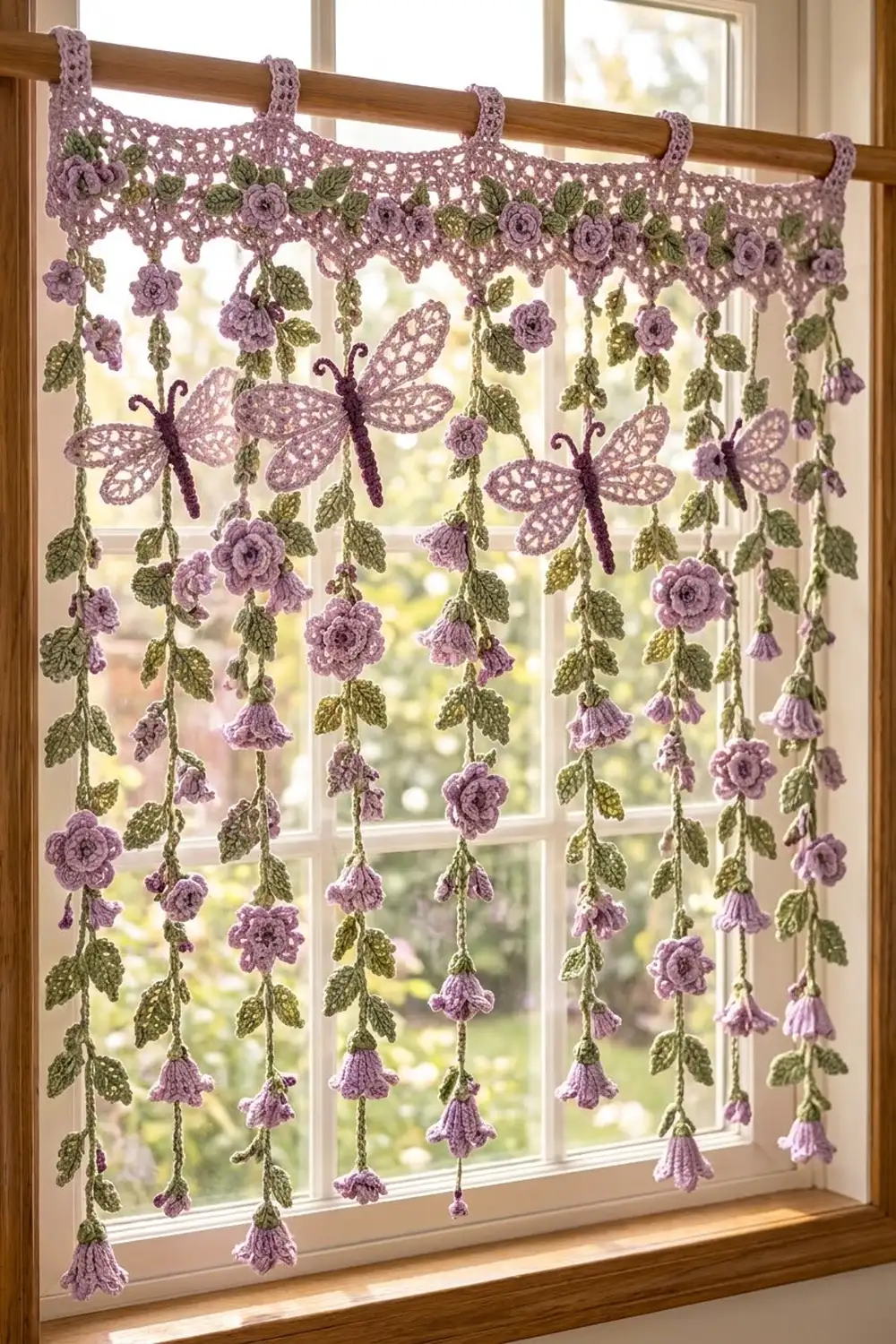
This valance curtain makes a window look like a summer garden. A pale lilac lace header with pointed edges hangs from a rod on crocheted tabs. Fourteen sage-green vines drop from the points, each carrying leaves, layered lavender roses, and bell-shaped flowers. Four lace-winged dragonflies with deep plum bodies rest between the vines.
The palette is soft and cottage-style: pale lilac lace, medium lavender flowers, sage green stems and leaves, and deep plum dragonfly bodies. Light comes through the mesh header and the gaps between the vines, so the curtain stays airy.
The pattern uses US crochet terms. The finished curtain is 34.2 in (86.9 cm) wide and 47 in (119.4 cm) long from the top of the header to the tip of the lowest bellflower, not counting the rod tabs.
You crochet a filet-mesh header and add a border with pointed scallops and rod tabs. Each vine is a chain stem with its leaves worked in as you go. Roses, bellflowers, and dragonflies are made separately and sewn on.
Finished Size and Construction
- Finished size: 34.2 in x 47 in (86.9 cm x 119.4 cm)
- Skill level: Intermediate
- Terminology: US
- Yarn weight: DK (#3) cotton
- Hook: 3.5 mm (E-4)
- Number of pieces: 1 header, 14 strands, 28 large roses, 14 mini roses, 28 loose leaves, 28 bellflowers, 4 dragonflies
- Layout: 1 header with 14 strands hanging 2.4 in (6.1 cm) apart
- Strand size: 40 in (101.6 cm), plus a 1.5 in (3.8 cm) bellflower
- Header before border: 33.8 in x 4 in (85.9 cm x 10.2 cm)
- Border depth: 0.2 in (0.5 cm) at the top and sides; 1.3 in (3.3 cm) at the bottom points
Materials
Use a smooth DK cotton, about 115 m per 50 g. Cotton keeps the lace and petals crisp, and the strands won’t stretch much as they hang.
- Pale lilac (header, wings): 100 g / 230 m
- Medium lavender (roses, bellflowers): 150 g / 345 m
- Sage green (stems, leaves, bell caps): 150 g / 345 m
- Deep plum (dragonfly bodies): 25 g / 58 m
Tools:
- 3.5 mm (E-4) hook
- Tapestry needle
- Stitch markers
- Rust-proof pins and a blocking board
- Spray starch
- A little fiberfill
- Tape measure
All quantities include about a 20% margin.
Abbreviations (US Terms)
- ch: chain
- sl st: slip stitch
- sc: single crochet
- hdc: half double crochet
- dc: double crochet
- tr: treble crochet
- dtr: double treble crochet
- sc2tog: single crochet 2 together
- rev sc: reverse single crochet (crab stitch)
- sp(s): space(s)
- st(s): stitch(es)
Special stitch – Mesh: (dc, ch 1, skip 1). A row of N mesh squares has N + 1 dc and N ch-1 sps, so it has 2N + 1 sts.
Gauge and Checkpoints
Header gauge: 20 sts and 10 rows of mesh = 4 in (10.2 cm), or 5 sts and 2.5 rows per inch.
Test before you start. Ch 24 and work 10 rows of mesh. You should get 10 mesh squares (21 sts) measuring 4.2 in (10.7 cm) wide x 4 in (10.2 cm) tall.
Next, make one of each motif and check its size:
- Upper wing: 2.5 in (6.4 cm) long
- Lower wing: 2.25 in (5.7 cm) long
- Large rose: 2 in (5.1 cm) across
- Mini rose: 1.25 in (3.2 cm) across
- Leaf: 1.5 in (3.8 cm) long
- Bellflower: 1.5 in (3.8 cm) long
- Stem: 5 sl sts = 1 in (2.5 cm)
If your swatch is too big, go down 0.25 mm. If it’s too small, go up 0.25 mm. Even a 0.2 in (0.5 cm) error in the swatch grows to about 1.6 in (4.1 cm) across the header.
Header
With pale lilac, ch 172.
Row 1: Dc in 6th ch from hook. *Ch 1, skip 1 ch, dc in next ch. Repeat from * across. Turn. (84 mesh squares; 85 dc and 84 ch-1 sps; 169 sts)
Rows 2–10: Ch 4 (counts as dc + ch 1), skip the ch-1 sp, dc in next dc. *Ch 1, dc in next dc. Repeat from * across, working the last dc in the 3rd ch of the turning ch. Turn. (169 sts)
Checkpoint: 33.8 in x 4 in (85.9 cm x 10.2 cm). Don’t fasten off.
Vine Strands (make 14)
Leaf (worked off the stem): Ch 8.
- Side A: Sc in 2nd ch from hook, hdc in next ch, dc in next 3 ch, hdc in next ch, sc in last ch. (7 sts)
- Side B: Working in the free loops of the same chain, sc in next ch, hdc in next ch, dc in next 3 ch, hdc in next ch, then (sc, ch 2, sl st) in the tip ch.
- Vein: Sl st down the center through each of the 6 chs, back to the stem.
The vein shows as a raised line down the middle of the leaf.
Stem: With sage, ch 201, leaving a 12 in (30.5 cm) tail. This end is the bottom of the strand.
Sl st in the back bump of the 2nd ch from hook and of each ch back up the chain. (200 sl sts)
Leaf nodes: After sl sts 10, 30, 50, 70, 90, 110, 130, 150, 170, and 190, make 1 leaf on each side of the stem. (10 nodes, 20 leaves)
Leave a 12 in (30.5 cm) tail at the top.
Checkpoint: The stem measures 40 in (101.6 cm). The nodes are 4 in (10.2 cm) apart, and the first node sits 2 in (5.1 cm) above the bottom.
Large Rose (make 28) and Mini Rose (make 14)
With medium lavender, make a magic ring.
Rnd 1: Ch 1, 10 sc in ring. Join. (10 sc)
Rnd 2: Ch 1, sc in first st, ch 3, skip 1. *Sc in next st, ch 3, skip 1. Repeat from * 3 more times. Join. (5 sc, 5 ch-3 sps)
Rnd 3: In each ch-3 sp, work (sc, hdc, 3 dc, hdc, sc). Join. (5 petals, 35 sts)
Mini rose: Fasten off here. It measures 1.25 in (3.2 cm).
Rnd 4: Working behind the petals, ch 1 and sc around the post of the first Rnd 2 sc. *Ch 5, sc around the post of the next Rnd 2 sc. Repeat from * 3 more times, ch 5, join. (5 ch-5 loops)
Rnd 5: In each loop, work (sc, hdc, 5 dc, hdc, sc). Join and fasten off, leaving a tail. (5 petals, 45 sts; 2 in / 5.1 cm)
The back petals sit between the front petals, so the rose looks layered.
Loose Leaves (make 28)
With sage, start with a slip knot and work Side A, Side B, and the vein as for the stem leaves. Fasten off.
Bellflower (make 28)
With sage, make a magic ring.
Rnd 1: 6 sc in ring. (6)
Rnd 2: 2 sc in each st. (12) Change to lavender.
Rnds 3–4: Sc in each st. (12)
Rnd 5: *Sc in next st, 2 sc in next st. Repeat from * around. (18)
Rnd 6: *Sc in next 2 sts, 2 sc in next st. Repeat from * around. (24)
Rnd 7 (points): *Sl st in next st, hdc in next st, (dc, ch 2, dc) in next st, hdc in next st. Repeat from * 5 more times. This is 24 sts worked 1-per-st plus 6 extra dc: 30 sts and 6 ch-2 tips. Fasten off.
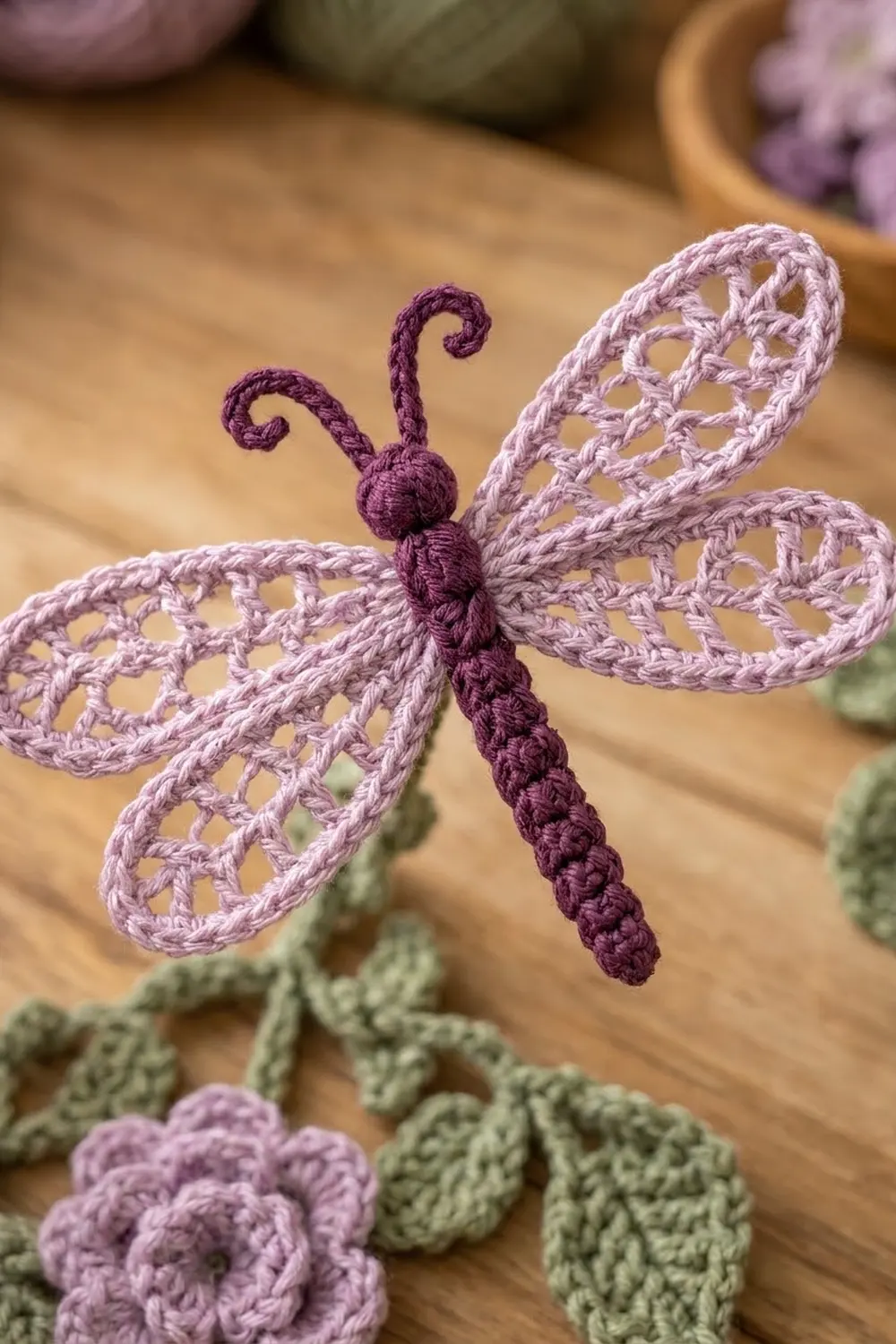
Dragonfly (make 4)
Upper wing (make 2 per dragonfly): With pale lilac, ch 11.
- Rnd 1: Sc in 2nd ch from hook, hdc in next ch, dc in next 6 ch, hdc in next ch, 5 dc in last ch. On the other side of the chain, hdc in next ch, dc in next 6 ch, hdc in next ch, 2 sc in the first ch. Join. (24 sts)
- Rnd 2: Ch 5 (counts as dc + ch 2), skip 1. *Dc in next st, ch 2, skip 1. Repeat from * around. Join. (12 dc, 12 ch-2 sps)
- Rnd 3: Sl st into the first sp, ch 1, sc in same sp. *Ch 4, sc in next sp. Repeat from * around, ch 4, join. (12 ch-4 loops)
- Rnd 4: Ch 1, 5 sc in each loop. Join. (60 sc; 2.5 in / 6.4 cm)
Lower wing (make 2 per dragonfly): Ch 10.
- Rnd 1: Work as for the upper wing, but with 5 dc on each side instead of 6. (22 sts)
- Rnd 2: Work as for the upper wing. (11 dc, 11 sps)
- Rnd 3: Work as for the upper wing. (11 loops)
- Rnd 4: Work as for the upper wing. (55 sc; 2.25 in / 5.7 cm)
Thorax: With plum, make a magic ring.
- Rnd 1: 6 sc. (6)
- Rnd 2: 2 sc in each st. (12)
- Rnd 3: Sc around. (12)
- Rnd 4: Sc2tog 6 times. (6)
Stuff lightly and close. It measures 0.75 in (1.9 cm).
Antennae: At the top of the thorax, *ch 8, sl st back along the chain (7 sl sts), sl st into the thorax. Repeat from * once more. Curl each antenna outward.
Abdomen: With plum, ch 16. Sc in 2nd ch from hook and each ch across. (15) Ch 1, and without turning, work 15 rev sc along the free loops. This makes a twisted, segmented rope 3 in (7.6 cm) long.
Assembly: Sew the upper wings to the sides of the thorax, the lower wings just below them, and the abdomen underneath. The wingspan is 5.5 in (14.0 cm), and the body is 3.75 in (9.5 cm) long.
Make All Pieces
- Pale lilac: 1 header, 8 upper wings, 8 lower wings
- Lavender: 28 large roses, 14 mini roses, 28 bellflowers
- Sage: 14 strands (280 leaves), 28 loose leaves
- Plum: 4 thoraxes, 4 abdomens
TABS:    T     T     T     T     T     T     T
HEADER:  [ mesh band: mini rose + 2 leaves above each point ]
POINTS:  V  V  V  V  V  V  V  V  V  V  V  V  V  V
STRAND:  1  2  3  4  5  6  7  8  9 10 11 12 13 14
DRAG.:      D        D           D        D
          (2-3)    (5-6)       (9-10)  (12-13)
Count nodes from the bottom of each strand. Sew a bellflower at the tip, a rose at node 3, a hanging bellflower at node 5, and a rose at node 7.
Border
Border gauge: 5 sc = 1 in (2.5 cm) on every edge.
Corners are ch-2 sps, and they are not included in the side counts below.
Rnd 1: Continuing from Row 10, ch 1 and work around the header:
- Top: Sc in each st. (169)
- Corner: Ch 2.
- Side: 2 sc in each row end. (20)
- Corner: Ch 2.
- Bottom: Work into the foundation, 1 sc in the base of each dc and 1 sc in each ch-1 sp. (169)
- Corner: Ch 2.
- Side: 2 sc in each row end. (20)
- Corner: Ch 2.
Join. (378 sc + 4 ch-2 corners)
Rnd 2 (points, bottom edge only): Sl st to the first bottom sc and sc in it. *Hdc in next st, dc in next 2 sts, tr in next 2 sts, (dtr, ch 4, dtr) in next st, tr in next 2 sts, dc in next 2 sts, hdc in next st, sc in next st. Repeat from * 13 more times. Each repeat uses 12 sts: 1 + (14 x 12) = 169. This is 169 sts worked 1-per-st plus 14 extra dtr: 183 sts and 14 ch-4 loops. Fasten off.
Rod tabs: Skip the first top sc. *Join pale lilac in the next st, ch 1, and sc in that st and the next 4 sts. (5 sc) Work 15 more rows of 5 sc. (16 rows; 3.5 in / 8.9 cm) Fasten off and skip 22 sts. Repeat from * for 7 tabs in total. One st remains after the last tab, so 1 + (7 x 5) + (6 x 22) + 1 = 169. Fold each tab to the back and sew it down along Rnd 1. The tabs fit a rod up to 1 in (2.5 cm) in diameter.
Why the math works: At 2.5 rows per inch, 2 sc per row end gives 5 sc per inch, the same as the width gauge, so the edges lie flat. Each point is 12 sts (2.4 in / 6.1 cm) wide, so 14 points use exactly the 169 bottom sts.
Checkpoint: The header is 34.2 in (86.9 cm) wide and 5.5 in (14.0 cm) deep at the points.
Joining
Strands: Thread each strand’s top tail through one ch-4 loop until the top sl st meets the loop. Wrap the tail around the loop 3 times, then weave it into the stem. One loop holds one strand, so the strands are evenly spaced 2.4 in (6.1 cm) apart.
Header motifs: Sew a mini rose centered above each point in Rows 5–6. Add a leaf on each side, angled downward.
Flowers: Sew the tip bellflower snugly to the bottom of each stem. Sew the roses flat at nodes 3 and 7. Tack the node-5 bellflower so it hangs beside the stem.
Dragonflies: Center each thorax between its two strands, 4 in (10.2 cm) below the point tips. Tack the wing tips to the stems on either side.
Tension: Keep your sewing stitches small and loose. Tight stitches pucker the mesh and shorten the stems.
Size checkpoint: Hang the curtain. Every strand should measure 40 in (101.6 cm), and the overall length should be 47 in (119.4 cm).
Final Blocking
- Mist the header and pin it to 34.2 in x 5.5 in (86.9 cm x 14.0 cm), pinning each point at its loop.
- Pin the wings flat with the mesh open, then starch them lightly.
- Shape the petals and bell points, and curl the antennae.
- Let everything dry completely.
- Hang the curtain for 24 hours so the strands straighten.
Final Quality-Control Checklist
- The header has 169 sts per row, 10 rows, and 378 sc in Rnd 1.
- There are 14 points with 14 ch-4 loops.
- There are 7 tabs, spaced 22 sts apart.
- Every strand has 10 nodes and 20 leaves, plus 2 roses and 2 bells.
- The dragonflies sit symmetrically.
- All ends are secure.
Troubleshooting
- The header ruffles at the sides: Your rows aren’t 0.4 in (1.0 cm) tall. Adjust the side count so each side measures 4 in (10.2 cm).
- The strands twist: Hang them to dry with a light clip at each tip.
- The wings curl: Starch them again and pin them flatter.
- The strands are uneven: Recount the 200 sl sts in each stem.
- The points droop: Work tighter, or swap the dtr for tr.
Care
Hand wash in cool water and roll the curtain in a towel to remove excess water. Pin it flat to reshape, and rehang it once dry.
Final Notes
Each measurement builds on the one before it. A 4 in (10.2 cm) swatch confirms 5 sts per inch. That gives a 33.8 in (85.9 cm) header, which becomes 34.2 in (86.9 cm) wide after the border. Fourteen points, each 2.4 in (6.1 cm) wide, hold 40 in (101.6 cm) strands, for a finished length of 47 in (119.4 cm). If you check each stage as you go, the curtain will hang straight and even.
Happy crocheting!