

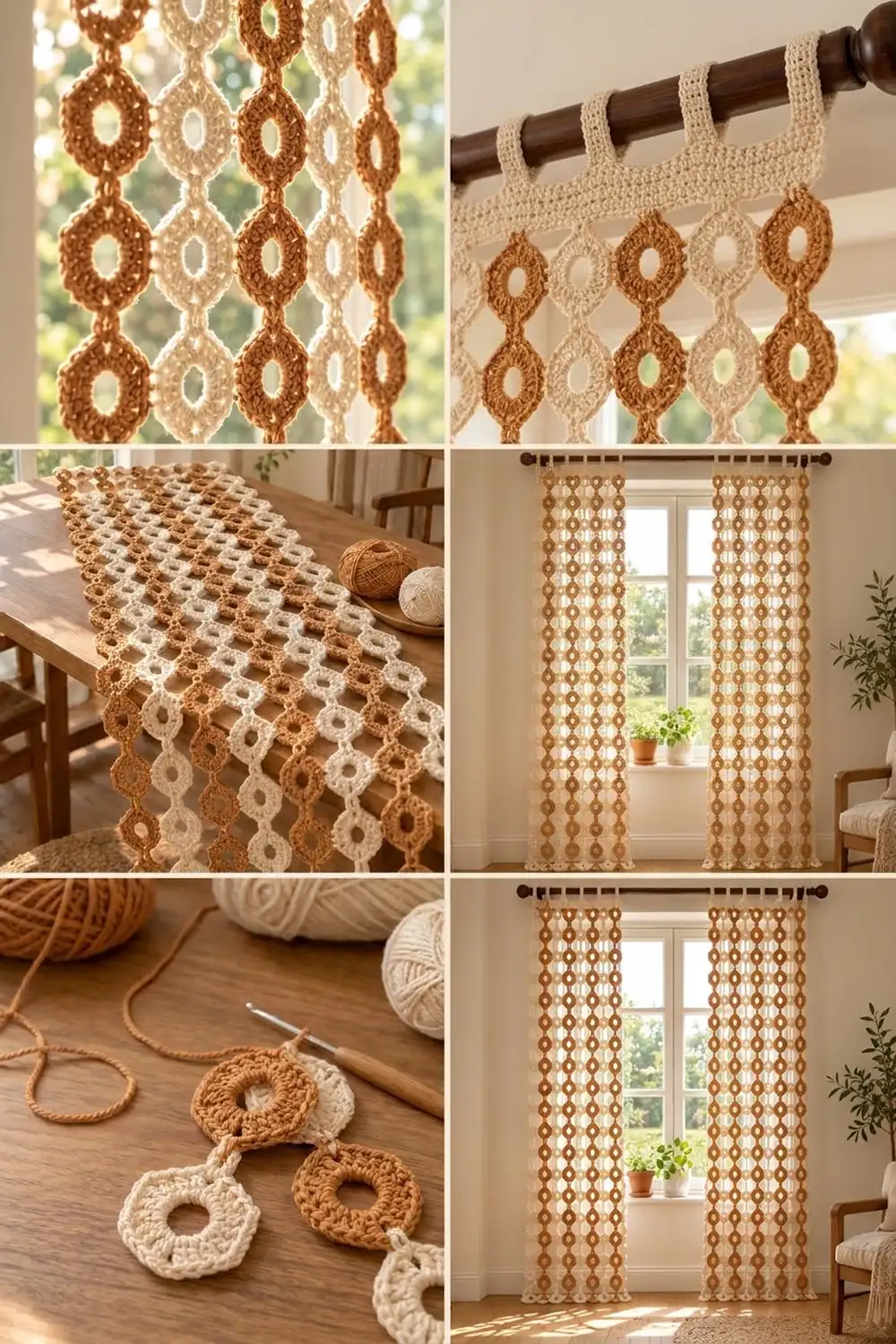
This curtain panel is made from hanging chains of small hexagon rings. Each ring has a round open center, a dense double crochet body, and a crisp single crochet edge that turns it into a six-sided shape. The rings hang point to point, joined by short chain links, so light comes through every center.
The colors are caramel and cream. Solid caramel strands alternate with solid cream strands across the panel. A cream single crochet header band holds the strands at the top, and seven cream tabs slide over a curtain rod. The look is boho, airy, and calm, and it works well in a sunny window.
The pattern uses US crochet terms. One finished panel measures 30 in (76.2 cm) wide and 74 in (188.0 cm) long from the top of the header to the bottom of the last ring. The tabs add about 2.5 in (6.4 cm) above the header. To get the pair shown on the window, make two panels.
Construction is join-as-you-go. You crochet 10 strands of 18 rings each, linking every new ring to the one above it in the ring’s last round. Then you crochet the header band and link each strand to its last row. Last, you work the tabs into the foundation chain and fold them to the back.
Finished Size and Construction
- Finished size: 30 in (76.2 cm) wide x 74 in (188.0 cm) long, plus tabs
- Skill level: Easy to intermediate
- Terminology: US
- Yarn weight: Worsted (#4), cotton or cotton blend
- Hook: 5.0 mm (US H-8)
- Number of pieces: 180 hexagon rings in 10 strands, plus 1 header band with 7 tabs
- Layout: 10 strands across, 18 rings per strand
- Piece size: 3 in (7.6 cm) flat to flat, 3.5 in (8.9 cm) point to point
- Size before border: strand section 30 in (76.2 cm) x 72 in (182.9 cm)
- Border (header) depth: 2 in (5.1 cm), plus tabs
Materials
Choose a smooth worsted cotton or cotton blend with clear stitch definition. Cotton keeps the rings flat and helps the strands hang straight. Avoid fuzzy yarns, because they blur the open centers. The amounts below assume about 170 m per 100 g.
- Caramel (Color A): 450 g, about 765 m, for 90 rings
- Cream (Color B): 550 g, about 935 m, for 90 rings, the header band, and the tabs
One ring uses about 7 m of yarn. The quantities include a margin of about 15-20 percent. Buy all yarn of one color from the same dye lot.
Tools
- 5.0 mm (US H-8) crochet hook
- Locking stitch markers
- Tapestry needle
- Scissors
- Measuring tape
- Spray bottle and blocking mats or a large towel
Abbreviations (US Terms)
- ch: chain
- sl st: slip stitch
- sc: single crochet
- dc: double crochet
- sp: space
- st(s): stitch(es)
- beg: beginning
- rep: repeat
- RS / WS: right side / wrong side
Special stitch: Join Link (JL). Ch 3, sl st in the named ch-2 sp of the other piece, ch 3. The two ch-3 strands form a short doubled link about 0.5 in (1.3 cm) long.
Gauge and Checkpoints
The gauge is 16 sc and 18 rows = 4 in (10.2 cm) in sc rows. Ring size matters more than swatch gauge, so make one complete ring first and measure it.
- After Round 1: outer diameter 2 in (5.1 cm), center hole about 1 in (2.5 cm)
- After Round 2: 2.75 in (7.0 cm) flat to flat
- After Round 3: 3 in (7.6 cm) flat to flat, 3.5 in (8.9 cm) point to point
- After 5 linked rings: 19.5 in (49.5 cm) long
If your ring is too big, use a hook 0.5 mm smaller. If it is too small, use a hook 0.5 mm larger. Then make a new test ring. Don’t skip this step: an error of 0.25 in (0.6 cm) per ring adds up to 4.5 in (11.4 cm) over a strand of 18 rings.
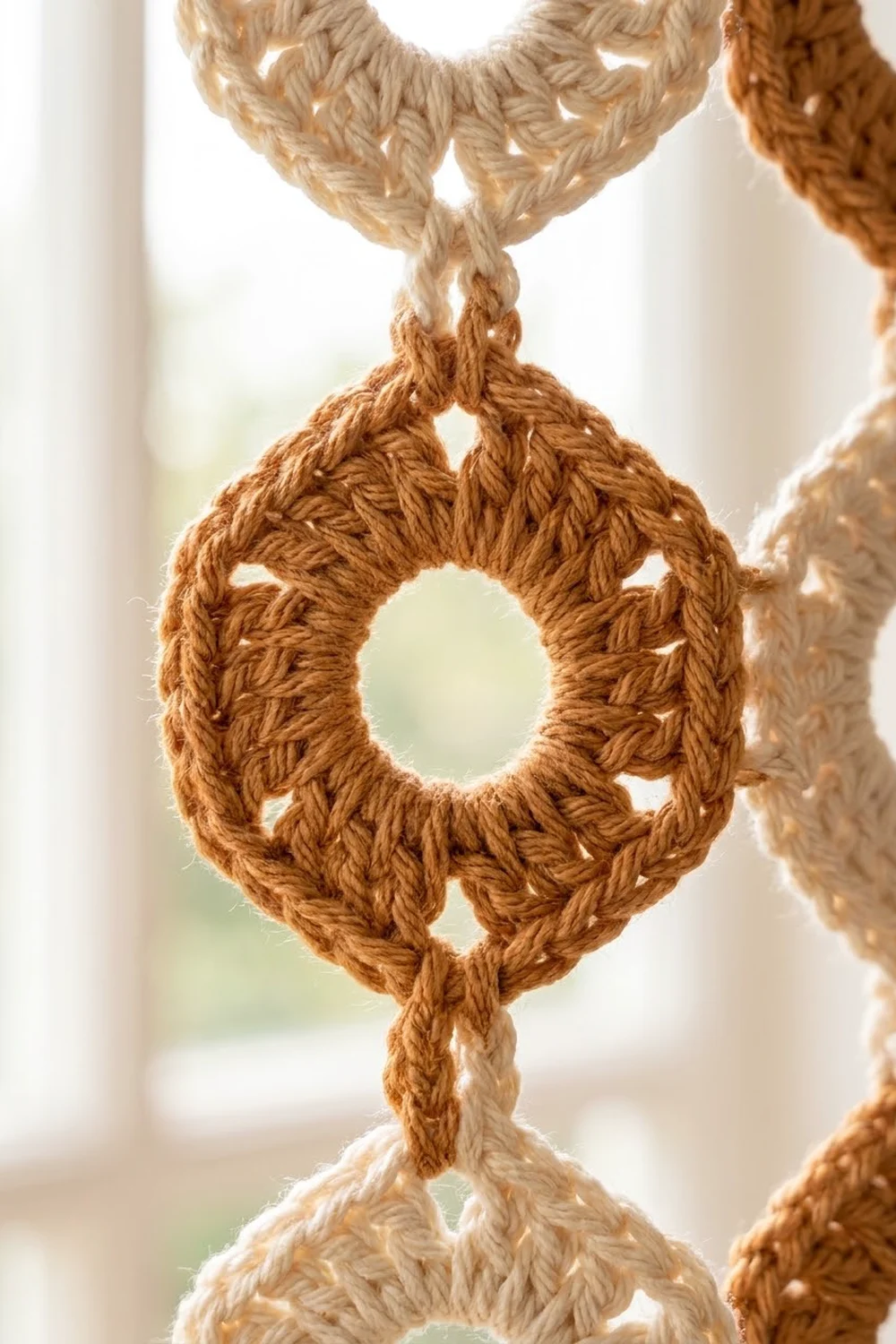
Hexagon Ring
Make 90 rings in caramel and 90 in cream. Work the first ring of each strand plain. Join every ring after that in Round 3.
Foundation: Ch 12, sl st in first ch to form a ring.
Round 1: Ch 3 (counts as dc), 23 dc in ring, sl st in top of beg ch-3. (24 dc)
As you go, push the stitches together around the ring so the center stays open and round.
Round 2: Ch 3 (counts as dc), dc in next 2 sts, (dc, ch 2, dc) in next st, dc in next 3 sts, (dc, ch 2, dc) in next st; rep from * 4 more times, sl st in top of beg ch-3. (30 dc, 6 ch-2 corner sps)*
This is a growth round. Each side now has 5 dc between the corner spaces: 1 corner dc, 3 dc, and 1 corner dc.
Round 3 (plain ring): Ch 1, sc in same st as join and in next 3 sts, (sc, ch 2, sc) in next ch-2 sp, sc in next 5 sts, (sc, ch 2, sc) in next ch-2 sp; rep from * 4 more times, sc in last st, sl st in first sc. Fasten off. (42 sc, 6 ch-2 corner sps)*
This is a conversion round: 30 sc worked 1 per existing dc, plus 12 extra sc at the corners, for 42 sc. Each side has 7 sc, and that count already includes the 2 corner sc of that side.
Naming the corners: The first ch-2 sp you make in Round 3 is the top corner (corner 1). Count around to the opposite corner (corner 4) and mark it. Corner 4 is the bottom point where the next ring will hang.
Round 3 (joined ring): Ch 1, sc in same st as join and in next 3 sts, (sc, JL into marked corner 4 of the ring above, sc) in next ch-2 sp, sc in next 5 sts, (sc, ch 2, sc) in next ch-2 sp; rep from * 4 more times, sc in last st, sl st in first sc. Fasten off. (42 sc, 5 ch-2 corner sps, 1 link)*
The top corner of the new ring now hangs from the bottom corner of the ring above. Mark corner 4 of the new ring before you start the next one.
Tip: Keep the RS of every ring facing you when you work the JL. If one ring is flipped, the strand will twist when it hangs.
Weave in ends as you go. Hide the tails inside the sc edge so the open centers stay clean.
Make All Pieces
Build each strand from the top down: 1 plain ring, then 17 joined rings.
- Caramel: 5 strands x 18 rings = 90 rings
- Cream: 5 strands x 18 rings = 90 rings
- Total: 180 rings
You can work Rounds 1 and 2 for many rings in advance, then add Round 3 one ring at a time as you link each strand. This makes the work easy to carry around.
Strand checkpoint: A finished strand of 18 rings measures 71.5 in (181.6 cm): 18 rings x 3.5 in (8.9 cm), plus 17 links x 0.5 in (1.3 cm). Before joining, lay all the strands side by side and check that they match within 0.5 in (1.3 cm).
Layout (A = caramel strand, B = cream strand), viewed from the RS:
Strand:  1  2  3  4  5  6  7  8  9  10
Color:   A  B  A  B  A  B  A  B  A  B
Rings:  18 18 18 18 18 18 18 18 18 18
Joining
The strands are not joined to each other along their sides. They hang free, side by side, and are joined only to the header band. This keeps the panel light and lets it move.
Each strand gets a 12-st section of the header. This number comes from the ring’s width, not its side count: 1 ring is 3 in (7.6 cm) wide, and 3 in x 4 sc per inch = 12 sc. The strand’s link sits in the exact center of its 12 sts, between the 6th and 7th sc.
Before you start the header, lay the strands out in layout order on the floor, top rings in a straight line. This makes it easy to pick up the right strand at each link.
Work the link chains at the same tension as your ring stitches. Tight links pull the strand up, and loose links make it sag. Each JL should hang 0.5 in (1.3 cm).
Size checkpoint: With all strands linked, the strand section is 30 in (76.2 cm) wide and 72 in (182.9 cm) long. That length is 71.5 in (181.6 cm) of rings plus the 0.5 in (1.3 cm) top link.
Border: Header Band and Tabs
The header is the panel’s only border. Work it in cream sc rows.
Border gauge: 16 sc = 4 in (10.2 cm), so 4 sc per inch; 9 rows = 2 in (5.1 cm).
Row 1 (RS): With cream, ch 121, sc in 2nd ch from hook and in each ch across, turn. (120 sc)
Rows 2-8: Ch 1, sc in each st across, turn. (120 sc each row)
Row 9 (joining row): Ch 1, sc in next 6 sts, JL into top corner (corner 1) of the first ring of the next strand, sc in next 6 sts; rep from * 9 more times, working strands 1 to 10 in layout order. Fasten off. (120 sc, 10 links)*
Why the math works: The bottom edge has 10 strands x 12 sts = 120 sc. No extra stitches are added between strands, and the links are chains, not sc, so they don’t change the count. At 4 sc per inch, 120 sc = 30 in (76.2 cm), which is the exact width of 10 rings at 3 in (7.6 cm) each.
Tabs: Turn the header so the foundation chain is on top and the RS faces you. The tabs sit over these foundation sts: 1-6, 20-25, 39-44, 58-63, 77-82, 96-101, and 115-120. That is 7 tabs x 6 sts = 42 sts, plus 6 gaps x 13 sts = 78 sts, for 120 sts total.
Each tab:
- Row 1: Join cream in the first st of the tab position, ch 1, sc in same st and next 5 sts, turn. (6 sc)
- Rows 2-22: Ch 1, sc in each st across, turn. (6 sc each row)
Fasten off with a 12 in (30.5 cm) tail. Each tab is 1.5 in (3.8 cm) wide and about 4.9 in (12.4 cm) long. Fold it to the WS and sew the last row to the back of Row 3 of the header. The folded loop rises about 2.5 in (6.4 cm) and fits a rod up to 1.25 in (3.2 cm) in diameter.
Final Blocking
- Lay the panel flat on a large towel or blocking mats, RS up.
- Straighten each strand so the rings line up point to point.
- Spray the rings and header evenly until damp, not soaked.
- Ease each ring into a clean hexagon, 3 in (7.6 cm) flat to flat.
- Pin the header to 30 in (76.2 cm) wide and 2 in (5.1 cm) deep.
- Check the full length: 74 in (188.0 cm) from the top of the header to the last ring.
- Let it dry completely.
- Hang the panel for a day. Gravity finishes the blocking and evens out the links.
Final Quality-Control Checklist
- 180 rings in total: 90 caramel and 90 cream
- Each ring has 42 sc and 6 corners in Round 3
- Every strand has 18 rings and 17 links
- Strands alternate A, B, A, B across
- Every header row has 120 sc
- Each strand’s link sits between the 6th and 7th sc of its 12-st section
- 7 tabs, evenly spaced, each 6 sts wide
- Panel measures 30 in (76.2 cm) x 74 in (188.0 cm)
- All ends are woven in and hidden
Troubleshooting
- Center hole closes up: Your foundation ring is too tight. Chain more loosely, or push the Round 1 dc together more firmly.
- Ring cups: Round 2 is too tight. Use a hook 0.5 mm larger for Rounds 2 and 3 only.
- Ring ruffles: Check that you made 24 dc in Round 1, not more.
- Ring looks round instead of hexagonal: Make sure each corner has (sc, ch 2, sc), and block firmly at the points.
- Strand twists: One ring was linked with its WS facing. Undo that link and rejoin with all rings RS up.
- Strands are different lengths: Your link tension varies. Redo the longest or shortest links to 0.5 in (1.3 cm).
- Header ripples: Recount to 120 sc and check that no sc went into a link chain.
Care
Hand wash, or machine wash on a gentle cold cycle in a mesh bag. Lay flat to dry, then hang to finish shaping.
Final Notes
The measurements build on each other in a simple chain. One ring is 3 in (7.6 cm) wide and 3.5 in (8.9 cm) tall. Eighteen rings and 18 links make a 72 in (182.9 cm) strand. Ten strands make 30 in (76.2 cm) of width, which matches the 120 sc of the header. Add the 2 in (5.1 cm) header, and the panel is 74 in (188.0 cm) long. If your first ring is right, the whole panel will be right.
Happy crocheting!