

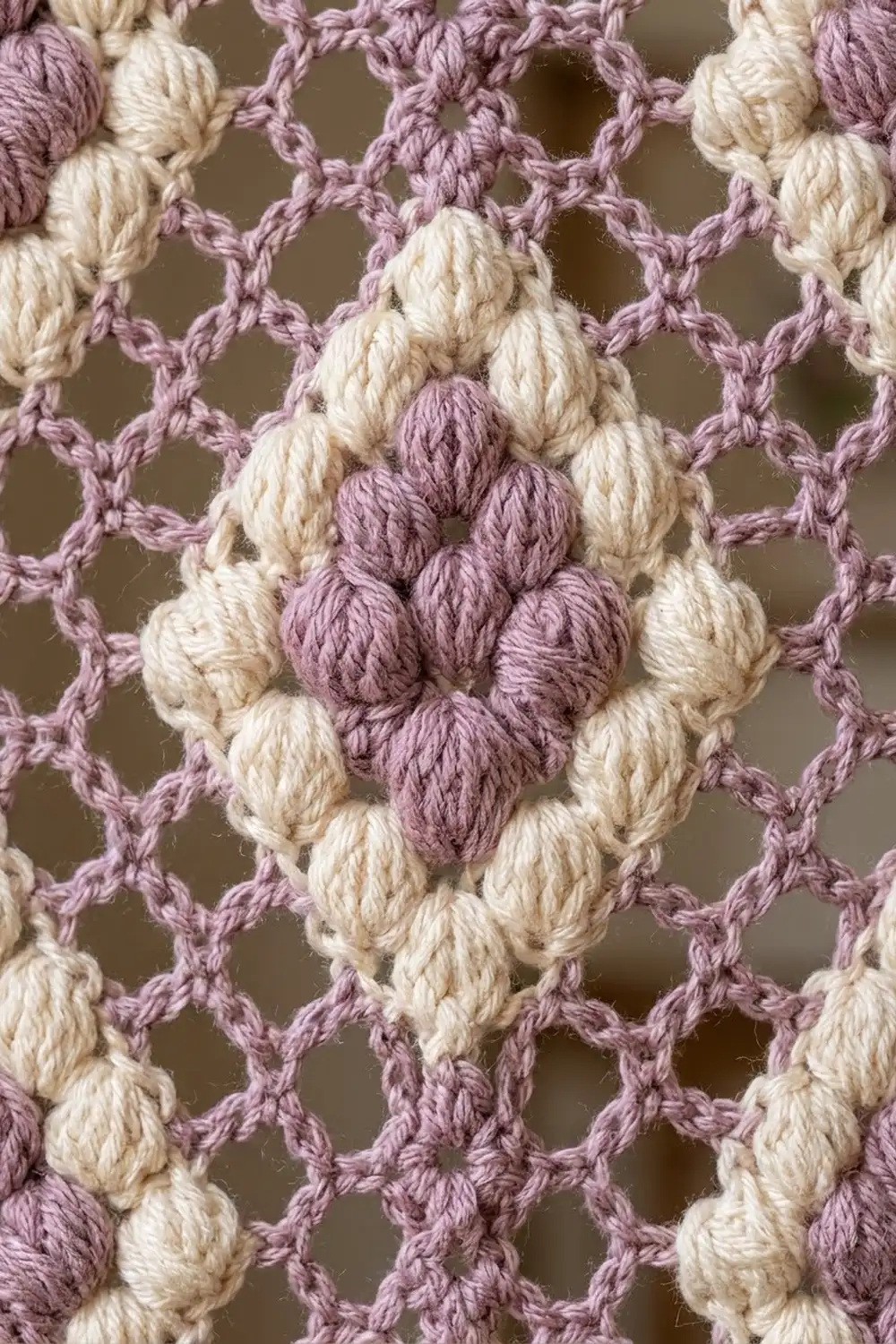
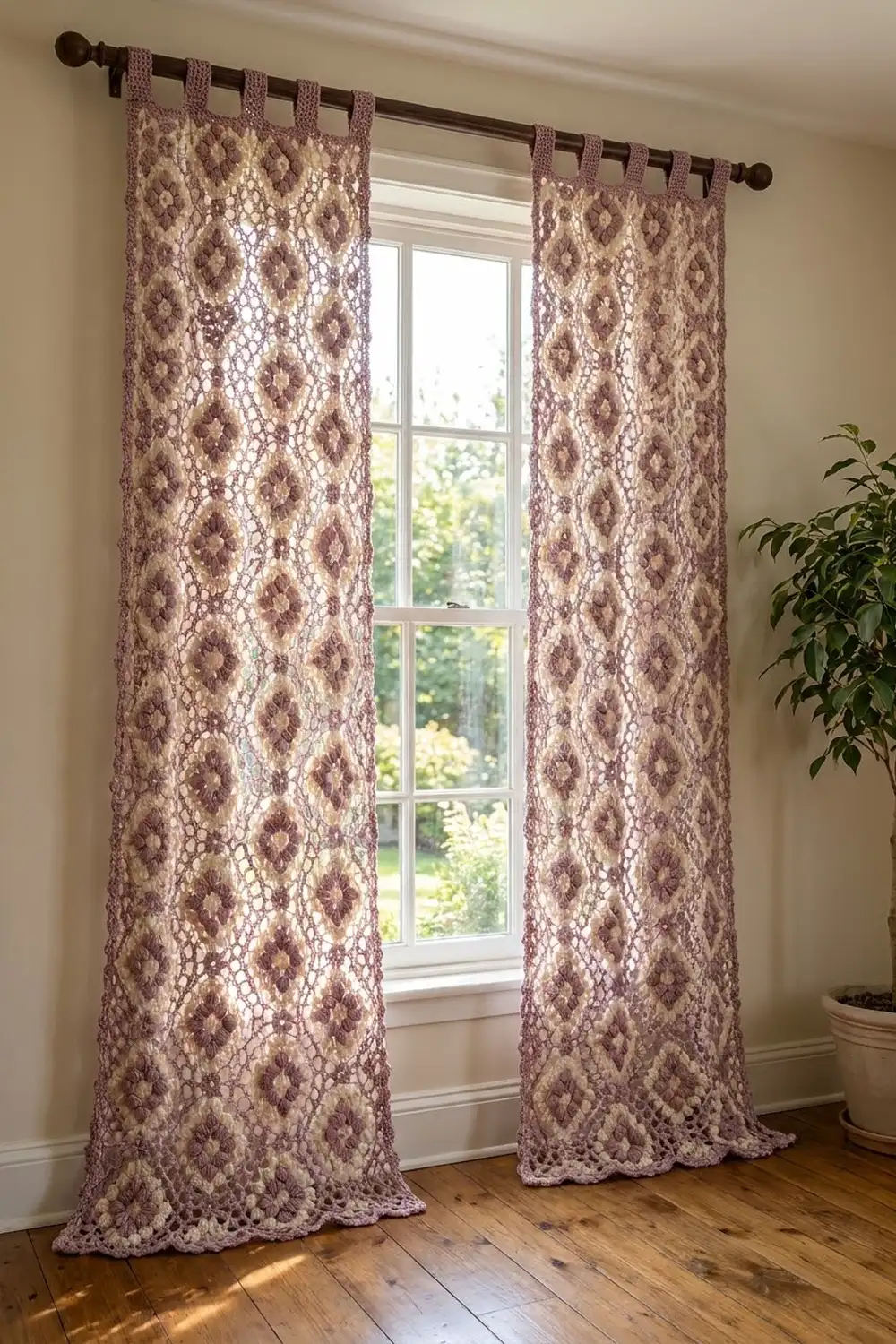
This tab-top curtain panel is a lacy mauve net scattered with soft, raised diamonds. Each diamond is a ring of cream puff stitches framing a small cluster of mauve puffs, and the diamonds sit in staggered bands, so the whole panel reads as an open trellis when light comes through it.
The palette is two colors: a dusty mauve for the net, the center puffs, the top band, the tabs and the picot edging, and a warm cream for the diamond outlines. The look is cottage-style and vintage, but it is easy to read and repeat.
The pattern uses US crochet terms. One finished panel measures 23 in (58.4 cm) wide by 70.5 in (179.1 cm) long without the tabs. From the top of the rod to the hem it hangs about 74 in (188.0 cm).
The panel is worked flat in one piece from the hem up. You work a ch-5 net and put a puff stitch in place of the usual sc wherever a diamond needs one. A solid sc band closes the top, six tabs are worked straight off that band, and a two-row picot border runs down both sides and across the hem. For a pair of curtains, make two identical panels.
Finished Size and Construction
- Finished size: 23 x 70.5 in (58.4 x 179.1 cm), tabs not included
- Hanging length: about 74 in (188.0 cm) from the top of the rod
- Skill level: Intermediate
- Terminology: US
- Yarn weight: Worsted (#4) cotton
- Hook: 5.0 mm (H-8)
- Number of pieces: 1 per panel; tabs are worked onto the panel
- Layout: 22 net loops across; 7 vertical repeats of the diamond pattern
- Size before border: 22 x 70 in (55.9 x 177.8 cm)
- Border depth: 0.5 in (1.3 cm) on the sides and hem
Materials
Choose a smooth, mercerized or combed worsted cotton, about 100 m per 50 g. Cotton keeps the mesh crisp and the puffs well defined, and it doesn’t stretch much under its own weight when it hangs.
Per panel:
– Mauve (MC): 400 g / 800 m
– Cream (CC): 70 g / 140 m
For a pair: 800 g / 1600 m mauve and 140 g / 280 m cream.
All quantities include a margin of roughly 10 percent for your gauge swatch and for differences in tension.
Tools:
– 5.0 mm (H-8) crochet hook
– 3 small yarn bobbins for the cream
– Locking stitch markers
– Tapestry needle
– Tape measure
– Blocking mats, rust-proof pins, and a spray bottle
– Scissors
Abbreviations (US Terms)
- ch – chain
- sc – single crochet
- dc – double crochet
- sl st – slip stitch
- sp – space
- st(s) – stitch(es)
- tch – turning chain
- yo – yarn over
- RS / WS – right side / wrong side
- MC / CC – mauve / cream
Puff stitch (PS): [Yo, insert hook into the ch-5 sp, yo, pull up a loop to 0.75 in (1.9 cm)] 4 times (9 loops on hook), yo and draw through all 9 loops, then ch 1 to close. The ch 1 is not counted as a stitch.
Cream PS: Drop MC and work the PS with CC through the final draw-through. Then pick MC back up and use it for the closing ch 1.
Picot: Ch 3, sl st in the 3rd ch from the hook.
Gauge and Checkpoints
Net gauge: 4 ch-5 loops = 4 in (10.2 cm) wide and 10 rows = 6 in (15.2 cm) tall, blocked. That makes each loop 1 in (2.5 cm) wide and each row 0.6 in (1.5 cm) tall.
Band gauge: 16 sc = 4 in (10.2 cm).
Test swatch: Ch 34 and work Rows 1–2 as written below, but with 8 loops instead of 22, so each repeat count drops from 21 to 7. Then work one diamond on Rows 3–9 using the Band A instructions with the diamond placed at positions 3–6: cream at 4; cream at 4, 5; C3 M4 C5; C3 M4 M5 C6; then mirror back up. Finish with Row 10 as a plain even row.
Block the swatch. It should measure 8 x 6 in (20.3 x 15.2 cm), and the diamond should measure 4 x 4.2 in (10.2 x 10.7 cm).
- Too big: use a 4.5 mm hook, or keep your chains snugger.
- Too small: use a 5.5 mm hook.
Even half an inch of error over 8 in becomes nearly 3 in (7.6 cm) across the panel and much more down its length.
Checkpoints (measured flat, lightly stretched):
– After Row 2: 22 in (55.9 cm) wide
– After Row 18: 10.8 in (27.4 cm) long
– After Row 66: 39.6 in (100.6 cm) long
– After Row 115: 69 in (175.3 cm) long
– After the top band: 70 in (177.8 cm) long
How the Net Works
Every row has anchor positions. An anchor is normally an sc placed in a ch-5 sp, but at the listed positions you work a PS into that sp instead. The next row always works into ch-5 spaces and never into the anchors themselves, so puffs never change the stitch count.
- Odd rows have 21 numbered anchors (one in each full loop of the row below), plus an edge sc at each end. They make 22 loops.
- Even rows have 22 numbered anchors (one in each loop of the row below), plus half-loops of ch 2 and dc at each end.
Count anchor positions from the start of each row. The motif layout is mirror-symmetric, so the count works in both directions.
Carrying cream: Give each diamond its own cream bobbin. Between cream puffs in the same diamond, float the cream loosely along the WS of the curtain, behind no more than 2 loops. Bring the bobbin up to the next row loosely as well. Cut the cream after the last puff of each diamond.
Panel
Foundation: With MC, ch 90.
Row 1 (RS, odd): Sc in 2nd ch from hook, [ch 5, sk 3 ch, sc in next ch] 22 times. Turn. (22 loops, 23 sc)
Row 2 (even): Ch 5 (counts as dc + ch 2), sc in first ch-5 sp, [ch 5, sc in next ch-5 sp] 21 times, ch 2, dc in last sc. Turn. (22 anchors, 21 full loops + 2 half-loops)
Plain odd row: Ch 1, sc in first dc, [ch 5, sc in next ch-5 sp] 21 times, ch 5, sc in 3rd ch of tch. Turn. (22 loops, 23 sc)
Plain even row: Work as Row 2.
The 16-Row Repeat
Work each row as a plain row of the same parity, but replace the sc with a PS at the listed positions (C = cream PS, M = mauve PS).
Band A (three diamonds):
– R1 (odd): C at 5, 11, 17. (3 PS, 18 sc anchors)
– R2 (even): C at 5, 6, 11, 12, 17, 18. (6 PS, 16 sc)
– R3 (odd): C4 M5 C6, C10 M11 C12, C16 M17 C18. (6 C + 3 M, 12 sc)
– R4 (even): C4 M5 M6 C7, C10 M11 M12 C13, C16 M17 M18 C19. (6 C + 6 M, 10 sc)
– R5: As R3.
– R6: As R2.
– R7: As R1.
– R8: Plain even row.
Band B (two diamonds + two edge clusters):
– R9 (odd): C at 8, 14. (2 PS, 19 sc)
– R10 (even): C at 8, 9, 14, 15. (4 PS, 18 sc)
– R11 (odd): M2, C7 M8 C9, C13 M14 C15, M20. (4 C + 4 M, 13 sc)
– R12 (even): M2 M3, C7 M8 M9 C10, C13 M14 M15 C16, M20 M21. (4 C + 8 M, 10 sc)
– R13: As R11.
– R14: As R10.
– R15: As R9.
– R16: Plain even row.
Each full diamond is 4 loops wide and 7 rows tall: 12 cream puffs around 4 mauve puffs. The mauve-only clusters on R11–R13 continue the diagonal lattice out to the side edges. Each repeat uses 60 cream and 28 mauve puffs and is 9.6 in (24.4 cm) tall.
Rows 3–114: Work the 16-row repeat 7 times. Repeat Row 1 always falls on an odd panel row (3, 19, 35, and so on).
Row 115: Plain odd row. (22 loops, 23 sc)
Top Band
Row 116: Ch 1, sc in first sc, [3 sc in next ch-5 sp, sc in next sc] 22 times. Turn. (1 + 88 = 89 sc)
Rows 117–119: Ch 1, sc in each st across. Turn. (89 sc)
The band is 1 in (2.5 cm) tall and should match the net width within 0.25 in (0.6 cm). Don’t fasten off.
Tabs (make 6)
Place markers to divide Row 119 into six 9-st tabs with 7-st gaps between them. The tabs fall on sts 1–9, 17–25, 33–41, 49–57, 65–73, and 81–89, which accounts for 6 x 9 + 5 x 7 = 89 sts.
Tab Row 1: Ch 1, sc in 9 sts. Turn. (9 sc)
Tab Rows 2–28: Ch 1, sc in each st. Turn. (9 sc)
Fasten off, leaving a 12 in (30.5 cm) tail. Join MC to the first st of the next tab and repeat.
Each tab measures 2.25 x 7 in (5.7 x 17.8 cm). Fold each tab to the WS and whipstitch its last row along the base of Row 117. This makes a loop 3.5 in (8.9 cm) deep, which fits a rod up to 1.5 in (3.8 cm) across.
Border
Border gauge: 21 sc = 5 in (12.7 cm) worked along an edge.
Border Row 1 (RS): Join MC at the top of the right edge (the end of Row 119). Work 1 sc in the side of each of the 4 band rows. Then work down the net: 3 sc around the post of each even-row edge dc or tch, and 2 sc in the side of each odd-row edge sc.
That gives 291 sc down the side: 4 + (57 x 3) + (58 x 2).
At the hem, work along the free loops of the foundation chain: 3 sc in the first free loop (corner), sc in the next 87 loops, 3 sc in the last free loop (corner). That gives 93 sc, including both 3-sc corner groups.
Work up the left side to mirror the right: 291 sc. Turn. (675 sc total)
Border Row 2: Ch 1, sc in first 2 sts, picot, [sc in next 3 sts, picot] across to the last st, sc in last st. Fasten off. (675 sc, 225 picots)
Why the math works:
– Every count divides evenly by 3: 291 = 97 x 3 and 93 = 31 x 3.
– Because the picots start after 2 sts, they land on sts 293 and 383, which are exactly the center sts of the two hem corners.
– Each side carries 97 picots and the hem carries 31.
– At 4.2 sc per inch, 291 sc covers about 69.3 in (176.0 cm), a hair under the 70 in (177.8 cm) edge. This keeps the side firm and straight, and blocking relaxes it to length.
Final Blocking
- Weave in all ends along the mesh chains. Never cross an open loop to hide a tail.
- Soak the panel in cool water for 15 minutes, then press the water out in a towel. Don’t wring it.
- Pin it flat to 23 x 70.5 in (58.4 x 179.1 cm). If your mats are short, block it in two or three sections.
- Open every ch-5 loop into a diamond shape so the lattice lines up straight.
- Gently pinch each puff so it stands up rather than flattening.
- Pin out each picot along the sides and hem.
- Let it dry completely, then hang it for 24 hours before hemming any extra length.
Final Quality-Control Checklist
- 22 loops across on every odd row
- 7 complete repeats: 21 Band A diamonds and 14 Band B diamonds
- All 14 edge clusters present
- No cream floats longer than 2 loops, and all floats on the WS
- Top band of 89 sc, with 6 tabs evenly spaced
- Border counts: 291 / 93 / 291
- Hem picots centered on the corners
- Blocked size within 0.5 in (1.3 cm) of the target
Troubleshooting
- Panel narrows as you go: Your ch-5 loops are tightening. Count the chains and loosen your grip.
- Diamonds lean sideways: You miscounted positions. Count from the first anchor, not from the turning chain.
- Puffs look flat: Pull every loop to the full 0.75 in (1.9 cm) before closing.
- Cream shows on the RS: Leave more slack in the float, and keep it behind the chain, not in front.
- Side border ruffles: Use 2 sc around the even-row dc posts for a few rows to ease it in.
- Tabs twist on the rod: Line up the folded edge with the tab’s own stitches before sewing.
Care
Hand wash in cool water with a mild detergent and dry flat, reblocking lightly as needed. Avoid hanging the panel wet, because cotton lace will stretch under its own weight.
Final Notes
The panel’s measurements all build on each other:
- One loop measures 1 in (2.5 cm), so 22 loops make 22 in (55.9 cm).
- One row measures 0.6 in (1.5 cm), so 115 rows make 69 in (175.3 cm).
- The top band adds 1 in (2.5 cm), for 70 in (177.8 cm).
- The 0.5 in (1.3 cm) border brings the panel to 23 x 70.5 in (58.4 x 179.1 cm).
- The 3.5 in (8.9 cm) tab loops make a hanging length of about 74 in (188.0 cm).
Check your swatch and keep your loops even, and the diamonds will line up from hem to rod.
Happy crocheting!