

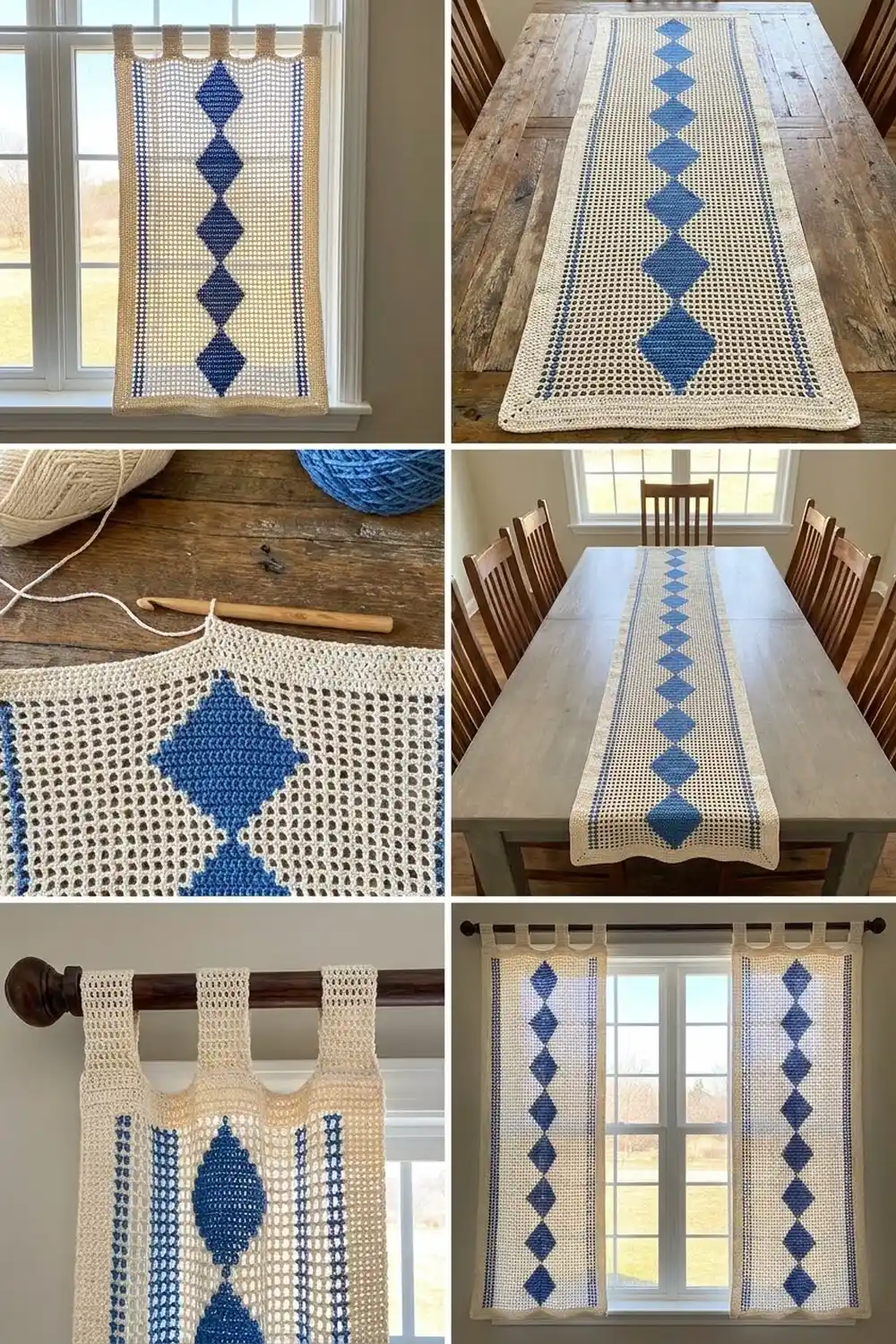
The Blue Lattice Diamond Curtain Panel is a light, airy filet crochet panel with two vertical columns of blue diamonds running down a cream mesh background. Every diamond has a solid blue outline, an open inner diamond and a single blue block in the center. Short stems link one diamond to the next, so each column reads as one continuous chain.
The palette is just cream and soft denim blue. Cream forms the mesh, the solid border and the hanging tabs. Blue appears only in the filled blocks, and every vertical post stays cream, so a fine cream grid shows through the blue motifs. The style is farmhouse and cottage: simple, graphic and easy to live with.
This pattern uses US crochet terms. One panel measures 24.25 in (61.6 cm) wide by 79 in (200.7 cm) long, not counting the tabs. Five mesh tabs rise from the top edge and fold over a rod up to 2 in (5.1 cm) across.
You work the panel as one piece, in rows, from the bottom edge up. The diamonds come from colored blocks worked into the mesh. Then you add a three-round single crochet border and work the tabs off the top of the border. This pattern makes one panel. For a matching pair, crochet a second panel the same way.
Finished Size and Construction
- Finished size: 24.25 in x 79 in (61.6 cm x 200.7 cm), not counting tabs
- Skill level: Intermediate (filet mesh plus two-color blocks)
- Terminology: US
- Yarn weight: DK / light worsted (#3) cotton
- Hook: 4.0 mm (G-6)
- Number of pieces: 1 (border and tabs are worked onto it)
- Layout: 31 filet squares wide x 104 rows tall
- Piece size before border: 23.25 in x 78 in (59.1 cm x 198.1 cm)
- Border depth: 0.5 in (1.3 cm) on every side
- Tabs: 5 tabs, each 2.5 in (6.4 cm) wide and 7.5 in (19.1 cm) long before folding
Materials
Use a smooth, mercerized or combed cotton in DK weight, about 105 m per 50 g. Cotton keeps the mesh square, hangs straight and washes well. Avoid fuzzy or very stretchy yarns: the open squares will blur and the panel will grow as it hangs.
- Cream (main color): 450 g, about 945 m
- Denim blue (contrast): 100 g, about 210 m
These quantities include a margin of about 15% for your gauge swatch, tension differences and weaving in ends.
Tools:
- 4.0 mm (G-6) crochet hook
- 6 small yarn bobbins (or wound butterflies) for the blue
- Locking stitch markers
- Tapestry needle
- Scissors and a tape measure
- Blocking mats or a large clean sheet, rust-proof pins and a spray bottle
Abbreviations (US Terms)
- ch – chain
- sk – skip
- sc – single crochet
- dc – double crochet
- sp – space
- st(s) – stitch(es)
- RS / WS – right side / wrong side
Filet units:
- Post: the 1 cream dc that separates two squares. Posts are always cream.
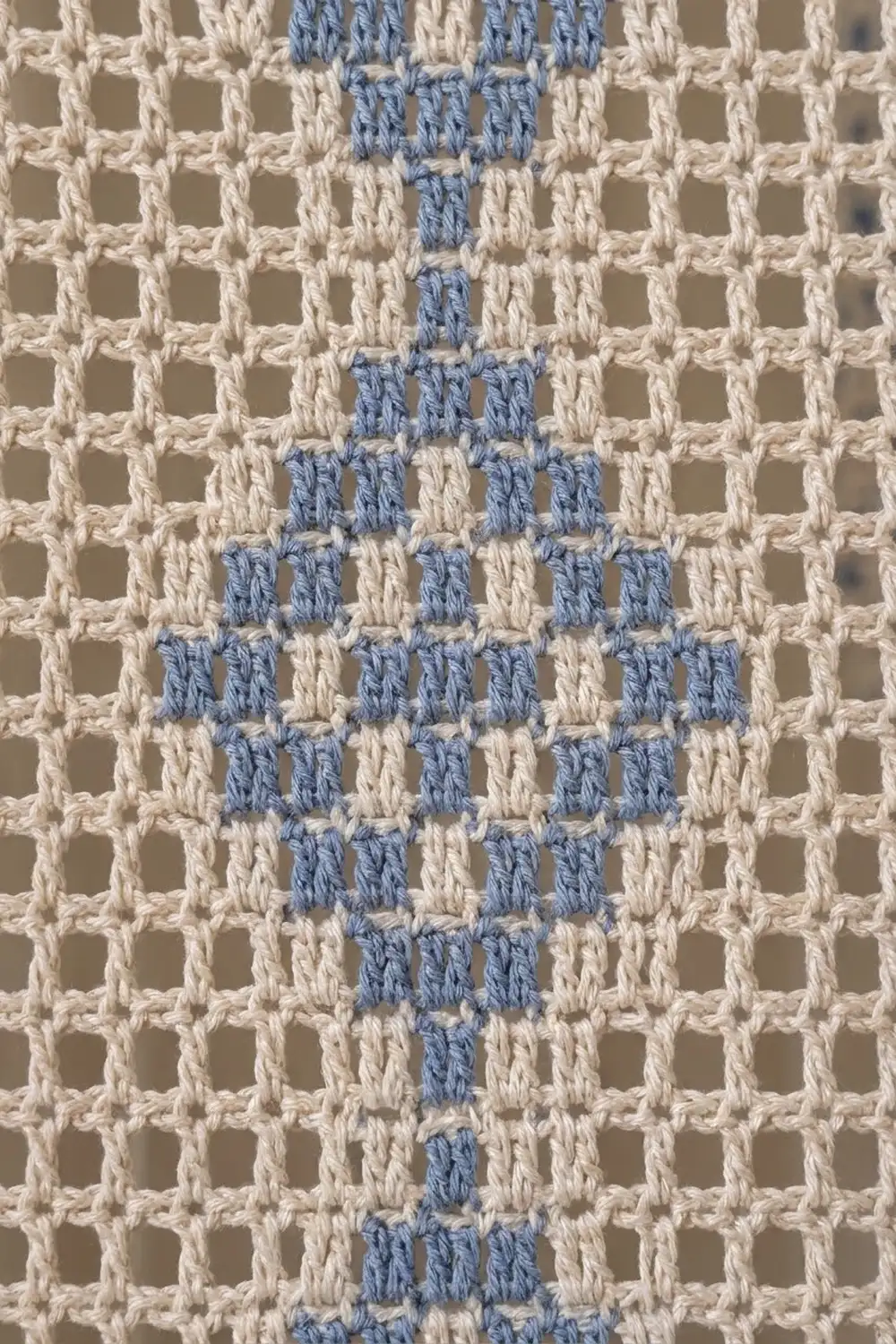
- Mesh square (M): ch 2, sk 2 sts (or the ch-2 sp), then 1 cream dc in the next post. Over a block: ch 2, sk 2 dc, dc in next post.
- Block (B): 2 blue dc (in the ch-2 sp below, or 1 in each of the 2 fill dc of a block below), then 1 cream dc in the next post.
- Color change: work the last yarn-over of the stitch before the change in the new color. Carry the cream strand inside the 2 blue dc so it is ready for the next post.
Every row is 94 sts: 32 cream posts plus 31 squares x 2 sts each (chains or blue dc).
Gauge and Checkpoints
Gauge: 4 squares x 4 rows = 3 in (7.6 cm) in filet mesh. One square is 0.75 in (1.9 cm) wide and one row is 0.75 in (1.9 cm) tall.
Make a test swatch before you start the panel. Ch 21, then work 1 solid dc row (19 dc) and 5 mesh rows (6 squares). Block it, let it dry and measure. It should be 4.5 in (11.4 cm) wide and 4.5 in (11.4 cm) tall.
- Squares too big: use a hook one size smaller.
- Squares too small: use a hook one size larger.
- Width right but rows too tall: pull the loop down snugly on the first yarn-over of each dc.
Checkpoints on the panel:
- After Row 6: 23.25 in (59.1 cm) wide, 4.5 in (11.4 cm) tall
- After Row 18 (first diamond and first stem): 13.5 in (34.3 cm) tall
- After Row 99 (last diamond): 74.25 in (188.6 cm) tall
- After Row 104: 23.25 in x 78 in (59.1 cm x 198.1 cm)
- After the border: 24.25 in x 79 in (61.6 cm x 200.7 cm)
Measure flat, without stretching. Cotton mesh gets a little longer when it hangs, so match the measurements exactly rather than working a little long.
Panel
Bottom Band
With cream, ch 96.
Row 1 (RS): Dc in 4th ch from hook (skipped ch count as 1 dc) and in each ch across. Turn. (94 dc)
Row 2: Ch 5 (counts as dc + ch 2), sk next 2 dc, dc in next dc; *ch 2, sk 2 dc, dc in next dc; rep from * across, working the last dc in top of turning ch. Turn. (31 mesh squares; 94 sts)
Rows 3–6: Ch 5 (counts as dc + ch 2), dc in next dc; *ch 2, dc in next dc; rep from * across, working the last dc in 3rd ch of turning ch-5. Turn. (31 squares; 94 sts)
Diamond Chart (one motif, 9 squares wide)
Each motif covers 9 squares. One full repeat is 12 rows: 9 rows of diamond, then 3 rows of stem.
Chart row  Squares 1-9    Written             Blocks
 1         ....X....      M4, B1, M4          1
 2         ...XXX...      M3, B3, M3          3
 3         ..XX.XX..      M2, B2, M1, B2, M2  4
 4         .XX...XX.      M1, B2, M3, B2, M1  4
 5         XX..X..XX      B2, M2, B1, M2, B2  5
 6         .XX...XX.      same as row 4       4
 7         ..XX.XX..      same as row 3       4
 8         ...XXX...      same as row 2       3
 9         ....X....      same as row 1       1
10-12      ....X....      M4, B1, M4 (stem)   1 each
One diamond has 29 blocks, and one full 12-row repeat has 32 blocks. Every chart row is symmetrical, so you read it the same way on RS and WS rows.
Motif Rows
Every motif row uses the same layout across all 31 squares:
M4, Motif A (9 squares), M5, Motif B (9 squares), M4
Motif A sits on squares 5–13 and Motif B on squares 19–27. Check: 4 + 9 + 5 + 9 + 4 = 31 squares.
Start each row with ch 5 (counts as dc + ch 2), which makes the first square a mesh square. End each row with the last dc in the 3rd ch of the turning ch-5. Every row stays at 94 sts.
Rows 7–15: Work Chart rows 1–9 in both motifs (Diamond 1).
Rows 16–18: Work Chart rows 10–12 (stem).
Rows 19–90: Repeat Rows 7–18 six more times. Each 12-row group is one diamond followed by one stem.
Rows 91–99: Work Chart rows 1–9 once more (Diamond 8). Do not work a stem after it.
Each column now has 8 diamonds linked by 7 stems. That is 93 motif rows: 8 x 9 + 7 x 3 = 93.
Blue yarn management: Join a bobbin of blue where a group of blocks first appears. When the group shifts one square outward or inward on the next row, lay the blue strand along the top of the previous row and work over it with the next blue dc. Never carry blue across more than one square. Chart row 5 needs 3 bobbins per motif, so you need 6 in total. When a group ends, cut the strand, leaving a 4 in (10.2 cm) tail to weave into the blue blocks.
Top Band
Rows 100–103: Mesh across as Row 3. (31 squares; 94 sts)
Row 104: Ch 3 (counts as dc), *2 dc in ch-2 sp, dc in next dc; rep from * across. Turn. (94 dc)
Do not fasten off.
Checkpoint: 23.25 in x 78 in (59.1 cm x 198.1 cm). The posts should line up vertically, and each diamond should sit centered in its column.
Border
Border gauge: 4 sc = 1 in (2.5 cm), the same as the mesh width of 12 sts per 3 in (7.6 cm). One row is 0.75 in (1.9 cm) tall, so 3 sc per row end on the sides also gives 4 sc per inch.
Here the corner stitch is the center sc of each 3-sc corner group. The per-side counts below include both corner stitches of that side.
Round 1 (RS): Ch 1. Along the top edge, work 3 sc in first st, sc in each of next 92 sts, 3 sc in last st. Rotate. Down the side, work 3 sc in each row end (around the turning ch or edge dc) for all 104 rows. (312 sc) Along the bottom edge, working into the other side of the foundation ch, work 3 sc in first ch, sc in each of next 92 ch, 3 sc in last ch. Work 3 sc in each row end up the second side. (312 sc) Sl st to first sc.
- Top and bottom: 92 + 1 side st from each corner group + 2 corner stitches = 96 sts per side
- Sides: 312 + 1 side st from each corner group + 2 corner stitches = 316 sts per side
- Total: 2 x 96 + 2 x 316 − 4 shared corners = 820 sc
Round 2: Ch 1, sc in each sc around, working 3 sc in each corner stitch. Sl st to first sc.
(Top/bottom 98, sides 318 per side; 820 + 8 = 828 sc)
Round 3: Rep Round 2.
(Top/bottom 100, sides 320 per side; 828 + 8 = 836 sc) Fasten off.
Why the math works: Row 104 has 94 sts. The 2 end sts take the corner groups, and 1 sc goes in each of the 92 sts between them, so the edge neither ruffles nor pulls in. On the sides, 3 sc per 0.75 in (1.9 cm) row gives the same 4 sc per inch as the top edge. Adding 8 sts per round (2 per corner) lets a flat sc border turn a square corner.
Tabs
Hold the panel RS facing, with the top edge up. The top side of Round 3 has 100 sts, counting corners. Starting at the top-right corner stitch, divide it like this:
Sk 3, Tab, sk 11, Tab, sk 11, Tab, sk 11, Tab, sk 11, Tab, sk 3
Each tab uses 10 sts. Check: 3 + 5 x 10 + 4 x 11 + 3 = 100. Place markers before you start.
Each tab (10 sts wide):
Row 1: Join cream in first marked st, ch 3 (counts as dc), dc in next 9 sts. Turn. (10 dc)
Row 2: Ch 5 (counts as dc + ch 2), sk 2 dc, dc in next dc, ch 2, sk 2 dc, dc in next dc, ch 2, sk 2 dc, dc in top of ch-3. Turn. (3 squares; 10 sts)
Rows 3–9: Mesh across. (3 squares; 10 sts)
Row 10: Ch 3, *2 dc in ch-2 sp, dc in next dc; rep from * twice more. (10 dc)
Fasten off, leaving a 16 in (40.6 cm) tail.
Each tab measures 2.5 in (6.4 cm) wide and 7.5 in (19.1 cm) long. Fold the tab to the WS and sew Row 10 to the back of Border Round 1, matching stitch to stitch. This leaves a loop about 3.5 in (8.9 cm) long, which fits a rod up to 2 in (5.1 cm) across.
Weave in all ends along posts or inside blue blocks. Never weave across an open square.
Final Blocking
- Soak the panel in cool water with a little wool wash for 15 minutes.
- Press the water out gently. Roll the panel in towels to remove more moisture. Do not wring.
- Lay it flat on mats or a sheet, RS up.
- Pin the four corners to 24.25 in x 79 in (61.6 cm x 200.7 cm).
- Pin along each side every 4 in (10.2 cm), keeping the border straight.
- Run a long ruler down each column of posts and nudge the posts into straight vertical lines. Each square should be 0.75 in (1.9 cm).
- Pin the tabs flat and straight.
- Let it dry completely, at least 24 hours, before you unpin it.
Final Quality-Control Checklist
- Panel is 24.25 in x 79 in (61.6 cm x 200.7 cm) after blocking
- 31 squares across and 104 rows in total
- Every row has 94 sts and 32 cream posts
- Each column has 8 diamonds and 7 stems, and the diamonds line up across both columns
- Every diamond has 29 blocks with a single blue center block
- No blue floats show across open squares
- Border Round 3 counts 100 sts per short side and 320 per long side
- All 5 tabs are 10 sts wide, with 11 sts between neighboring tabs
- Tabs are sewn securely and the panel hangs straight
Troubleshooting
Squares look like rectangles: Your dc are taller than your chains. Shorten the dc or make the ch-2 slightly looser.
Panel is getting narrower or wider: You are losing or adding a stitch at the row ends. Check that the first square starts with ch 5 and the last dc goes into the 3rd ch of the turning chain. Count 32 posts.
Diamond looks off-center: Count squares, not stitches. You should have M4 before Motif A and M5 between the motifs.
Cream shows through the blue blocks: Carry the cream strand closer to the top of the blue dc, and gently snug it after each block.
Border ruffles: Work 2 sc per row end on the sides for one round, then go back to 3 sc. Re-check your row gauge.
Border cups: Make sure you work 3 sc in every corner stitch and don’t skip any row ends.
Tabs twist on the rod: Before you hang the panel, sew each tab to the back of Round 1 straight across, stitch to stitch.
Care
Hand wash, or machine wash cool on a gentle cycle in a mesh bag. Lay flat to dry, or re-block lightly so the squares stay true.
Final Notes
The measurement chain is simple: 1 square = 0.75 in (1.9 cm). Thirty-one squares give 23.25 in (59.1 cm), and 104 rows give 78 in (198.1 cm). A 0.5 in (1.3 cm) sc border brings the panel to 24.25 in x 79 in (61.6 cm x 200.7 cm). If your swatch matches gauge, every later checkpoint will follow.
Happy crocheting!