

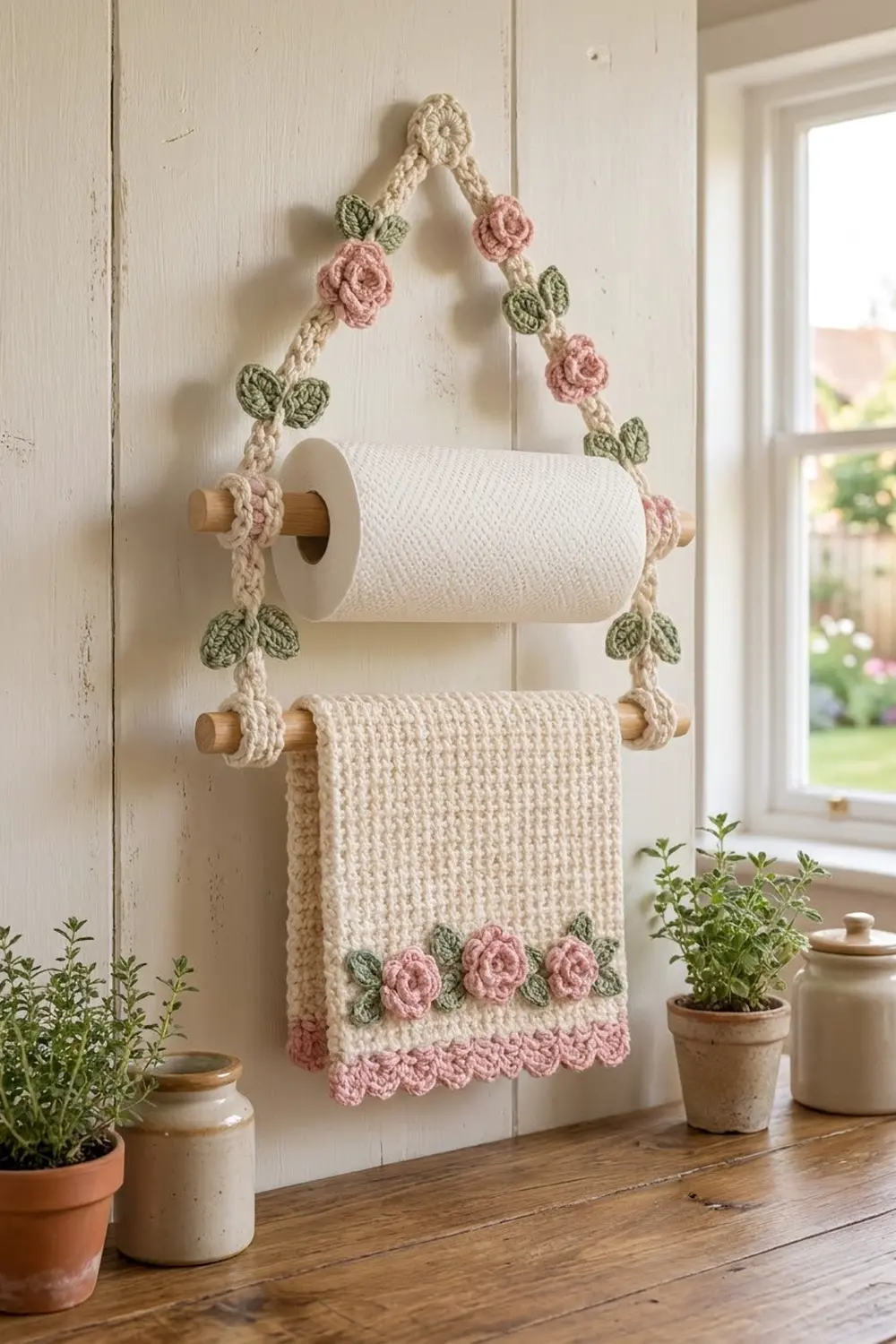
This set brings cottage-garden charm to the kitchen wall. A cream cord with a braided look hangs from a single loop, forms a triangle and wraps around two wooden dowels. The top dowel holds a paper towel roll. The bottom dowel holds a matching crocheted hand towel.
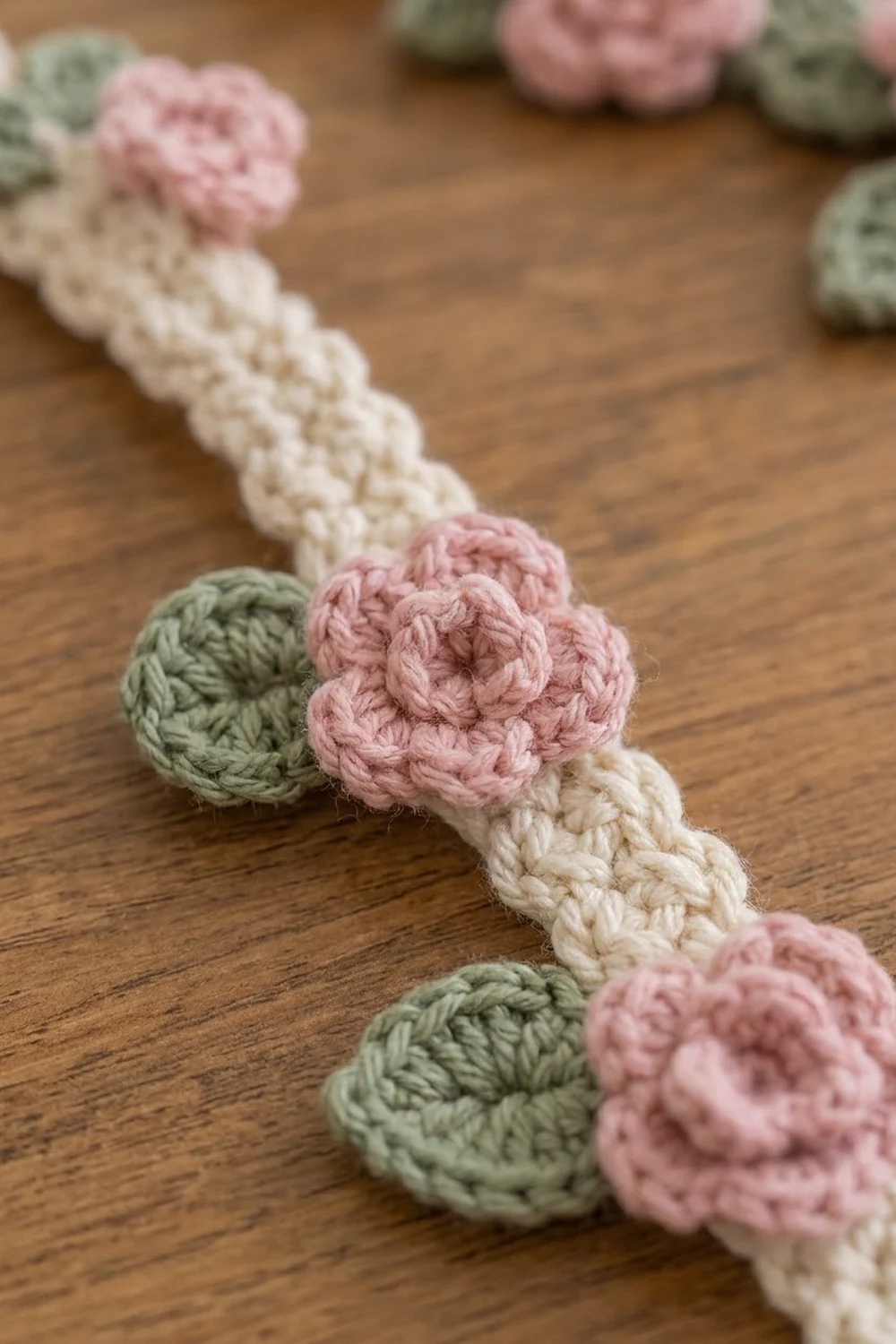
The palette is soft: cream for the cord and the towel body, dusty pink for the roses and scallops, and sage green for the leaves. Layered roses with leaf pairs climb both diagonals of the cord. A row of three roses sits just above the pink scallops on the towel.
The pattern uses US crochet terms. The finished towel measures 8.5″ x 22″ (21.6 cm x 55.9 cm) flat. Folded over the dowel, it hangs about 11″ (27.9 cm) deep. The cord is 46″ (116.8 cm) long before assembly.
You crochet one moss stitch towel panel, one long Romanian cord, 9 roses and 22 leaves. Then you edge the towel, add pink scallops to both short ends and sew everything together. The dowels are not crocheted.
Finished Size and Construction
- Finished towel size: 8.5″ x 22″ (21.6 cm x 55.9 cm)
- Towel panel before border: 8″ x 20″ (20.3 cm x 50.8 cm)
- Border depth: 0.25″ (0.6 cm) on the long sides; 1″ (2.5 cm) on the short ends
- Cord length: 46″ (116.8 cm)
- Rose diameter: 1.75″ (4.4 cm)
- Leaf size: 1.25″ x 0.6″ (3.2 cm x 1.5 cm)
- Skill level: Easy–Intermediate
- Terminology: US
- Yarn weight: Worsted (#4) cotton
- Hook: 5 mm (H-8)
- Number of pieces: 1 towel, 1 cord, 9 roses, 22 leaves
- Layout: cord hanger over 2 dowels with 6 roses and 16 leaves; towel with 3 roses and 6 leaves
Materials
Choose a smooth worsted-weight 100% cotton. Cotton absorbs water, washes well and gives the roses crisp petals. The amounts below assume about 1.5 m per gram, which is typical for worsted kitchen cotton.
- Cream: 150 g, about 225 m (towel, edging, cord)
- Dusty pink: 40 g, about 60 m (roses, scallops)
- Sage green: 25 g, about 38 m (leaves)
These amounts include about 15% extra for gauge differences and swatching.
Tools:
- 5 mm (H-8) crochet hook
- Tapestry needle
- Stitch markers
- Scissors and measuring tape
- 2 wooden dowels, each 14″ (35.6 cm) long and 0.75″ (1.9 cm) in diameter
- Rust-proof pins and a blocking mat
Abbreviations (US Terms)
- ch – chain
- sl st – slip stitch
- sc – single crochet
- hdc – half double crochet
- dc – double crochet
- sc2tog – single crochet 2 together
- sk – skip
- sp – space
- st(s) – stitch(es)
Moss stitch: Alternate sc and ch 1 across the row. From Row 3 on, each sc goes into a ch-1 sp and each ch-1 skips a sc. Each sc and each ch-1 counts as 1 stitch.
Romanian cord: Ch 2, then sc in the 2nd ch from the hook. Turn the work a half-turn to the left so the back faces you. Insert the hook under the single vertical loop at the left edge and work a sc. Turn again, insert the hook under the 2 loops now at the left edge and work a sc. Repeat this turn-and-sc step. Each sc counts as 1 row.
Gauge and Checkpoints
Gauge: 16 sts and 16 rows = 4″ (10.2 cm) in moss stitch.
Make one rose first as a test. It should measure 1.75″ (4.4 cm) across after Round 5. Then work a towel swatch of 16 sts and 16 rows.
Towel checkpoints:
- After Row 16: 4″ (10.2 cm) tall and 8″ (20.3 cm) wide
- After Row 40: 10″ (25.4 cm) tall
- After Row 80: 20″ (50.8 cm) tall
- After the cream edging: 8.5″ x 20.5″ (21.6 cm x 52.1 cm)
- After the pink scallops: 8.5″ x 22″ (21.6 cm x 55.9 cm)
Cord checkpoint: about 4 rows per 1″ (2.5 cm). After 40 rows, the cord should be close to 10″ (25.4 cm) long.
If your swatch is too big, go down half a hook size. If it is too small, go up half a size. Change the hook, not the stitch counts, so the border math still works.
Towel Panel
With cream, ch 33.
Row 1: Sc in the 2nd ch from the hook and in each ch across. (32 sc)
Row 2: Ch 1, turn. Sc in the first st, ch 1, sk the next st, sc in the next st 15 times, sc in the last st. (32 sts: 17 sc + 15 ch-1 sps)
Rows 3–80: Ch 1, turn. Sc in the first sc, ch 1, sk the next sc, sc in the next ch-1 sp 15 times, sc in the last sc. (32 sts: 17 sc + 15 ch-1 sps)
The sc at each end of the row keeps the side edges straight. The ch-1 sps stagger from row to row, which creates the small grid texture.
Do not fasten off. Go straight on to Round 1 of the Border.
Romanian Cord
With cream, work the Romanian cord until it measures 46″ (116.8 cm), about 184 rows. Measure it lying flat, not stretched. Fasten off and leave a 12″ (30.5 cm) tail for sewing.
Roses (Make 9)
With dusty pink, make a magic ring.
Round 1: Ch 1, work 10 sc in the ring, sl st to the first sc. Pull the ring closed. (10 sc)
Round 2: Ch 1, sc in the first st, ch 2, sk the next st, sc in the next st, ch 2, sk the next st 4 times, sl st to the first sc. (5 sc + 5 ch-2 sps)
Round 3: (Sc, hdc, 2 dc, hdc, sc) in the next ch-2 sp 5 times, sl st to the first sc. (5 petals, 30 sts)
Round 4: Working behind the petals, ch 3, sl st around the post of the next Round 2 sc 5 times. (5 ch-3 loops)
Round 5: (Sc, hdc, 3 dc, hdc, sc) in the next ch-3 loop 5 times, sl st to the first sc. (5 petals, 35 sts)
Fasten off and leave a 10″ (25.4 cm) tail. The larger back petals sit between the front petals, which gives the rose its layered, cupped look.
Leaves (Make 22)
With sage green, ch 8.
Side 1: Working in the back bumps, sl st in the 2nd ch from the hook, sc in the next ch, hdc in the next ch, dc in the next 2 ch, hdc in the next ch, sc in the last ch. (7 sts)
Base: Work 2 more sc in the same last ch. (7 + 2 = 9 sts)
Side 2: Working in the free loops of the foundation chain, hdc in the next ch, dc in the next 2 ch, hdc in the next ch, sc in the next ch, sl st in the next ch (the tip ch). (9 + 6 = 15 sts)
Tip: Ch 2, sl st in the 2nd ch from the hook, then sl st in the first sl st of Side 1.
Fasten off and leave an 8″ (20.3 cm) tail.
Make All Pieces
Totals by color:
- Cream: 1 towel panel, 1 cord
- Dusty pink: 9 roses (6 for the cord, 3 for the towel)
- Sage green: 22 leaves (16 for the cord, 6 for the towel)
Layout on each side of the cord, from the top loop down:
Diagonal:  rose | leaf pair | rose | leaf pair | rose
Top dowel loop
Vertical:  leaf pair | leaf pair
Bottom dowel loop
Each side gets 3 roses and 8 leaves.
Towel front, left to right:
leaf-ROSE-leaf leaf-ROSE-leaf leaf-ROSE-leaf
Joining and Assembly
Hanging loop. Mark the center of the cord. Fold the 4″ (10.2 cm) section around the center in half to form a 2″ (5.1 cm) loop. Whipstitch the two layers together at the base of the loop for 0.5″ (1.3 cm).
Below the loop, each side has 21″ (53.3 cm) of cord:
- 8″ (20.3 cm) diagonal
- 3″ (7.6 cm) top dowel loop
- 7″ (17.8 cm) vertical between the dowels
- 3″ (7.6 cm) bottom dowel loop
Dowel loops. Wrap each 3″ (7.6 cm) loop section around a dowel, 1″ (2.5 cm) in from the dowel end. Where the cord meets itself, whipstitch edge stitch to edge stitch so the cord stays round. At the bottom loop, fold the cord end back up and sew it to the cord for 0.5″ (1.3 cm).
Tension. Pull each sewing stitch snug but not tight. The cord should still look braided, not puckered.
Cord appliqués. Sew each rose on through the Round 4 loops on its back, so no stitches show between the petals. Sew each leaf through its base and center. Space the roses about 2.5″ (6.4 cm) apart along each diagonal, with a leaf pair between them. Space the two leaf pairs evenly along each vertical section.
Towel appliqués. Do this after blocking. Use the front half of the towel. Center the middle rose 1″ (2.5 cm) above the pink border. Place the other two roses 2.5″ (6.4 cm) to each side, measured center to center, with a leaf on each side of each rose.
Size checkpoint. The two cords should be 12″ (30.5 cm) apart on both dowels. A standard 11″ (27.9 cm) paper towel roll fits with a little room.
Border
The border has one cream round all the way around the towel, then two pink rows on each short end. The border gauge matches the body: 4 sc per 1″ (2.5 cm).
Round 1 (cream edging): After Row 80, ch 1 and turn. Work 3 sc in the first st (corner), sc in the next 30 sts, 3 sc in the last st (corner). Along the long side, work 1 sc in the end of each row from Row 79 down to Row 2. (78 sc) Working into the free loops of the foundation chain, work 3 sc in the first ch, sc in the next 30 ch, 3 sc in the last ch. Along the second long side, work 1 sc in the end of each row from Row 2 to Row 79. (78 sc) Sl st to the first sc and fasten off.
Round 1 total: 228 sc. Count the middle sc of each 3-sc group as the corner stitch:
- Each short end: 1 + 1 + 30 + 1 + 1 = 34 sts, including both corners
- Each long side: 1 + 1 + 78 + 1 + 1 = 82 sts, including both corners
- Check: (34 x 2) + (82 x 2) − 4 shared corners = 228
Pink Row 1 (each short end): Join pink in the corner sc. Ch 1, sc in the same st and in the next 15 sts, sc2tog over the next 2 sts, sc in the next 16 sts, ending in the other corner sc. (33 sts: 32 sc worked 1 into each st + 1 sc2tog worked over 2 sts)
Pink Row 2 (scallops): Ch 1, turn. Sc in the first st, sk 1, 5 dc in the next st, sk 1, sc in the next st 8 times. (8 scallops, 9 sc)
Fasten off. Repeat Pink Rows 1–2 on the other short end.
Why the math works: Each scallop uses 4 sts, and the row needs 1 more sc to close the last scallop, so the row needs 4 x 8 + 1 = 33 sts. The short end has 34 sts, an even number that does not fit this repeat. One sc2tog brings it to 33 without visible shaping. The 8 scallops span about 8.5″ (21.6 cm), about 1″ (2.5 cm) each.
Final Blocking
- Weave in all ends on the towel, roses and leaves.
- Soak the towel in cool water for 10 minutes. Roll it in a dry towel to press out the water; do not wring it.
- Pin it flat to 8.5″ x 22″ (21.6 cm x 55.9 cm).
- Pin the point of each scallop so they all sit evenly.
- Mist the roses and leaves, shape the petals with your fingers and pin the leaf tips.
- Lay the cord out straight and mist it lightly.
- Let everything dry completely before sewing on the towel appliqués.
Final Quality-Control Checklist
- The towel measures 8.5″ x 22″ (21.6 cm x 55.9 cm).
- Every towel row has 32 sts.
- The cream edging has 228 sc, with 34 sts on each short end.
- Each short end has 8 even pink scallops.
- All 9 roses measure 1.75″ (4.4 cm) and have 10 petals.
- All 22 leaves have pointed tips.
- The cord is 46″ (116.8 cm) long, with a 2″ (5.1 cm) hanging loop.
- Both diagonals are the same length.
- The dowel loops are sewn securely and do not slide.
Troubleshooting
The towel edges wave or narrow. Start and end every row with a sc worked into a sc. If you miss an end sc, you lose 1 st.
The towel is too long. Count rows instead of measuring while it hangs, because cotton stretches under its own weight.
The roses look flat. Keep the Round 4 chains snug, and work the sl sts firmly around the posts.
The scallops ripple. Your dc may be loose. Work 4 dc per scallop with the same skips, or use a hook half a size smaller for the pink rows.
The hanger tilts. Re-measure both diagonals from the hanging loop, and move one dowel loop to match.
The cord twists. Always turn the work in the same direction between stitches.
Care
Hand wash the towel in cool water and dry it flat. Spot clean the hanger, and reshape the roses while they are damp.
Final Notes
Here is how the measurements fit together. The 32-st, 80-row moss panel measures 8″ x 20″ (20.3 cm x 50.8 cm). The cream edging adds 0.25″ (0.6 cm) on every edge, giving 8.5″ x 20.5″ (21.6 cm x 52.1 cm). The pink rows add 0.75″ (1.9 cm) to each short end, for a finished size of 8.5″ x 22″ (21.6 cm x 55.9 cm). The 46″ (116.8 cm) cord divides into a 4″ (10.2 cm) loop section and two 21″ (53.3 cm) sides, each holding 3 roses and 8 leaves.
Check your gauge early and count stitches at each checkpoint, and the set will hang straight and even.
Happy crocheting!