

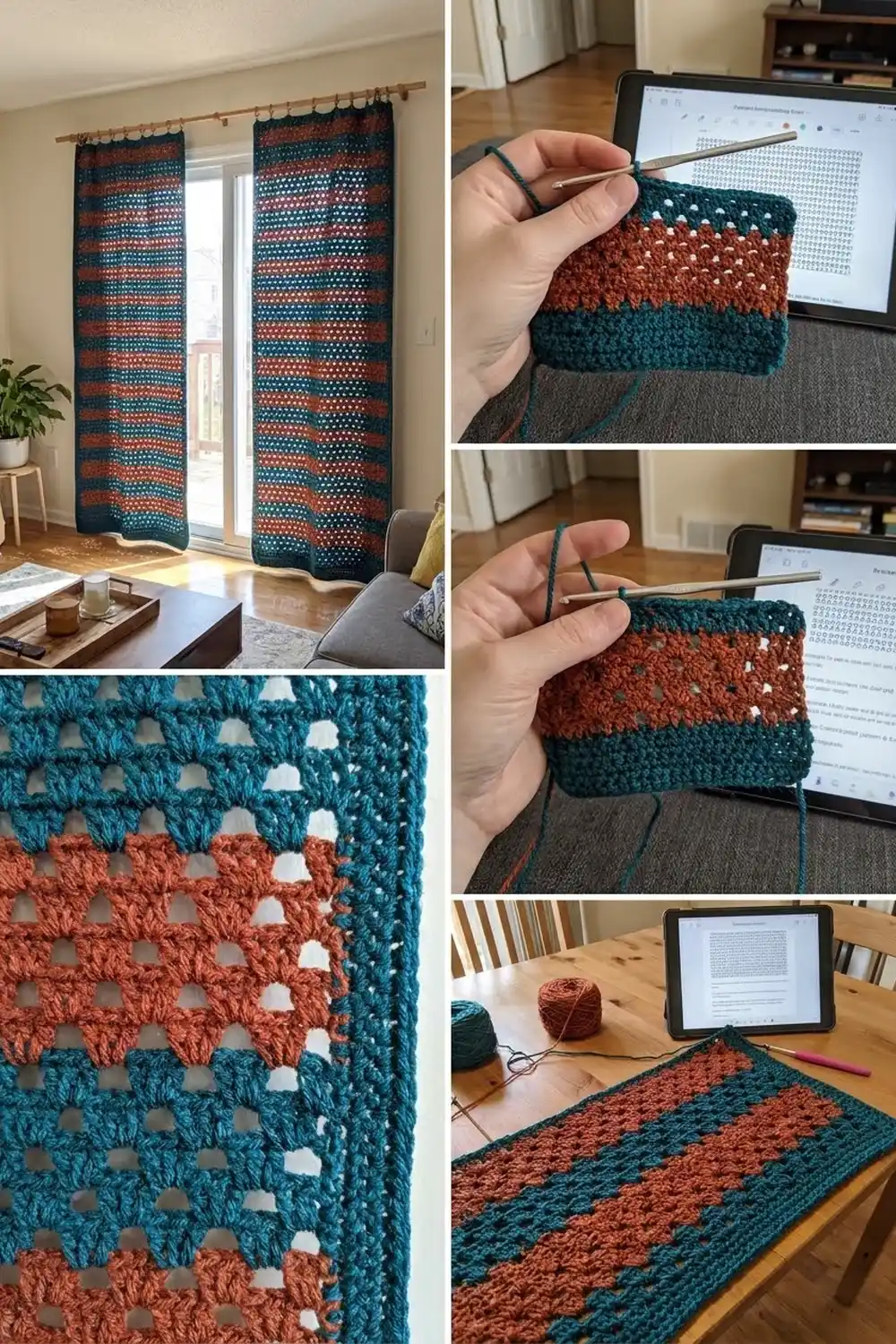
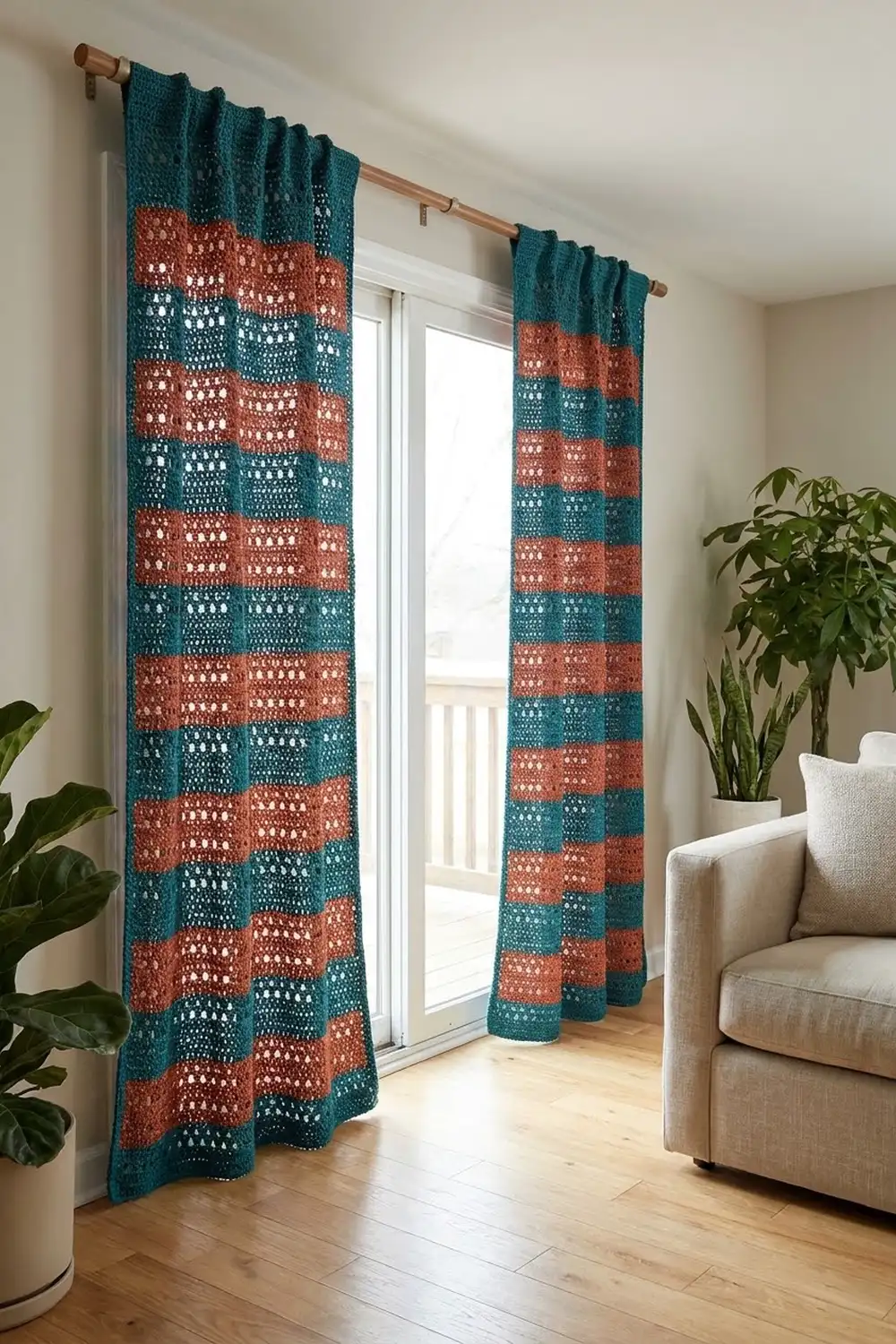
These curtain panels bring a soft, airy texture to a sunny room. An open V-stitch mesh lets light through, while wide stripes of deep teal and warm rust run across the window.
The style is relaxed boho with a clean structure. Each panel has 5 teal stripes and 4 rust stripes, starting and ending with teal. A narrow teal single crochet border frames every edge so the panel hangs straight.
This pattern uses US crochet terms. Each finished panel measures 40 in wide x 82 in long (101.6 cm x 208.3 cm) after blocking. You make two identical panels and hang them side by side. They are not joined to each other.
Construction is simple. You work one large rectangle in rows from the bottom up:
– a foundation row of double crochet
– a V-stitch set-up row
– stacked V-stitch rows
– a closing row of double crochet
Then you add two rounds of single crochet around the whole panel.
Finished Size and Construction
- Finished size (each panel): 40 in x 82 in (101.6 cm x 208.3 cm)
- Skill level: Easy
- Terminology: US crochet terms
- Yarn weight: Worsted (#4), cotton or cotton blend
- Hook: 5.5 mm (US I-9)
- Number of pieces: 2 identical panels, made separately
- Layout: 1 panel on each side of the window, hung from clip rings on a rod
- Size of each panel before the border: 39 in x 81 in (99.1 cm x 205.7 cm)
- Border depth: 0.5 in (1.3 cm) on every side
- Stripe sequence: 9 stripes of 18 rows each, each 9 in (22.9 cm) deep
Materials
Choose a smooth worsted-weight cotton or cotton-acrylic blend. Cotton drapes well, sags less than wool, and shows the V-stitch openings clearly. Avoid fuzzy yarns, which fill in the mesh.
Yarn amounts for both panels (based on yarn of about 170 m per 100 g):
- Color A, Deep Teal: 1,300 g (about 2,210 m)
- Color B, Rust / Terracotta: 950 g (about 1,615 m)
For one panel, halve these amounts. All amounts include a margin of about 10-15% for your gauge swatch and small differences in tension. Buy all of each color from the same dye lot.
Tools:
- 5.5 mm (US I-9) crochet hook
- Tapestry needle
- Stitch markers (at least 4)
- Measuring tape
- Scissors
- Blocking mats or towels, and rust-proof pins
- Spray bottle
- 18 curtain clip rings (9 per panel) and a curtain rod
Abbreviations (US Terms)
- ch = chain
- sc = single crochet
- dc = double crochet
- sk = skip
- sp = space
- st(s) = stitch(es)
- tch = turning chain
- RS / WS = right side / wrong side
Special stitch: V-stitch (V-st) = (dc, ch 1, dc) all in the same stitch or space.
The ch 3 at the start of each dc row counts as the first dc.
Gauge and Checkpoints
Gauge: 5 V-sts = 4 in (10.2 cm) wide and 8 rows = 4 in (10.2 cm) tall in the V-stitch pattern, after blocking. Each V-st repeat uses 3 base stitches and is 0.8 in (2.0 cm) wide.
Make a test piece first. Ch 19. Work Row 1 (17 dc) and Row 2 (5 V-sts), then 8 more rows like Row 3. Wet-block the swatch, let it dry, then measure across the 5 V-sts and over 8 rows.
- Swatch too big: go down one hook size (5 mm / US H-8).
- Swatch too small: go up one hook size (6 mm / US J-10).
- Width is right but rows are too tall: pull up each dc loop a little shorter. Keep the same hook.
Measurement checkpoints on the panel:
- After Row 2: width is 39 in (99.1 cm), with 48 V-sts.
- After Row 18 (first stripe): height is 9 in (22.9 cm).
- After Row 90 (fifth stripe): height is 45 in (114.3 cm).
- After Row 162: 39 in x 81 in (99.1 cm x 205.7 cm).
- After the border: 40 in x 82 in (101.6 cm x 208.3 cm).
Always measure on a flat surface, never while the panel hangs from your lap. Heavy mesh stretches when it hangs.
Panel Pattern
With Color A, ch 148.
Row 1 (RS): Dc in the 4th ch from the hook (the 3 skipped ch count as the first dc) and in each ch across. Turn. (146 dc)
Row 2 (set-up row): Ch 3 (counts as dc), sk next dc, V-st in next dc, sk next 2 dc; repeat from * 46 more times, V-st in next dc, sk next dc, dc in top of tch. Turn. (48 V-sts + 2 edge dc)*
Check the math: 1 edge dc + 1 skipped + (47 x 3) + 1 V-st base + 1 skipped + 1 edge dc = 146. A V-st sits in every 3rd dc.
Row 3: Ch 3 (counts as dc), V-st in the ch-1 sp of each V-st across, dc in top of tch. Turn. (48 V-sts + 2 edge dc)
Each new V-st sits directly on the V-st below it. The two legs of the new V meet at the open center of the V below. This makes the small crossed lattice and the open diamond holes between the columns.
Rows 4-18: Repeat Row 3. (48 V-sts + 2 edge dc in every row)
Stripe Sequence
Keep repeating Row 3, and change color every 18 rows. To change color, work the last yarn-over of the final dc in the old stripe with the new color, so the new stripe starts cleanly. Cut the old color, leaving a 6 in (15.2 cm) tail.
| Rows | Color | Height at end of stripe |
|---|---|---|
| 1-18 | A, Teal | 9 in (22.9 cm) |
| 19-36 | B, Rust | 18 in (45.7 cm) |
| 37-54 | A, Teal | 27 in (68.6 cm) |
| 55-72 | B, Rust | 36 in (91.4 cm) |
| 73-90 | A, Teal | 45 in (114.3 cm) |
| 91-108 | B, Rust | 54 in (137.2 cm) |
| 109-126 | A, Teal | 63 in (160.0 cm) |
| 127-144 | B, Rust | 72 in (182.9 cm) |
| 145-162 | A, Teal | 81 in (205.7 cm) |
Work Rows 19-161 the same as Row 3. Then work Row 162 as follows.
Row 162 (closing row, Color A): Ch 3 (counts as dc), dc in first dc of V-st, dc in ch-1 sp, dc in second dc of V-st; repeat from * across, dc in top of tch. Fasten off. (146 dc)*
This is a conversion row: (48 V-sts x 3 sts) + 2 edge sts = 144 + 2 = 146 dc. It matches the 146 dc in Row 1, so the top and bottom edges are the same width.
Weave in each end along its own stripe for 3 in (7.6 cm), going up and down through the dc posts.
Make Both Panels
Make 2 panels exactly as written. Each panel has 5 Color A stripes, 4 Color B stripes, and a Color A border.
Hanging layout, as seen from inside the room:
[ Rod ===================================== ]
[ Panel 1 ]      window      [ Panel 2 ]
  Teal                          Teal
  Rust                          Rust
  Teal                          Teal
  Rust                          Rust
  Teal                          Teal
  Rust                          Rust
  Teal                          Teal
  Rust                          Rust
  Teal                          Teal
Hang both panels with Row 1 at the bottom so the stripes line up across the window.
Joining
You don’t join the two panels. Each one gets its own border and hangs on its own. Before you add the border to Panel 2, lay it next to Panel 1. Every stripe line should match within 0.5 in (1.3 cm). If one panel is taller, block it to match. Don’t add or remove rows.
Border
Work the border in Color A with the RS facing you. The counts below are the stitches between the corner sc on each side. The 4 corner sc are counted separately.
Border gauge: 15 sc = 4 in (10.2 cm), or 3.75 sc per inch. This matches the body width: 146 sts over 39 in is 3.75 sts per inch.
Round 1: Join Color A in the first dc of Row 162.
- Top edge: 3 sc in first dc (the middle sc is the corner sc), sc in each of next 144 dc, 3 sc in last dc (the middle sc is the corner sc).
- Long side: Working into the row ends, *2 sc in each of next 7 row ends, 1 sc in next row end; repeat from * 19 more times (160 row ends), then 2 sc in each of the last 2 row ends. This gives 20 x 15 + 4 = 304 sc.
- Bottom edge: Working into the free loops of the foundation chain, 3 sc in first ch, sc in each of next 144 ch, 3 sc in last ch.
- Second long side: Repeat the long-side sequence. Join with a sl st to the first sc.
Counts between corners: top 146 (1 + 144 + 1), each long side 306 (1 + 304 + 1), bottom 146. Round 1 total: 4 corner sc + 146 + 306 + 146 + 306 = 908 sc.
Round 2: Ch 1, sc in each sc around, working 3 sc in each corner sc. Join. Fasten off.
This is a trim round: 908 sc worked 1 per existing stitch + 8 extra (2 at each corner) = 916 sc. Between corners: 148 each on the top and bottom, 308 on each long side. Check: 4 + 148 + 308 + 148 + 308 = 916.
Why the math works: On the long sides, 15 sc per 8 rows at 2 rows per inch gives 3.75 sc per inch, the same as the top and bottom. With the same density on all four sides, the edges won’t ruffle or pull in. 304 sc / 3.75 = 81.1 in, matching the 81 in body. 146 sc / 3.75 = 38.9 in, matching the 39 in body. Each sc round adds 0.25 in (0.6 cm), so the two rounds add 0.5 in (1.3 cm) per side. That brings the panel to 40 in x 82 in.
Final Blocking
- Weave in all remaining ends.
- Soak the panel in cool water with a little mild soap for 15 minutes.
- Gently press out the water without wringing. Roll the panel in towels to remove more water.
- Lay it flat on mats or towels, RS up.
- Ease it to 40 in x 82 in (101.6 cm x 208.3 cm). Pin the corners first, then pin each side every 6 in (15.2 cm).
- Straighten the V-st columns so they run straight up and down, and make every stripe line straight across.
- Let it dry completely, usually 24-48 hours.
- Unpin it. Attach 9 clip rings along the top border: one at each corner and the rest 5 in (12.7 cm) apart.
Final Quality-Control Checklist
- Each panel has 48 V-sts in every V-st row, and 146 dc in Rows 1 and 162.
- Each panel has 9 stripes of 18 rows, with teal at both ends.
- The stripe lines match between the two panels.
- Border Round 2 has 916 sc with neat 3-sc corners.
- The long edges are straight, not wavy or pulled in.
- Each panel measures 40 in x 82 in (101.6 cm x 208.3 cm).
- All ends are woven into stripes of the same color.
- The clip rings are evenly spaced and the panel hangs straight.
Troubleshooting
- V-st count changes: You missed a V-st or worked one twice. Place a marker in every 10th V-st and count each row.
- Panel leans or slants: You skipped the tch or added a dc at one edge. Always end the row with a dc in the top of the tch.
- Long edges ruffle: Round 1 has too many sc. Follow the 15-sc-per-8-rows sequence exactly. If they still ruffle, use 1 sc in every 4th row end.
- Long edges pull in: Round 1 has too few sc. Check that you are working 2 sc in most row ends.
- Panel gets longer while hanging: Cotton stretches. Block it flat again and let it dry fully.
- Color changes look jagged: Change color on the last yarn-over of the old stripe, not after you turn.
Care
Hand wash, or machine wash on a gentle cold cycle in a mesh laundry bag. Dry flat and reshape to size. Don’t hang wet panels on the rod, because the weight of the water will stretch them.
Final Notes
Here is the measurement chain for each panel. A gauge of 5 V-sts and 8 rows per 4 in (10.2 cm) gives 48 V-sts across 39 in (99.1 cm) and 162 rows up 81 in (205.7 cm). Each of the 9 stripes has 18 rows and is 9 in (22.9 cm) deep. The two border rounds add 0.5 in (1.3 cm) per side, so the finished panel is 40 in x 82 in (101.6 cm x 208.3 cm). Check the width after Row 2 and the height at every color change, and both panels will match.
Happy crocheting!