

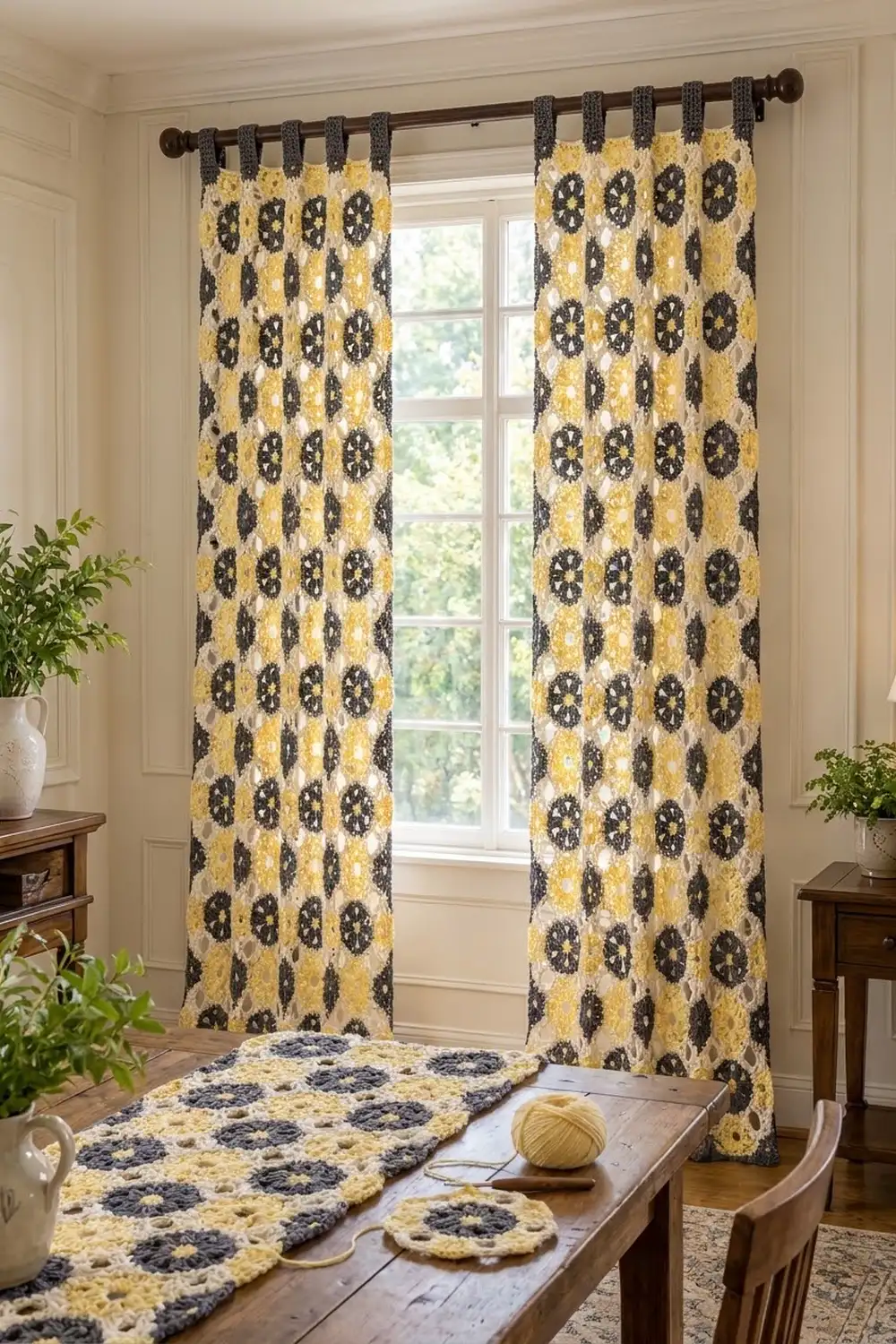
This tab-top curtain panel is made from lacy hexagon motifs in charcoal gray, butter yellow and cream. Rows of charcoal “wheel” hexagons with yellow centers alternate with rows of yellow wheel hexagons set in cream. From a distance the panel reads as soft bands of dark and light.
The style is cottage-modern. Small open windows in every motif let daylight through, and a charcoal border and charcoal tabs frame the panel cleanly.
The pattern uses US crochet terms. One panel measures 45.4″ x 74.8″ (115.3 cm x 190.0 cm) after the border and hangs about 78″ (198.1 cm) from the top of the rod. Make two panels for a pair.
Here’s how it’s built: crochet hexagons and a few half-hexagons, then seam them into a honeycomb. Next, level the zigzag top and bottom with graded rows, add a two-round border and work the tabs.
Finished Size and Construction
- Finished size (one panel): 45.4″ x 74.8″ (115.3 cm x 190.0 cm), plus 3.25″ (8.3 cm) tab loops
- Skill level: Intermediate
- Terminology: US
- Yarn weight: Worsted (#4)
- Hook: 5.0 mm (H-8)
- Number of pieces per panel: 36 Motif A, 25 Motif B and 10 half-hexagons (71 total)
- Layout: 11 honeycomb rows. Odd rows have 6 Motif A. Even rows have 5 Motif B plus a half-hexagon at each end.
- Piece size: 4.25″ (10.8 cm) per side, 7.4″ (18.8 cm) flat to flat, 8.5″ (21.6 cm) point to point
- Size before border: 44.4″ x 73.8″ (112.8 cm x 187.5 cm)
- Border depth: 0.5″ (1.3 cm)
Materials
Choose a smooth worsted cotton or cotton blend. Cotton holds its shape at a window, fades less in sun than most acrylics and shows the lace clearly. Avoid fuzzy or splitty yarn.
Per panel:
- Cream: 1,250 g / about 2,500 m
- Butter yellow: 300 g / about 600 m
- Charcoal gray: 260 g / about 520 m
Double every amount for a pair. These quantities include about a 15% margin for gauge differences and swatching.
Tools:
- 5.0 mm (H-8) hook
- Tapestry needle and stitch markers
- Rust-proof pins and blocking mats (or a clean sheet)
- Spray bottle and measuring tape
Abbreviations (US Terms)
ch = chain; sl st = slip stitch; sc = single crochet; hdc = half double crochet; dc = double crochet; tr = treble crochet; dtr = double treble crochet; sc2tog / dc2tog / tr2tog = work two stitches together at that height; sk = skip; sp = space; MR = magic ring; RS / WS = right side / wrong side.
Cluster (cl): *Yarn over, insert hook in the stitch, pull up a loop, yarn over and pull through 2 loops; repeat from * 2 more times in the same stitch. Yarn over and pull through all 4 loops.
Beginning cluster (beg cl): Ch 2, then work the cluster with only 2 repeats and pull through 3 loops at the end.
Gauge and Checkpoints
Gauge: 16 sc = 4″ (10.2 cm) and 14 dc = 4″ (10.2 cm) in plain rows.
Make and block one Motif A first. It is your real gauge swatch.
- After Rnd 3, the circle is 3.25″ (8.3 cm) across.
- After Rnd 7, each side is 4.25″ (10.8 cm). The motif is 7.4″ (18.8 cm) flat to flat and 8.5″ (21.6 cm) point to point.
If the motif is larger, go down half a hook size. If it is smaller, go up half a size. An error of only 0.25″ (0.6 cm) per motif adds 1.5″ (3.8 cm) across the panel.
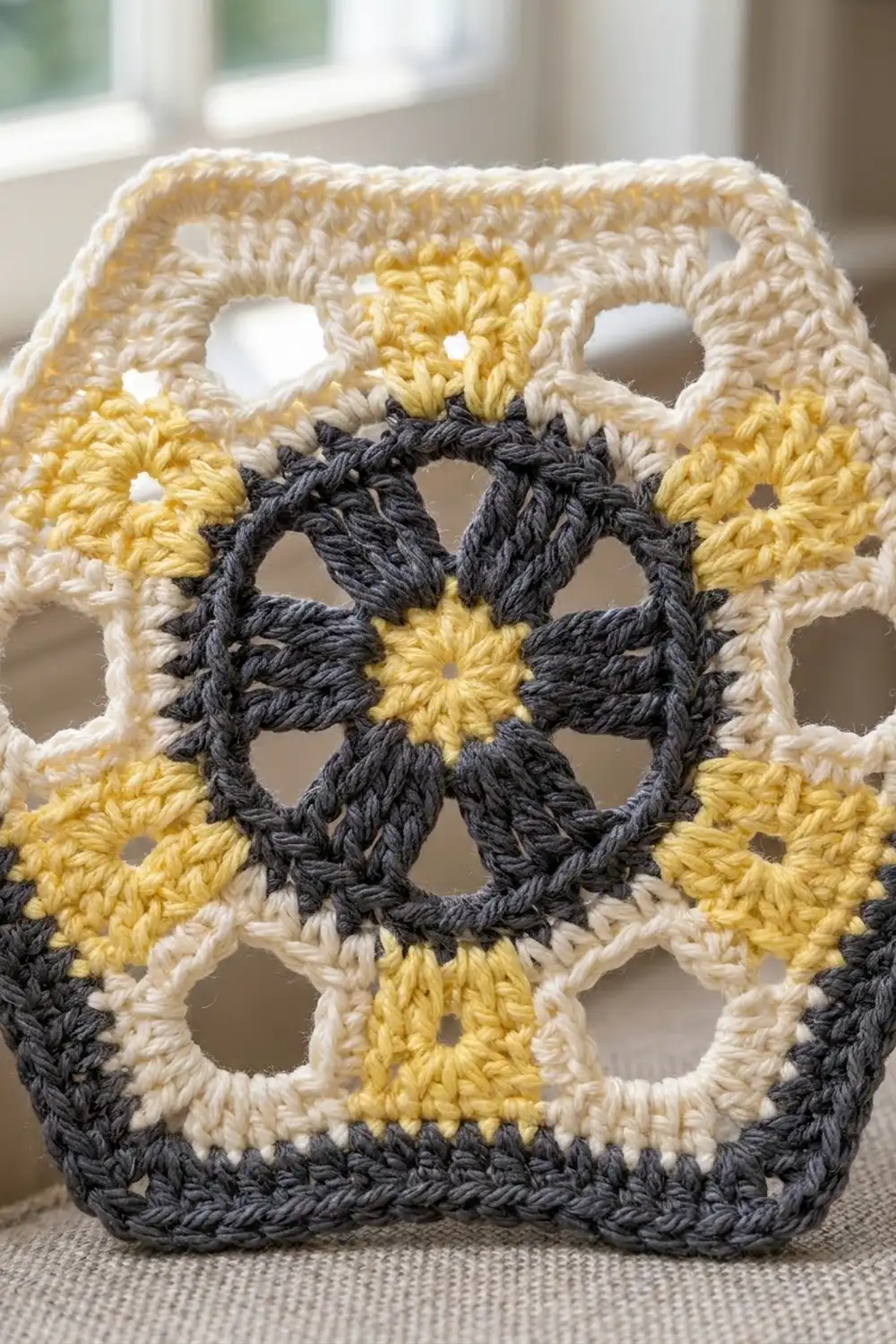
Motif A (Charcoal Wheel)
Colors: Rnd 1 yellow; Rnds 2-3 charcoal; Rnd 4 cream; Rnd 5 yellow; Rnds 6-7 cream. Fasten off at each color change.
Rnd 1 (yellow): MR, ch 3 (counts as dc), work 15 dc in the ring, join to the top of the ch-3. (16 dc)
Rnd 2 (charcoal): Join in any dc. Beg cl in the same st, ch 3, sk next st. Cl in next st, ch 3, sk next st; repeat from * 6 more times. Join to the top of the beg cl. (8 cl, 8 ch-3 sps)* These are the spokes.
Rnd 3 (charcoal): Ch 3 (counts as dc), 5 dc in next ch-3 sp. Dc in next cl, 5 dc in next ch-3 sp; repeat from * 6 more times, join. (48 dc)* The solid rim leaves a small window under each arc.
Rnd 4 (cream, conversion round): This round turns the circle into a hexagon, using 8 sts per side. Join in any dc. Ch 4 (counts as tr), work (tr, ch 2, 2 tr) in the same st, ch 3, sk 3, sc in next st, ch 3, sk 3. Work (2 tr, ch 2, 2 tr) in next st, ch 3, sk 3, sc in next st, ch 3, sk 3; repeat from * 4 more times. Join to the top of the ch-4. (24 tr, 6 sc, 6 corner ch-2 sps, 12 ch-3 sps)*
Rnd 5 (yellow): Join in the ch-3 sp just after any corner. Ch 3 (counts as dc), 2 dc in the same sp, dc in next sc, 3 dc in next ch-3 sp, ch 3, sc in the corner ch-2 sp, ch 3. Work 3 dc in next ch-3 sp, dc in next sc, 3 dc in next ch-3 sp, ch 3, sc in the corner sp, ch 3; repeat from * 4 more times, join. (six 7-dc yellow blocks centered on the sides, 6 corner sc, 12 ch-3 arcs)* The arcs pass over the cream tr groups and open a window at each corner.
Rnd 6 (cream): Join in any corner sc. Ch 3 (counts as dc), work (dc, ch 2, 2 dc) in the same sc, 2 dc in next ch-3 sp, dc in each of the next 7 dc, 2 dc in next ch-3 sp. Work (2 dc, ch 2, 2 dc) in next sc, 2 dc in next ch-3 sp, dc in next 7 dc, 2 dc in next ch-3 sp; repeat from * 4 more times, join. (15 dc per side = 2 + 2 + 7 + 2 + 2; 90 dc, 6 corner ch-2 sps)*
Rnd 7 (cream, trim round): Ch 1. Sc in the same st and in each dc around, working (sc, ch 2, sc) in each corner sp. Join and fasten off. (17 sc per side = 15 worked 1-per-stitch + 2 added at the corners; 102 sc, 6 ch-2 sps)
Make 36.
Motif B (Yellow Wheel)
Work exactly as Motif A, changing only the colors: Rnd 1 cream; Rnds 2-3 yellow; Rnds 4-7 cream. All counts stay the same, with 17 sc per side. Make 25.
Half-Hexagon (Edge Filler)
These solid cream pieces fill the ends of the even rows so the panel sides are straight. Their cut edge becomes the panel edge. Work in turned rows.
Row 1 (RS): MR, ch 3 (counts as dc), then work 2 dc, ch 2, 3 dc, ch 2, 3 dc in the ring. Close the ring and turn. (3 sides of 3 dc; 9 dc)
Rows 2-7: Ch 3 (counts as dc), dc in the first st, dc in each dc to the corner, work (dc, ch 2, dc) in each corner sp, dc in each dc to the end, 2 dc in the top of the turning ch, turn. (Each side gains 2 per row: 5, 7, 9, 11, 13, then 15 per side in Row 7; 45 dc)
Row 8: Ch 1, 2 sc in the first st, sc in each st to the corner, work (sc, ch 2, sc) in each corner sp, sc in each st to the end, 2 sc in the last st. Fasten off. (17 sc per side; 51 sc)
The three outer sides now match a motif side stitch for stitch. The cut edge measures 8.5″ (21.6 cm). Make 10.
Make All Pieces
Per panel:
- Motif A: 36 (each uses 4.5 g yellow, 3.5 g charcoal and 12 g cream)
- Motif B: 25 (each uses 16.5 g cream and 3.5 g yellow)
- Half-hexagon: 10 (each uses 11 g cream)
Block every piece before joining. The hexagons sit pointy-top, so each one has two vertical sides, two upper slanted sides and two lower slanted sides.
Row 1:   A  A  A  A  A  A
Row 2:  ½  B  B  B  B  B  ½
Row 3:   A  A  A  A  A  A
Row 4:  ½  B  B  B  B  B  ½
...continue alternating...
Row 11:  A  A  A  A  A  A
Joining
Use a flat slip stitch seam in cream. Hold two pieces RS up with their edges touching. Sl st through the back loop of one edge, then the matching loop of the other, moving one stitch at a time.
Every side joins stitch to stitch: 17 sc to 17 sc, and corner ch-2 sp to corner ch-2 sp. The seam adds no stitches to any edge.
- Join the 6 Motif A of Row 1 along their vertical sides.
- Join the Row 2 pieces in a line: half-hexagon short side to a Motif B vertical side, B to B, and the last B to the second half-hexagon.
- Seam Row 2 to Row 1 along the zigzag. Each B’s two upper slanted sides meet the lower slanted sides of the two A motifs above it. Each half-hexagon’s upper slanted side meets the outer A above it.
- Repeat down to Row 11.
Keep the seams as relaxed as the motifs. If the panel puckers, seam with a hook one size larger.
Checkpoint: after Rows 1-3 are joined, the width is 44.4″ (112.8 cm). The height from top points to bottom points is 21.25″ (54.0 cm).
Leveling the Top and Bottom
The top and bottom edges zigzag. Three cream rows fill the valleys and turn each edge into a straight line. Work these rows on the top, then repeat them on the bottom.
Each slanted side has 17 sc. A valley is a pair of joined corner sps. A peak is a hexagon’s top corner sp.
Row 1 (RS, conversion row): Join at the right end in the corner sp at the top of the vertical side and work a dtr there. Then repeat these four steps across all 6 hexagons:
- Upslope (17 sts become 14): Dtr in next 3, tr in next 2, tr2tog, dc in next 2, dc2tog, hdc in next 2, sc2tog, sc in next 2.
- Peak: Sc in the corner sp. (1)
- Downslope (17 sts become 14): Sc in next 2, sc2tog, hdc in next 2, dc2tog, dc in next 2, tr2tog, tr in next 2, dtr in next 3.
- Valley: Dtr through both joined corner sps. (1) After the sixth hexagon, work this dtr in the single end corner sp instead.
Count: 2 ends + 6 x (14 + 1 + 14) + 5 valleys = 181 sts. Turn.
Row 2 (WS): Ch 1. Work 1 st in each st, matching the height below: sc over sc or sc2tog, hdc over hdc, dc over dc or dc2tog, tr over tr or tr2tog, and dtr over dtr. (181 sts) Turn.
Row 3 (RS): Ch 1, sc in each st across. (181 sc) Fasten off.
The decreases keep the row flat. Each slope is 4.25″ (10.8 cm) along its slant but covers only 3.7″ (9.4 cm) of width. With 181 sts across 44.4″ (112.8 cm), the row works out to about 4.1 sts per inch, which matches gauge.
Checkpoint: the panel measures 44.4″ x 73.8″ (112.8 cm x 187.5 cm).
Border
Border gauge: 4 sc per 1″ (2.5 cm).
Side count (each side):
- 6 full vertical sides x 17 sc = 102
- 5 half-hexagon cut edges x 31 sc = 155 (2 sc per dc row-end, 1 per sc row-end and 1 at the ring)
- 10 sc, one at each point where a hexagon corner meets a cut edge
- 7 sc across each leveling block (3 per dtr row-end and 1 per sc row-end) x 2 blocks = 14
Total: 102 + 155 + 10 + 14 = 281.
Rnd 1 (charcoal): Join at the top right corner. Work 181 sc across the top, ch 2, 281 sc down the side, ch 2, 181 sc across the bottom, ch 2, 281 sc up the side, ch 2, join. (181 / 281 / 181 / 281; 924 sc)
Rnd 2 (charcoal): Ch 1, sc in each sc, work (sc, ch 2, sc) in each corner sp, join. Fasten off. (183 / 283 / 183 / 283; 932 sc)
Why the math works: the top and bottom take exactly 1 sc per leveling stitch. The sides follow gauge on motif edges and use slightly fewer stitches on the looser row-ends. In Rnd 2, each corner adds just 1 sc per side, so no corner is counted twice.
Tabs
With RS facing, work across the 183 sts of the top edge. Each tab is 9 sts wide with 20-st gaps between tabs: 7 x 9 + 6 x 20 = 183.
Each tab: Join charcoal in the first st of the tab position. Row 1: ch 3 (counts as dc), dc in next 8. (9 dc) Rows 2-12: ch 3, turn, dc in each st across. (9 dc) Fasten off, leaving a 12″ (30.5 cm) tail.
Fold each tab to the WS and sew Row 12 behind its base. Each tab is about 2.6″ (6.6 cm) wide and makes a 3.25″ (8.3 cm) loop, which fits a 1.5″ (3.8 cm) rod.
Final Blocking
- Weave in all ends along seams of matching color.
- Soak the panel in cool water for 15 minutes. Press the water out in towels without wringing.
- Lay the panel flat, RS up.
- Pin the straight edges first: 45.4″ (115.3 cm) across and 74.8″ (190.0 cm) down.
- Pat each wheel and corner window open with your fingers.
- Let it dry fully, at least 24 hours, before hanging.
Final Quality-Control Checklist
- Every hexagon measures 7.4″ (18.8 cm) flat to flat, and every half-hexagon cut edge measures 8.5″ (21.6 cm).
- Each seam joins 17 sts to 17 sts with the corners aligned.
- Leveling Row 3 has 181 sts on both the top and the bottom.
- Border Rnd 2 counts are 183 / 283 / 183 / 283.
- There are seven evenly spaced tabs, each 9 sts wide.
- The panel lies flat with no rippling.
Troubleshooting
Motif cups: The Rnd 4 tr are too tight. Work Rnd 4 half a hook size larger.
Motif ruffles: Rnds 5-6 are too loose. Work them half a size smaller.
Top still dips at the valleys: In Row 2, replace the 3 dtr nearest each valley with triple trebles (yarn over 4 times).
Sides wave: There are too many sc on the cut edges. Use 29 per cut edge and recount the side.
Panel is narrower than 44.4″ (112.8 cm): The seams are too tight. Rework them with a larger hook.
Care
Hand wash, or machine wash cold in a mesh bag on a gentle cycle. Dry flat and re-pin if needed; never hang the panel wet.
Final Notes
Everything rests on one chain of measurements. A 17-stitch side gives a 4.25″ (10.8 cm) side and a 7.4″ (18.8 cm) motif. Six motifs make 44.4″ (112.8 cm) across. Eleven honeycomb rows plus the leveling rows make 73.8″ (187.5 cm). The 0.5″ (1.3 cm) border brings the panel to 45.4″ x 74.8″ (115.3 cm x 190.0 cm). Get the first motif right and the rest follows.
Happy crocheting!