

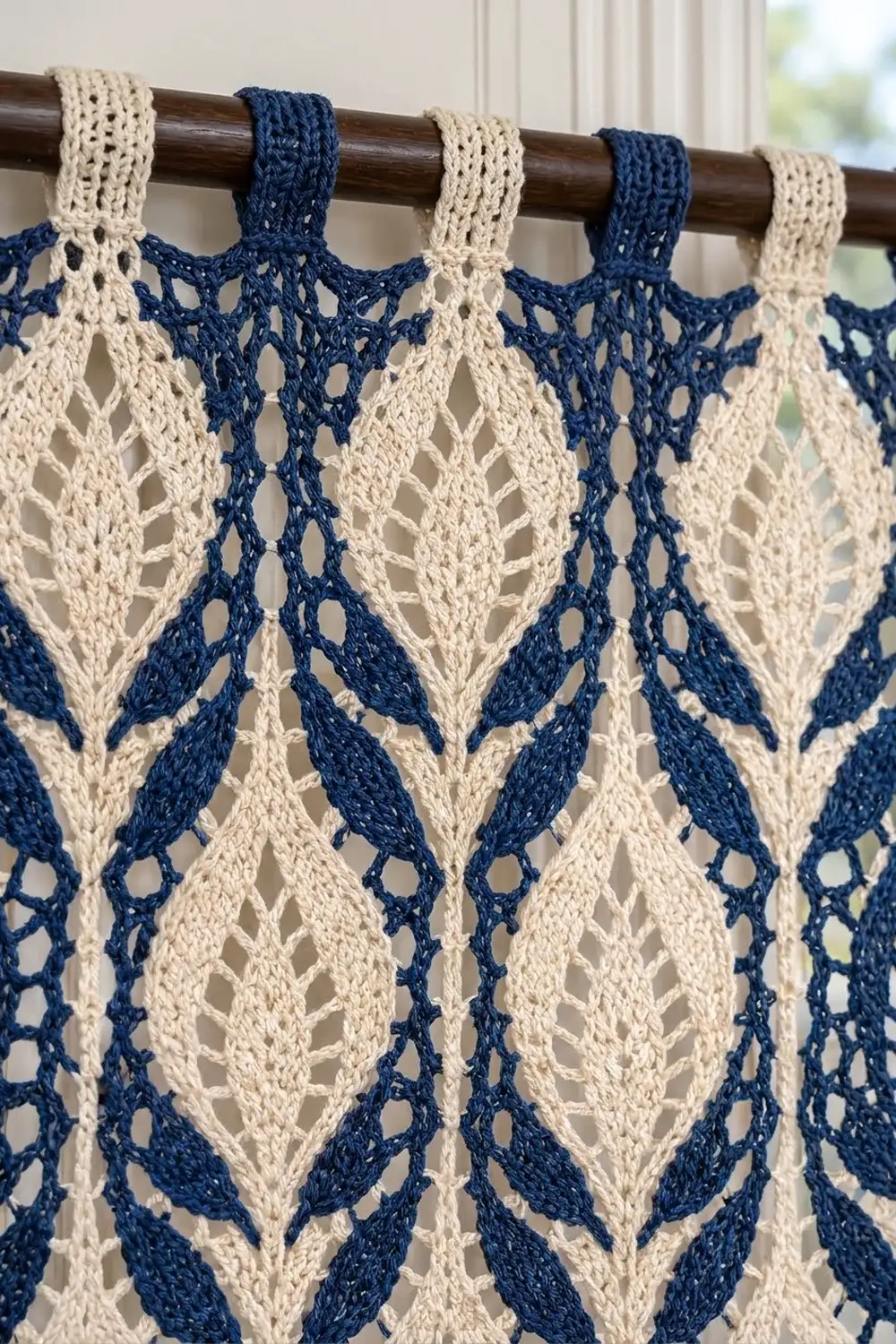
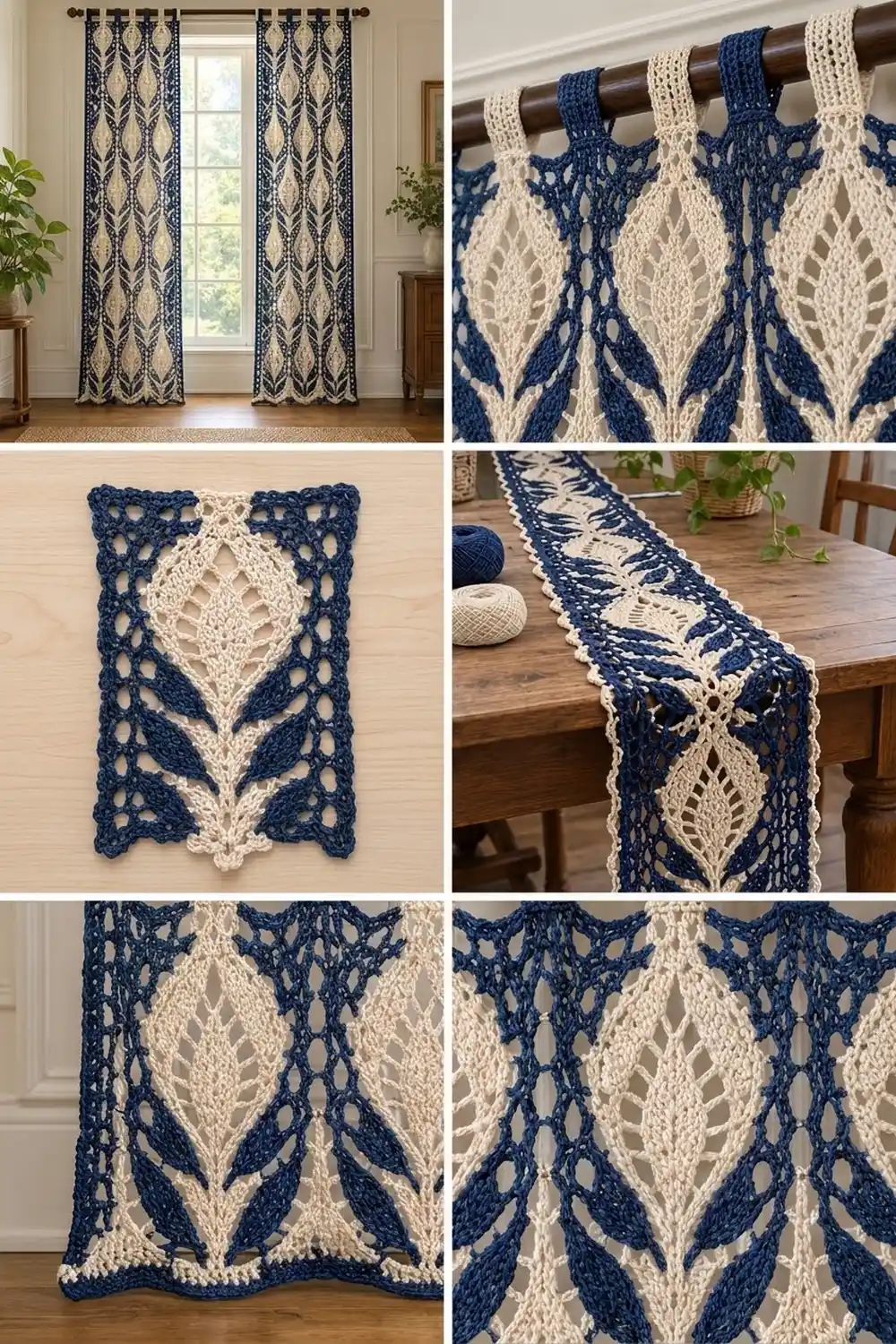
The Indigo Leaf Column Curtain Panel is a tall, airy tab-top curtain with a calm botanical rhythm. Three vertical columns of cream leaves climb the panel. Each leaf is a pointed oval with a lacy openwork center and a solid center vein. Navy side leaves sweep up and outward from the base of every cream leaf, and an open navy mesh fills the background so daylight shows through.
The palette is just deep navy and natural cream, a crisp, classic pairing that suits farmhouse, coastal, or traditional rooms. The tabs across the top alternate cream and navy and fold over the curtain rod.
This pattern uses US crochet terms. One finished panel measures 34 in wide by 86.5 in long (86.4 cm by 219.7 cm) after the border, not counting the tab loops. The photo shows a pair, so you’ll make two identical panels. They hang side by side and are never joined.
Each panel is worked flat in one piece from the bottom up, using filet-style blocks with intarsia color changes. You start with one solid navy row, repeat a 16-row leaf motif 7 times, and finish with another solid navy row. Two rounds of navy single crochet frame the panel, and seven ribbed tabs finish the top.
Finished Size and Construction
- Finished size (one panel): 34 in x 86.5 in (86.4 cm x 219.7 cm), plus tab loops about 3 in (7.6 cm) tall
- Skill level: Experienced (filet blocks plus intarsia)
- Terminology: US
- Yarn weight: Worsted (#4) cotton
- Hook: 5.0 mm (US H-8)
- Number of pieces: 1 per panel; make 2 panels for the pair shown
- Layout: 3 leaf columns across x 7 leaves tall, on a grid 33 blocks wide
- Panel size before border: 33 in x 85.5 in (83.8 cm x 217.2 cm)
- Border depth: 0.5 in (1.3 cm) on each side
- Size after border: 34 in x 86.5 in (86.4 cm x 219.7 cm)
Materials
Choose a smooth, combed or mercerized worsted-weight cotton of about 190 m per 100 g. Cotton keeps the leaf edges crisp, hangs straight, and stretches less than acrylic on a long panel.
For one panel:
- Navy (Color A): 700 g, about 1,330 m
- Cream (Color B): 500 g, about 950 m
For the pair shown:
- Navy (Color A): 1,400 g, about 2,660 m
- Cream (Color B): 1,000 g, about 1,900 m
These quantities include a margin of about 10% for your gauge swatch, intarsia tails, and small tension differences. Buy all of each color from a single dye lot.
Tools:
- 5.0 mm (US H-8) crochet hook
- 7 yarn bobbins (4 navy, 3 cream)
- Locking stitch markers
- Tapestry needle
- Scissors and a tape measure
- Blocking mats or a sheet over carpet, rustproof pins, and a spray bottle
Abbreviations (US Terms)
- ch: chain
- sk: skip
- st(s): stitch(es)
- sc: single crochet
- dc: double crochet
- BLO: back loop only
- sp: space
- RS / WS: right side / wrong side
Special stitches and symbols:
- Open block: ch 2, sk 2 sts (or the ch-2 sp), dc in next dc.
- Solid block: dc in each of next 3 sts. If you’re working over an open block, work 2 dc in the ch-2 sp, then dc in next dc.
- M: open block in navy (background mesh)
- S: solid block in navy (side leaves)
- C: solid block in cream (leaf body and vein)
- O: open block in cream (lacy leaf interior)
Every block is 3 sts. Each row begins with ch 3, which counts as the first dc and acts as the anchor for the first block. That makes every row 1 anchor + (33 blocks x 3 sts) = 100 sts.
Color changes: Work each block entirely in its own color. To switch colors, work the last dc of the previous block until 2 loops remain, drop the old color to the WS, and pull the new color through. Use a separate bobbin for each color area, and never carry yarn across the back.
Gauge and Checkpoints
Gauge: 3 blocks (9 sts) = 3 in (7.6 cm) wide, and 4 rows = 3 in (7.6 cm) tall, in block pattern after blocking. So each block is 1 in (2.5 cm) wide and each row is 0.75 in (1.9 cm) tall.
Test one repeat first. Ch 36 and work Row 1 (34 sts). Then work Motif Rows 1–16 over a single 11-block repeat, and finish with one solid navy row. After blocking, the swatch should measure 11 in (27.9 cm) wide by 13.5 in (34.3 cm) tall. It’s also a good way to practice the intarsia changes before you start the panel.
Panel checkpoints:
- After Row 1: 33 in (83.8 cm) wide.
- After Row 17 (first full leaf): 12.75 in (32.4 cm) tall.
- Each leaf repeat adds 12 in (30.5 cm).
- After Row 113: 84.75 in (215.3 cm) tall.
- After Row 114: 85.5 in (217.2 cm) tall.
If your swatch is too big, go down 0.5 mm in hook size. If it’s too small, go up 0.5 mm. If the width is right but your rows are too tall, pull up a slightly shorter first loop on each dc instead of changing hooks.
Panel Pattern
Wind 4 navy bobbins and 3 cream bobbins before you start. Keep the main navy ball for Rows 1 and 114.
Foundation: With navy, ch 102.
Row 1 (RS, solid navy): Dc in 4th ch from hook (the skipped ch count as the first dc) and in each ch across, turn. (100 sts = anchor + 33 solid blocks)
Rows 2–113 (leaf motif): For each row, ch 3 in navy (anchor), then work that Motif Row’s 11-block sequence 3 times, and turn. Work Motif Rows 1–16 seven times in all. Every row has 100 sts (33 blocks).
Each sequence is symmetrical, so it reads the same on RS and WS rows. Blocks 1 and 11 are always navy mesh, which means the side edges and the anchor are always navy.
| Motif Row | Blocks 1–11 (work 3 times per row) |
|---|---|
| 1 | M M M M M C M M M M M |
| 2 | M M M M S C S M M M M |
| 3 | M M M S S C S S M M M |
| 4 | M M S S M C M S S M M |
| 5 | M S S M C C C M S S M |
| 6 | M S M C C C C C M S M |
| 7 | M M C C O C O C C M M |
| 8 | M M C O O C O O C M M |
| 9 | M C C O O C O O C C M |
| 10 | M C O O O C O O O C M |
| 11 | M C C O O C O O C C M |
| 12 | M M C O O C O O C M M |
| 13 | M M C C O C O C C M M |
| 14 | M M M C C C C C M M M |
| 15 | M M M M C C C M M M M |
| 16 | M M M M M C M M M M M |
How the rows shape the leaf:
- Motif Rows 1–4: These rows make the one-block cream stem. Rows 2–4 also start the navy side leaves, which step outward one block per row.
- Motif Rows 5–6: The cream leaf base widens to 3 blocks, then 5 blocks. The side leaves reach their tips at blocks 2 and 10.
- Motif Rows 7–13: These rows form the leaf body, up to 9 blocks wide. The solid center block (block 6) is the vein, and the open cream blocks on either side make the lacy interior.
- Motif Rows 14–16: The leaf tapers to 5 blocks, then 3, then 1. Row 16’s single cream block lines up with the next stem, so each leaf column flows without a break.
Bobbins: Use one cream bobbin for each of the 3 leaf columns. Use the 4 navy bobbins for the left edge area, the 2 areas between columns, and the right edge area. Cream areas change by only 1 block per side per row, so every bobbin stays close to where it’s needed.
Mark the RS with a locking marker, and measure after each leaf.
Row 114 (solid navy): With navy, ch 3. Work 2 dc in each ch-2 sp and dc in each dc across. Fasten off all bobbins. (100 sts)
Weave in the intarsia tails on the WS, running each one through an area of the same color.
For the pair, make a second identical panel.
Border
Border gauge: 3 sc = 1 in (2.5 cm). Two rounds of sc are 0.5 in (1.3 cm) deep.
The 33 in (83.8 cm) top and bottom edges need about 100 sts each. The 85.5 in (217.2 cm) sides need about 256 sts each. Each dc row is 0.75 in (1.9 cm) tall, which works out to 2.25 sc per row. Working the row ends in a repeat of 2, 2, 2, 3 gives exactly 9 sc for every 4 rows.
Round 1 (navy): With RS facing, join navy in the first st of Row 114.
- Top: 3 sc in the corner st, sc in each of next 98 sts, 3 sc in the last st (corner).
- Side: Working in row ends, repeat [2 sc, 2 sc, 2 sc, 3 sc] 28 times over 112 rows (252 sc), then work 2 sc in each of the last 2 row ends (4 sc). (256 sc)
- Bottom: Working in the free loops of the foundation chain, 3 sc in the corner st, sc in each of next 98 sts, 3 sc in the last st (corner).
- Second side: Work as for the first side. (256 sc)
Join with sl st to the first sc. Round 1 total: 98 + 98 + 256 + 256 sts between corners + (4 corners x 3 sc) = 720 sts.
Round 2 (navy): Ch 1, sc in each st around, working 3 sc in the center st of each corner. Join.
- Top and bottom: 100 sc each between corner centers (98 + the 2 outer sts of the corner groups).
- Sides: 258 sc each (256 + 2).
- Corners: 3 sc each.
Round 2 total: 100 + 100 + 258 + 258 + 12 = 728 sts. Fasten off.
Why the math works: At 3 sc per inch, 100 top sts span 33.3 in, which matches the 33 in (83.8 cm) panel plus the corner turn. Likewise, 258 side sts span 86 in, which matches the 85.5 in (217.2 cm) body. Because the counts match the measurements, the edges lie flat without ruffling or cupping.
Tabs
The seven tabs alternate colors: tabs 1, 3, 5, and 7 are cream, and tabs 2, 4, and 6 are navy. Each tab is 6 sts wide, about 2 in (5.1 cm).
The top edge of Round 2 has 100 sts between corner centers. Place markers as follows: skip 2, tab (6 sts), [skip 9, tab (6 sts)] 6 times, skip 2. That’s 2 + 42 + 54 + 2 = 100. The tabs sit 15 sts apart, about 5 in (12.7 cm).
Each tab:
- Row 1: With RS facing, join the tab color in the first marked st. Ch 1, sc in the same st and in the next 5 sts, turn. (6 sts)
- Rows 2–24: Ch 1, sc BLO in each st across, turn. (6 sts)
The tab measures about 6.9 in (17.5 cm). Fasten off, leaving a 12 in (30.5 cm) tail. Fold the tab to the WS and sew the last row to the WS of Border Round 1. This makes a loop about 3 in (7.6 cm) tall.
Final Blocking
- Weave in all remaining tails.
- Soak the panel in cool water for 15 minutes, then press out the water without wringing.
- Roll the panel in towels to remove more water.
- Lay it flat, RS up. If you don’t have enough space, block it in sections, starting from the bottom.
- Pin the edges to 34 in x 86.5 in (86.4 cm x 219.7 cm).
- Square the open blocks into even 1 in (2.5 cm) blocks, and line up each leaf tip with the stem above it.
- Let the panel dry completely, then pin the tabs flat to dry.
Final Quality-Control Checklist
- Panel measures 34 in x 86.5 in (86.4 cm x 219.7 cm).
- Every row has 100 sts (33 blocks).
- There are 3 leaf columns with 7 leaves each.
- Each leaf is 9 blocks wide at its widest point and has a solid center vein.
- Each leaf tip meets the stem of the leaf above it.
- The navy side leaves match on both sides of each stem.
- Border Round 2 has 728 sts, and the corners lie flat.
- There are 7 evenly spaced tabs, alternating cream and navy.
- No colors peek through on the RS.
- Both panels are the same length to within 0.5 in (1.3 cm).
Troubleshooting
- The panel slants: Count 100 sts every few rows. A missing anchor or last dc is the usual cause.
- The leaves are off-center: Make sure every row has exactly 3 repeats of 11 blocks.
- Color shows through at changes: Change on the final yarn-over of the previous dc, and twist the two yarns on the WS.
- The bobbins tangle: Turn clockwise after RS rows and counterclockwise after WS rows.
- The side edges ruffle: Use the 2, 2, 2, 3 repeat, not 3 sc in every row end.
- The side edges pull in: Check the side count against 256 sts, and add sts evenly if you’re short.
- The panel lengthens as it hangs: Re-block it and let it dry flat before you rehang it.
Care
Hand wash, or machine wash cool on a gentle cycle in a mesh bag. Reshape and dry flat. Never hang the panel while it’s wet, because it will stretch.
Final Notes
Every measurement in this pattern builds on the one before it. Each block is 1 in (2.5 cm) wide, so 33 blocks make 33 in (83.8 cm). Each row is 0.75 in (1.9 cm) tall, so 114 rows make 85.5 in (217.2 cm). The border adds 0.5 in (1.3 cm) all around, for a finished panel of 34 in x 86.5 in (86.4 cm x 219.7 cm). If your swatch measures 11 in x 13.5 in (27.9 cm x 34.3 cm), every other number in the pattern will work out.
Happy crocheting!