

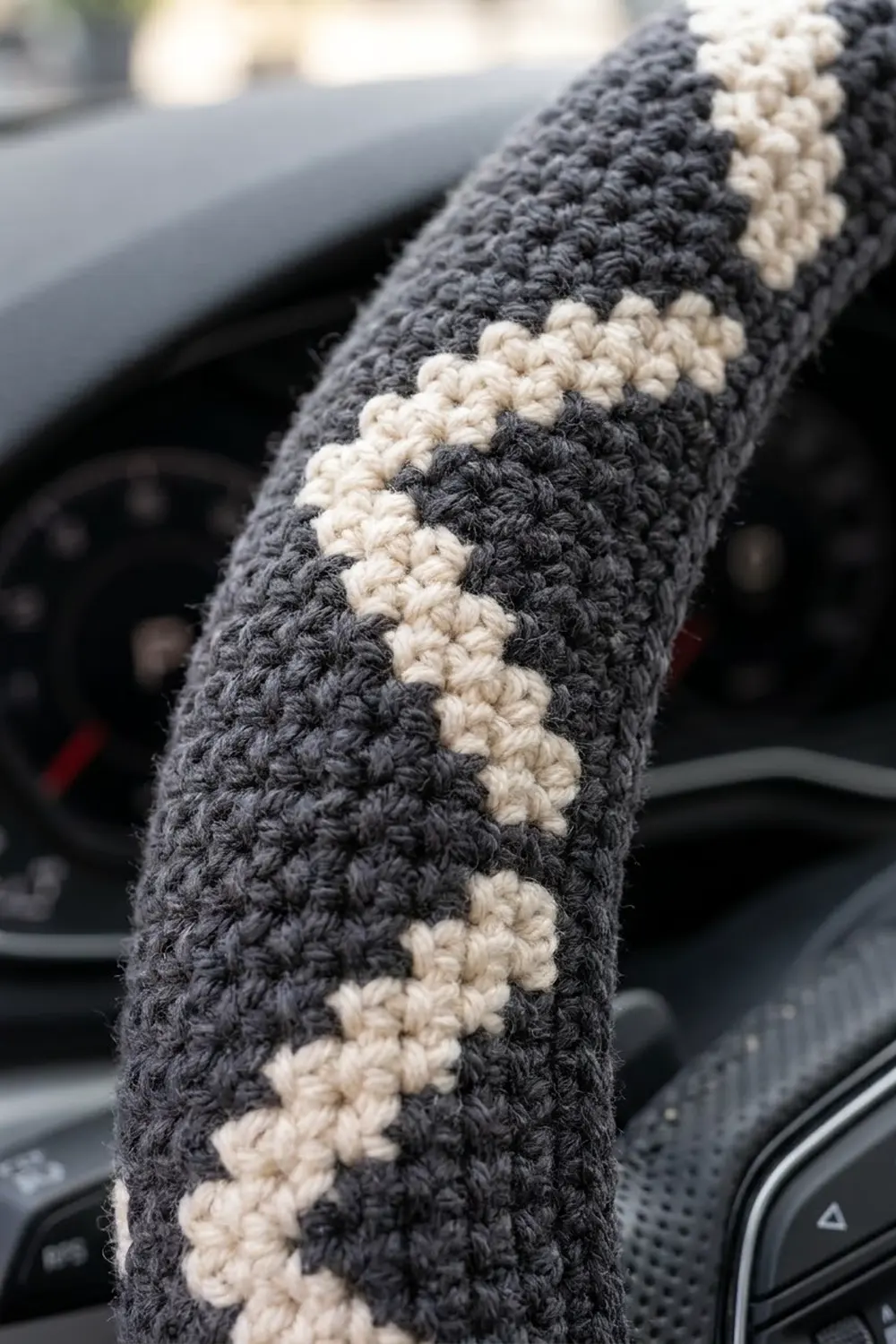
The Highway Zigzag Steering Wheel Cover is a thick, grippy wrap that turns a plain wheel into something cozy and graphic. A bold cream zigzag runs all the way around a deep charcoal background. Its sharp points reach both edges, so the pattern reads clearly from the driver’s seat.
The design uses tapestry single crochet. Both colors are carried inside every stitch, which makes the fabric dense and cushioned. That density helps grip, stops the colors showing through, and helps the cover hold its shape on the wheel. All instructions use US crochet terms.
The finished cover is 4.9 in (12.4 cm) wide and 42 in (106.7 cm) long when joined. It fits most standard steering wheels about 14.5–15 in (36.8–38.1 cm) across, with a grip circumference of 4.25–5 in (10.8–12.7 cm).
Construction is simple. You work one long strip in short rows across the width and seam the two short ends into a ring. Then you add a charcoal edge to each long side, block, and lace the cover onto the wheel.
Finished Size and Construction
- Finished size: 4.9 in (12.4 cm) wide × 42 in (106.7 cm) circumference
- Skill level: Intermediate (colorwork in single crochet)
- Terminology: US crochet terms
- Yarn weight: Worsted weight (#4), cotton or cotton blend
- Hook: 4.0 mm (US G-6)
- Number of pieces: 1 strip, seamed into a ring
- Layout: Single continuous band, 18 stitches wide × 210 rows long
- Piece size (before border): 4.5 in (11.4 cm) × 42 in (106.7 cm)
- Border depth: about 0.2 in (0.5 cm) on each long edge
Materials
Yarn advice: Use a smooth, firm worsted-weight cotton or a cotton/acrylic blend. Cotton holds the zigzag crisply and stands up to handling. Avoid fuzzy or very slippery yarns, which blur the colorwork and stretch out on a warm wheel.
- Color C (charcoal gray): 120 g, about 204 m
- Color B (cream): 75 g, about 128 m
Both quantities include a margin of about 15% for the gauge swatch, the seam, the edging, and the lacing cord. Because both colors are carried through every row, cream uses more yarn than its share of the visible surface suggests.
Tools:
- 4.0 mm (US G-6) crochet hook
- Tapestry needle with a large eye
- 2 locking stitch markers
- Flexible measuring tape
- Scissors
- Spray bottle with clean water
Abbreviations (US Terms)
- ch – chain
- sc – single crochet
- sl st – slip stitch
- st(s) – stitch(es)
- C – charcoal
- B – cream
- RS / WS – right side / wrong side
Special technique: Tapestry single crochet (tsc). Hold the color you are not using along the tops of the stitches in the row below, and work each sc over it so it is hidden inside. Color change: work the last sc before a change until 2 loops remain on the hook. Drop the old color, pick up the new one, and pull it through both loops. The old color is now carried. Keep the carried strand relaxed, never tight.
Gauge and Checkpoints
Gauge: 16 sts and 20 rows = 4 in (10.2 cm) in tapestry sc, carrying both colors. That works out to 4 sts and 5 rows per 1 in (2.5 cm).
Test first: Ch 19 and work Rows 1–14 of the pattern twice, for 28 rows in total. Lay this test piece flat without stretching it.
- Width checkpoint: 18 sts should measure 4.5 in (11.4 cm).
- Length checkpoint: 28 rows should measure 5.6 in (14.2 cm).
- One zigzag repeat: 14 rows = 2.8 in (7.1 cm).
If the piece is too big: go down to a 3.75 mm hook, or tighten the carried strand slightly. If it is too small: go up to a 4.25 mm hook. The width matters most because it must wrap the grip. Length can be adjusted later by adding or removing full 14-row repeats.
You can keep this test piece as the start of your strip if the gauge is right.
The Strip
Keep the same edge as Edge A throughout. Mark it with a stitch marker on Row 1. Odd rows are worked starting at Edge A. Even rows are worked starting at the opposite edge, Edge B.
Every row has exactly 18 sts: some sc in C, 4 sc in B, then the remaining sc in C. Ch 1 at the start of each row does not count as a stitch.
Foundation: With C, ch 19, carrying B along the chain from the first stitch.
Row 1 (RS): Change to B as you finish the turning chain. Starting in the 2nd ch from the hook, work 4 sc in B and 14 sc in C. Turn. (18 sts)
From here on, start each row with ch 1 in the color of the first stitch, and work into each stitch across.
Zigzag repeat (Rows 1–14): Counts read in the order you work each row.
| Row | Starts at | C | B | C | Total |
|---|---|---|---|---|---|
| 1 | Edge A | 0 | 4 | 14 | 18 |
| 2 | Edge B | 12 | 4 | 2 | 18 |
| 3 | Edge A | 4 | 4 | 10 | 18 |
| 4 | Edge B | 8 | 4 | 6 | 18 |
| 5 | Edge A | 8 | 4 | 6 | 18 |
| 6 | Edge B | 4 | 4 | 10 | 18 |
| 7 | Edge A | 12 | 4 | 2 | 18 |
| 8 | Edge B | 0 | 4 | 14 | 18 |
| 9 | Edge A | 12 | 4 | 2 | 18 |
| 10 | Edge B | 4 | 4 | 10 | 18 |
| 11 | Edge A | 8 | 4 | 6 | 18 |
| 12 | Edge B | 8 | 4 | 6 | 18 |
| 13 | Edge A | 4 | 4 | 10 | 18 |
| 14 | Edge B | 12 | 4 | 2 | 18 |
How the zigzag works: Measured from Edge A, the cream block starts at stitch 1 in Row 1. It moves 2 sts toward Edge B on each row and reaches stitches 15–18 in Row 8. Then it moves 2 sts back each row until Row 14, when it starts at stitch 3. Each new block overlaps the one below it by 2 sts, so the line looks continuous. The block touches Edge A in Row 1 and Edge B in Row 8. This makes one V-point on each edge per repeat.
Rows 15–210: Repeat Rows 1–14 fourteen more times, for 15 repeats and 210 rows in total. On the last repeat, ch 1 at the end of Row 14 is not needed. Fasten off both colors, leaving a 20 in (50.8 cm) tail of C for seaming.
Length checkpoints (measured flat, unstretched):
- After 70 rows (5 repeats): 14 in (35.6 cm)
- After 140 rows (10 repeats): 28 in (71.1 cm)
- After 210 rows (15 repeats): 42 in (106.7 cm)
Fitting check before seaming: Wrap the strip around the center line of your wheel rim. It should come up about 0.5–1 in (1.3–2.5 cm) short, so it stretches gently into place. If it reaches all the way without stretching, remove one 14-row repeat. If it is more than 2 in (5.1 cm) short, add one repeat. Always add or remove full repeats so the zigzag lines up across the seam.
Close the Ring
Make sure the strip is not twisted. Hold the two short ends with RS facing each other. Using the C tail and a tapestry needle, whipstitch Row 210 to the foundation chain, stitch to stitch: 18 stitches matched to 18 stitches. Catch only the back loops so the seam stays flat.
Turn RS out. Row 210 is Row 14 of a repeat, with the block starting at stitch 3. Row 1 has the block starting at stitch 1, so the zigzag continues across the seam with no break.
Border
The border is one round of sc in C along each long edge. It neatens the row ends and gives the lacing a firm edge to grip.
Border gauge: 5 sc per 1 in (2.5 cm) along the row ends. This is 1 sc per row, matching the row gauge exactly.
Edge A, Round 1: With RS facing, join C with a sl st in any row end on Edge A. Ch 1. Work 1 sc in each row end all the way around the ring, including the row ends next to the seam. Join with a sl st to the first sc. Fasten off. (210 sc)
Edge B, Round 1: Repeat on Edge B. (210 sc)
Why the math works: The ring has 210 rows, and each edge gets 1 sc per row, so each edge has 210 sc. Nothing is added at the seam because the seam lies between Row 210 and Row 1, and both rows are already counted. At 5 sc per 1 in (2.5 cm), 210 sc ÷ 5 = 42 in (106.7 cm), the same length as the strip. The edge will not ruffle or pull in.
Each border round adds about 0.2 in (0.5 cm) of width. The finished width is 4.5 in + 0.2 in + 0.2 in = 4.9 in (12.4 cm).
Weave in all ends inside the carried strands on the WS.
Final Blocking
- Lightly mist the whole ring with water until it is damp but not wet.
- Lay it flat in sections on a towel. Gently straighten the zigzag lines by hand so each cream block sits square.
- Check the width in several places. It should be 4.9 in (12.4 cm) everywhere. Ease narrow areas outward with your fingers.
- Leave it until it is completely dry, at least 12 hours.
- Fit: Slide the ring over the wheel rim with RS out. Center the zigzag so the points on Edge A face the driver and wrap toward the back. Pull the two long edges around the grip so they meet along the inner side of the rim, facing the hub.
- Lace: Cut about 4 yd (3.7 m) of C. Using a tapestry needle, lace the two edges together in a zigzag through the border sc, going into every 2nd stitch on alternating edges. Where a spoke meets the rim, go around the spoke by lacing on either side of it, and leave the edges just open enough for the spoke. Snug the lacing evenly, tie off, and tuck the ends under the cover.
Final Quality-Control Checklist
- Every row has 18 sts and each cream block is exactly 4 sts wide.
- There are 15 complete zigzag repeats, for 210 rows.
- The cream points touch Edge A and Edge B on every repeat.
- The zigzag continues across the seam with no jump.
- Each border round has 210 sc.
- The width is 4.9 in (12.4 cm) after blocking.
- No charcoal shows through the cream, and no cream shows through the charcoal.
- The lacing is even and no ends are visible on the driver’s side.
Troubleshooting
Cream shows through the charcoal stitches: The carried strand is too loose or sits too high. Tug it lightly after each color change and keep it on top of the stitches below.
The strip narrows or curls: The carried strand is too tight. Spread the stitches along the hook before each color change.
The zigzag looks jagged: Recount the stitches in that row. One extra stitch before the cream block shifts the whole line. Use the table and check that each row totals 18.
The cover slides around the wheel: The ring is too long. Remove one 14-row repeat, or lace more tightly at the back.
The edges ruffle: You worked more than 1 sc per row end. Undo the round and redo it with exactly 210 sc.
Cover will not reach around a thick grip: Add a second border round of sc on each edge (210 sc each). This adds about 0.2 in (0.5 cm) per edge.
Care
Remove the cover, hand wash it in cool water with mild soap, press out the water in a towel, and dry it flat. Do not use a dryer or leave the cover in a parked car in strong direct sun for long periods, because heat can fade the cream.

Final Notes
The whole fit depends on a short chain of measurements. A gauge of 4 sts and 5 rows per 1 in (2.5 cm) gives 18 sts = 4.5 in (11.4 cm) wide. Each 14-row repeat is 2.8 in (7.1 cm), so 15 repeats make 210 rows = 42 in (106.7 cm). One sc per row end gives 210 border sc on each edge, and the two border rounds bring the width to 4.9 in (12.4 cm). Check each link as you go and the cover will fit your wheel snugly.
Happy crocheting!