

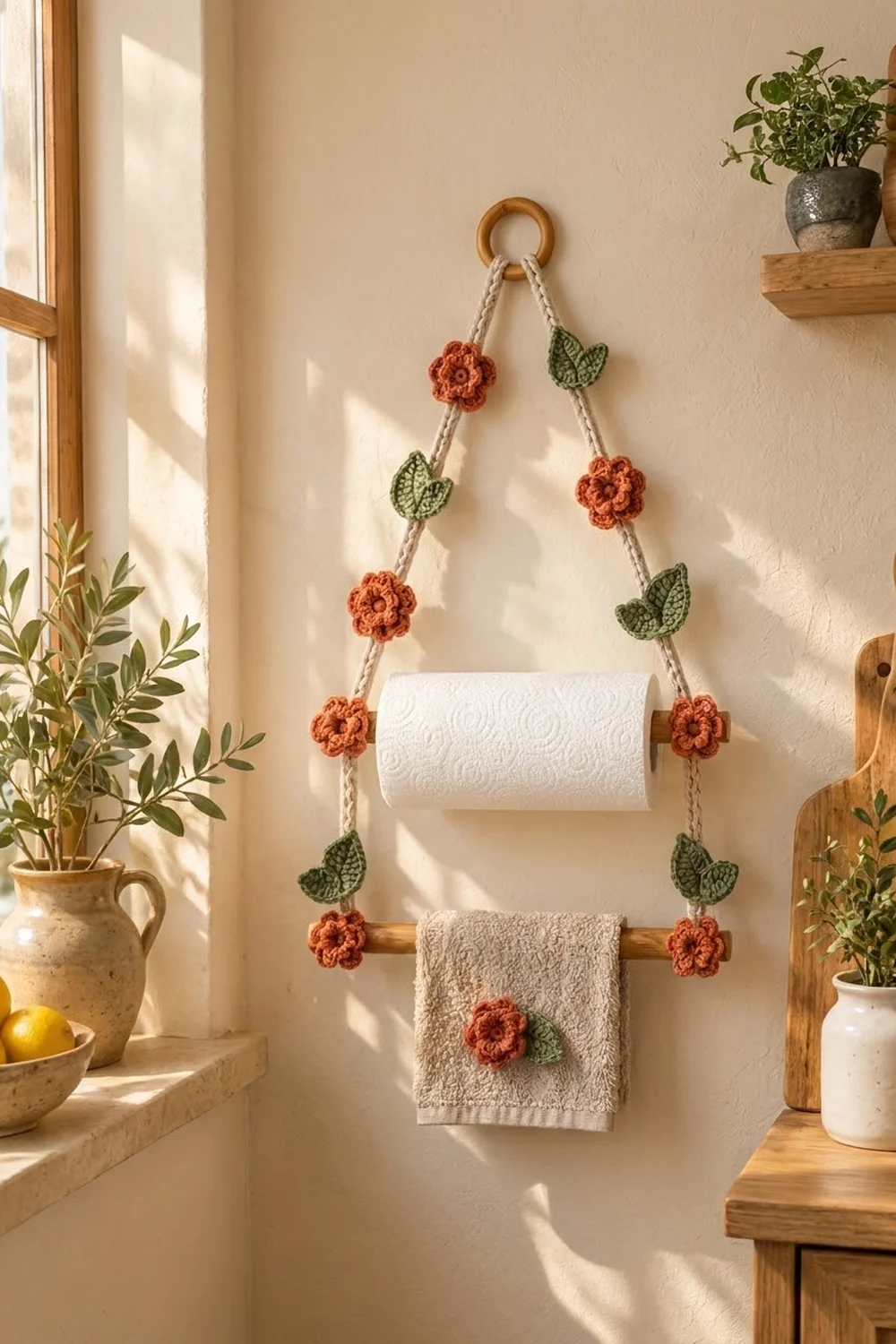
This hanging paper towel holder adds a soft cottage touch to a kitchen wall. A cream braided cord hangs from a wooden ring, forms an A-shape, and holds two wooden dowels: the top one for a paper towel roll and the bottom one for a hand towel. Small rust-orange flowers and sage-green leaves trail down both sides.
The colors are warm and earthy: cream cord, terracotta flowers, and muted sage leaves. Each flower has two layers of petals with a small open center, so it reads clearly even from across the room. A matching flower and leaf can be sewn onto the hand towel to tie the set together.
This pattern uses US crochet terms. The assembled holder measures about 28 in (71.1 cm) tall and 16 in (40.6 cm) wide. Each flower is 2 in (5.1 cm) across, and each leaf is 2 in (5.1 cm) long, not counting the stem.
You’ll make one long Romanian cord, 8 layered flowers, and 6 leaves. The cord folds over the ring, wraps around both dowel ends on each side, and is stitched in place. Flowers cover every dowel wrap, and the remaining flowers and leaves are sewn along the cord.
Finished Size and Construction
- Finished size: about 28 in (71.1 cm) tall × 16 in (40.6 cm) wide
- Skill level: Easy / advanced beginner
- Terminology: US crochet terms
- Yarn weight: Worsted (#4), cotton or cotton blend
- Hook: 4.0 mm (G-6)
- Number of pieces: 15 crocheted pieces (1 cord, 8 flowers, 6 leaves)
- Layout: A-frame cord with 7 flowers and 5 leaves; 1 flower and 1 leaf on the towel
- Flower size: 2 in (5.1 cm) across
- Flower size before outer petals: 1.25 in (3.2 cm)
- Outer petal depth: about 0.375 in (1 cm) on each side
- Leaf size: 2 in (5.1 cm) long × 1 in (2.5 cm) wide, plus a 0.5 in (1.3 cm) stem
- Cord: 66 in (167.6 cm) long × 0.5 in (1.3 cm) wide
Materials
Use a smooth, firm worsted-weight cotton. Cotton holds its shape on the cord, and it won’t stretch much under the weight of a towel. The amounts below assume about 190 m per 100 g.
- Cream (cord): 50 g / 95 m
- Rust / terracotta (flowers): 25 g / 48 m
- Sage green (leaves): 15 g / 29 m
All quantities include a safety margin of about 20%.
Tools and hardware:
- 4.0 mm (G-6) crochet hook
- Yarn needle
- Scissors
- Stitch markers
- 1 wooden ring, 2.5 in (6.4 cm) across
- 1 wooden dowel, 14 in (35.6 cm) long × 0.75 in (1.9 cm) thick (upper)
- 1 wooden dowel, 16 in (40.6 cm) long × 0.75 in (1.9 cm) thick (lower)
- Measuring tape
- Optional: fabric glue, a plain hand towel
Abbreviations (US Terms)
- ch – chain
- sl st – slip stitch
- sc – single crochet
- hdc – half double crochet
- dc – double crochet
- st(s) – stitch(es)
- sp – space
- BPsc – back post single crochet
- rnd – round
Special stitch: BPsc (back post single crochet). Insert the hook from back to front to back around the post of the stitch you’re told to work around. Yarn over, pull up a loop, then yarn over and pull through both loops.
Special technique: Romanian cord. Ch 2. Sc in the 2nd ch from the hook. Turn the work clockwise, insert the hook into the single loop on the left, and sc. Turn the work clockwise again, insert the hook under the two loops on the left side, and sc. Repeat from * to *. Each sc counts as one row.
Gauge and Checkpoints
Make one flower and one leaf before anything else, then measure both.
- Cord gauge: 4 rows = 1 in (2.5 cm); the cord is 0.5 in (1.3 cm) wide
- Flower checkpoint 1: after Rnd 3, 1.25 in (3.2 cm) across
- Flower checkpoint 2: after Rnd 5, 2 in (5.1 cm) across
- Leaf checkpoint: 2 in (5.1 cm) from base to tip, 1 in (2.5 cm) wide
If your pieces are too big, go down to a 3.75 mm hook. If they’re too small, go up to a 4.5 mm hook. For the cord, gauge matters less than total length, so measure as you go. A tight cord is better than a loose one because it won’t sag.
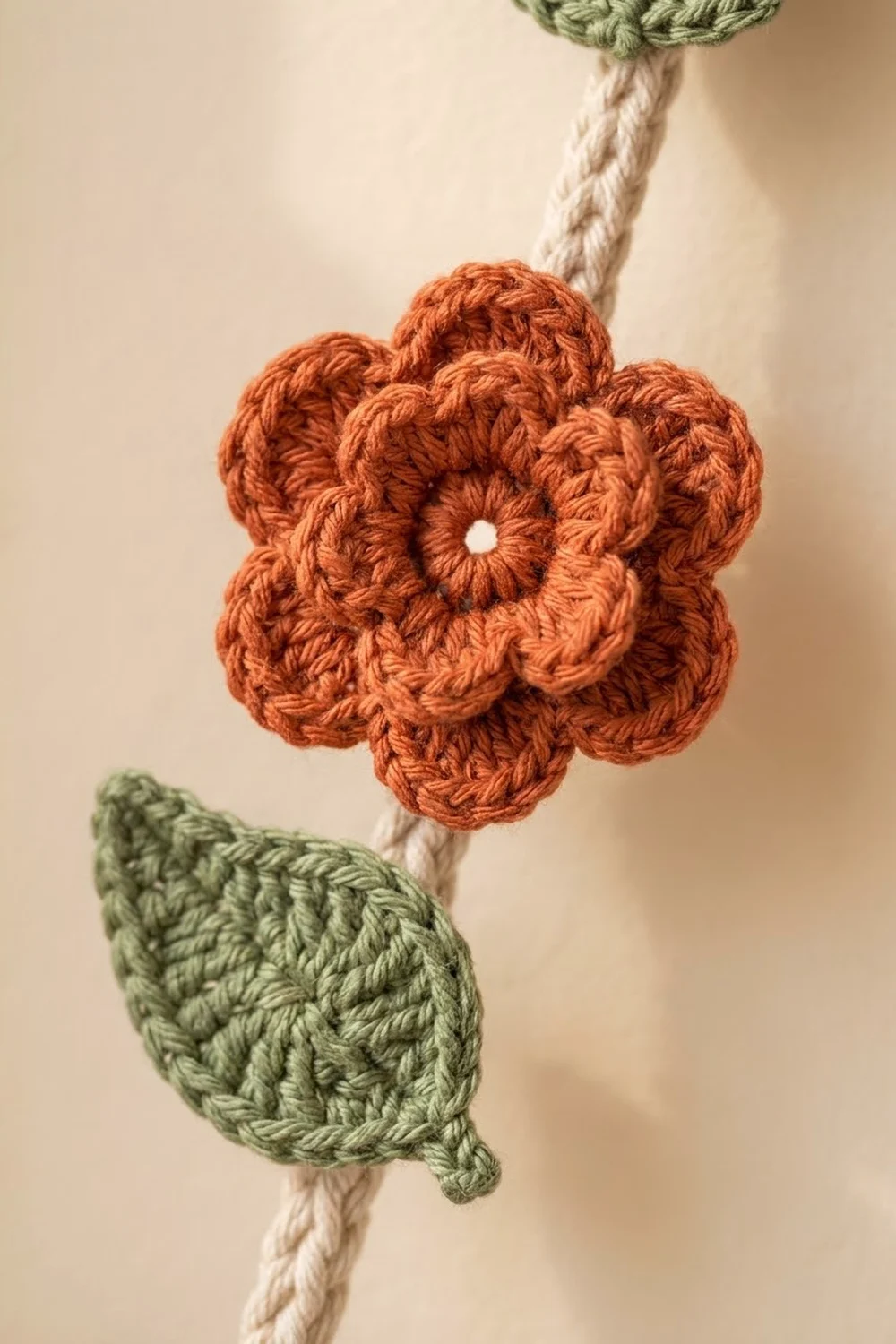
Romanian Cord (Make 1)
Use cream.
Setup: Work the Romanian cord as described in the Abbreviations section.
Rows 1–264: Keep working Romanian cord until you have 264 rows. At 4 rows per inch, that gives 66 in (167.6 cm).
Place markers to plan the assembly. Each half of the cord is 132 rows, or 33 in (83.8 cm). Starting at the center of the cord and working out toward each end, place markers at these points:
- Rows 1–4 from center (1 in / 2.5 cm): wraps over the ring
- Next 76 rows (19 in / 48.3 cm): diagonal down to the upper dowel
- Next 10 rows (2.5 in / 6.4 cm): wraps around the upper dowel
- Next 32 rows (8 in / 20.3 cm): runs down to the lower dowel
- Last 10 rows (2.5 in / 6.4 cm): wraps around the lower dowel
Check: 4 + 76 + 10 + 32 + 10 = 132 rows per half, and 132 × 2 = 264 rows. Fasten off, leaving a 10 in (25.4 cm) tail.
Checkpoint: Lay the cord flat without stretching it. It should measure 66 in (167.6 cm). If it’s short, add rows evenly to both 19 in (48.3 cm) sections.
Layered Flower (Make 8)
Use rust.
Rnd 1: Make a magic ring. Ch 1, then work 10 sc in the ring. Pull the ring snug but leave a small hole in the center. Sl st to the first sc. (10 sc)
Rnd 2: Ch 1. Sc in the next st, ch 2, skip 1 st. Repeat from * to * 5 times. Sl st to the first sc. (5 sc, 5 ch-2 sps)
Rnd 3 (inner petals): In each ch-2 sp, work (sc, hdc, 2 dc, hdc, sc). Sl st to the first sc. (5 petals of 6 sts = 30 sts)
Checkpoint: 1.25 in (3.2 cm) across.
Rnd 4: Fold the inner petals toward you so you can work behind them. Ch 1, then BPsc around the first sc of Rnd 2. Ch 4. BPsc around the next sc of Rnd 2, ch 4. Repeat from * to * 3 more times. Sl st to the first BPsc. (5 BPsc, 5 ch-4 sps)
Rnd 5 (outer petals): In each ch-4 sp, work (sc, hdc, 4 dc, hdc, sc). Sl st to the first sc. (5 petals of 8 sts = 40 sts)
Fasten off, leaving a 12 in (30.5 cm) tail for sewing.
Checkpoint: 2 in (5.1 cm) across. Each inner petal should sit centered over the gap between two outer petals.
Leaf (Make 6)
Use sage green.
Foundation: Ch 10.
Side 1: Starting in the 2nd ch from the hook, work sl st, sc, hdc, dc, dc, dc, hdc, sc. (8 sts)
Tip: In the last ch, work (sc, ch 2, sl st in the 2nd ch from the hook, sc). (2 sc + 1 picot)
Side 2: Rotate the piece and work along the free loops on the other side of the foundation chain: sc, hdc, dc, dc, dc, hdc, sc, sl st. (8 sts)
Total: 18 sts + 1 picot.
Stem: Ch 4. Sl st in the 2nd ch from the hook and in each of the next 2 ch, then sl st in the first sl st of the leaf. (3 sl sts)
Fasten off, leaving a 10 in (25.4 cm) tail.
The foundation chain shows as a ridge down the center, which forms the vein. Checkpoint: 2 in (5.1 cm) long, 1 in (2.5 cm) wide.
Make All Pieces
- Cream: 1 cord, 264 rows
- Rust: 8 flowers (7 for the cord, 1 for the towel)
- Sage: 6 leaves (5 for the cord, 1 for the towel)
Layout grid (F = flower, L = leaf; read from the ring down):
              [RING]
     LEFT CORD        RIGHT CORD
        F                 L
        L                 F
        F                 L
   F (upper dowel)   F (upper dowel)
        L                 L
   F (lower dowel)   F (lower dowel)

  Cord totals: Left 4F + 2L, Right 3F + 3L = 7F + 5L
  Towel: 1F + 1L
  Grand total: 8F + 6L
Joining and Assembly
1. Ring. Fold the cord in half and line up the two center markers. Push the 1 in (2.5 cm) center section over the ring so both halves hang down. With the cream tail or a separate strand, whipstitch the two halves together just below the ring, working 3 stitches through both cord thicknesses.
2. Upper dowel. On each side, measure 19 in (48.3 cm) down from the ring. Wrap the next 2.5 in (6.4 cm) of cord once around the dowel, 1 in (2.5 cm) in from its end. Whipstitch the cord to itself where the wrap meets, working cord stitch to cord stitch. Keep these stitches snug but not tight, so the dowel can still turn slightly for loading the roll.
3. Lower dowel. On each side, measure 8 in (20.3 cm) down. Wrap the last 2.5 in (6.4 cm) around the lower dowel, 1 in (2.5 cm) in from its end. Stitch the cord end to the cord and weave in the tail through the cord’s center channel.
4. Flowers and leaves. Center a flower over each of the 4 dowel wraps and sew it through the cord with the rust tail, stitching around Rnd 1 so the petals stay free. Space the remaining pieces evenly along each 19 in (48.3 cm) diagonal, about 4.75 in (12.1 cm) apart, following the grid. Sew one leaf to the middle of each 8 in (20.3 cm) section. Angle the leaf stems toward the ring.
5. Towel. Sew the last flower and leaf to the lower-right front of the towel, with the leaf tucked behind the edge of the flower.
Size checkpoint: Hang the holder empty. The cords should sit 12 in (30.5 cm) apart on the upper dowel and 14 in (35.6 cm) apart on the lower dowel. Both dowels should hang level, and the total height should be about 28 in (71.1 cm). If one dowel tips, adjust the wrap on the low side by 1–2 rows.
Border: Outer Petal Round
This design doesn’t have a separate border. The outer petal round (Rnd 5) acts as the flower’s edge, and its math is what keeps the flower flat.
Border gauge: 8 sts per petal, which adds about 0.375 in (1 cm) of depth on each side.
- Starting count: Rnd 4 has 5 ch-4 sps, so one space per “side” (petal).
- Per-petal count: sc + hdc + 4 dc + hdc + sc = 8 sts.
- Round total: 5 petals × 8 sts = 40 sts.
Why the math works: Each ch-4 space is longer than the ch-2 spaces of Rnd 2, so 4 dc fit without ruffling. The rise from sc to dc and back down gives a rounded petal. Anchoring Rnd 4 to the same Rnd 2 stitches as the inner petals lines the two layers up evenly, so no extra stitches are needed. The inner layer (6 sts per petal, 30 total) is shorter than the outer layer (8 sts per petal, 40 total), which makes the stacked, stepped look.
Final Blocking
- Pin each flower to a foam mat at 2 in (5.1 cm) across, opening every outer petal.
- Pin each leaf at 2 in × 1 in (5.1 cm × 2.5 cm), pulling the picot out to a point.
- Hold a steam iron 1 in (2.5 cm) above the pieces and steam them. Don’t press.
- Let them dry completely, about 1 hour.
- Hang the cord with the lower dowel attached overnight so it straightens.
- Lift the inner petals slightly with your fingertips to add dimension.
Final Quality-Control Checklist
- [ ] Cord is 264 rows, 66 in (167.6 cm) long
- [ ] Each half is 132 rows, with the sections marked correctly
- [ ] 8 flowers, each 40 sts in Rnd 5 and 2 in (5.1 cm) across
- [ ] 6 leaves, each 18 sts plus picot and stem
- [ ] Both dowels hang level
- [ ] All 4 dowel wraps are hidden under flowers
- [ ] Layout matches the grid (7F + 5L on the cord)
- [ ] All tails are woven in through the cord center or the back of each motif
- [ ] Flower petals are free and not stitched down
Troubleshooting
Flower cups or curls: Your Rnd 4 chains are too short. Ch 5 instead of ch 4, or loosen your tension.
Flower ruffles: Your chains are too long. Ch 3, or go down a hook size.
Inner and outer petals don’t line up: You worked the BPsc around the wrong stitches. Work them only around the 5 sc from Rnd 2.
Cord twists while you work: Always turn clockwise. Mixing directions breaks the braid.
Cord stretches under the towel: Use a firmer cotton, or go down to a 3.5 mm hook.
Leaf tip is blunt: Tighten the picot chain and pin it to a point when blocking.
Care
Spot clean with mild soap and cool water. If the dowels are unfinished wood, slide them out before washing the cord, and let all pieces dry flat.
Final Notes
Your measurements build on each other. A cord gauge of 4 rows per inch gives 132 rows per half and 66 in (167.6 cm) total. Flowers grow from 1.25 in (3.2 cm) at Rnd 3 to 2 in (5.1 cm) at Rnd 5, and leaves come out 2 in (5.1 cm) long. Once assembled, the holder is about 28 in (71.1 cm) tall and 16 in (40.6 cm) wide. Check each stage before moving on, and the finished holder will hang straight.
Happy crocheting!