

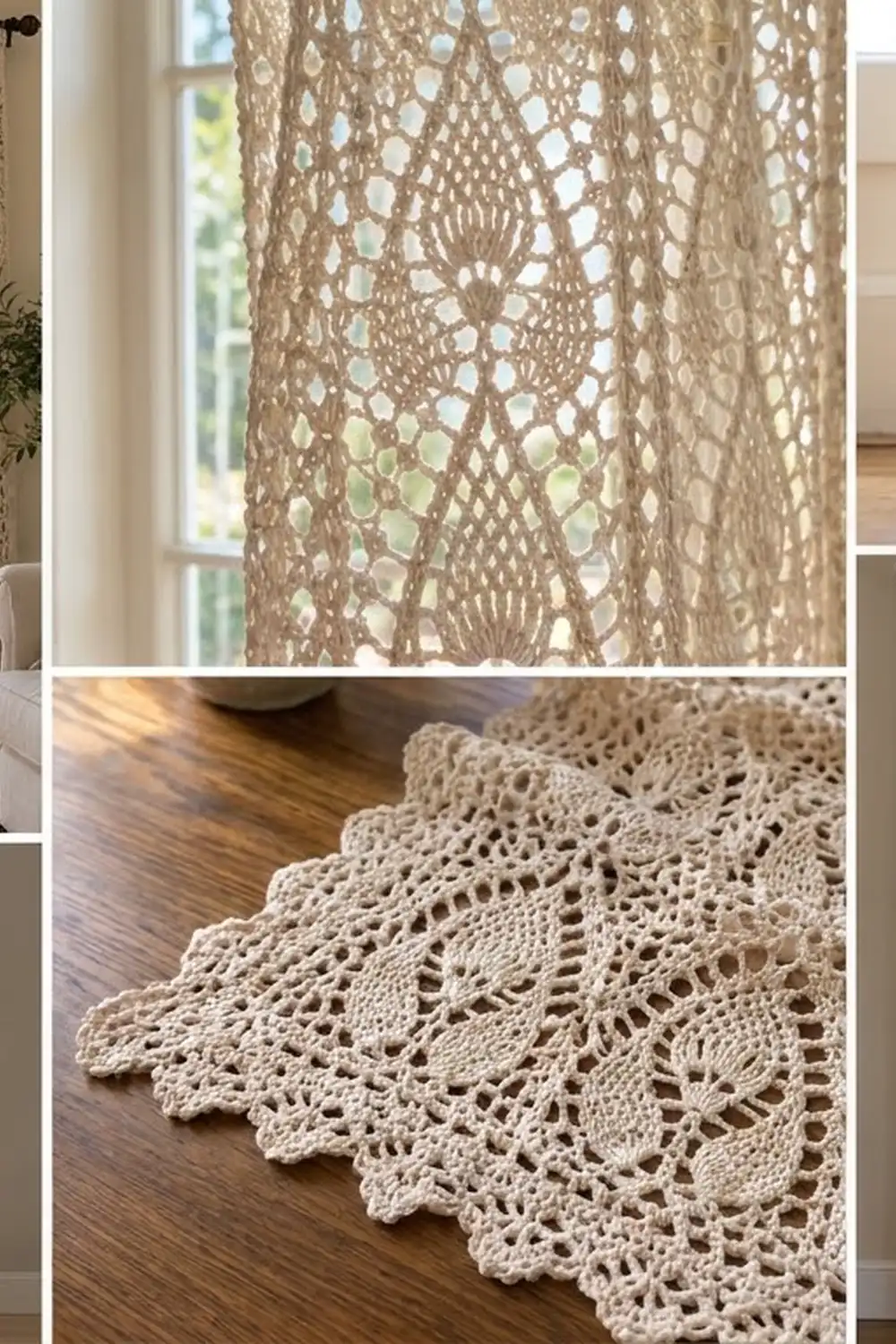
These lace curtains are made to let soft light through. Each panel has vertical columns of teardrops on an open mesh. Every teardrop has a solid outline, a small fan of rays at its rounded base and a narrow solid tip. The bottom edge ends in a deep scalloped hem with picot points.
The design uses one color, a warm cream or ecru cotton. Natural cotton looks right at a sunny window and keeps the stitches crisp. This pattern uses US crochet terms throughout.
Each finished panel measures 37 in (94.0 cm) wide and 74¾ in (189.9 cm) long, from the top of the rod pocket to the hem points. You make two identical panels and hang them as a pair.
Each panel is one piece, worked flat in rows from the bottom up. A 24-stitch, 10-row repeat builds the teardrop columns. Solid rows at the top fold over to make a rod pocket. A picot edging finishes the long sides, and a scalloped border runs along the bottom.
Finished Size and Construction
- Finished size (each panel): 37 in (94.0 cm) x 74¾ in (189.9 cm)
- Skill level: Intermediate
- Terminology: US crochet terms
- Yarn weight: DK / light (#3) cotton
- Hook: 4.0 mm (G-6)
- Number of pieces: 2 identical panels, each worked in one piece
- Layout: two panels hung side by side on one rod, not joined
- Panel body: 193 sts wide, with 8 teardrop columns
- Size before border: 36¼ in (92.1 cm) x 73 in (185.4 cm), with the pocket folded
- Border depth: ⅜ in (1.0 cm) on each long side; 1¾ in (4.4 cm) at the hem
Materials
Choose a smooth DK cotton or cotton blend with about 230 m per 100 g. Mercerized cotton makes crisp, slightly shiny lace. Matte cotton looks softer. Avoid fuzzy yarns, because they blur the mesh.
- Cream / ecru: 600 g (about 1,380 m) per panel, or 1,200 g (about 2,760 m) for the pair
Tools:
- 4.0 mm (G-6) crochet hook
- Locking stitch markers
- Tapestry needle
- Tape measure
- Rust-proof pins and blocking mats, or a clean carpet covered with a sheet
These amounts include a margin of about 10% for the swatch and for differences in tension. Buy all your yarn from one dye lot.
Abbreviations (US Terms)
- ch: chain
- sl st: slip stitch
- sc: single crochet
- dc: double crochet
- sk: skip
- st(s): stitch(es)
- RS / WS: right side / wrong side
Special stitches:
- sp (space): ch 1, sk next st, dc in next st. One sp covers 2 sts.
- picot: ch 3, sl st in 3rd ch from hook.
Counting rule: Every ch 1 and every dc counts as 1 st. “Dc in next st” means the next stitch of any kind, whether it’s a chain or a dc. The beginning ch 3 counts as a dc.
Gauge and Checkpoints
Gauge in pattern: One 24-st repeat measures 4½ in (11.4 cm) wide, and 10 rows measure 5 in (12.7 cm) tall. That works out to 16 sts = 3 in (7.6 cm), with each row ½ in (1.3 cm) tall.
Make a test swatch first. Ch 51. Work Row 0 (49 sts), then Rows 1–10 with 2 repeats across, then one row of dc in each st. Block the swatch and let it dry. It should measure 9¼ in (23.5 cm) wide and 6 in (15.2 cm) tall.
- Too big: go down to a 3.75 mm hook.
- Too small: go up to a 4.5 mm hook.
- Rows too short: pull up the first loop of each dc a little higher.
Checkpoints on the panel:
- After Row 0: 36¼ in (92.1 cm) wide
- After the first Row 10: 5½ in (14.0 cm) tall
- After Row 70: 35½ in (90.2 cm) tall
- After Row 141: 71 in (180.3 cm) tall
- After Row 149: 75 in (190.5 cm) tall, before folding the pocket
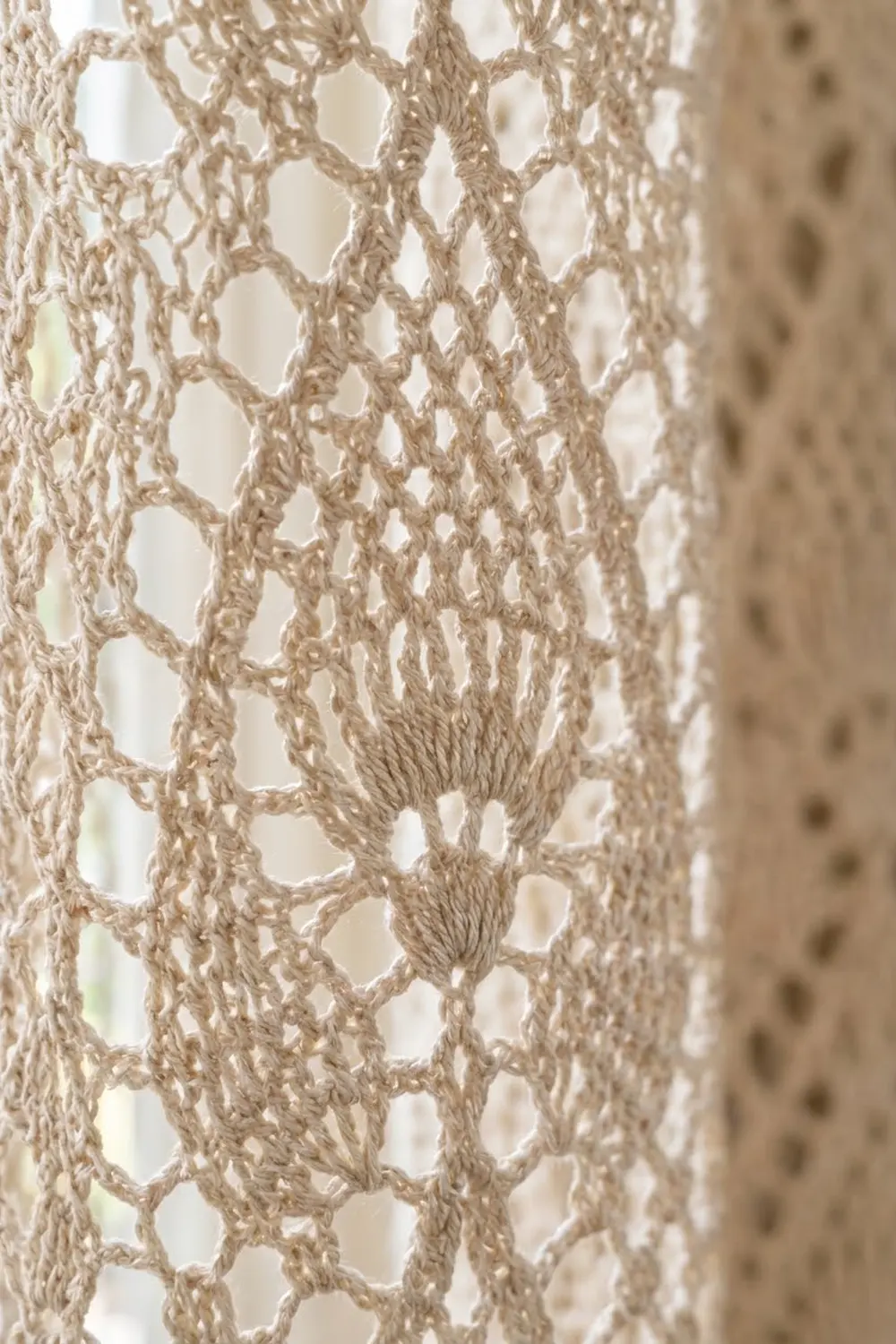
Panel Body
Stitch positions count from the dc that ends the previous repeat (position 1) to the dc that ends the current repeat (position 25). Each teardrop is centered on position 13. Every row ends with a dc in the top of the turning ch.
Row 0 (foundation): Ch 195. Dc in 4th ch from hook and in each ch across. Turn. (193 sts)
Start every pattern row with ch 3 (counts as dc), then work the repeat 8 times and turn. Each row has 1 + (8 x 24) = 193 sts.
Row 1 (mesh): Ch 3, sp 12 times; rep from * 7 more times. (24 sts per repeat)*
Row 2 (teardrop base): Ch 3, sp 4 times, dc in next 8 sts, sp 4 times; rep from * across. (8 + 8 + 8 = 24)*
This makes a solid bar over positions 9–17, which forms the rounded bottom of the teardrop.
Row 3 (shell): Ch 3, sp 3 times, dc in next 2 sts, ch 1, sk next 3 sts, 5 dc in next st, ch 1, sk next 3 sts, dc in next 3 sts, sp 3 times; rep from * across. (6 + 2 + 7 + 3 + 6 = 24)*
The outline now sits at positions 7–9 and 17–19, and the 5-dc shell sits on position 13.
Row 4 (fan opens): Ch 3, sp 2 times, dc in next 2 sts, ch 1, sk next 3 sts, [dc in next dc, ch 1] 4 times, dc in next dc, ch 1, sk next 3 sts, dc in next 3 sts, sp 2 times; rep from * across. (4 + 2 + 11 + 3 + 4 = 24)*
The ch 1s between the shell dc are new chains, not skips. They spread the shell into 5 rays.
Row 5 (rays): Ch 3, sp 2 times, dc in next 2 sts, sp 6 times, dc in next 2 sts, sp 2 times; rep from * across. (4 + 2 + 12 + 2 + 4 = 24)*
Each ray dc lands on a ray dc from Row 4. The outline stays at positions 5–7 and 19–21, which is the widest part of the teardrop.
Row 6 (fan arc): Ch 3, sp 2 times, dc in next 2 sts, ch 1, sk next st, dc in next 9 sts, ch 1, sk next st, dc in next 3 sts, sp 2 times; rep from * across. (4 + 2 + 11 + 3 + 4 = 24)*
Row 7 (taper): Ch 3, sp 3 times, dc in next 2 sts, sp 4 times, dc in next 2 sts, sp 3 times; rep from * across. (6 + 2 + 8 + 2 + 6 = 24)*
Row 8 (taper): Ch 3, sp 4 times, dc in next 2 sts, sp 2 times, dc in next 2 sts, sp 4 times; rep from * across. (8 + 2 + 4 + 2 + 8 = 24)*
Row 9 (tip): Ch 3, sp 5 times, dc in next 4 sts, sp 5 times; rep from * across. (10 + 4 + 10 = 24)*
Row 10 (mesh): Work the same as Row 1. (193 sts)
Rows 10 and 1 together form a 2-row band of mesh between the teardrops. Each teardrop is 8 rows tall, which is 4 in (10.2 cm), and 3¼ in (8.3 cm) wide at its widest row.
Rows 11–140: Repeat Rows 1–10 thirteen more times. That gives 14 teardrops in each column.
Row 141: Ch 3, dc in each st across. Turn. (193 sts)
The body now has 142 rows and measures 71 in (180.3 cm) tall.
Rod Pocket
Rows 142–149: Ch 3, dc in each st across. Turn. (193 sts each row) Fasten off.
Fold Rows 146–149 to the WS. Using a separate length of yarn, whipstitch the top of Row 149 to the back loops at the top of Row 141, one stitch to one stitch, for 193 stitches. Leave both short ends open. The pocket is 2 in (5.1 cm) deep and fits a rod up to 1¼ in (3.2 cm) across.
Make Both Panels
- Panel A: 1 piece, 600 g (about 1,380 m) of cream
- Panel B: 1 piece, 600 g (about 1,380 m) of cream
[ Panel A ] [ Panel B ]
   37 in       37 in
The panels are not joined, and either one can hang on the left. Add the borders to both panels before you block them.
Border
Border gauge: 4 sc = ¾ in (1.9 cm) along the side edging. Each hem scallop covers 6 foundation sts, which is 1⅛ in (2.9 cm).
Side Edging (each long side)
Edge the row ends of Rows 0–141 only. Leave the pocket rows unedged so the pocket stays flat and open.
Row 1: With RS facing, join the yarn at the top of the side. Ch 1, then work 2 sc in each row end down to Row 0. Turn. (142 x 2 = 284 sc)
Row 2: Ch 1, sc in next 4 sc, picot, sc in next 4 sc; work from * 70 times in total. Fasten off. (284 sc, 70 picots)*
Repeat on the other long side.
Why the math works: Each dc row is ½ in (1.3 cm) tall, and 2 sc fill that height without ruffling. Since 284 = 4 x 71, the edge splits into 71 groups of 4 sc with 70 picots between them, and both ends match.
Scalloped Hem
Work along the underside of the foundation chain.
Row 1: With RS facing, join the yarn at the right corner. Ch 1, then work 1 sc in each foundation ch loop, including the base of the beginning ch 3. Turn. (193 sc)
Row 2: Ch 1, sc in first sc, ch 5, sk next 5 sc, sc in next sc; rep from * 31 more times. Turn. (33 sc + 32 ch-5 loops = 33 + 160 = 193 sts)*
Row 3: Ch 1, sc in first sc, 9 dc in next ch-5 loop, sc in next sc; rep from * 31 more times. Turn. (33 sc + 288 dc = 321 sts; 32 shells)*
Row 4: Ch 1, sl st in first sc, sc in next 4 dc, (sc, ch 3, sc) in next dc, sc in next 4 dc, sl st in next sc; rep from * 31 more times. Fasten off. (Each scallop has 10 sc, 1 ch-3 point and 1 sl st.)*
Why the math works: 193 = 1 + (32 x 6), so the edge divides into exactly 32 scallops, with an anchor sc at each end. The 5th dc of each 9-dc shell sits in the center, so it carries the point. 32 scallops x 1⅛ in (2.9 cm) = 36 in (91.4 cm), which matches the body width.
Final Blocking
- Weave in the ends along the solid outline dc, where they won’t show.
- Soak the panel in cool water with a little wool wash for 15 minutes.
- Press out the water gently and roll the panel in towels. Don’t wring it.
- Lay it flat on mats or on a floor covered with a sheet.
- Pin it to 37 in (94.0 cm) x 74¾ in (189.9 cm), with the pocket folded flat.
- Pin each side every 4 in (10.2 cm) to keep the edges straight.
- Pin the point of each scallop. Check that each one is 1⅛ in (2.9 cm) wide.
- Smooth the teardrop columns so they run straight up and down.
- Let the panel dry completely, which takes 24–48 hours. Block the second panel to the same size.
Final Quality-Control Checklist
- Every row has 193 sts.
- There are 8 straight columns, with 14 teardrops in each column.
- Each fan has 5 rays that line up under the arc row.
- The pocket is 2 in (5.1 cm) deep, and both ends are open.
- Each side has 70 evenly spaced picots.
- The hem has 32 even scallops.
- Both panels measure 37 in x 74¾ in (94.0 cm x 189.9 cm).
- No ends show on the RS.
Troubleshooting
- Teardrops drift sideways: a repeat is off by one stitch. Place a marker after every 24 sts and count each repeat.
- Fan looks crowded: loosen the chains in Row 4 and check that you skipped 3 sts on each side.
- Mesh droops: your dc are too tall. Go down one hook size.
- Sides ripple: work 2 sc per row end, not 3, and keep a relaxed tension.
- Hem flares: check that each loop skips exactly 5 sc and each shell has 9 dc.
- Panel too short: add one 10-row repeat, which adds 5 in (12.7 cm), before Row 141. Allow about 40 g (92 m) more yarn per panel.
Care
Hand wash in cool water, or machine wash on a gentle cold cycle inside a mesh bag. Reshape the panel, dry it flat and pin the scallops lightly.
Final Notes
Each measurement in this pattern depends on the one before it. If one 24-st repeat measures 4½ in (11.4 cm), the 193-st body will be 36¼ in (92.1 cm) wide. At ½ in (1.3 cm) per row, 142 rows measure 71 in (180.3 cm). The folded pocket adds 2 in (5.1 cm), and the side edging brings the width to 37 in (94.0 cm). The hem adds 1¾ in (4.4 cm), for a finished length of 74¾ in (189.9 cm). If you check your gauge and count in repeats, both panels will match.
Happy crocheting!