

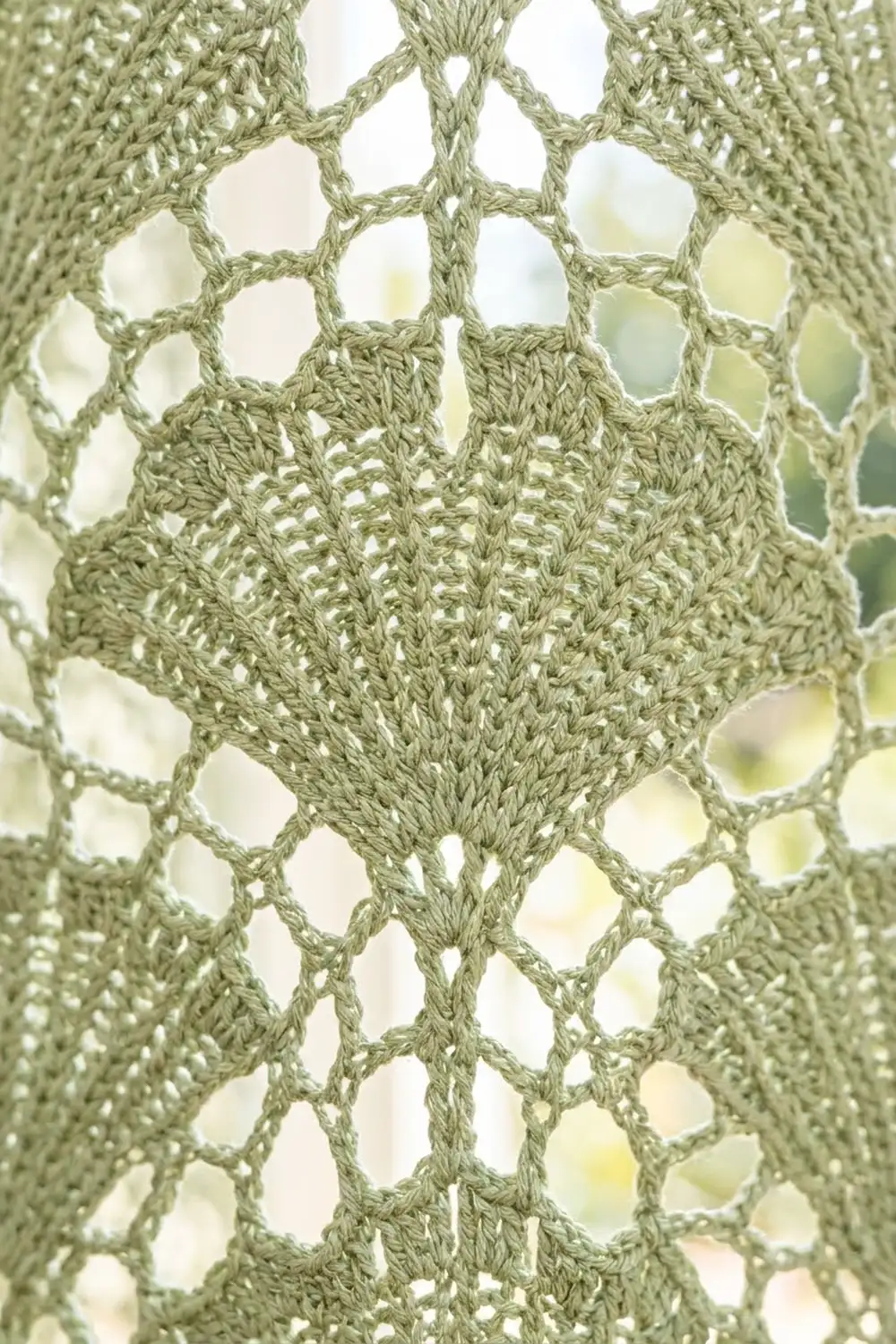
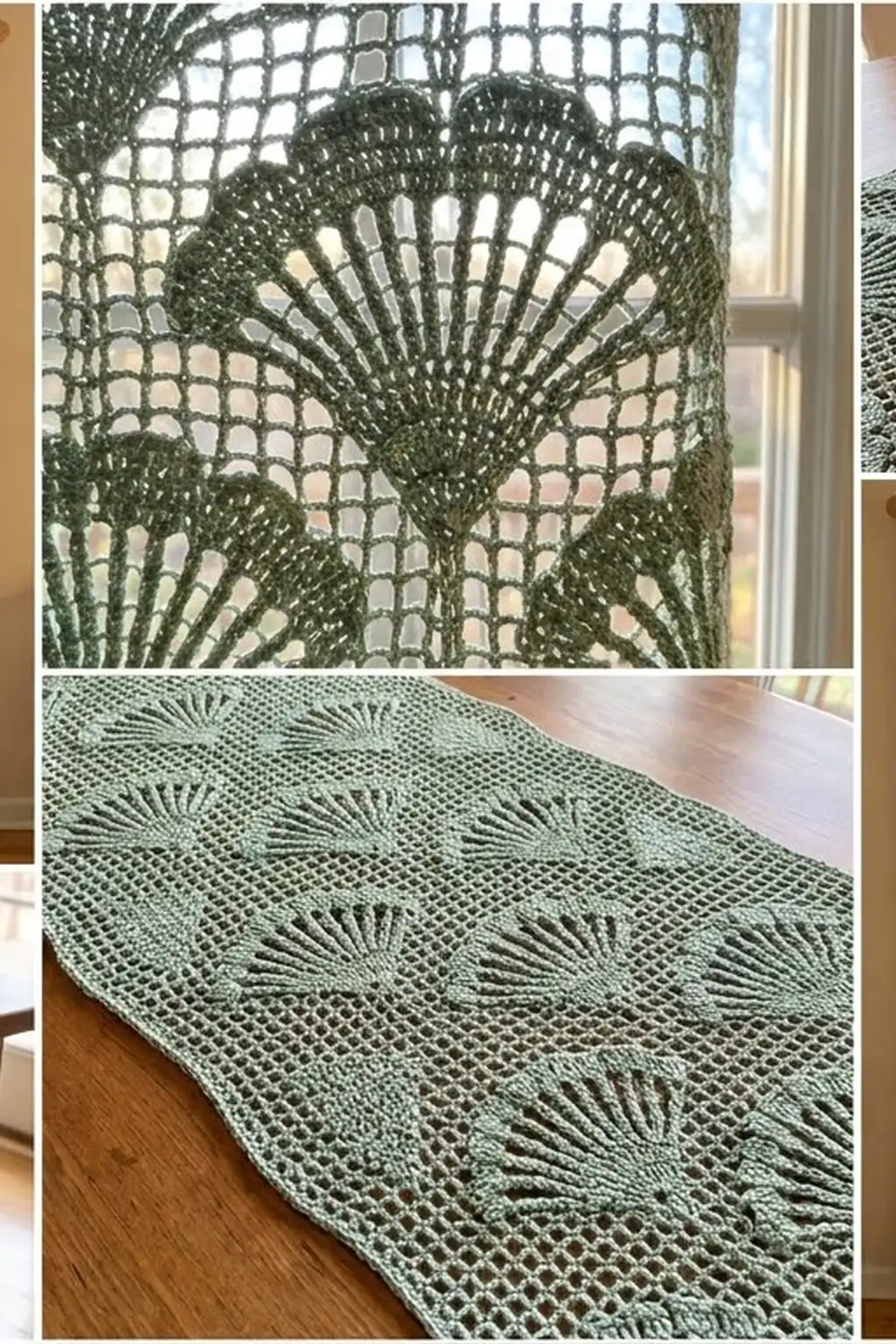
The Sage Ginkgo Lace Curtain Panel is a tall, airy lace curtain covered in fan-shaped ginkgo leaves. Each fan has radiating ribs and a softly lobed top edge with a small notch in the center. The fans sit in staggered rows inside an open chain mesh, and they stand out clearly against the open background when light comes through a window.
The panel is worked in one soft sage green cotton. The look is botanical and calm, and it suits sunrooms, cottage kitchens, and French doors. Make two identical panels for a classic pair.
This pattern uses US crochet terms. Each finished panel measures 43.25 in (109.9 cm) wide and 82 in (208.3 cm) long. That size includes the side borders, the pointed bottom edging, and the folded rod pocket.
Construction is easy to follow. You work the panel from the bottom up in rows on a fixed count of 169 stitches, and every chain counts as a stitch. Fan rows and mesh rows alternate in a 14-row repeat. When the body is done, you add a pointed scallop edging along the foundation and a narrow border on both long sides. Last, you fold the top rows into a rod pocket.
Finished Size and Construction
- Finished size (one panel): 43.25 in x 82 in (109.9 cm x 208.3 cm)
- Skill level: Intermediate
- Terminology: US crochet terms
- Yarn weight: DK (#3) cotton or cotton blend
- Hook: 4.0 mm (US G-6)
- Number of pieces: 2 identical panels, each one continuous piece (no joining)
- Layout: staggered fans: 7 fans in each A row and 6 fans in each B row, with 22 fan rows per panel (143 fans)
- Piece size: each fan is 4.25 in (10.8 cm) wide and 2.5 in (6.4 cm) tall
- Size before border: 42.25 in x 80.5 in (107.3 cm x 204.5 cm)
- Border depth: 0.5 in (1.3 cm) on each long side; the bottom edging is 1.5 in (3.8 cm)
Materials
Choose a smooth mercerized or matte cotton in DK weight. Cotton holds the fan shapes, blocks crisply, and hangs well in sunlight. Avoid fuzzy yarns, because they blur the ribs and the mesh.
- Sage green: 650 g (1,300 m) per panel; 1,300 g (2,600 m) for a pair
These amounts include about 15 percent extra for swatching, test blocking, and small length changes.
Tools:
- 4.0 mm (US G-6) crochet hook
- Tapestry needle
- Locking stitch markers (at least 10)
- Tape measure
- Rustproof pins and a large blocking surface (foam mats, a bed, or a carpet covered with a towel)
- Spray bottle
- Curtain rod up to 1.25 in (3.2 cm) in diameter
Abbreviations (US Terms)
- ch – chain
- sl st – slip stitch
- sc – single crochet
- hdc – half double crochet
- dc – double crochet
- tr – treble crochet
- sk – skip
- st(s) – stitch(es)
- sp – space
- RS / WS – right side / wrong side
Fixed-count rule: In this pattern, every dc AND every chain of the previous row counts as one stitch. “Sk 3” means skip 3 stitches of any kind. “Dc in next st” can land in a dc or in a chain. When it lands in a chain, insert the hook under 2 strands of that chain. Every body row has exactly 169 sts.
Picot: ch 3, sl st in 3rd ch from hook.
Gauge and Checkpoints
Gauge in pattern: 24 sts and 14 rows = 6 in (15.2 cm) wide x 7 in (17.8 cm) tall, after blocking. One row is 0.5 in (1.3 cm) tall.
Test one piece first. Make a swatch: ch 51, then work Row 1 (49 sts) and Rows 2–3. Next, work Block A (Rows 4–8) with the bracketed repeat worked 2 times instead of 7, then work Rows 9–10. Block the swatch the same way you will block the panel.
Swatch checkpoint: 12.25 in (31.1 cm) wide x 5 in (12.7 cm) tall, with 2 complete fans.
- If the swatch is wider than 12.5 in (31.8 cm), go down one hook size.
- If the swatch is narrower than 12 in (30.5 cm), go up one hook size.
- If the width is right but the height is off, change how tall you make your dc (pull the first loop up more or less) instead of changing hooks.
Panel checkpoints:
- After Row 1: 42.25 in (107.3 cm) wide
- After Row 17: 8.5 in (21.6 cm) tall
- After Row 73: 36.5 in (92.7 cm) tall
- After Row 157: 78.5 in (199.4 cm) tall
Measure flat, without stretching. Lace relaxes when blocked, so rely mostly on the blocked swatch to judge width.
Panel Body
Foundation: Ch 171.
Row 1 (RS): Dc in 4th ch from hook (the skipped ch count as the first dc) and in each ch across. Turn. (169 sts)
Row 2 (mesh): Ch 3 (counts as dc throughout), *ch 3, sk 3, dc in next st; rep from * 42 times, working the last dc in top of turning ch. Turn. (43 dc + 126 ch = 169 sts; 42 mesh spaces)
Row 3: Repeat Row 2.
The dc now sit at positions 0, 4, 8, and so on up to 168. Each 24-st repeat holds 6 mesh spaces.
Block A (7 fans)
For each row: ch 3 (this is position 0), then work the bracketed 24-st repeat 7 times, working the last dc in top of turning ch. Turn. Every row has 169 sts.
Row 4 (stem): [Ch 3, sk 3, dc in next st; ch 3, sk 3, dc in next st; ch 2, sk 2, dc in next 3 sts; ch 2, sk 2, dc in next st; (ch 3, sk 3, dc in next st) 2 times]. (Per repeat: 4 + 4 + 5 + 3 + 8 = 24 sts)
Row 5 (fan base): [Ch 3, sk 3, dc in next st; ch 3, sk 3, dc in next st; ch 1, sk 1, dc in next 5 sts; ch 1, sk 1, dc in next st; (ch 3, sk 3, dc in next st) 2 times]. (Per repeat: 4 + 4 + 6 + 2 + 8 = 24 sts; fan = 5 solid dc)
Row 6 (fan opens): [Ch 3, sk 3, dc in next st; ch 1, sk 1, (dc in next st, ch 1, sk 1) 7 times; dc in next st; ch 3, sk 3, dc in next st]. (Per repeat: 4 + 1 + 14 + 1 + 4 = 24 sts; fan = 7 ribs)
Row 7 (full fan): [Ch 3, sk 3, (dc in next st, ch 1, sk 1) 8 times; dc in next st; ch 3, sk 3, dc in next st]. (Per repeat: 3 + 16 + 1 + 4 = 24 sts; fan = 9 ribs)
Row 8 (ginkgo top): [Ch 3, sk 3; sc in next st, hdc in next st, dc in next 2 sts, tr in next 2 sts, dc in next st, hdc in next st, sc in next st (center notch), hdc in next st, dc in next st, tr in next 2 sts, dc in next 2 sts, hdc in next st, sc in next st; ch 3, sk 3, dc in next st]. (Per repeat: 3 + 17 + 4 = 24 sts)
The tr pairs rise into two rounded lobes, and the center sc pulls down to form the ginkgo notch.
Rows 9–10: Repeat Row 2. (169 sts; 42 mesh spaces each)
Block B (6 fans, offset)
Block B shifts the fans over by 12 sts, so each fan sits halfway between two Block A fans.
For each row: ch 3, then (ch 3, sk 3, dc in next st) 3 times. Work the bracketed repeat of the matching Block A row 6 times. Finish with (ch 3, sk 3, dc in next st) 3 times, working the last dc in top of turning ch. Turn. (1 + 12 + 144 + 12 = 169 sts)
- Row 11: Use the Row 4 repeat.
- Row 12: Use the Row 5 repeat.
- Row 13: Use the Row 6 repeat.
- Row 14: Use the Row 7 repeat.
- Row 15: Use the Row 8 repeat.
- Rows 16–17: Repeat Row 2.
Rows 18–157: Repeat Rows 4–17 ten more times (11 repeats in total). Do not fasten off.
The panel now has 22 fan rows: 11 rows of 7 fans and 11 rows of 6 fans, for 143 fans.
Rod Pocket Heading
Rows 158–165: Ch 3, dc in each st across. Turn. (169 dc) Fasten off after Row 165.
The heading is 4 in (10.2 cm) tall before folding.
Bottom Edging
With RS facing, join yarn at the first stitch of the foundation edge.
Edging Row 1: Ch 1, sc in the base of each of the 169 foundation sts. Turn. (169 sc)
Edging Row 2: Ch 1, sc in first sc, *sk 5, (3 tr, ch 3, 3 tr) in next sc, sk 5, sc in next sc; rep from * 14 times. Turn. (14 pointed shells + 15 sc; 1 + 14 x 12 = 169 sts used)
Edging Row 3: Ch 1, sc in first sc, *sc in each of next 3 tr, (2 sc, picot, 2 sc) in ch-3 sp, sc in each of next 3 tr, sc in next sc; rep from * 14 times. Fasten off. (1 + 14 x 11 = 155 sc + 14 picots)
Each point is 3 in (7.6 cm) wide. The edging adds 1.5 in (3.8 cm) to the length.
Side Border
Border gauge: 4 sc = 1 in (2.5 cm) along a vertical edge. That works out to 2 sc in each dc row end.
With RS facing, join yarn at the end of Row 1 on one long side. Skip the edging row ends.
Border Row 1: Ch 1, work 2 sc in each row end of Rows 1–165. Turn. (165 x 2 = 330 sc)
Border Row 2: Ch 1, sc in each sc across. Fasten off. (330 sc)
Repeat on the other long side. (330 sc per side)
Why the math works: Before the heading is folded, the side edge is 165 rows x 0.5 in = 82.5 in (209.6 cm) long. At 4 sc per inch, that edge needs 82.5 x 4 = 330 sc. Each row end is 0.5 in tall, so 2 sc per row end gives exactly 330 sc, and the border lies flat without ruffling or pulling in. The 2 border rows add 0.5 in (1.3 cm) per side: 42.25 + 0.5 + 0.5 = 43.25 in (109.9 cm).
Final Blocking
- Weave in all ends along dc posts or inside the border, never across the mesh.
- Soak the panel in cool water with a little mild wash for 15 minutes. Press the water out; do not wring.
- Roll the panel in towels to remove more water.
- Lay it flat and pin the width to 43.25 in (109.9 cm). Check the width at several points along the length.
- Pin the length to 84 in (213.4 cm) flat. That is 82.5 in (209.6 cm) of body and unfolded heading plus 1.5 in (3.8 cm) of edging.
- Pin each bottom point and picot so all 14 points are even.
- Open each fan gently with your fingers so the ribs spread out and the two lobes curve evenly.
- Let it dry completely.
- Fold Rows 162–165 to the WS and whipstitch the top of Row 165 to the base of Row 158. The pocket is 2 in (5.1 cm) tall. Leave the side openings open for the rod.
- Check the finished length: 78.5 in (199.4 cm) body + 2 in (5.1 cm) heading + 1.5 in (3.8 cm) edging = 82 in (208.3 cm).
Final Quality-Control Checklist
- Every body row has 169 sts.
- Block A rows show 7 fans and Block B rows show 6 fans.
- Each Block B fan sits centered between two Block A fans.
- Each fan has 9 ribs in Row 7 and a two-lobed top with a center notch.
- Mesh rows have 42 even spaces.
- The bottom edging has 14 points with picots.
- Each side border has 330 sc and lies flat.
- The panel measures 43.25 in x 82 in (109.9 cm x 208.3 cm).
- The two panels match in length to within 0.5 in (1.3 cm).
Troubleshooting
Fans drift sideways. You probably lost or added a stitch. Count each row to 169, and place a marker at the start of every 24-st repeat.
Fans look squashed. Your tr stitches are too short. Pull up each loop fully, or go up one hook size for Row 8 only.
Mesh spaces sag. Your chains are too loose. Keep each ch-3 about as wide as 3 dc.
Side border ruffles. Work 3 sc per 2 row ends instead, and recount.
Side border pulls in. Your sc are too tight. Use a hook one size larger for the border.
Bottom points curl. Pin and steam the points during blocking. Also check that you skipped 5 sts on each side of every shell.
Panels differ in length. Block both panels together and pin them to the same measurements.
Care
Hand wash in cool water, or machine wash on a gentle cycle in a mesh bag, then lay flat to dry. Rehang the panel while it is still slightly damp so the fans settle straight.
Final Notes
Here is how the measurements add up. A gauge of 24 sts = 6 in (15.2 cm) gives a body width of 42.25 in (107.3 cm). Each row is 0.5 in (1.3 cm), so 157 rows make 78.5 in (199.4 cm). The folded heading adds 2 in (5.1 cm), and the edging adds 1.5 in (3.8 cm). The side borders add 0.5 in (1.3 cm) each. Together, that gives a finished panel of 43.25 in x 82 in (109.9 cm x 208.3 cm).
To change the length, add or remove one 14-row repeat. Each repeat is 7 in (17.8 cm). Make the second panel exactly like the first for a matching pair.
Happy crocheting!