

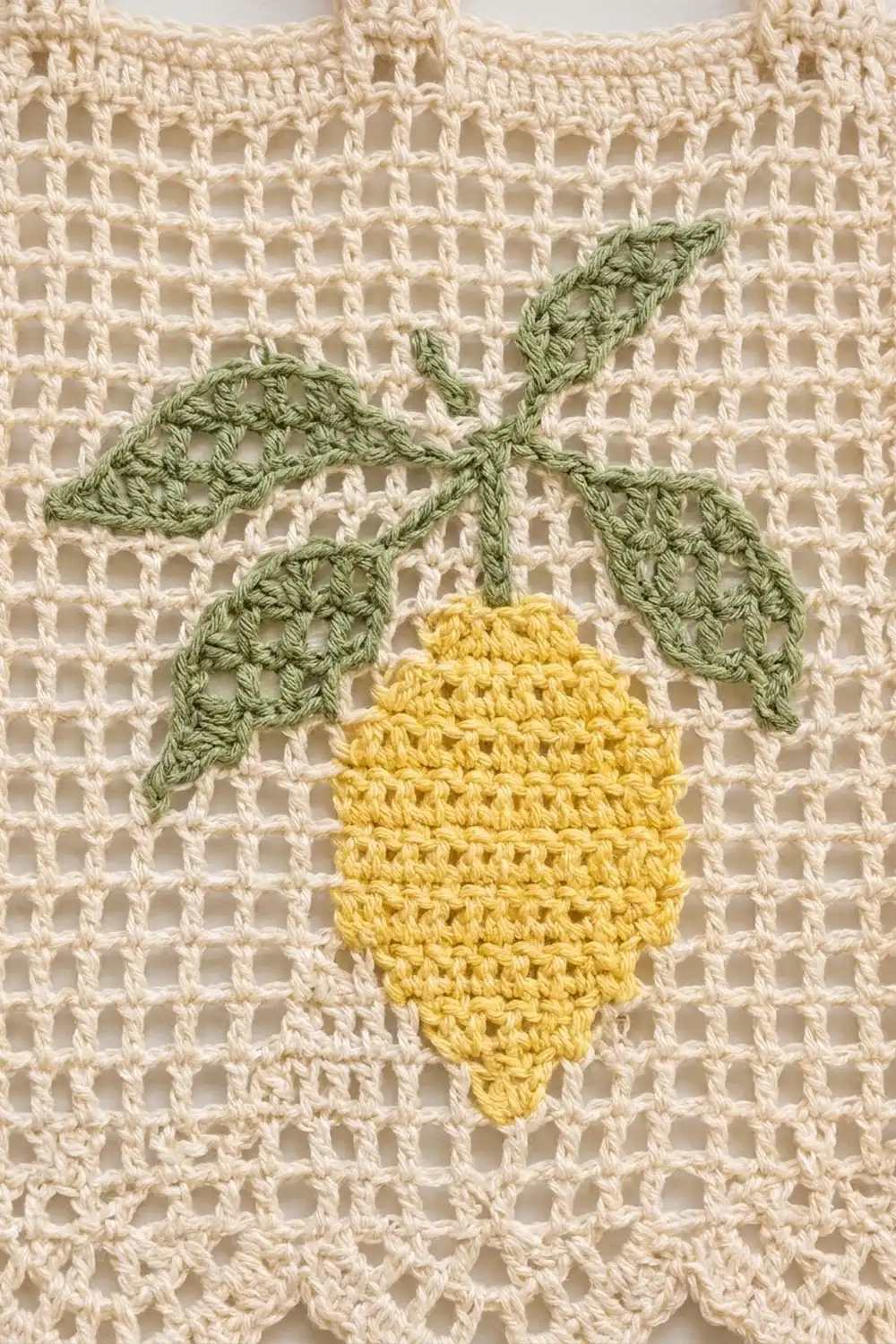
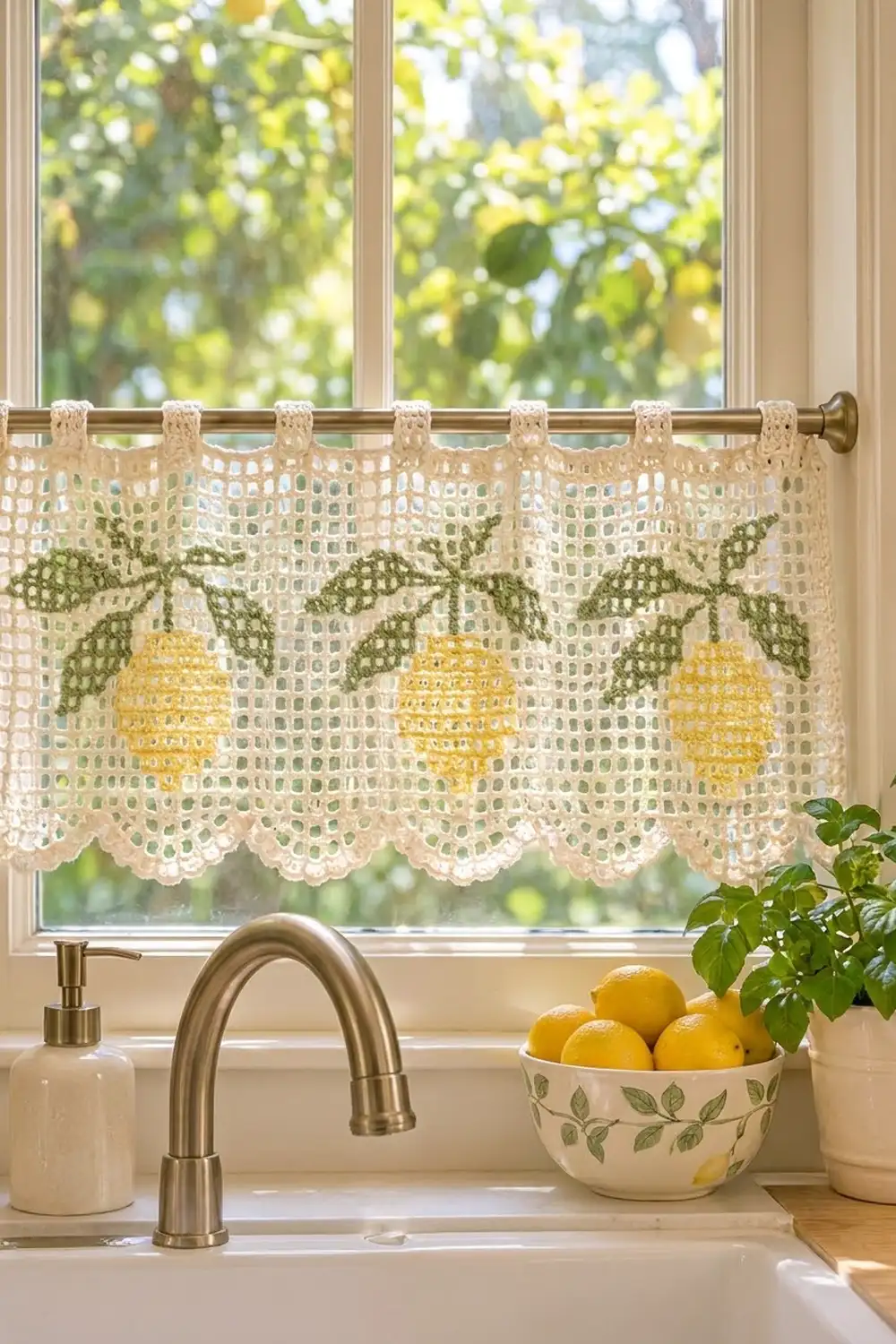
This café curtain brings a little citrus sunshine to a kitchen window. It is worked in cream filet mesh, and three butter-yellow lemons hang from sage-green stems and leaves across the middle. Light filters through the open squares, while the solid lemon blocks stand out as clean shapes.
The style is classic cottage filet with a fresh farmhouse feel. Rounded scallops edged with tiny picots finish the bottom, and nine solid tabs along the top slip over a standard café rod.
The pattern uses US crochet terms. The finished curtain measures about 32.6 in (82.8 cm) wide by 16.6 in (42.2 cm) deep, plus 1.5 in (3.8 cm) of folded tab above the rod line.
The construction is simple. You work the body in one piece, row by row from the bottom up, and place the lemons with small bobbins. Next you add a sc frame along the sides and top, then crochet the scalloped border into the foundation edge. Finally, you add the tabs to the top edge.
Finished Size and Construction
- Finished size: 32.6 in × 16.6 in (82.8 cm × 42.2 cm), not counting tabs
- Skill level: Intermediate
- Terminology: US
- Yarn weight: Sport / #2 cotton
- Hook: 3.25 mm (US D-3)
- Number of pieces: 1
- Layout: One rectangle, 81 squares wide × 36 rows tall, with 3 motifs across
- Body size: 32.4 in × 14.4 in (82.3 cm × 36.6 cm)
- Size before border: 32.6 in × 14.6 in (82.8 cm × 37.1 cm) after the sc frame
- Border depth: 2 in (5.1 cm) at the scallop points and 1 in (2.5 cm) at the valleys
- Tabs: 9 tabs, each 1.6 in (4.1 cm) wide, folding to a 1.5 in (3.8 cm) loop
Materials
Mercerized cotton is the best choice. It holds crisp filet squares, resists sagging in window light, and washes well. Pick a soft cream for the main color so the yellow and green read clearly.
- Cream (MC): 250 g / 700 m
- Butter yellow (Y): 60 g / 168 m
- Sage green (G): 40 g / 112 m
These quantities include roughly a 15% margin for swatching, bobbin tails, and tension differences.
Tools:
– 3.25 mm (US D-3) hook
– 8–10 small yarn bobbins
– Tapestry needle
– Stitch markers
– Blocking mats and rust-proof pins
– Measuring tape
– Spray bottle
Abbreviations (US Terms)
- ch – chain
- sl st – slip stitch
- sc – single crochet
- hdc – half double crochet
- dc – double crochet
- tr – treble crochet
- sk – skip
- sp – space
- RS / WS – right side / wrong side
- O – open square
- B – block, or filled square (Y = yellow block, G = green block)
Special stitches
- Open square (O): Ch 2, sk the next 2 sts (or the ch-2 sp), dc in the next dc.
- Block (B): Dc in each of the next 2 sts (or 2 dc in the ch-2 sp), then dc in the next dc. Each square’s closing dc belongs to that square and is worked in that square’s color.
- Picot: Ch 3, sl st in the 3rd ch from the hook.
- Color change: Work the last yarn-over of the stitch before the change with the new color.
Gauge and Checkpoints
Gauge: 10 squares and 10 rows = 4 in (10.2 cm) in filet mesh. Each square is 0.4 in (1.0 cm) square. In sc, 15 sts and 12 rows = 2 in (5.1 cm).
Test first. Chain 41 and work 12 rows of open squares (12 squares wide). The swatch should measure about 4.8 in (12.2 cm) each way. Measure the central 10 squares.
- Too big: go down 0.25 mm.
- Too small: go up 0.25 mm.
Row height matters as much as width. If your dc rows run tall, try a firmer yarn-over before changing hooks.
Checkpoints:
– After Row 1: 32.4 in (82.3 cm) wide, within ±0.25 in (0.6 cm)
– After Row 4: 1.6 in (4.1 cm) tall
– After Row 24 (end of the motifs): 9.6 in (24.4 cm) tall
– After Row 36: 14.4 in (36.6 cm) tall
If Row 1 is off by more than 0.5 in (1.3 cm), restart with the adjusted hook. The error only grows across 36 rows.
Body
Stitch count: Every row has 244 sts. That is 81 squares × 3 sts plus 1 closing dc, with chains counted as stitches. A block simply replaces a ch-2 with 2 dc, so the count never changes.
Foundation: With MC, ch 248 (81 × 3 + 5).
Row 1 (RS): Dc in the 8th ch from the hook. This makes the first open square. Ch 2, sk 2 ch, dc in the next ch 80 times. Turn. (81 open squares, 244 sts)
Rows 2–4: Ch 5 (counts as dc + ch 2), sk the ch-2 sp, dc in the next dc. Ch 2, dc in the next dc across, ending with the last dc in the 3rd ch of the turning ch. Turn. (81 O)
Motif Rows (Rows 5–24)
Each motif row reads:
6 O, [motif row], 12 O, [motif row], 12 O, [motif row], 6 O = 81 squares
Body Row 5 uses Motif Row M1, Row 6 uses M2, and so on through Row 24 (M20). The motif is symmetrical, so you read it the same way on RS and WS rows.
| Row | Squares across the motif (15 total) |
|---|---|
| M1 | 7 O, 1 Y, 7 O |
| M2 | 6 O, 3 Y, 6 O |
| M3 | 5 O, 5 Y, 5 O |
| M4–M8 | 4 O, 7 Y, 4 O |
| M9–M10 | 5 O, 5 Y, 5 O |
| M11 | 6 O, 3 Y, 6 O |
| M12 | 7 O, 1 G, 7 O |
| M13 | 2 O, 3 G, 2 O, 1 G, 2 O, 3 G, 2 O |
| M14 | 1 O, 13 G, 1 O |
| M15 | 2 O, 3 G, 2 O, 1 G, 2 O, 3 G, 2 O |
| M16 | 4 O, 2 G, 1 O, 1 G, 1 O, 2 G, 4 O |
| M17 | 3 O, 3 G, 1 O, 1 G, 1 O, 3 G, 3 O |
| M18 | 3 O, 2 G, 2 O, 1 G, 2 O, 2 G, 3 O |
| M19–M20 | 7 O, 1 G, 7 O |
What the rows build:
– M1–M11: a lemon 7 squares wide at its widest, with a single-square pointed tip at the bottom. That is 57 yellow blocks per lemon.
– M12, M19, and M20: the stem.
– M13–M15: two diamond-shaped lower leaves, joined to the stem by the full row M14.
– M16–M18: two smaller upper leaves that angle out from the stem.
That makes 47 green blocks per motif. Each motif is 6 in (15.2 cm) wide and 8 in (20.3 cm) tall.
Color method:
– Use a separate bobbin for each yellow or green section.
– Carry MC along the top of the previous row and work the colored dc over it, so the cream strand hides inside the block. Pick MC back up for the next open square.
– Never carry color across an open square.
– If a section’s bobbin hangs more than 1 square from where that section starts on the next row, cut it and rejoin.
Rows 25–36: Work as for Row 2, with 81 open squares. Fasten off after Row 36.
Checkpoint: The body measures 32.4 in × 14.4 in (82.3 cm × 36.6 cm).
Border
Border gauge: 3 sc per square width and 3 sc per dc row end. That equals 7.5 sc per inch, which matches the mesh, so the edges lie flat without ruffling or pulling.
Part A: Frame Row (sides and top)
With the RS facing, join MC at the bottom-left corner.
- Left side: Work 3 sc around each row-end dc post, for 108 sc (36 rows × 3).
- Top corner: Ch 1. This is a turning space and is not counted.
- Top edge: Sc in the corner dc. 2 sc in the next ch-2 sp, sc in the next dc 81 times. That gives 244 sc (1 + 81 × 3). The first and last sc sit on the corner dc and are already in this count.
- Top corner: Ch 1.
- Right side: 108 sc down to the bottom-right corner.
Do not fasten off.
Why the math works: Each square is 3 sts wide and each row is 0.4 in tall. Three sc per row end and per square give the same 7.5 sc per inch on every edge. The frame adds about 0.1 in (0.3 cm) to each side and 0.2 in (0.5 cm) to the top.
Part B: Scalloped Bottom Edge
B1: Ch 1 and rotate to work along the opposite side of the foundation chain. Sc in the corner. 2 sc in the next bottom ch-2 sp, sc at the base of the next dc 81 times. Turn. (244 sc)
B2: Ch 5 (counts as dc + ch 2), sk 2 sc, dc in the next sc. Ch 2, sk 2 sc, dc in the next sc across. Turn. (82 dc, 81 ch-2 sps)
You now have 9 scallop repeats of 9 sps each. Each scallop will be 3.6 in (9.1 cm) wide.
B3: Ch 1, sc in the first dc. Sc in the next sp, [ch 4, sc in the next sp] 8 times, sc in the next dc 9 times. Turn. (91 sc, 72 ch-4 arches, 8 per scallop)
B4: Ch 1, sc in the first sc. Sk the next sc, then work into the next 8 arches, skipping the sc between them:
– 3 sc
– 4 hdc
– 5 dc
– 6 tr
– 6 tr
– 5 dc
– 4 hdc
– 3 sc
Sk the next sc, sc in the next sc. Repeat 9 times. Turn. (37 sts per repeat; total 1 + 9 × 37 = 334 sts)
The graded stitch heights create the rounded curve, and the single sc between repeats forms each valley.
B5: Ch 1, sc in the first sc. Sc in the next 3 sts, [picot, sc in the next 3 sts] 11 times, sl st in the valley sc 9 times. (325 sc, 99 picots, 9 sl sts) Fasten off.
Checkpoint: The scallops reach 2 in (5.1 cm) below the body at their points and 1 in (2.5 cm) at the valleys.
Part C: Tabs
Count the 244 top sc. The tabs start on sc 1, 30, 59, 88, 117, 146, 175, 204, and 233. Each tab starts every 29 sts: 12 tab sts plus a 17-st gap of 2.3 in (5.8 cm).
The math checks out: 9 tabs × 12 + 8 gaps × 17 = 108 + 136 = 244.
For each tab:
1. Join MC, then ch 1 and sc in the same st and the next 11 sts. (12 sc)
2. Work 17 more rows: ch 1, turn, sc in each sc. (12 sc per row)
3. The tab is now 18 rows, or 3 in (7.6 cm) long.
4. Fasten off with a 12 in (30.5 cm) tail.
5. Fold the tab to the WS and whipstitch its last row to the base of the frame row.
The finished loop is 1.5 in (3.8 cm) deep and fits rods up to 0.75 in (1.9 cm) in diameter.
Final Blocking
- Weave in all ends inside blocks or along the sc rows, never across open squares.
- Soak in cool water for 15 minutes, then press out the water in a towel.
- Pin the curtain flat at 32.6 in (82.8 cm) wide by 16.6 in (42.2 cm) deep, not counting tabs.
- Pin the top edge in a straight line, then the side edges.
- Square the mesh by running a measuring tape along a row. The squares should be 0.4 in (1.0 cm).
- Pin each scallop point and valley. Open every picot with a pin.
- Leave the tabs unpinned but flat.
- Let it dry completely, at least 24 hours.
Final Quality-Control Checklist
- [ ] Every row holds 81 squares, with 244 sts.
- [ ] All three lemons sit in the same rows with 12 open squares between them.
- [ ] Each lemon has a single-square tip, and each stem lines up with the lemon’s center column.
- [ ] No colored strands are visible across open squares.
- [ ] The sides have 108 sc each and the top has 244 sc.
- [ ] There are 9 even scallops, each with 11 picots.
- [ ] There are 9 tabs, evenly spaced and folded to the same depth.
- [ ] The blocked size is 32.6 in × 16.6 in (82.8 cm × 42.2 cm).
Troubleshooting
- The body slants: You probably missed the turning ch-5 or the last dc. Count squares every few rows.
- The lemon looks lopsided: You may have miscounted the margin squares. Mark the start of each motif with a stitch marker.
- The blocks pucker: The carried MC strand is too tight. Lay it loosely before working over it.
- Cream shows through the yellow: Hold the carried strand at the back of the stitch and tighten your colored dc.
- The scallops ruffle: Your tension in B4 is loose. Drop to 5 tr in each center arch only if the edge still ruffles after blocking.
- The tabs are too tight for the rod: Add 2–4 rows to each tab.
Care
Hand wash in cool water with a mild detergent and dry flat, reshaping the scallops while damp. To refresh, press with a warm iron through a cloth.
Final Notes
Everything rests on one measurement chain:
– A 0.4 in (1.0 cm) square gives a body of 81 × 36 squares, or 32.4 in × 14.4 in (82.3 cm × 36.6 cm).
– The sc frame brings it to 32.6 in (82.8 cm) wide.
– The 2 in (5.1 cm) scallop border and the 0.2 in (0.5 cm) top frame finish the depth at 16.6 in (42.2 cm).
Check your gauge, count each row, and your lemon curtain will hang square and bright.
Happy crocheting!