

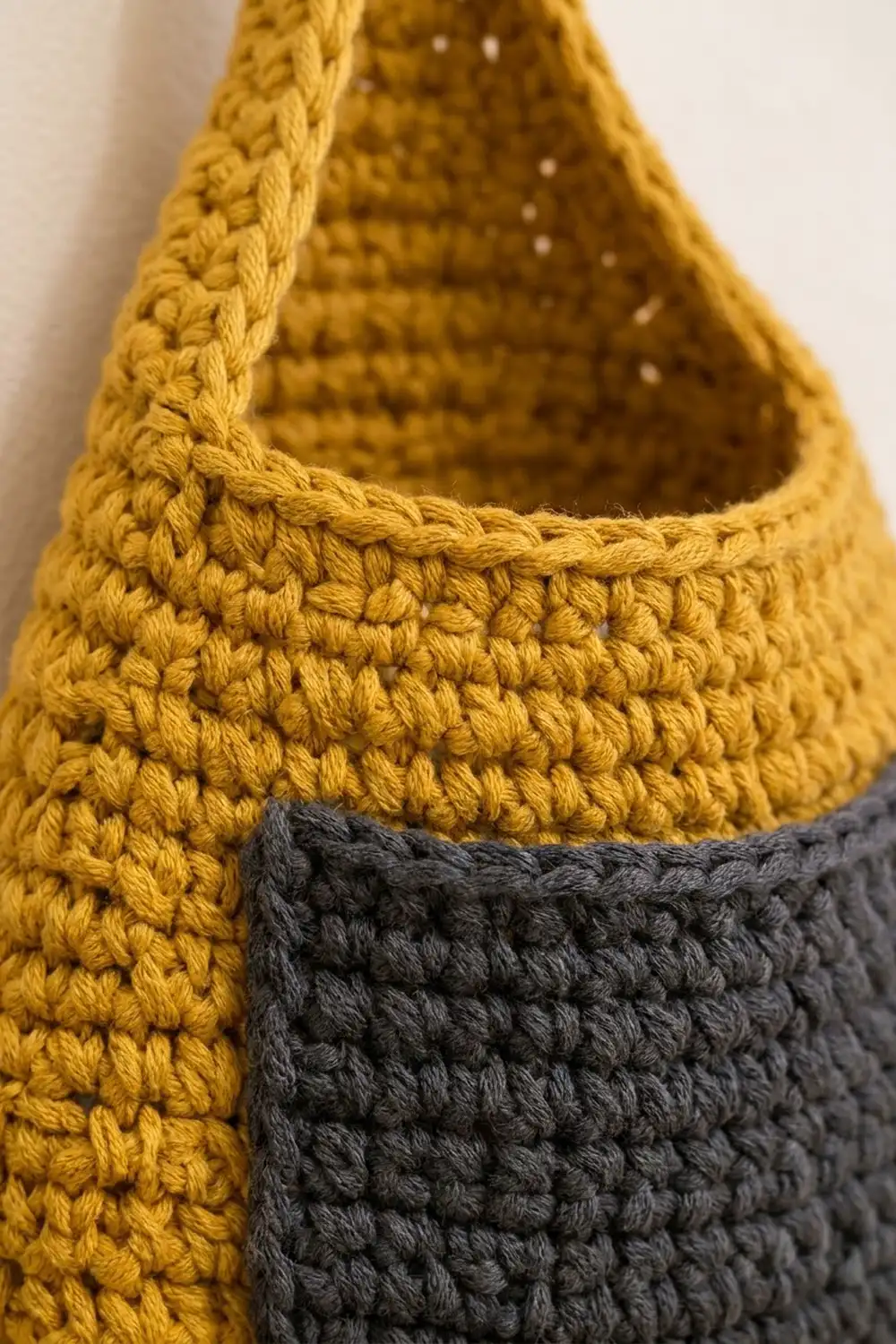
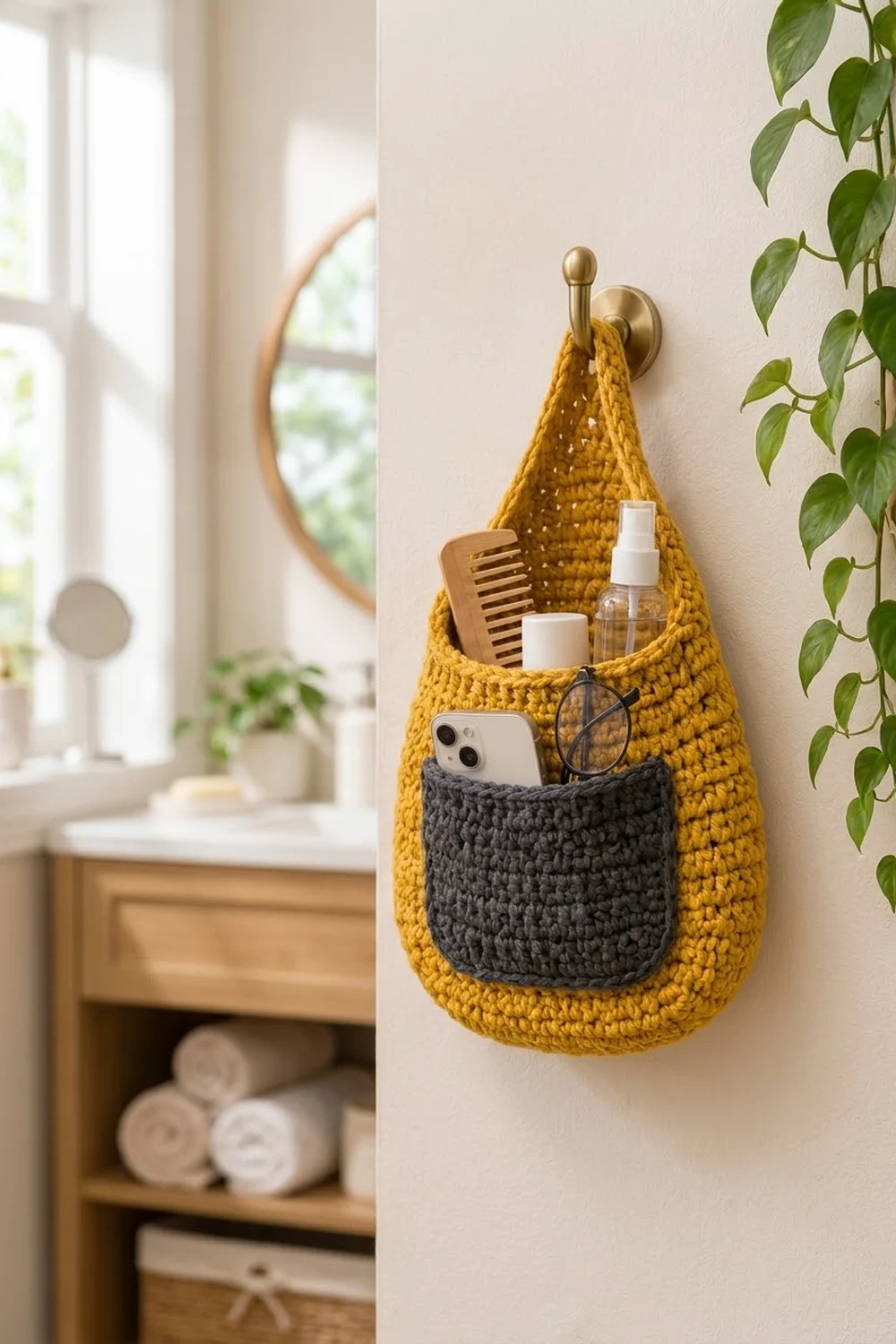
This hanging wall basket has a teardrop shape: a round, full bottom that narrows into a pointed back panel and ends in a slim strap with a hanging loop. A flat charcoal pocket is sewn to the front. Hang it from a wall hook by the bed, by the door, or in the bathroom for a phone, glasses, a comb, or small bottles.
The basket is mustard yellow and the pocket is charcoal gray. Both are worked in single crochet in bulky yarn, so the fabric is dense and firm enough to keep its shape when filled. The pattern uses US crochet terms throughout.
The finished basket measures about 8.75 in (22.2 cm) wide at its widest point and about 15.25 in (38.7 cm) tall from the bottom fold to the top of the hanging loop. The front pocket measures 5.5 in (14.0 cm) wide by 4.75 in (12.1 cm) tall.
You work the body in continuous rounds from a flat circular base up to the front rim. The back half then continues in rows, decreasing into a point and narrowing into a strap. You fold the strap into a loop, crochet the pocket separately, sew it on, and finish the opening with one row of edging.
Finished Size and Construction
- Finished size: 8.75 in (22.2 cm) wide × 15.25 in (38.7 cm) tall, including loop
- Front height (bottom fold to front rim): about 8.25 in (21.0 cm)
- Opening width (laid flat): about 6.5 in (16.5 cm)
- Skill level: Easy
- Terminology: US
- Yarn weight: Bulky (#5)
- Hook: 6.0 mm (US J-10)
- Number of pieces: 2 (basket body with built-in strap, plus 1 pocket)
- Layout: one pocket centered on the front of the basket
- Pocket size: 5.5 in (14.0 cm) × 4.75 in (12.1 cm)
- Pocket size before border: 4.75 in (12.1 cm) × 4 in (10.2 cm)
- Border depth: 1 round of sc, about 0.375 in (1.0 cm) on each edge
Materials
Use a smooth bulky yarn with good stitch definition, such as a cotton blend or a sturdy acrylic. Cotton blends hold their shape best under weight. Avoid fuzzy or very stretchy yarns, because the basket will sag when filled.
- Mustard yellow (Color A): 120 g / 140 m
- Charcoal gray (Color B): 25 g / 30 m
The quantities include a margin of about 15% for your gauge swatch and sewing tails.
Tools:
- 6.0 mm (US J-10) crochet hook
- Tapestry needle
- 4 locking stitch markers
- Rust-proof pins
- Measuring tape
- Scissors
- Blocking mat or folded towel
Abbreviations (US Terms)
- ch – chain
- sc – single crochet
- sc2tog – single crochet 2 together: (insert hook in next st, yarn over, pull up a loop) twice, yarn over, pull through all 3 loops on hook
- sl st – slip stitch
- st(s) – stitch(es)
- rnd(s) – round(s)
- MR – magic ring
- RS / WS – right side / wrong side
Special technique – spiral rounds: The body rounds are not joined. Work the first sc of each new round straight into the first st of the previous round. Move a stitch marker up each round to mark the first st.
Gauge and Checkpoints
Gauge: 11 sc × 12 rows/rnds = 4 in (10.2 cm) in sc. That works out to 2.75 sts and 3 rnds per inch.
Gauge decides both the size of the basket and how firm it is. Before you start, work a 14-st × 14-row swatch in Color A and measure the middle 4 in (10.2 cm). Then make the pocket first, since it’s the smaller piece. Check it against the pocket checkpoint below before you start the body.
Checkpoints:
- Pocket before border: 4.75 in (12.1 cm) wide × 4 in (10.2 cm) tall
- Pocket after border: 5.5 in (14.0 cm) × 4.75 in (12.1 cm)
- Body base after Rnd 8: flat circle about 5.25 in (13.3 cm) across
- Body after Rnd 20: about 6.75 in (17.1 cm) from the bottom fold, flattened width 8.75 in (22.2 cm)
- Body after Rnd 25: about 8.25 in (21.0 cm) tall, opening 6.5 in (16.5 cm) wide flat
- Back panel after Row 15: 5 in (12.7 cm) above the front rim
If your pieces are too big, go down a hook size, to 5.5 mm (US I-9). If they are too small, go up to 6.5 mm (US K-10.5). Keep your stitches firm. Loose sc makes a floppy basket that won’t hold its teardrop shape.
Basket Body
Use Color A. Work in continuous spiral rounds and move the marker up each round.
Rnd 1: Make a MR, 6 sc in ring. (6 sts)
Rnd 2: 2 sc in each st around. (12 sts)
Rnd 3: (Sc 1, 2 sc in next st) 6 times. (18 sts)
Rnd 4: (Sc 2, 2 sc in next st) 6 times. (24 sts)
Rnd 5: (Sc 3, 2 sc in next st) 6 times. (30 sts)
Rnd 6: (Sc 4, 2 sc in next st) 6 times. (36 sts)
Rnd 7: (Sc 5, 2 sc in next st) 6 times. (42 sts)
Rnd 8: (Sc 6, 2 sc in next st) 6 times. (48 sts)
Checkpoint: the base lies flat and measures about 5.25 in (13.3 cm) across. If it cups, your tension is too tight. If it ruffles, it is too loose.
Rnds 9–20: Sc in each st around. (48 sts per rnd, 12 rnds)
The sides now rise straight up from the base. Once you flatten the tube, the bottom folds into the rounded base of the teardrop. Checkpoint: about 6.75 in (17.1 cm) tall, 8.75 in (22.2 cm) wide flat.
Rnd 21: (Sc 6, sc2tog) 6 times. (42 sts)
Rnds 22–23: Sc in each st around. (42 sts)
Rnd 24: (Sc 5, sc2tog) 6 times. (36 sts)
Rnd 25: Sc in each st around. (36 sts)
These gentle decreases draw in the top of the body so it narrows like a drop. Sl st in the next st to smooth the step at the end of the spiral. Do not fasten off.
Checkpoint: the body is about 8.25 in (21.0 cm) tall and the opening is 6.5 in (16.5 cm) wide flat.
Back Panel and Strap
Flatten the body so the working loop sits at one side fold. The 18 sts on one half are the back, and the other 18 sts are the front. Put a marker in the first and last back st. Leave the front 18 sts unworked. They become the front rim.
Row 1: Ch 1, sc in each of the 18 back sts. (18 sts)
Row 2: Ch 1, turn, sc in each st across. (18 sts)
Row 3: Ch 1, turn, sc2tog, sc 14, sc2tog. (16 sts)
Row 4: Ch 1, turn, sc across. (16 sts)
Row 5: Ch 1, turn, sc2tog, sc 12, sc2tog. (14 sts)
Row 6: Ch 1, turn, sc across. (14 sts)
Row 7: Ch 1, turn, sc2tog, sc 10, sc2tog. (12 sts)
Row 8: Ch 1, turn, sc across. (12 sts)
Row 9: Ch 1, turn, sc2tog, sc 8, sc2tog. (10 sts)
Row 10: Ch 1, turn, sc across. (10 sts)
Row 11: Ch 1, turn, sc2tog, sc 6, sc2tog. (8 sts)
Row 12: Ch 1, turn, sc across. (8 sts)
Row 13: Ch 1, turn, sc2tog, sc 4, sc2tog. (6 sts)
Row 14: Ch 1, turn, sc across. (6 sts)
Row 15: Ch 1, turn, sc2tog, sc 2, sc2tog. (4 sts)
Losing one stitch at each end on every other row gives the back its smooth, tapered point. Checkpoint: the panel stands 5 in (12.7 cm) above the front rim.
Rows 16–27 (strap): Ch 1, turn, sc across. (4 sts per row, 12 rows)
The strap is 1.5 in (3.8 cm) wide and 4 in (10.2 cm) long. Fasten off and leave a 12 in (30.5 cm) tail for sewing.
Use Color B. Work in rows.
Foundation: Ch 14.
Row 1: Sc in 2nd ch from hook and in each ch across. (13 sts)
Rows 2–12: Ch 1, turn, sc across. (13 sts per row)
Checkpoint: 4.75 in (12.1 cm) wide × 4 in (10.2 cm) tall.
Edge round (conversion round): Do not turn. Ch 1, then work around all four sides:
- Down the first side: 1 sc in each of the 12 row-ends.
- Bottom: 3 sc in the first foundation ch you reach, sc in the next 11 chs, 3 sc in the last ch.
- Up the second side: 1 sc in each of the 12 row-ends.
- Top: 3 sc in the first st of Row 12, sc in the next 11 sts, 3 sc in the last st.
Count: (13 + 12 + 13 + 12 = 50 sts worked 1-per-existing-st) + (4 corners × 2 extra = 8) = 58 sts.
Treat the center sc of each 3-sc group as the corner st. Counting both corners, the top and bottom edges each have 15 sts and each side has 16 sts. Check: 15 + 16 + 15 + 16 − 4 shared corners = 58. Sl st to the first sc and fasten off. Leave a 24 in (61.0 cm) tail for sewing.
Checkpoint: 5.5 in (14.0 cm) wide × 4.75 in (12.1 cm) tall. In bulky yarn the 3-sc corners soften slightly, which gives the pocket gently rounded corners.
Joining: Attach the Pocket and Form the Loop
Pocket placement: Lay the basket flat with the front facing up. Center the pocket from side to side, with its top edge 1 in (2.5 cm) below the front rim, roughly level with Rnd 22. The bottom of the pocket will then sit near Rnd 8, where the base starts to curve. Pin all four corners and the middle of each side.
Sewing: Thread the Color B tail. Whipstitch the two sides and the bottom edge to the body, through the back loop of each edge-round st and one strand of a body st beneath it. Work one stitch per edge st: 16 down one side, 15 across the bottom and 16 up the other side, sharing the corners. Leave the 15 top sts open.
Slide a hand inside the basket while you sew so you don’t catch the back wall.
Tension: Pull each stitch snug but not tight. The pocket should lie flat, with no puckering on the body and no gap at the edge. If the body puckers, loosen the last few stitches. Add two extra stitches at both top corners, since these take the most strain.
Loop: Fold the strap toward the WS so its last row lies against the WS of Row 15. Whipstitch it in place through all 4 sts with the Color A tail. This makes a closed loop about 2 in (5.1 cm) tall.
Size checkpoint: the total height is now 15.25 in (38.7 cm).
Border: Rim Edging
The rim edging neatens the opening and the sides of the back panel, and stops those edges from stretching.
Border gauge: same as the body, 2.75 sc per inch.
Edging row: With RS facing, join Color A at the base of the strap on the left side of Row 15.
- Down the left side of the back panel: 1 sc in each row-end of Rows 15 to 1. (15 sts)
- Across the front rim: 1 sc in each of the 18 unworked front sts. (18 sts)
- Up the right side of the back panel: 1 sc in each row-end of Rows 1 to 15. (15 sts)
Total: 15 + 18 + 15 = 48 sts. Fasten off and weave in the ends.
Why the math works: The front rim uses exactly the 18 unworked sts left from Rnd 25’s 36, so no stitches are added or lost. On the sides there are 3 rows per inch but only 2.75 sts per inch, so one sc per row-end pulls the edge in slightly. That keeps the back point from flaring and makes the opening a smooth curve.
Final Blocking
- Lightly spray the whole basket with water until it is damp, not soaked.
- Stuff the body loosely with a rolled towel so it holds a rounded teardrop shape.
- Lay it face up on the blocking mat and pat the pocket flat.
- Pin the back point and strap straight, centered over the body.
- Check the measurements: 8.75 in (22.2 cm) wide and 15.25 in (38.7 cm) tall.
- Leave it to dry completely, usually 24 hours, before removing the towel.
Final Quality-Control Checklist
- Width at the widest point is 8.75 in (22.2 cm).
- Front height is about 8.25 in (21.0 cm), and total height is 15.25 in (38.7 cm).
- The pocket is 5.5 in (14.0 cm) × 4.75 in (12.1 cm), centered, with its top 1 in (2.5 cm) below the rim.
- The pocket is open across the full top edge.
- The back point is symmetrical, and the strap is centered.
- The loop is firmly sewn through all 4 strap sts.
- The rim edging has 48 sts, lies flat, and does not ripple.
- All ends are woven in at least 2 in (5.1 cm) and trimmed.
Troubleshooting
- Base cups or ruffles: Recheck that Rnd 8 has 48 sts and adjust your tension or hook.
- Basket sags when filled: Your gauge is too loose. Remake it with a smaller hook or a firmer cotton blend.
- Back point leans to one side: Make sure each decrease row has an sc2tog at both ends.
- Pocket puckers the body: You sewed too tightly. Unpick the stitches and resew with even, relaxed stitches.
- Pocket gapes at the top: Add one extra tacking stitch at each top corner.
- Rim edging flares: Use a hook one size smaller for the edging only.
- Visible jog in the spiral: The sl st at the end of Rnd 25 smooths it. Put the jog at a side fold.
Care
Hand wash in cool water with mild soap. Press out the water in a towel and dry the basket over a rolled towel to keep its shape. Don’t tumble dry.
Final Notes
All of the sizes come from the gauge: 11 sc × 12 rnds = 4 in (10.2 cm). The 13-st pocket measures 4.75 in (12.1 cm) wide and grows to 5.5 in (14.0 cm) with its 58-st edge round. The 48-st base gives a width of 8.75 in (22.2 cm), and 25 rnds give a front height of 8.25 in (21.0 cm). The 15-row back panel adds 5 in (12.7 cm) and the folded strap adds a 2 in (5.1 cm) loop, for a total of 15.25 in (38.7 cm). The 48-st rim edging uses exactly the stitches already there. If each checkpoint matches as you go, your finished basket will match too.
Happy crocheting!