

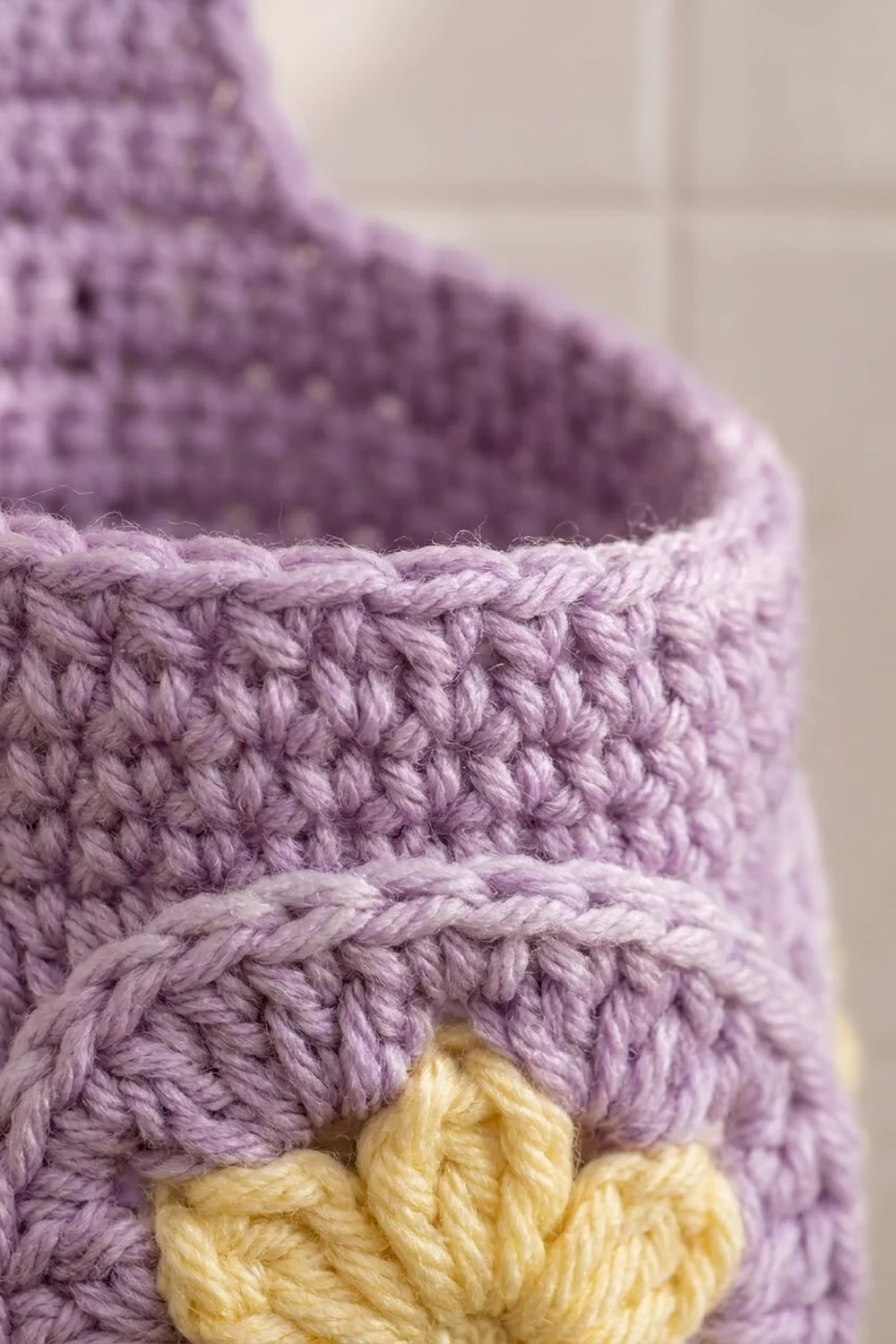
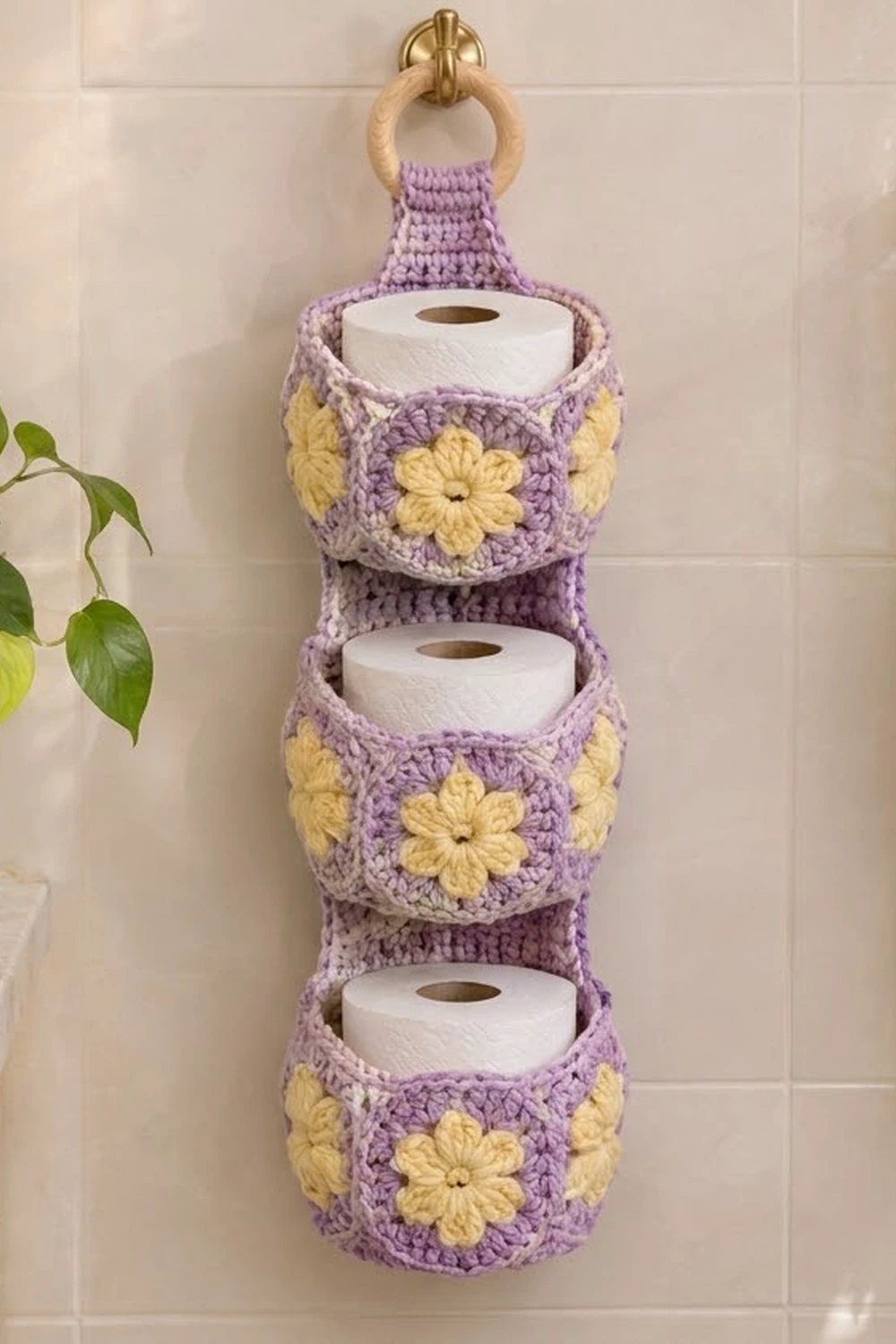
This hanging holder has three round pockets stacked on one strap and hangs from a wooden ring. Each pocket is a ring of five African flower hexagons. Every hexagon has a buttery yellow six-petal flower on a lavender background with a pale lilac outline. Solid lavender rims, round bases and a long lavender strap hold everything together.
The style is soft, cottage-bathroom pretty: pastel, textured and practical. Each pocket holds one standard roll, and the whole piece hangs from a hook or towel peg.
The pattern uses US crochet terms. Each pocket is 6.4 in (16.3 cm) across and about 6 in (15.2 cm) tall. The finished holder hangs 22.5 in (57.2 cm) long, not counting the ring.
Construction is modular. You make 15 hexagons and join them five at a time into rings. Then you level the zigzag top and bottom edges with graduated stitches, add a rim, and sew in a flat round base. Finally, you sew the three pockets to a crocheted strap and fold the strap’s narrow top tab around the wooden ring.
Finished Size and Construction
- Finished size: 22.5 in (57.2 cm) long × 6.4 in (16.3 cm) wide (pocket diameter)
- Skill level: Intermediate
- Terminology: US
- Yarn weight: Worsted (#4), cotton or cotton blend
- Hook: US G-6 (4 mm)
- Number of pieces: 15 hexagons, 3 bases, 1 strap (19 pieces)
- Layout: 3 pockets stacked vertically, 5 hexagons per pocket
- Hexagon size: 4 in (10.2 cm) flat side to flat side, 4.6 in (11.7 cm) point to point, 2.3 in (5.8 cm) per side
- Size before border (one joined ring): 20 in (50.8 cm) around × 4.6 in (11.7 cm) tall
- Border depth: top rim 0.75 in (1.9 cm) above the hexagon peaks; bottom edge 0.5 in (1.3 cm) plus a 0.25 in (0.6 cm) base seam
Materials
Choose a smooth worsted cotton. It holds its shape, shows the petal texture clearly and copes with bathroom humidity. Acrylic also works, but it is softer, so the pockets may sag a little more.
- Lavender (main color): 250 g / 475 m
- Buttery Yellow (flowers): 75 g / 143 m
- Pale Lilac (hexagon outlines and seams): 50 g / 95 m
The quantities assume about 190 m per 100 g. They include roughly a 15–20% margin for gauge differences and swatching.
Tools:
– US G-6 (4 mm) crochet hook
– 1 wooden ring, 2.5 in (6.4 cm) outer diameter
– Tapestry needle
– Stitch markers
– Scissors
– Measuring tape
– Spray bottle and pins for blocking
Abbreviations (US Terms)
- ch – chain
- sl st – slip stitch
- sc – single crochet
- hdc – half double crochet
- dc – double crochet
- tr – treble crochet
- sc2tog – single crochet 2 together
- tr2tog – treble crochet 2 together
- sp – space
- st(s) – stitch(es)
- rep – repeat
- RS / WS – right side / wrong side
Special stitch: Long sc (spike sc). Insert the hook into the gap between two shells of Round 2 (the space between the petals, two rounds down). Yarn over and pull up a loop to the height of the current round. Yarn over and pull through both loops. This anchors the lavender between the petals and makes them puff.
Gauge and Checkpoints
Gauge: 19 sc and 16 rows = 4 in (10.2 cm) in sc rows. That works out to about 4.8 sc and 4 rows per inch.
Make one hexagon before anything else and check it at each stage:
- After Round 3 (flower): about 2.5 in (6.4 cm) across
- After Round 5: about 3.6 in (9.1 cm) flat side to flat side
- After Round 6: 4 in (10.2 cm) flat side to flat side, with 11 sts per side
If the hexagon is more than 4.25 in (10.8 cm) across, go down to a 3.75 mm hook. If it is under 3.75 in (9.5 cm), go up to a 4.5 mm hook. A 0.25 in (0.6 cm) error per hexagon adds up to 1.25 in (3.2 cm) around each pocket, so the base will no longer fit.
Hexagon (Make 15)
Round 1 (Yellow): Make a magic ring. Ch 3 (counts as dc), dc in ring, ch 1, 2 dc in ring, ch 1; rep from * 4 more times. Sl st to top of ch-3. (12 dc, 6 ch-1 sps)*
Round 2 (Yellow): Sl st in next dc and into ch-1 sp. Ch 3, (dc, ch 1, 2 dc) in same sp, then (2 dc, ch 1, 2 dc) in each remaining ch-1 sp. Sl st to top of ch-3. (24 dc in 6 shells, 6 ch-1 sps)
Round 3 (Yellow): Sl st in next dc and into ch-1 sp. Ch 3, 6 dc in same sp, then 7 dc in each remaining ch-1 sp. Sl st to top of ch-3 and fasten off. (42 dc: 6 petals of 7 dc)
Round 4 (Lavender): Join with sc in the first dc of any petal. Sc in next 6 dc, then long sc between the shells of Round 2 below. Sc in next 7 dc, long sc; rep from * 4 more times. Sl st to first sc. (48 sts: 42 sc + 6 long sc)*
Round 5 (Lavender): Ch 3 (counts as dc), dc in next 6 sc, (dc, ch 2, dc) in long sc. Dc in next 7 sc, (dc, ch 2, dc) in long sc; rep from * 4 more times. Sl st to top of ch-3 and fasten off. (54 dc, 6 ch-2 corner sps; 9 dc per side)*
Round 6 (Pale Lilac): Join in any ch-2 corner sp. Ch 1, (sc, ch 2, sc) in same sp. Sc in next 9 dc, (sc, ch 2, sc) in next ch-2 sp; rep from * 4 more times. Sc in next 9 dc and sl st to first sc. Fasten off. (66 sc, 6 ch-2 corner sps)*
Each side has 11 sc: 1 corner sc + 9 sc + 1 corner sc. Those two corner sc are already counted in the 11. Weave in all ends now.
Make All Pieces
| Piece | Qty | Colors |
|---|---|---|
| Hexagon | 15 | Yellow (Rnds 1–3), Lavender (Rnds 4–5), Pale Lilac (Rnd 6) |
| Base | 3 | Lavender |
| Strap | 1 | Lavender |
Lightly spray-block every hexagon to 4 in (10.2 cm) flat side to flat side before joining.
Layout of one pocket (seen from the front, opened out flat):
  /\    /\    /\    /\    /\
 |H1|  |H2|  |H3|  |H4|  |H5|  <- H5 joins back to H1
  \/    \/    \/    \/    \/
Layout of the holder (top to bottom):
     [ring]
     |    |    tab, rows 85-96
    /      \   taper, rows 81-84
   |  clear |  rows 79-80
   |POCKET 3|  rows 55-78
   |   gap  |  rows 52-54
   |POCKET 2|  rows 28-51
   |   gap  |  rows 25-27
   |POCKET 1|  rows 1-24
Joining the Hexagons
Each hexagon stands on a point, so its two vertical sides are opposite each other. Join on those opposite sides only. That leaves two free sides sloping up to the top point and two sloping down to the bottom point.
Method: Hold two hexagons WS together with the edges aligned. Using Pale Lilac and working through the inner loop of each layer, sl st 1 into the corner ch-2 sp, 1 into each of the 11 sc, and 1 into the next corner ch-2 sp. (13 sl sts per seam)
Join H1 to H2, H2 to H3, H3 to H4 and H4 to H5. Then join H5 to H1 to close the ring. (5 seams per pocket)
Tension: Keep the sl sts as loose as the sc. If the seam is tight, the ring will pucker and come up short. Go up a hook size for the seams if you need to.
Checkpoint: Flattened, the ring should measure 10 in (25.4 cm) across, which means 20 in (50.8 cm) around, and 4.6 in (11.7 cm) tall from point to point.
Border: Leveling, Rim and Base
Border gauge: The rim works at the same 4.8 sc per inch as the hexagon edges.
Top Rim (Lavender)
Round 1 (leveling): Join Lavender at the top of any seam, through both corner ch-2 sps held together (this is the valley). Ch 4 (counts as tr). Then for each hexagon:
- Rising side: tr in next 2 sc, dc in next 3 sc, hdc in next 3 sc, sc in next 3 sc (11 sts)
- Peak: sc in the peak ch-2 sp (1 st)
- Falling side: sc in next 3 sc, hdc in next 3 sc, dc in next 3 sc, tr in next 2 sc (11 sts)
- Valley: tr2tog, with one leg in each corner ch-2 sp at the seam (1 st)
On the last hexagon, skip the final tr2tog. The beginning ch-4 stands in for it. Sl st to top of ch-4. (24 sts per hexagon; 120 sts total)
The tall sts at the valleys and short sts at the peaks fill in the zigzag, so the top becomes a straight line.
Round 2 (decrease): Ch 1. Sc in next 3 sts, sc2tog; rep from * around. Sl st to first sc. (24 repeats of 5 sts worked into 4 sc = 96 sc)*
Round 3: Ch 1, sc in each st around, sl st to first sc. Fasten off. (96 sc)
Bottom Edge (Lavender)
Turn the ring over. Work Rounds 1 and 2 exactly as for the top rim, starting at the bottom of any seam. (120 sts, then 96 sc) Fasten off.
Why the Math Works
Each hexagon top has 2 sloping sides of 11 sc. Each of those sts is worked once, plus 1 st at the peak and 1 at the valley: 11 + 11 + 1 + 1 = 24. Five hexagons × 24 = 120.
Those 120 sts sit across only 20 in (50.8 cm), because the sloping edges are 4.6 in (11.7 cm) long but span just 4 in (10.2 cm) horizontally. Round 2 brings the count back to gauge: 96 sc ÷ 4.8 sc per inch = 20 in (50.8 cm). That matches the ring exactly.
The 96 is spread evenly as 24 five-stitch repeats. The repeats do not line up with the hexagon sections (96 ÷ 5 = 19.2 per hexagon), which is fine. What matters is the total, because 96 is exactly the base’s final count.
Base (Make 3, Lavender)
Round 1: Magic ring, ch 3 (counts as dc), 11 dc in ring. Sl st to join. (12 dc)
Round 2: Ch 3, dc in same st, 2 dc in each st around. Join. (24 dc)
Round 3: Ch 3, 2 dc in next st, dc in next st, 2 dc in next st; rep from * around. Join. (36 dc)*
Round 4: Dc in next 2 sts, 2 dc in next st; rep around. (48 dc) Checkpoint:* 3.2 in (8.1 cm) across.
Round 5: Dc in next 3, 2 dc in next; rep around. (60 dc)*
Round 6: Dc in next 4, 2 dc in next; rep around. (72 dc)*
Round 7: Dc in next 5, 2 dc in next; rep around. (84 dc)*
Round 8: Dc in next 6, 2 dc in next; rep around. (96 dc)* Fasten off, leaving a long tail.
Checkpoint: 6.4 in (16.3 cm) across. Shift the increases by a st or two each round so the circle stays round rather than turning hexagonal.
Attaching the base: Hold the base and the bottom edge WS together, with the base on the outside. Using Lavender, sc through both layers, 1 st to 1 st, all around. (96 sc) This makes a neat ridge around the bottom of the pocket.
The finished pocket should measure 6.4 in (16.3 cm) across and about 6 in (15.2 cm) tall.
Strap (Lavender)
Foundation: Ch 13.
Row 1: Sc in 2nd ch from hook and in each ch across. (12 sc)
Rows 2–80: Ch 1, turn, sc in each st. (12 sc) Checkpoint: 20 in (50.8 cm) long × 2.5 in (6.4 cm) wide.
Row 81: Ch 1, turn, sc2tog, sc in next 8, sc2tog. (10 sc)
Row 82: Ch 1, turn, sc in each st. (10 sc)
Row 83: Ch 1, turn, sc2tog, sc in next 6, sc2tog. (8 sc)
Row 84: Ch 1, turn, sc in each st. (8 sc)
Rows 85–96 (tab): Ch 1, turn, sc in each st. (8 sc, 1.7 in / 4.3 cm wide) Fasten off, leaving a 16 in (40.6 cm) tail.
Assembly: Pass the tab through the ring and fold it back on itself so Row 96 meets Row 85 on the back. Whipstitch it down to make a 1.5 in (3.8 cm) loop.
Place the pockets using the layout above, with each pocket’s back hexagon centered on the strap. Whipstitch the base seam, the top rim, and both strap edges where they meet the back hexagon. That gives 1 pocket per 24 rows, with 0.75 in (1.9 cm) gaps between pockets.
Final Blocking
- Fit a roll, or a rolled towel, into each pocket to give it a firm, round shape.
- Mist the whole holder until it is damp, but not soaked.
- Lay it flat and pat the strap to 2.5 in (6.4 cm) wide and 20 in (50.8 cm) long up to the taper.
- Push the petals up gently with your fingers so they stand proud.
- Leave it to dry completely before you take out the rolls and hang it.
Final Quality-Control Checklist
- 15 hexagons, each 4 in (10.2 cm) across with 11 sc per side
- 5 seams per ring, each 13 sl sts, with no puckering
- Top rim and bottom edge each 96 sc, sitting level
- Bases 96 dc, flat and 6.4 in (16.3 cm) across
- Strap 2.5 in (6.4 cm) wide, with the tab securely sewn around the ring
- Pockets evenly spaced, with 0.75 in (1.9 cm) gaps
- All ends woven in on the WS
Troubleshooting
- Petals lie flat: Make sure the long sc goes into Round 2, not Round 3.
- Hexagon cups: Your Round 5 tension is too tight. Go up a hook size for that round.
- Rim still wavy: Check you have 120 sts in Round 1 and 96 in Round 2.
- Base too small or too big: Recount Round 8. If it is 96 and still doesn’t fit, change the base hook by 0.25 mm.
- Pockets tilt forward: Add a second line of whipstitching across the back rim.
Care
Hand wash in cool water, reshape the pockets around a roll and dry flat. Don’t tumble dry, because the cotton will shrink and distort the hexagons.
Final Notes
The measurement chain is simple. Each hexagon is 4 in (10.2 cm) with 11 sc per side. Five hexagons make a 20 in (50.8 cm) ring. Leveling gives 120 sts, which decrease to 96 sc. That matches a 96-dc base 6.4 in (16.3 cm) across. Three pockets on a 2.5 in (6.4 cm) strap finish at 22.5 in (57.2 cm) long.
Check each link in that chain as you go, and the pieces will fit together.
Happy crocheting!