

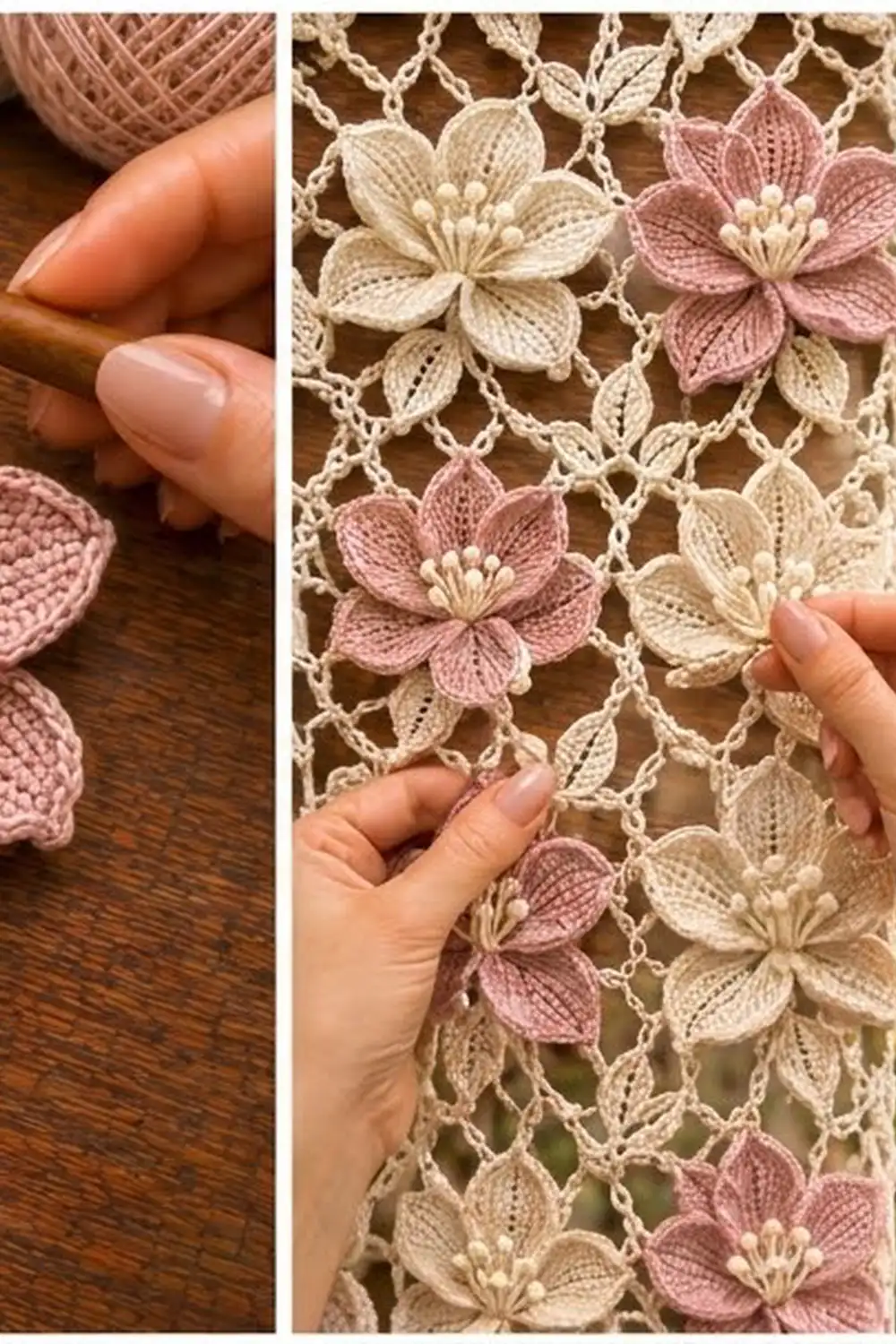
This curtain panel is a cream diamond mesh scattered with three-dimensional five-petal flowers. Half the flowers are dusty pink and half are cream, set in a checkerboard. Each one has a cluster of beaded cream stamens and a small stem with two leaves.
The style is romantic and airy, like vintage Irish-style lace. Light comes through the open mesh, and the textured petals add depth. The pattern uses US crochet terms.
One finished panel measures 41 in × 81 in (104.1 cm × 205.7 cm) after blocking, including the border. The photo shows a pair of panels, so make two to match it.
You crochet the mesh in one piece, in rows, from the bottom up. Then you make 50 flower motifs, sew them on, add a three-round border, and block the panel.
Finished Size and Construction
- Finished panel: 41 in × 81 in (104.1 cm × 205.7 cm)
- Skill level: Intermediate
- Terminology: US terms
- Yarn weight: Super fine (#1) mercerized cotton
- Hook: 2.5 mm
- Number of pieces: 51 per panel (1 mesh + 50 flowers)
- Layout: 5 flowers across × 10 down, pink and cream alternating
- Flower size: 4 in (10.2 cm) across; about 6 in (15.2 cm) tall with the leaf sprig
- Mesh before border: 40 in × 80 in (101.6 cm × 203.2 cm)
- Border depth: 0.5 in (1.3 cm) per side
Materials
Use a smooth mercerized cotton. It shows stitches crisply, stands up to sunlight, and blocks flat. The amounts below assume about 170 m (186 yd) per 50 g.
- Cream (A): 450 g, about 1,530 m (1,673 yd). This covers the mesh, the border, 25 flowers, and all the stamens and sprigs.
- Dusty pink (B): 100 g, about 340 m (372 yd). This covers 25 flowers.
Double these amounts for a pair of panels. All quantities include a margin of about 15%.
Tools: You’ll need:
– A 2.5 mm hook
– A 3.0 mm hook (optional, for the foundation)
– A tapestry needle and stitch markers
– Rustproof pins and blocking mats
– A measuring tape
– A spray bottle and optional starch
Abbreviations (US Terms)
- ch – chain
- sl st – slip stitch
- sc – single crochet
- hdc – half double crochet
- dc – double crochet
- tr – treble crochet
- BLO – back loop only
- sk – skip
- st(s) – stitch(es)
- rev sc – reverse single crochet (crab stitch)
Stamen: Ch 6. In the 3rd ch from the hook, work a 3-dc bobble: (yarn over, insert hook, pull up a loop, yarn over, pull through 2 loops) 3 times, then yarn over and pull through all 4 loops. Sl st in each of the remaining 3 ch back to the base.
Leaf: Ch 10. Starting in the 2nd ch from the hook, work sc, hdc, dc, dc, tr, tr, dc, hdc, then (sc, ch 2, sc) in the last ch. Work back along the other side of the chain: hdc, dc, tr, tr, dc, dc, hdc, sc. Sl st in the base. (18 sts + ch-2 tip)
Gauge and Checkpoints
Before you start the panel, test one flower and a mesh swatch.
Mesh gauge: 4 ch-7 loops = 4 in (10.2 cm) wide, and 8 rows = 4 in (10.2 cm) tall, measured lightly stretched. To swatch, ch 26 and work 9 rows of the mesh pattern. It should block to about 4 in × 4 in (10.2 cm × 10.2 cm).
Flower checkpoints:
– Round 1: 0.6 in (1.5 cm) across
– Round 3: 3.5 in (8.9 cm) across
– Round 4: 4 in (10.2 cm) across
– Each leaf: 1.25 in (3.2 cm) long
Too big? Go down 0.25 mm in hook size. Too small? Go up 0.25 mm. The mesh gauge matters most. Being off by 0.1 in (0.3 cm) per loop changes the panel width by 4 in (10.2 cm).
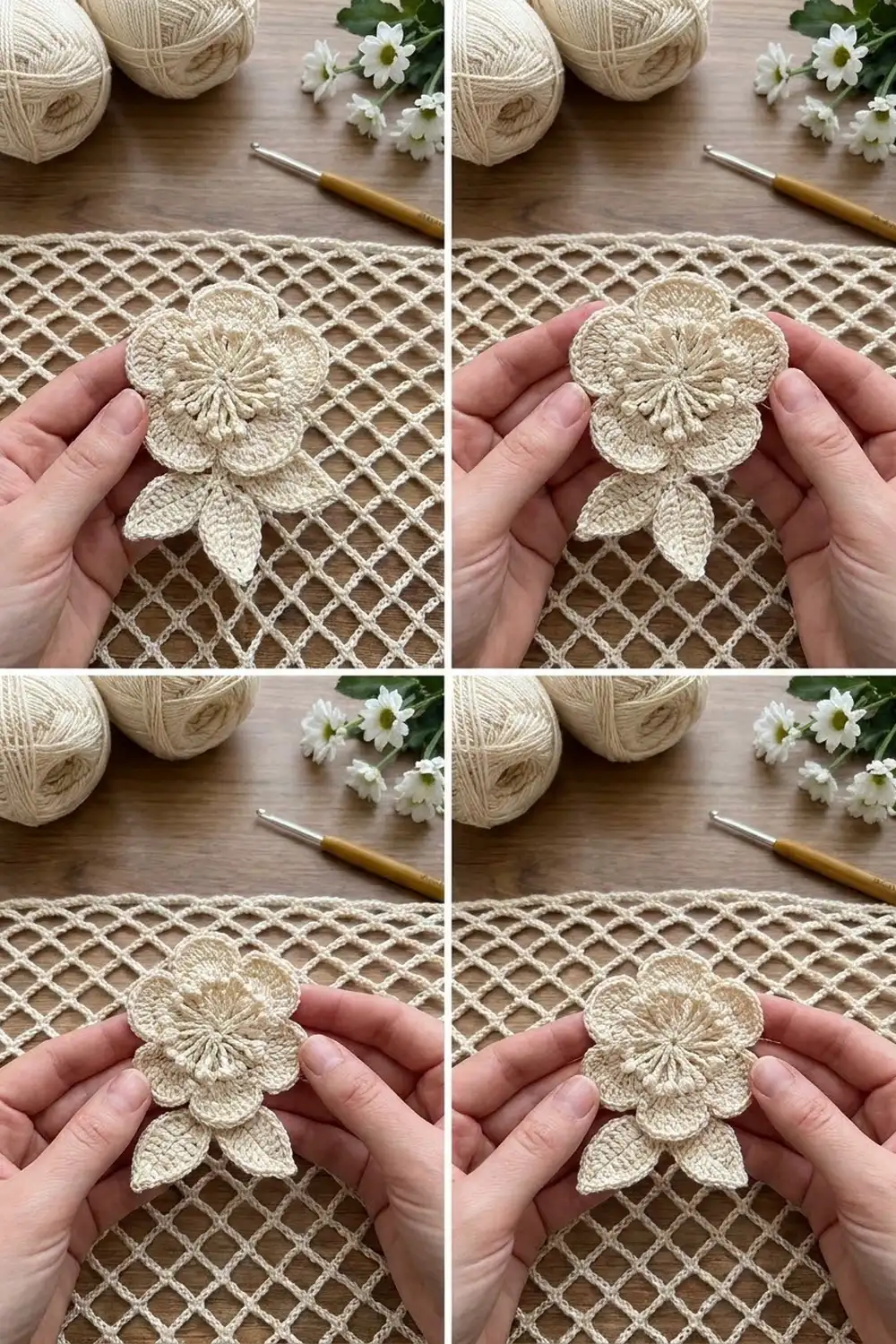
Flower Motif
Make 25 flowers in pink and 25 in cream. Rounds 1–4 use the flower color. The stamens and sprig are always cream.
Round 1: Magic ring, ch 1, 15 sc in the ring. Join with a sl st to the first sc. (15 sc)
Round 2: Ch 1. Sc in BLO of the next st, ch 9, sk 2 sts. Repeat from * 4 more times. Join to the first sc. (5 sc, 5 ch-9 loops) The front loops of Round 1 stay free for the stamens.
Round 3 (petals): Sl st into the first loop. In each loop, work (sc, hdc, 3 dc, 2 tr, ch 3, 2 tr, 3 dc, hdc, sc), then sl st in the next Round 2 sc. (70 sts: 14 per petal, plus 5 ch-3 tips) The tr stitches make the widest part of each petal, and the ch-3 forms the point.
Round 4 (ridged outline): For each petal: sc in BLO of the next 7 sts, (sc, ch 2, sc) in the ch-3 tip, sc in BLO of the next 7 sts, then sl st in the sl st between petals. (80 sc: 16 per petal, plus 5 ch-2 tips) The unused front loops make a raised ridge around each petal. Fasten off.
Stamens: With cream, join with a sl st in any free front loop of Round 1. Work a Stamen, sk the next front loop, sl st in the next. Repeat from * 6 more times (14 of the 15 loops used), then sl st in the last loop. (7 stamens) Fasten off and push the stamens upright.
Leaf sprig: With cream, join with a sl st in the sl st between any two petals. This point becomes the bottom of the flower. Ch 8 for the stem. Work 2 Leaves from the same base, angled to opposite sides. Sl st back up the 8 stem chains. (2 leaves, 18 sts each) Fasten off, leaving a 12 in (30.5 cm) tail for sewing.
Mesh Panel
Work the mesh in cream with the 2.5 mm hook. If your foundation chain runs tight, use the 3.0 mm hook for the foundation only.
Foundation: Ch 242 (6 × 40 + 2).
Row 1: Sc in the 2nd ch from the hook. Ch 7, sk 5 ch, sc in the next ch. Repeat from * to the end. (41 sc, 40 ch-7 loops)
Row 2: Ch 4 (counts as tr), turn, ch 3. Sc in the center (4th) ch of the first loop. Ch 7, sc in the center ch of the next loop. Repeat from * 38 more times. Ch 3, tr in the last sc. (40 sc, 39 ch-7 loops, 2 ch-3 half loops, 2 edge posts)
Row 3: Ch 1, turn, sc in the first tr. Ch 7, sc in the center ch of the next ch-7 loop. Repeat from * 38 more times. Ch 7, then sc in the top of the turning ch-4. (41 sc, 40 ch-7 loops)
Rows 4–161: Repeat Rows 2–3 another 79 times, so you end on a Row 3. (161 rows)
Checkpoints: At Row 21, the mesh should measure 40 in (101.6 cm) wide and about 10 in (25.4 cm) tall. At Row 161, it should be 40 in × 80 in (101.6 cm × 203.2 cm). Fasten off.
Make All Pieces
- Mesh: 1, cream
- Pink flowers: 25, with cream stamens and sprigs
- Cream flowers: 25, with cream stamens and sprigs
Layout grid (P = pink, C = cream; Row 1 is the top):
Row 1:  P  C  P  C  P
Row 2:  C  P  C  P  C
Row 3:  P  C  P  C  P
Row 4:  C  P  C  P  C
Row 5:  P  C  P  C  P
Row 6:  C  P  C  P  C
Row 7:  P  C  P  C  P
Row 8:  C  P  C  P  C
Row 9:  P  C  P  C  P
Row 10: C  P  C  P  C
Space the flower centers 8 in (20.3 cm) apart. Across the panel, the centers sit 4, 12, 20, 28, and 36 in (10.2, 30.5, 50.8, 71.1, and 91.4 cm) from the left edge. Down the panel, they start 4 in (10.2 cm) from the top and end at 76 in (193.0 cm). Each 8 in (20.3 cm) step equals 8 loops across or 16 rows down.
Joining
Sew each flower onto the mesh as an appliqué, using the sprig’s tail.
- Mark each flower position on the nearest mesh sc point.
- Center a flower on its marker with the sprig pointing down. Tack the back of Round 1 to the sc point with 2 small stitches.
- Tack each petal tip (the ch-2 spaces) to the nearest mesh strand.
- Tack each leaf tip, then run the tail through the stem to the flower base and fasten off. That makes 8 tack points per flower.
For each tack, catch one mesh strand and one flower stitch. Keep the tension relaxed. If the diamonds around a flower pull out of shape, that tack is too tight.
Size checkpoint: After each row of 5 flowers, measure the panel. It should still be 40 in (101.6 cm) wide and lie flat without puckering.
Border
The border goes around the mesh edge only, so no stitches are added at flower positions. The corner groups are counted separately from the per-side counts.
Border gauge: 7 sc = 1 in (2.5 cm).
Round 1: With cream, join in the top-right corner sc of Row 161 and work 3 sc there.
- Top edge: 7 sc in each of the 40 loops, skipping the sc points. (280 sc) Then 3 sc in the corner sc.
- Left side: 4 sc around each of the 80 even-row edge posts, plus 3 sc in each edge sc of odd Rows 159 down to 3 (79 rows). (320 + 237 = 557 sc) Then 3 sc in the corner foundation ch.
- Bottom edge: Work into the free loops of the foundation chain. In each of the 40 sections of 5 skipped ch, work sc, 2 sc, sc, 2 sc, sc. Skip the free loops under the interior Row 1 sc. (40 × 7 = 280 sc) Then 3 sc in the corner.
- Right side: Work as for the left side. (557 sc)
Join to the first sc. (Total: 280 + 557 + 280 + 557 + 12 corner sc = 1,686 sc)
Round 2: Ch 1. Sc in each st, with 3 sc in the center sc of each corner. Join. (1,686 worked 1-per-stitch + 8 extra corner sc = 1,694 sc. Between corner centers, that’s 282 on the top and bottom and 559 on each side.)
Round 3: Ch 1. Rev sc in each st around. Join and fasten off. (1,694 rev sc)
Why the math works:
– Top and bottom: Each 1 in (2.5 cm) loop gets 7 sc, which matches the border gauge, so 280 sc span exactly 40 in (101.6 cm).
– Sides: Each pair of rows is 1 in (2.5 cm) tall and gets 4 + 3 = 7 sc. So 557 sc cover 79.6 in (202.2 cm), and the corner groups make up the rest of the 80 in (203.2 cm).
– Final size: Three rounds add 0.5 in (1.3 cm) per side, for a finished panel of 41 in × 81 in (104.1 cm × 205.7 cm).
Final Blocking
- Soak the panel in cool water for 15 minutes, then gently press out the water.
- Roll it in towels to remove the excess.
- Pin the corners to a 41 in × 81 in (104.1 cm × 205.7 cm) rectangle.
- Pin along every edge at 4 in (10.2 cm) intervals.
- Open each mesh diamond evenly.
- Shape the petal points, lift the stamens, and flatten the leaves.
- If you like, mist the flowers with starch.
- Let it dry completely (24–48 hours) before unpinning.
Final Quality-Control Checklist
- [ ] The panel measures 41 in × 81 in (104.1 cm × 205.7 cm).
- [ ] Every full mesh row has 40 loops, and there are 161 rows.
- [ ] Each flower has 5 petals, 7 stamens, and 2 leaves.
- [ ] The colors match the layout grid.
- [ ] Each flower has 8 tacks and no puckering.
- [ ] Border Round 1 has 280 / 557 / 280 / 557 sc between the corners.
- [ ] All tails are woven in at least 2 in (5.1 cm).
Troubleshooting
- The bottom edge is narrow: The foundation chain is too tight. Redo it with the 3.0 mm hook.
- The petals cup: Loosen your tr stitches, or block the petals flatter with starch.
- The stamens droop: Close each bobble firmly and keep the sl sts snug.
- The mesh puckers around a flower: Snip the tight tacks and re-tack them more loosely.
- The side border ripples: Count exactly 4 sc per post and 3 sc per odd-row sc.
- The panel is too short: Re-block it while damp, pinning the length slightly longer.
Care
Hand wash in cool water with mild detergent, and dry flat or rehang while slightly damp. Keep the panel out of harsh direct sun for long periods to protect the pink.
Final Notes
Here’s how the measurements build on each other. Each ch-7 loop is 1 in (2.5 cm) wide, and two rows are 1 in (2.5 cm) tall, so 40 loops and 161 rows make a 40 in × 80 in (101.6 cm × 203.2 cm) mesh. The 4 in (10.2 cm) flowers sit on an 8 in (20.3 cm) grid, 5 across and 10 down. The border adds 0.5 in (1.3 cm) per side, for a finished panel of 41 in × 81 in (104.1 cm × 205.7 cm). If you check your gauge early and measure at each checkpoint, the curtain will hang straight.
Happy crocheting!