
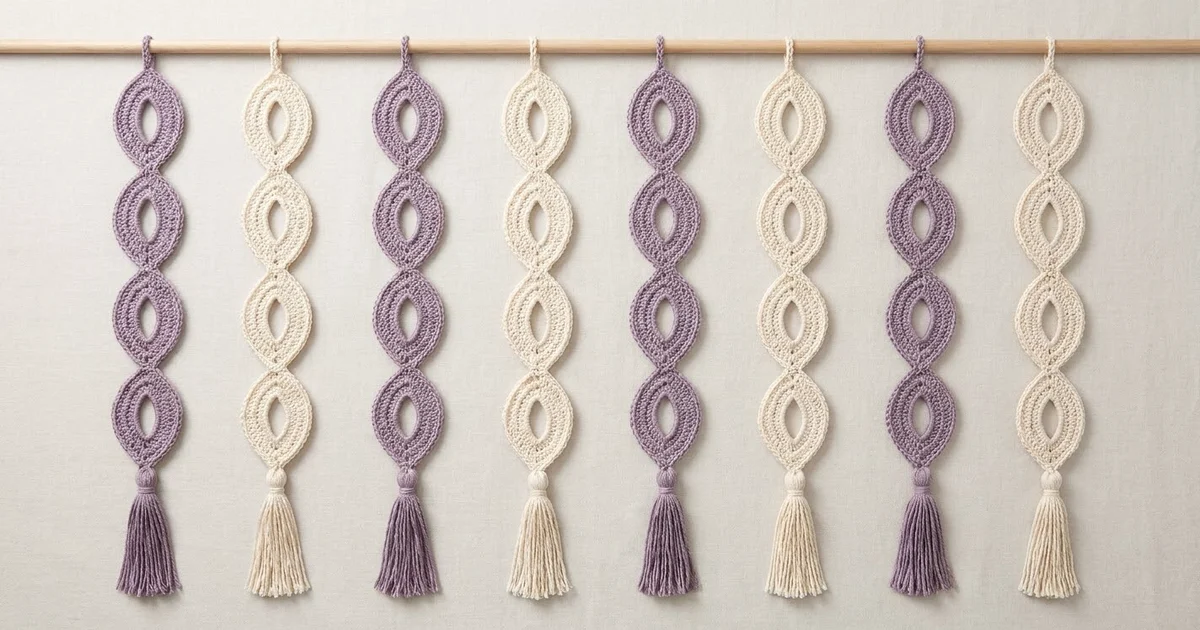
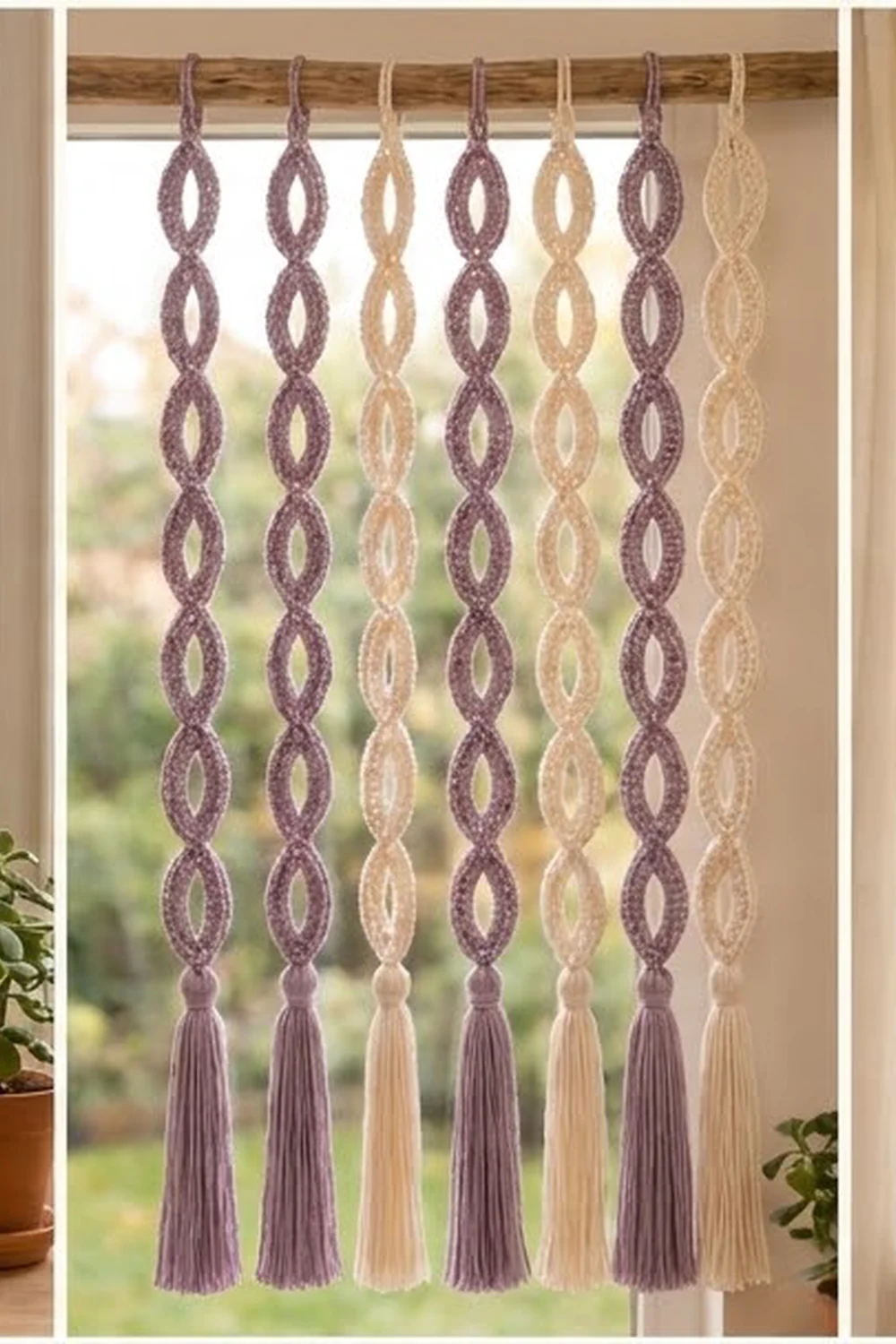
This strand curtain uses pointed almond-shaped links with open centers. The links are joined tip to tip into long vertical strands, and each strand ends in a full tassel. Light passes through every opening, so it works well in a window, doorway, or reading nook.
The sample uses two soft colors: dusty lavender and warm cream. The strands alternate colors, giving a calm, striped boho look. Worsted-weight cotton gives each link a firm, rope-like texture that holds its shape when it hangs.
This pattern uses US crochet terms. The finished curtain has 8 strands. Each strand measures 43.5 in (110.5 cm) from the top of the hanging loop to the bottom link, plus a 6 in (15.2 cm) tassel, for a total drop of 49.5 in (125.7 cm). With strands spaced 3 in (7.6 cm) apart, the curtain is 23.5 in (59.7 cm) wide.
Each link is worked in the round around an elongated chain ring. Round 1 is single crochet. Round 2 is double crochet, with sharp increases at both points. Round 3 is the single crochet edge, and it is also the round where you join each link to the one above it. You’ll tie the tassels last.
Finished Size and Construction
- Finished size: 23.5 in (59.7 cm) wide × 49.5 in (125.7 cm) long, including tassels
- Skill level: Easy / advanced beginner
- Terminology: US crochet terms
- Yarn weight: Worsted (#4) cotton
- Hook: 5.0 mm (H-8)
- Number of pieces: 64 links (8 strands × 8 links) plus 8 tassels
- Layout: 8 vertical strands, alternating lavender and cream
- Link size: 5 in (12.7 cm) tall × 2.5 in (6.4 cm) wide
- Link size before border (after Round 2): 4.5 in (11.4 cm) × 2 in (5.1 cm)
- Border depth: 0.25 in (0.6 cm) on every edge
Materials
Yarn: Use a smooth worsted-weight cotton or cotton blend with about 170 m (186 yd) per 100 g. Cotton keeps the points crisp and doesn’t stretch much under the weight of the tassels. Avoid fuzzy or very stretchy acrylic, because the strands will lengthen as they hang.
- Lavender: 165 g / 280 m (306 yd): 32 links, 4 hanging loops, 4 tassels
- Cream: 165 g / 280 m (306 yd): 32 links, 4 hanging loops, 4 tassels
These quantities include a margin of about 12%. Each link uses roughly 6 m (6.6 yd), including tails. Each tassel uses about 14 m (15.3 yd).
Tools:
- 5.0 mm (H-8) crochet hook
- Tapestry needle
- Scissors
- Stiff card 6.5 in (16.5 cm) tall, for wrapping tassels
- Stitch markers
- Rust-proof pins and a blocking mat
- Wooden curtain rod up to 1 in (2.5 cm) in diameter
Abbreviations (US Terms)
- ch – chain
- sl st – slip stitch
- sc – single crochet
- dc – double crochet
- st(s) – stitch(es)
- sp – space
- rnd – round
Special stitch – Point group: (2 dc, ch 2, 2 dc) in the same stitch. This group forms the sharp top and bottom tips of the almond.
Gauge and Checkpoints
Gauge: 14 sc = 4 in (10.2 cm) worked in rows with the 5.0 mm hook. That works out to 3.5 sc per inch (1.4 sc per cm).
Make one complete link before you start the full set. Gauge matters a lot here: a small error in each link adds up over 8 links and 7 joins per strand.
Checkpoints for one link (measured flat, without stretching):
- After Round 1: 3.5 in (8.9 cm) tall × 1.25 in (3.2 cm) wide. The opening is 2.75 in (7.0 cm) long × 0.75 in (1.9 cm) wide.
- After Round 2: 4.5 in (11.4 cm) × 2 in (5.1 cm).
- After Round 3: 5 in (12.7 cm) × 2.5 in (6.4 cm).
If your link is too big, go down to a 4.5 mm (US 7) hook. If it’s too small, go up to a 5.5 mm (I-9) hook. Don’t change the stitch counts. The point groups and side counts set the almond shape, and the hook size sets the scale.
Link Pattern (Make 64)
Each link is worked separately. Every round begins and ends at the top point.
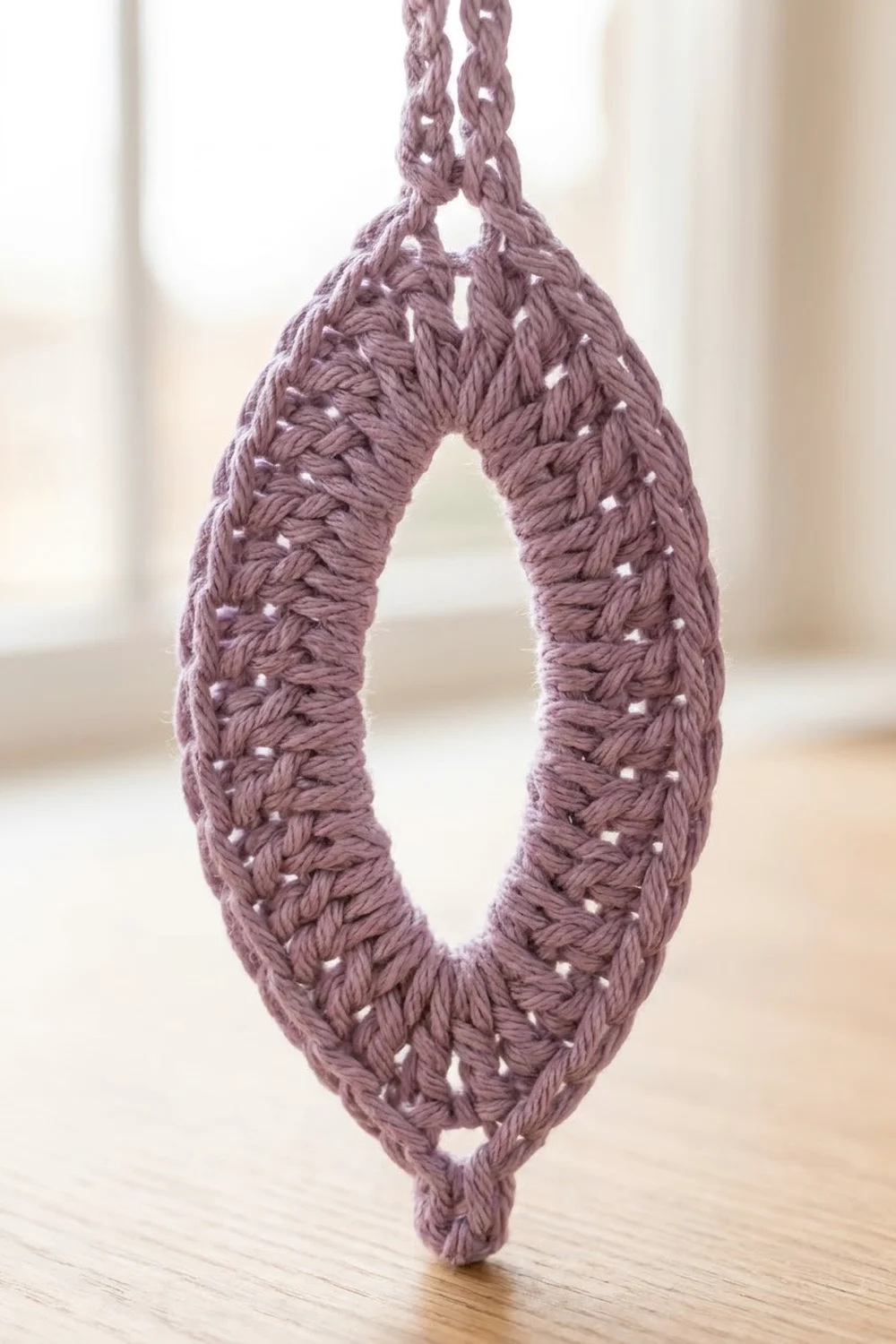
Foundation: Ch 22, then sl st in the first ch to form a ring, taking care not to twist it. The ch with the join is ch 1, and it becomes the top point. Ch 12 sits directly opposite and becomes the bottom point. That leaves 10 ch on each side.
Round 1: Ch 1 (doesn’t count as a stitch). Work 3 sc in ch 1 (the joining ch), sc in the next 10 ch, 3 sc in ch 12, sc in the next 10 ch. Join with a sl st to the first sc. (26 sc)
Work into the chains themselves, not into the center of the ring, so the opening stays narrow and almond-shaped. The center sc of each 3-sc group is the point stitch. Between the two point stitches there are 12 sc on each side: the last sc of one group, 10 side sc, and the first sc of the next group.
Round 2 (growth round): Sl st in the next sc, which is the top point stitch. Ch 3 (counts as dc), then work (dc, ch 2, 2 dc) in the same st to complete the top point group. Along the first side, dc in the next 6 sts, 2 dc in the next st, and dc in the next 5 sts (13 dc). Work a point group in the bottom point stitch. Along the second side, dc in the next 6 sts, 2 dc in the next st, and dc in the next 5 sts (13 dc). Join with a sl st to the top of the beginning ch-3. (34 dc and 2 ch-2 point spaces)
Count check: 4 (top group) + 13 + 4 (bottom group) + 13 = 34 dc. Measured from one ch-2 space to the other, each side has 17 dc: 2 from the top group, 13 along the side, and 2 from the bottom group.
The single increase in the middle of each side lets the outer edge curve without cupping. The 2 extra dc and the ch-2 at each point push the tips into sharp points.
Round 3: Worked as the border. See the Border section, and use the joining method for every link except the first link of each strand.
Make All Pieces
- Lavender: 32 links and 4 tassels
- Cream: 32 links and 4 tassels
Work Rounds 1 and 2 on all links of one strand. Then add Round 3 to each link in order from top to bottom, joining as you go.
Layout grid (L = lavender link, C = cream link; columns are strands, rows run from top to bottom):
Strand:  1  2  3  4  5  6  7  8
Row 1:   L  C  L  C  L  C  L  C   <- hanging loops
Row 2:   L  C  L  C  L  C  L  C
Row 3:   L  C  L  C  L  C  L  C
Row 4:   L  C  L  C  L  C  L  C
Row 5:   L  C  L  C  L  C  L  C
Row 6:   L  C  L  C  L  C  L  C
Row 7:   L  C  L  C  L  C  L  C
Row 8:   L  C  L  C  L  C  L  C
Tassel:  L  C  L  C  L  C  L  C
Joining
Links join point to point during Round 3. Strands aren’t joined to each other, so they can move freely.
Method: When you work Round 3 on a new link, replace its top ch-2 with a ch-1, sl st, ch-1 join that attaches to the bottom ch-2 point space of the link above it.
Stitch-to-stitch logic: A ch-2 point normally takes 2 ch. In the join, the ch 1 + sl st + ch 1 also takes about 2 ch of length. That means the joined point is the same size as an unjoined one, and the two tips meet cleanly. The joined tips overlap slightly, so each join adds only 0.25 in (0.6 cm) to the strand.
Tension: Keep the sl st in the join snug but not tight. If it’s tight, the tips pucker and twist. If it’s loose, the links sag and the strand gets longer. Let the links hang straight in line and check that neither one is twisted before you make the sl st.
Size checkpoint: After 4 links, the strand should measure 20.75 in (52.7 cm) from top tip to bottom tip: 4 × 5 in plus 3 × 0.25 in. A full strand of 8 links measures 41.75 in (106.0 cm). Add the 1.75 in (4.4 cm) hanging loop and you get 43.5 in (110.5 cm).
Border (Round 3)
Border gauge: 3.5 sc per inch (1.4 sc per cm), the same as your swatch.
Begin each link’s Round 3 with a sl st in the next dc after the ch-3, then a sl st into the top ch-2 space.
Round 3, first link of a strand (hanging loop): Ch 1, then (sc, ch 12, sc) in the top ch-2 space. Sc in each of the next 17 dc, (sc, ch 2, sc) in the bottom ch-2 space, sc in each of the next 17 dc. Join with a sl st to the first sc. Fasten off. (38 sc, 1 ch-12 hanging loop, 1 ch-2 point)
Round 3, links 2–8 (joining): Ch 1. In the top ch-2 space, work sc, ch 1, sl st in the bottom ch-2 space of the previous link, ch 1, sc. Sc in each of the next 17 dc, (sc, ch 2, sc) in the bottom ch-2 space, sc in each of the next 17 dc. Join with a sl st to the first sc. Fasten off. (38 sc)
Count per side: Each side has 19 sc: the 17 sc worked one in each dc, plus the 2 point sc on that side (one at the top tip, one at the bottom tip). 19 + 19 = 38 sc. The point sc are counted only once, inside the side counts, and there are no extra corner stitches.
Why the math works: Each curved side of a finished link is about 5.6 in (14.2 cm) long. The 19 sc at 3.5 sc per inch cover 5.4 in (13.7 cm), and half of each point space adds the rest. One sc per dc keeps the edge from ruffling. Putting the ch-2 at each tip keeps the points sharp instead of rounded.
Hanging loop: The ch-12 measures about 3.4 in (8.6 cm) around and lies 1.75 in (4.4 cm) long when folded. It fits a rod up to 1 in (2.5 cm) in diameter. For a thicker rod, add 2 ch for every extra 0.25 in (0.6 cm) of diameter.
Tassels (make 8): Wrap the yarn 40 times around the 6.5 in (16.5 cm) card. Slide a 12 in (30.5 cm) length of yarn under the wraps at the top and tie it tightly. Cut the wraps at the bottom. Wrap another strand around the bundle 0.75 in (1.9 cm) below the top, 6 times, and tie it off. Hide the ends inside the tassel. Use the top tie to attach the tassel through the bottom ch-2 point of link 8, then trim it to 6 in (15.2 cm).
Final Blocking
- Weave in all ends along the sc edge in the same color as the link.
- Mist each strand lightly with water, or soak it briefly and press out the water in a towel.
- Pin each link flat to 5 in (12.7 cm) × 2.5 in (6.4 cm), with a pin at each tip.
- Open each center to 2.75 in (7.0 cm) × 0.75 in (1.9 cm) by placing a pin at each end of the opening.
- Pin the full strand straight to 43.5 in (110.5 cm). Don’t stretch it beyond that length.
- Steam the tassels and comb them straight with your fingers, then trim them evenly.
- Let everything dry completely before you unpin.
Final Quality-Control Checklist
- Every link has 26 sc in Round 1, 34 dc in Round 2, and 38 sc in Round 3.
- Each side has 19 sc in Round 3.
- Both tips are sharp and line up with the strand’s center line.
- No link is twisted at a join.
- Each strand measures 43.5 in (110.5 cm) without the tassel.
- All 8 strands are within 0.5 in (1.3 cm) of each other in length.
- The colors alternate L, C, L, C across the rod.
- All tassels are 6 in (15.2 cm) long and tied securely.
Troubleshooting
- The link cups or curls: Round 2 is too tight. Check that you made the 2-dc increase on each side, or go up a hook size.
- The edge ruffles: You probably added extra sc in Round 3. Recount to 17 sc between the point spaces.
- The tips are rounded: You worked the point group into the wrong stitch. It belongs in the center sc of each 3-sc group.
- The opening closed up: In Round 1, you worked into the center of the ring instead of into the chains. Rework it, putting each sc into a chain.
- Strands are different lengths: Tension at the joins varies. Re-block the strands side by side, or redo any loose joins.
- The strand twists when hung: Block it again, and check that each join sl st went in from the front.
Care
Hand wash the curtain in cool water with mild soap, press out the water, and dry it flat, pinned to size. Comb the tassels gently while they’re damp.
Final Notes
Your measurements build on each other. A gauge of 14 sc = 4 in (10.2 cm) produces a 26-sc Round 1 at 3.5 in (8.9 cm). Round 2 brings the link to 4.5 in (11.4 cm), and the 38-sc border brings it to 5 in (12.7 cm) × 2.5 in (6.4 cm). Eight links and seven 0.25 in (0.6 cm) joins give a 41.75 in (106.0 cm) strand. With the hanging loop it measures 43.5 in (110.5 cm), and the tassel brings the total to 49.5 in (125.7 cm). Eight strands spaced 3 in (7.6 cm) apart give a 23.5 in (59.7 cm) wide curtain. Check each stage as you go, and the finished curtain will hang evenly.
Happy crocheting!