

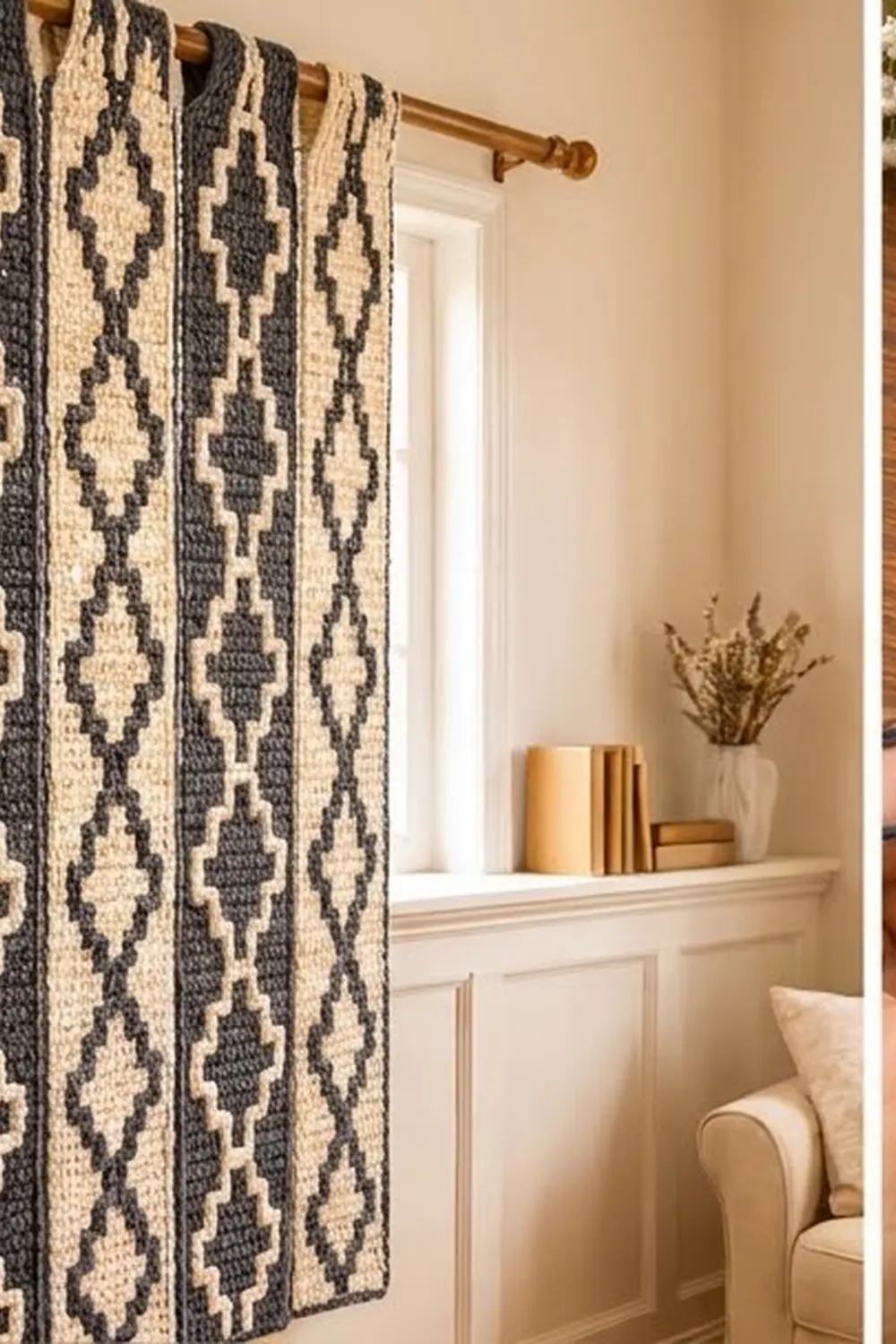
This curtain is made of ten long tapestry crochet strips that hang side by side from a rod. Each strip has a column of stepped diamond outlines running down its full length, and the strips alternate between two colorways.
The palette is charcoal gray and cream. Five strips have a charcoal background with cream diamonds, and five have a cream background with charcoal diamonds. Each strip has a thin one-stitch border in its contrast color, which gives the edges a neat outline. The overall look is graphic and a little geometric, with soft natural cotton texture.
The pattern uses US crochet terms. Each finished strip measures 3.5 in (8.9 cm) wide by 64.5 in (163.8 cm) long, not counting the hanging tab. Hung with 0.5 in (1.3 cm) gaps, the full curtain is 39.5 in (100.3 cm) wide.
Each strip is worked flat in rows of tapestry single crochet, carrying the unused color inside the stitches. You finish with one round of border in the contrast color and a fold-over tab for the rod. There is no seaming between strips; they simply hang next to each other.
Finished Size and Construction
- Finished strip size: 3.5 in x 64.5 in (8.9 cm x 163.8 cm)
- Full curtain width (hung): 39.5 in (100.3 cm)
- Skill level: Intermediate (tapestry crochet)
- Terminology: US
- Yarn weight: Worsted (#4), cotton or cotton blend
- Hook: 4.5 mm (US 7)
- Number of pieces: 10 strips (5 Version A, 5 Version B)
- Layout: 10 strips in one row, alternating A and B
- Strip size before border: 3 in x 64 in (7.6 cm x 162.6 cm), 12 sts x 256 rows
- Border depth: 1 round, 0.25 in (0.6 cm) on every side
- Hanging tab: 2.5 in (6.4 cm) wide, folded to a 2 in (5.1 cm) loop
Materials
Choose a smooth, firm worsted cotton so the stepped edges of the diamonds stay crisp. Fuzzy yarns blur tapestry color changes, and very drapey yarns may stretch over this length.
- Charcoal gray: 800 g / about 1,360 m (1,487 yd)
- Cream: 800 g / about 1,360 m (1,487 yd)
These amounts assume a yarn with roughly 85 m per 50 g. Both colors are used in equal amounts because each color is the background on five strips and the contrast on the other five. The amounts include a margin of about 10% for swatching and color carrying.
Tools:
– 4.5 mm (US 7) crochet hook
– Tapestry needle
– Stitch markers
– Measuring tape
– Blocking mats and rust-proof pins
– Spray bottle or steamer
– Curtain rod, at least 42 in (106.7 cm) long, up to 1.25 in (3.2 cm) in diameter
Abbreviations (US Terms)
- ch – chain
- sc – single crochet
- sl st – slip stitch
- st(s) – stitch(es)
- RS / WS – right side / wrong side
- M – main (background) color
- C – contrast (motif and border) color
Tapestry single crochet (special stitch): Lay the unused color along the tops of the stitches in the current row and work each sc over it so it is hidden inside. To change color, work the last sc in the old color until 2 loops remain on the hook. Then yarn over with the new color and pull through both loops. Keep carrying the unused yarn across every row, including plain rows, so the fabric stays the same thickness all the way through.
Version A: M = charcoal, C = cream.
Version B: M = cream, C = charcoal.
Gauge and Checkpoints
Gauge: 16 sts and 16 rows = 4 in (10.2 cm) in tapestry sc with the carried strand.
Before starting all ten strips, make one test section. Ch 13 and work Rows 1–18 below: 6 plain rows plus one complete diamond.
- Checkpoint 1 (width): 12 sts = 3 in (7.6 cm).
- Checkpoint 2 (first diamond): After Row 18, length = 4.5 in (11.4 cm).
- Checkpoint 3 (halfway): After Row 126, length = 31.5 in (80.0 cm).
- Checkpoint 4 (body complete): After Row 256, length = 64 in (162.6 cm).
- Checkpoint 5 (bordered): 3.5 in x 64.5 in (8.9 cm x 163.8 cm).
If your piece is too big: go down to a 4 mm (US G-6) hook. If it is too small: go up to a 5 mm (US H-8) hook. Row gauge matters as much as stitch gauge here. If your rows come out short, the border will not lie flat along the long sides. Over 256 rows, being off by 1 row per inch adds up to several inches of length.
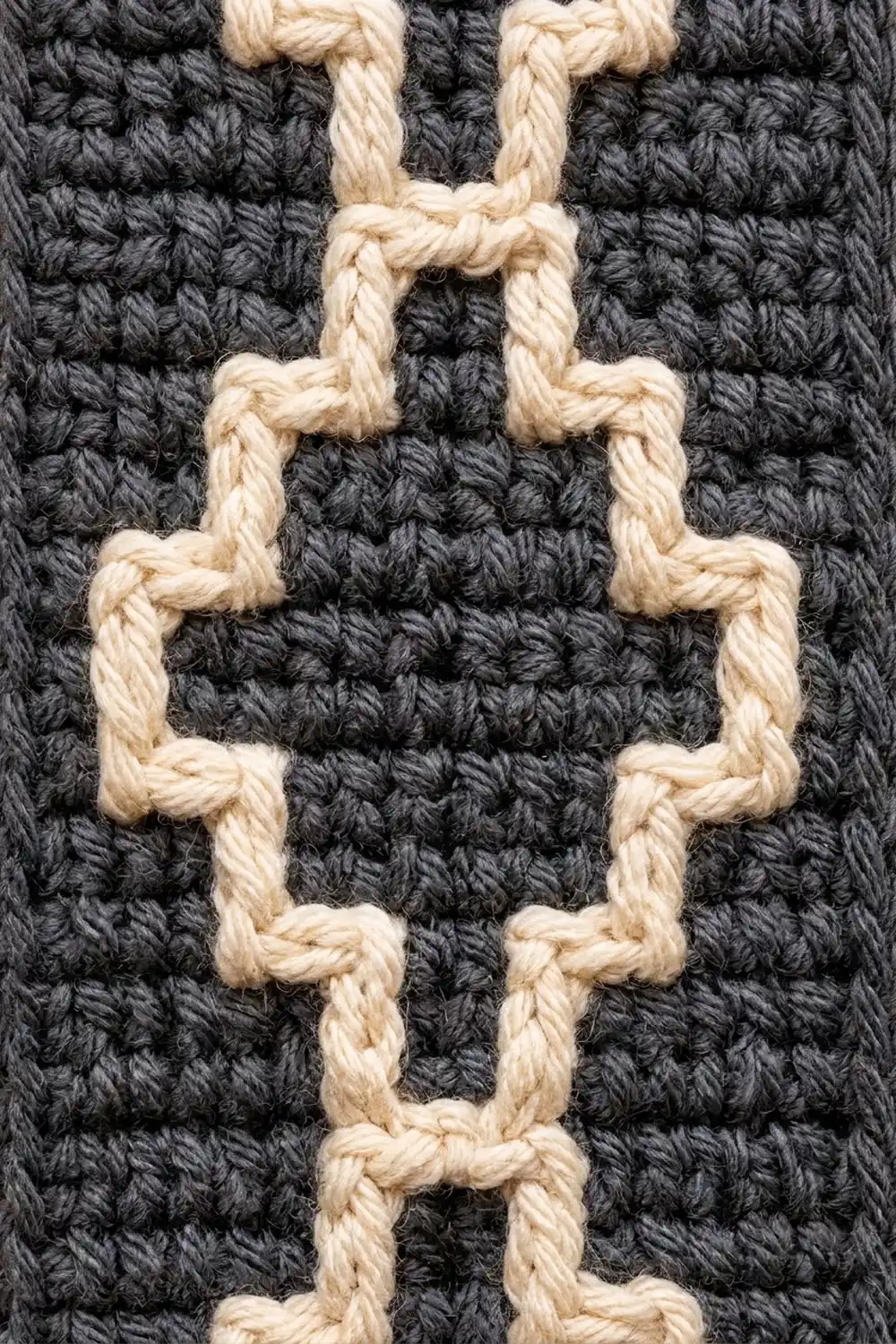
Strip Pattern (Make 10)
Work every row in tapestry sc and carry the unused color throughout. Each row has 12 sts. Ch 1 at the start of each row does not count as a stitch. Read each color sequence from the start of the row. Because every diamond row is symmetrical, the same sequence works on RS and WS rows.
Foundation: With M, ch 13.
Row 1 (RS): Lay C along the chain. Sc in 2nd ch from hook and in each ch across, working over C. Turn. (12 sts)
Rows 2–6: Ch 1, 12 sc in M, carrying C. Turn. (12 sts)
This makes a plain band 1.5 in (3.8 cm) deep.
Diamond Repeat (12 rows)
Each diamond takes 12 rows, which is 3 in (7.6 cm). The outline is one stitch wide and moves out by one stitch every 2 rows, which gives the stepped edge.
Repeat Rows 1–2: Ch 1, 5 M, 2 C, 5 M. Turn. (12 sts) This is the shared point that links one diamond to the next.
Repeat Rows 3–4: Ch 1, 4 M, 1 C, 2 M, 1 C, 4 M. Turn. (12 sts)
Repeat Rows 5–6: Ch 1, 3 M, 1 C, 4 M, 1 C, 3 M. Turn. (12 sts)
Repeat Rows 7–8: Ch 1, 2 M, 1 C, 6 M, 1 C, 2 M. Turn. (12 sts) This is the widest part of the diamond, with outline sts at stitches 3 and 10.
Repeat Rows 9–10: Ch 1, 3 M, 1 C, 4 M, 1 C, 3 M. Turn. (12 sts)
Repeat Rows 11–12: Ch 1, 4 M, 1 C, 2 M, 1 C, 4 M. Turn. (12 sts)
Strip Rows 7–246: Work the 12-row Diamond Repeat 20 times. That is 240 rows and 20 diamonds.
Strip Rows 247–248: Ch 1, 5 M, 2 C, 5 M. Turn. (12 sts) These rows close the bottom point of the last diamond.
Strip Rows 249–256: Ch 1, 12 sc in M, carrying C. Turn. (12 sts)
This makes a plain band 2 in (5.1 cm) deep, which supports the hanging tab.
Row total check: 6 + 240 + 2 + 8 = 256 rows. At 4 rows per inch, that is 64 in (162.6 cm).
Cut M and leave C attached for the border. Hide no ends yet.
Make All Pieces
- Version A (charcoal background, cream diamonds and border): make 5
- Version B (cream background, charcoal diamonds and border): make 5
Layout grid (left to right, as hung):
| A | B | A | B | A | B | A | B | A | B |
Each strip contains exactly 20 full diamonds. When the strips hang with their Row 1 at the bottom, the diamonds line up across the curtain.
Joining (Hanging Assembly)
The strips are not sewn to each other. Each one hangs on the rod from its own tab, and the “join” here is the tab fold. Work the border first (next section), then come back to this step.
Tab: With the RS facing and M, join with a sl st in the 4th st of the top border edge, counting from the right-hand corner group. The top edge has 16 border sts in total.
Tab Row 1: Ch 1, sc in the same st and in the next 9 sts. Turn. (10 sts, 2.5 in / 6.4 cm wide) This leaves 3 border sts free on each side of the tab.
Tab Rows 2–16: Ch 1, 10 sc. Turn. (10 sts) The tab is now 4 in (10.2 cm) long.
Folding (stitch-to-stitch logic): Fold the tab to the WS. Line up each of the 10 sts in the last tab row with one of the 10 border sts it grew from, one-to-one. Whipstitch through both loops on each pair. The tab then forms a 2 in (5.1 cm) loop.
Tension advice: Sew the tab firmly, but do not pull it so tight that the top edge puckers. The tab carries the weight of the whole strip, so go over the seam a second time.
Hanging: Slide the strips onto the rod in A–B order and leave about 0.5 in (1.3 cm) between them.
Size checkpoint: 10 strips x 3.5 in + 9 gaps x 0.5 in = 35 + 4.5 = 39.5 in (100.3 cm).
Border
Border gauge: The border is 1 round of sc in C, at the same gauge as the body. Stitch gauge and row gauge are equal (4 per inch), so one sc per row end along the long sides lies flat without ruffling or pulling.
Border Round (RS): With C still attached at the end of Row 256, ch 1 and turn so the RS faces you.
- Top edge: 3 sc in the first st (corner), 1 sc in each of the next 10 sts, 3 sc in the last st (corner). (16 sts)
- Long side: Work 1 sc in each row end down the side. (256 sts)
- Bottom edge: Working into the underside of the foundation chain: 3 sc in the first ch (corner), 1 sc in each of the next 10 ch, 3 sc in the last ch (corner). (16 sts)
- Second long side: Work 1 sc in each row end up the side. (256 sts)
- Sl st to the first sc to join.
Round total: (12 + 256 + 12 + 256 = 536 sts worked one per existing st or row end) + (4 corners x 2 extra = 8) = 544 sts.
Why the math works: The body is 12 sts wide and 256 rows long. The border adds 1 st of width on each side, so the strip is 14 sts = 3.5 in (8.9 cm) wide. It also adds 1 row of height at each end, so the strip is 258 rows = 64.5 in (163.8 cm) long. The 3-sc corner groups give enough ease for the corners to turn flat. Each strip has its own border, so no seam stitches are added anywhere.
Fasten off. Weave in all ends inside the carried-yarn channel of a matching color.
Final Blocking
- Weave in every end before blocking.
- Lightly mist each strip until it is damp. Do not soak it, because heavy wet cotton stretches over this length.
- Lay the strip flat on blocking mats. Use several mats lined up end to end if you need to.
- Pin the width to 3.5 in (8.9 cm) every 6 in (15.2 cm).
- Ease the length to 64.5 in (163.8 cm). Smooth it gently; do not stretch it.
- Check that the diamond points sit on the center line and that the long edges are straight.
- Let the strip dry completely, then unpin it.
- Fold and sew the tab after blocking so the tab length stays true.
Final Quality-Control Checklist
- Every strip has 12 sts across the body and 256 rows.
- Every strip has exactly 20 full diamonds, closed at both ends.
- All 5 A strips and all 5 B strips are the same length, within 0.5 in (1.3 cm) of each other.
- Each border round has 544 sts and flat corners.
- No carried yarn shows through on the RS.
- Tabs are centered, 10 sts wide, and securely whipstitched.
- Hung width is 39.5 in (100.3 cm) and the diamonds line up across all strips.
Troubleshooting
Carried yarn shows through: Hold the carried strand snug against the tops of the stitches and work slightly tighter, or go down one hook size.
Diamond outlines look jagged or slanted: Tapestry sc naturally leans a little. Working flat and turning every row, as this pattern does, cancels most of the lean. Make sure you change color on the last yarn over of the stitch before the new color.
Strip curls: You may be carrying the unused yarn too tightly. Loosen it, and block the strip firmly.
Long sides ripple after the border: Your row gauge is taller than your stitch gauge. Skip 1 row end in every 10 and keep the count the same on both sides.
Strips are different lengths: Measure at Checkpoint 3 on every strip and adjust your tension before continuing.
Tab stretches out: Go over the tab seam a second time, or work the tab with a hook one size smaller.
Care
Hand wash cold and lay flat to dry, reblocking to 3.5 in x 64.5 in (8.9 cm x 163.8 cm). Do not hang the strips to dry while wet, because the weight will stretch them.
Final Notes
The measurement chain is simple and repeats for every strip. Start with 12 sts = 3 in (7.6 cm), and 256 rows = 64 in (162.6 cm). Twenty diamonds of 3 in (7.6 cm) each sit between plain bands of 1.5 in (3.8 cm) and 2 in (5.1 cm), with 0.5 in (1.3 cm) of closing point in between. One border round brings each strip to 3.5 in x 64.5 in (8.9 cm x 163.8 cm). Ten strips with 0.5 in (1.3 cm) gaps give a curtain 39.5 in (100.3 cm) wide.
If you check your gauge on the first strip, the other nine should come out the same size.
Happy crocheting!