

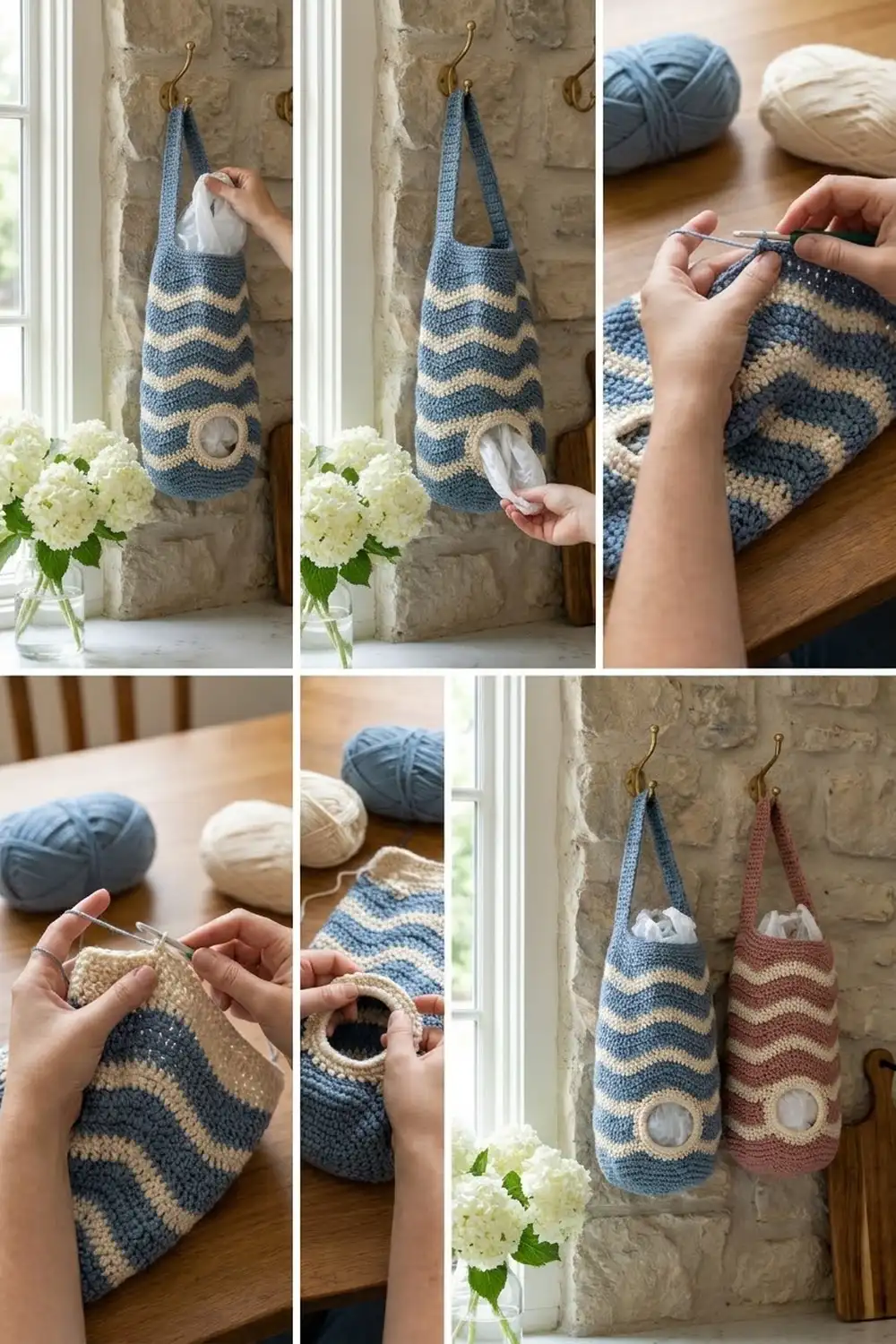
This Seaside Ripple Bag Holder is a tall, soft tube that stores plastic grocery bags. You push bags in through the open top and pull them out, one at a time, through a round opening near the bottom. It hangs from a single crocheted strap, so it fits on a hook by the pantry door, inside a cabinet, or next to the kitchen counter.
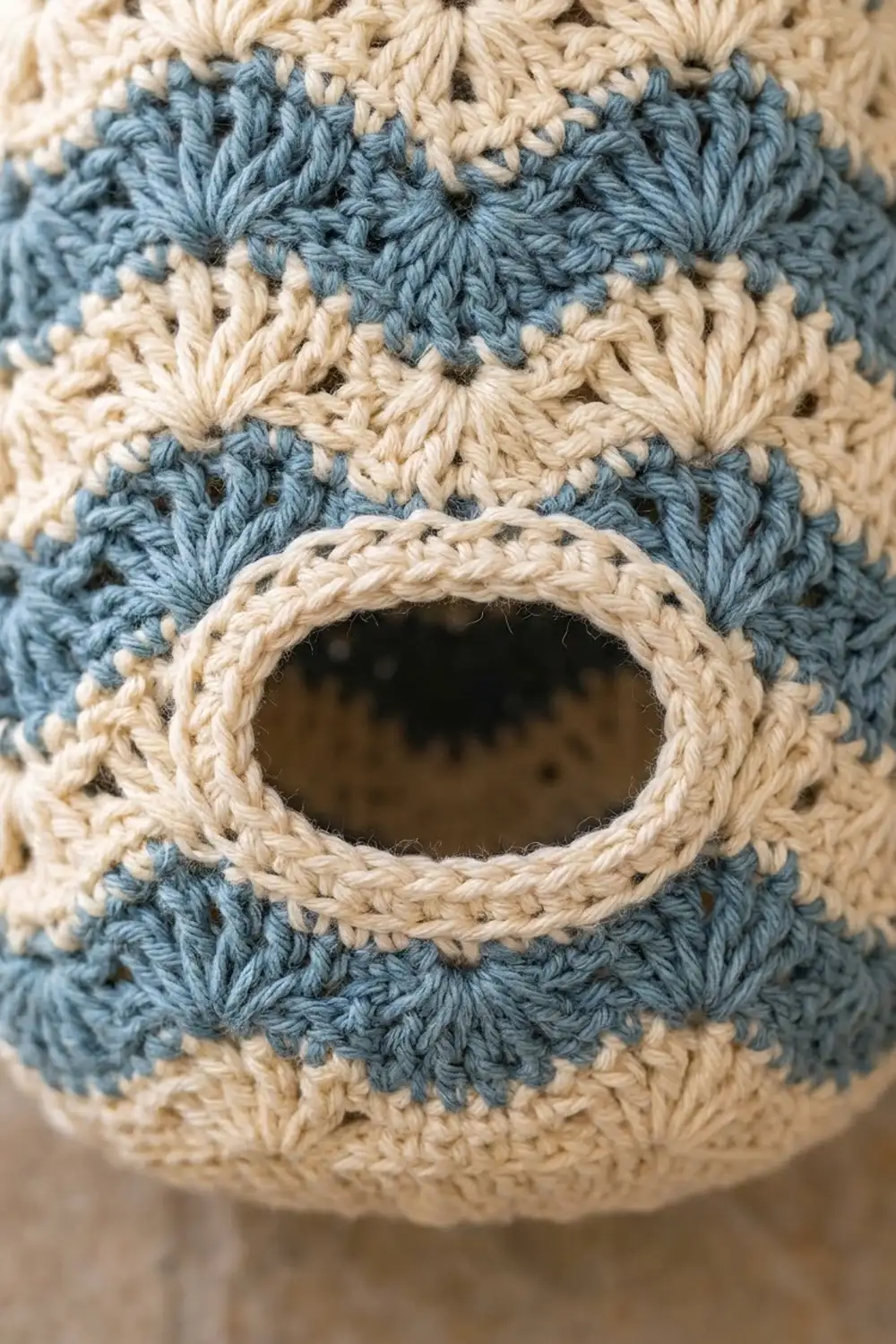
The body has wavy stripes of dusty blue and cream. Each wave peaks in a small fan and dips into a soft valley, which gives it a relaxed coastal look. The base, the top band, the strap, and the trim around the dispensing hole are all cream, so the stripes look framed. For a warmer version, swap the blue for dusty rose.
This pattern uses US crochet terms. The finished holder measures about 7.5 in (19.1 cm) wide laid flat and 14.75 in (37.5 cm) tall from the base edge to the rim. The strap adds about 4.5 in (11.4 cm), for a total hanging length of about 19.25 in (48.9 cm).
The whole holder is one piece. You start with a flat circular base, turn the edge up, and work the ripple in joined rounds. You leave a chain gap low on the front for the dispensing hole, then level the waves into a straight cream band at the top. Last, you work the strap straight off the rim and trim the hole.
Finished Size and Construction
- Finished size: 7.5 in (19.1 cm) wide flat x 14.75 in (37.5 cm) tall, plus a 4.5 in (11.4 cm) strap loop
- Skill level: Intermediate (easy ripple, simple color changes)
- Terminology: US
- Yarn weight: Worsted (#4), cotton or cotton blend
- Hook: 5 mm (US H-8)
- Number of pieces: 1 (a seamless tube with a closed base)
- Layout: Base, then 26 ripple rounds in 2-round stripes, then the top band and strap
- Body circumference: 15 in (38.1 cm), 60 sts
- Size before the top band: 7.5 in (19.1 cm) wide x 13.5 in (34.3 cm) tall, measured at the wave peaks
- Top band depth: 1.25 in (3.2 cm), narrowing to a 13.5 in (34.3 cm) rim
Materials
Pick a smooth worsted-weight cotton. Cotton holds its shape when the holder is stuffed full of bags, and it washes well. Acrylic works too, but the tube will stretch a bit more.
- Color A, Dusty Blue: 70 g (about 105 m)
- Color B, Cream: 120 g (about 180 m)
Tools:
- 5 mm (US H-8) crochet hook
- Locking stitch markers (at least 4)
- Tapestry needle
- Scissors
- Measuring tape
- Rust-proof pins and a towel for blocking
These quantities include a margin of about 15%, so a small difference in tension won’t leave you short.
Abbreviations (US Terms)
- ch: chain
- sl st: slip stitch
- sc: single crochet
- hdc: half double crochet
- dc: double crochet
- tr: treble crochet
- st(s): stitch(es)
- BLO: back loop only
- sc2tog: single crochet 2 together
- Rnd: round
Special stitch: dc2tog (double crochet 2 together). Yarn over, insert the hook in the next st, yarn over and pull up a loop, then yarn over and pull through 2 loops. Repeat in the next st. Yarn over and pull through all 3 loops on the hook. This works 2 sts and makes 1.
Ripple repeat (12 sts): [dc2tog] 2 times, [2 dc in next st] 4 times, [dc2tog] 2 times. This works 12 sts and makes 12 sts. The 8 dc in the middle form the fan-shaped peak. The decreases at each end meet the decreases of the next repeat to form the valley.
Gauge and Checkpoints
- Ripple gauge: 1 repeat (12 sts) = 3 in (7.6 cm) wide, and 8 rnds = 4 in (10.2 cm) tall
- Single crochet gauge: 16 sc = 4 in (10.2 cm), and 4 rnds = 1 in (2.5 cm)
The base is your gauge swatch. Make Rnds 1–5 and measure before you go on.
- After base Rnd 5: diameter 4.75 in (12.1 cm)
- After ripple Rnd 8: circumference 15 in (38.1 cm), ripple height 4 in (10.2 cm)
- After ripple Rnd 26: ripple height 13 in (33.0 cm)
- After top band: rim circumference 13.5 in (34.3 cm)
If your base is bigger than 4.75 in (12.1 cm), go down to a 4.5 mm hook. If it is smaller, go up to a 5.5 mm hook. Make the base again and measure. Even a 0.25 in (0.6 cm) difference in the base adds up to almost 1 in (2.5 cm) around the tube.
Pattern
Base
With Color B, make a magic ring.
Rnd 1: Ch 2 (doesn’t count as a st), 12 dc in the ring. Join with a sl st to the first dc. (12 sts)
Rnd 2: Ch 2, 2 dc in each st around. Join. (24 sts)
Rnd 3: Ch 2, dc in next st, 2 dc in next st; repeat from * around. Join. (36 sts)
Rnd 4: Ch 2, dc in next 2 sts, 2 dc in next st; repeat from * around. Join. (48 sts)
Rnd 5: Ch 2, dc in next 3 sts, 2 dc in next st; repeat from * around. Join. (60 sts)
Checkpoint: the base lies flat and measures 4.75 in (12.1 cm) across.
Rnd 6 (turning round): Ch 1, sc in BLO of each st around. Join. (60 sc + 0 added = 60 sts) The unused front loops form a neat ridge, and the edge starts to turn up.
Rnd 7: Ch 1, sc in each st around. Join. (60 sts)
Place a marker at the join. This is the center back. Every round starts here, so the joins line up out of sight on the back.
Body Ripple
Work each ripple round like this: ch 2 (doesn’t count as a st), work the ripple repeat 5 times, then join with a sl st to the top of the first dc2tog. (60 sts)
The 5 repeats sit around the tube. Repeat 3 falls at the center front.
Change colors on the final sl st of the last round of each stripe. Don’t cut the yarn. Carry the color you aren’t using loosely up the inside at the center back.
Rnds 1–2: With Color A, work 2 ripple rounds. (60 sts each round)
Rnd 3 (hole round): With Color B, ch 2, work Repeats 1 and 2. Ch 12, skip the next 12 sts (Repeat 3), then work Repeats 4 and 5. Join. (48 sts + 12 ch = 60)
Rnd 4: With Color B, ch 2, work the ripple repeat 5 times. Work Repeat 3 into the 12 chains, inserting the hook under 2 loops of each chain. Join. (60 sts)
The skipped stitches and the chain leave a slit 3 in (7.6 cm) wide. It opens into the round dispensing hole once you trim it.
Rnds 5–6: With Color A, work 2 ripple rounds. (60 sts each round)
Rnds 7–8: With Color B, work 2 ripple rounds. (60 sts each round)
Checkpoint: the tube measures 15 in (38.1 cm) around and 4 in (10.2 cm) from Rnd 7 of the base to the wave peaks.
Rnds 9–26: Keep alternating 2 rounds of Color A and 2 rounds of Color B, ending with Rnds 25–26 in Color A. (60 sts each round)
You now have 7 blue stripes and 6 cream stripes. Cut Color A after Rnd 26, and keep Color B attached.
Checkpoint: the ripple section measures 13 in (33.0 cm) tall at the peaks. Laid flat, the tube is 7.5 in (19.1 cm) wide.
Top Band and Trims (Border)
The cream top band, the hole trim, and the strap act as the border on this holder. Use the single crochet gauge for all of them: 16 sc = 4 in (10.2 cm). For “per side” counts, think of the tube laid flat. Each side, front and back, holds half the stitches.
Top Band
Rnd T1 (leveling round): With Color B, ch 4 (doesn’t count as a st). Work each 12-st repeat like this: tr in next 2 sts, dc in next st, hdc in next st, sc in next 4 sts, hdc in next st, dc in next st, tr in next 2 sts. Repeat 5 times. Join. (60 worked 1 per st + 0 added = 60 sts; 30 per side)
The tall stitches fill each valley, and the short stitches sit on each peak. The top edge comes out straight.
Rnd T2 (shaping round): Ch 1, sc in next 8 sts, sc2tog; repeat from * 6 times. Join. (54 sts; 27 per side)
Rnds T3–T5: Ch 1, sc in each st around. Join. (54 sts; 27 per side)
Do not fasten off.
Why the math works: 60 sts at 4 sts per in is 15 in (38.1 cm) around. Taking 6 sts away gives 54 sts, or 13.5 in (34.3 cm). Laid flat, that’s 6.75 in (17.1 cm) across, which gives the rim a soft, slightly narrower neck. Six even decreases spread over 6 groups of 10 sts make the narrowing smooth, with no pleats. The band is 5 rounds deep, about 1.25 in (3.2 cm).
Strap
Lay the holder flat with the hole centered on the front. Mark the two side folds on Rnd T5: st 14 and st 41, counted from the center-back join. These sts are 27 apart, so they sit exactly opposite each other.
Setup: Sl st along to st 14. Ch 36 and sl st in st 41. Sl st in st 42 and turn.
Row 1: Sc in each ch (36 sc). Sl st in st 13 and st 12 of the rim. Turn.
Row 2: Sc in each sc (36 sc). Sl st in st 43 and st 44. Turn.
Row 3: Sc in each sc (36 sc). Sl st in st 11. Fasten off.
The strap is 3 rows wide, about 0.75 in (1.9 cm), and 9 in (22.9 cm) long. Each end is anchored across 4 rim stitches. Hung up, it makes a loop about 4.5 in (11.4 cm) tall.
Hole Trim
Rnd H1: Join Color B at the right corner of the slit. Work 12 sc along the bottom edge, into the skipped tops of Rnd 2. Work 2 sc into the left end of the slit. Work 12 sc along the top edge, into the free bottom loops of the chain. Work 2 sc into the right end. Join. (12 + 2 + 12 + 2 = 28 sts)
Rnd H2: Ch 1, sc in each st around. Join. (28 sts) Fasten off.
Why the math works: 28 sc at 4 sts per in make an edge about 7 in (17.8 cm) around. When the edge opens into a circle, the hole measures about 2.25 in (5.7 cm) across. That’s wide enough for your fingers and snug enough to hold the bags in. The 12 sc on each long edge match the 12 sts of one ripple repeat, so the slit doesn’t pucker or flare.
Weave in all ends inside the tube.
Final Blocking
- Wet the holder in cool water and gently squeeze it out. Don’t wring it.
- Roll it in a towel and press to remove extra water.
- Lay it flat with the hole centered on the front. Smooth the tube to 7.5 in (19.1 cm) wide.
- Pin each wave peak gently upward so the fans open and the stripes run level.
- Ease the top band to 6.75 in (17.1 cm) wide, and pat the hole into a circle 2.25 in (5.7 cm) across.
- Stretch the strap straight to 9 in (22.9 cm).
- Let it dry fully, then flip it and let the back dry.
Final Quality-Control Checklist
- Base is 4.75 in (12.1 cm) across and lies flat
- Every ripple round has 60 sts
- There are 7 blue and 6 cream stripes, with every peak stacked straight above the last
- The hole is centered on the front, and its trim has 28 sts
- The rim has 54 sts and lies straight, with no waves
- The strap ends sit exactly opposite each other at the side folds
- Carried yarn on the inside is loose, so the stripes don’t pucker
- All ends are woven in securely on the inside
Troubleshooting
The waves are drifting sideways. Check that each round starts with the first dc2tog worked into the first st after the join.
The tube cups or narrows. Your dc2tog stitches are too tight. Make them looser, or use a bigger hook only for the decreases.
The tube flares out. You may be working extra sts at the join. Count to 60 each round.
The top band waves. In Rnd T1, check that the tr sts sit in the valleys and the sc sts sit on the peaks.
The hole gapes or droops. Pull Rnd H2 a little tighter, or work it as sl sts.
The strap twists. Turn after every row, and keep the 36-st count the same in every row.
The stripes pucker at the back. Loosen the carried strand inside before you join each round.
Care
Machine wash on cold in a laundry bag, then reshape and lay flat to dry. Don’t tumble dry, because cotton can shrink and the waves can lose their shape.
Final Notes
The measurements build on each other. A 4.75 in (12.1 cm) base gives 60 sts, or 15 in (38.1 cm) around. Twenty-six ripple rounds add 13 in (33.0 cm) of stripes. The leveling and sc band bring the rim down to 54 sts, or 13.5 in (34.3 cm). The 28-st trim opens the 3 in (7.6 cm) slit into a 2.25 in (5.7 cm) hole, and the 36-st strap makes a 4.5 in (11.4 cm) loop. Check your gauge on the base, count at every checkpoint, and the holder will come out at 7.5 in (19.1 cm) by 14.75 in (37.5 cm).
Happy crocheting!