

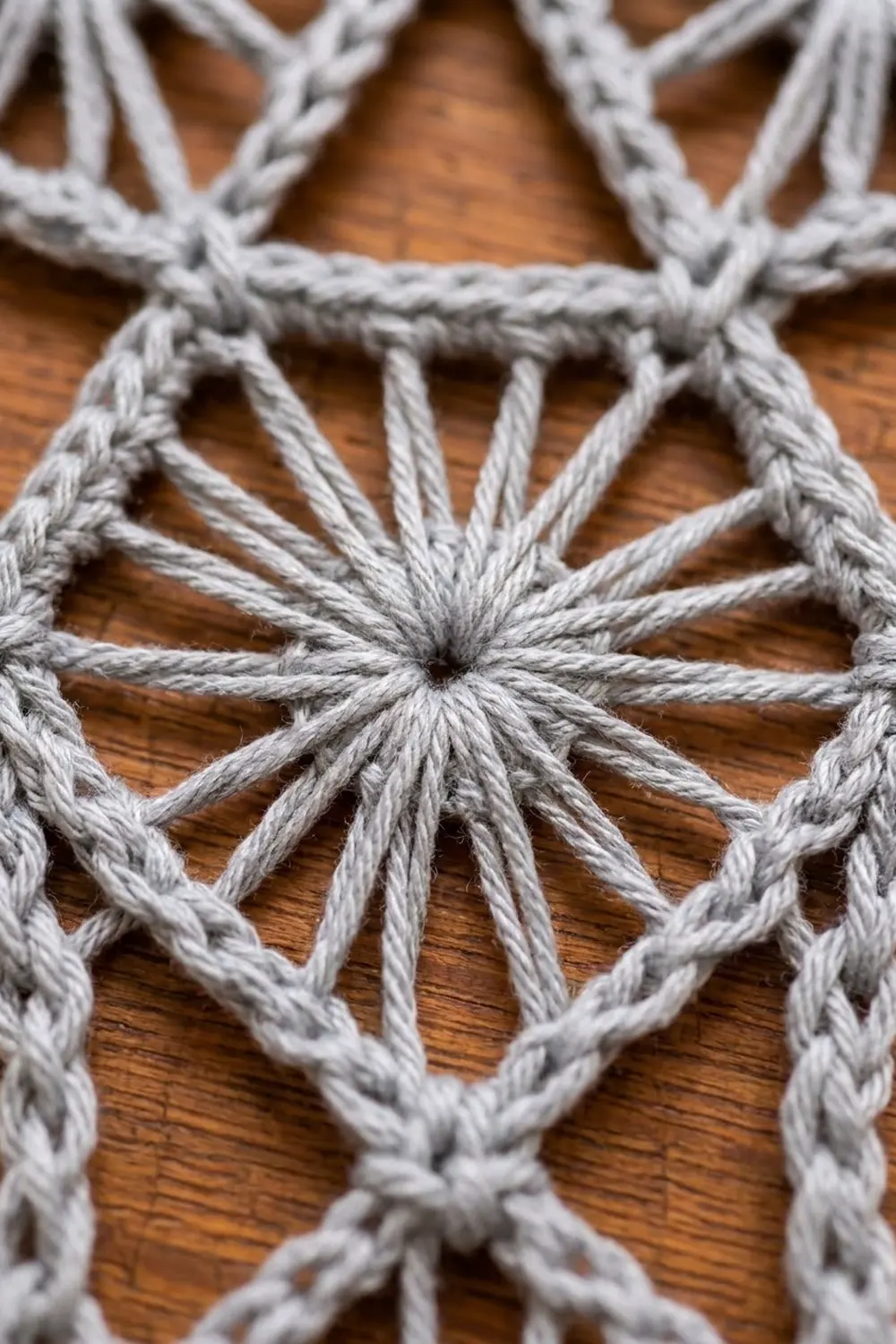
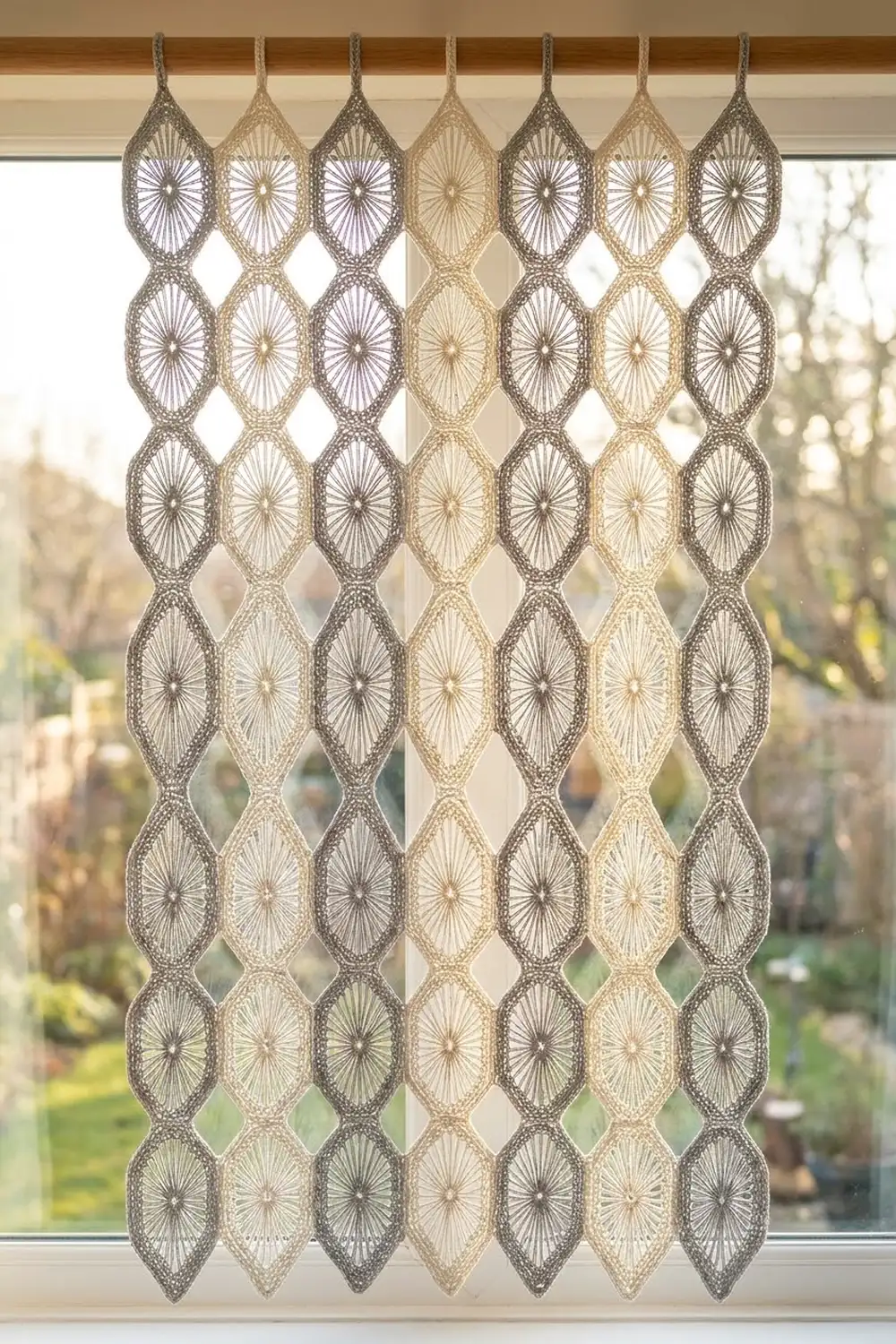
This airy curtain is made from slim lace strips. Each strip is a column of stacked starburst cells framed by chained cords. Hung in a window, the open lattice filters the light, and the alternating light gray and cream strips give it a soft two-tone rhythm.
The design is calm and modern, with a little bohemian flavor. Each cell holds a star of about 22 rays, made by working a tall cluster into one center point and then fanning the same number of stitches back out. Single-crochet waist bars separate the cells and pinch the strip edges into a gentle scallop. Each strip finishes in a crisp V point.
This pattern uses US crochet terms. The finished curtain measures about 31.75 in (80.6 cm) wide and 52.75 in (134.0 cm) long, including the folded rod band.
Here is how it comes together. You crochet nine identical strips from the top down in rows. Then you join neighboring strips with one slip stitch at the widest point of every cell. Finally, you work a single header band across all nine tops and fold it back to form a rod pocket.
Finished Size and Construction
- Finished size: about 31.75 in (80.6 cm) wide × 52.75 in (134.0 cm) long
- Skill level: Intermediate
- Terminology: US crochet terms
- Yarn weight: DK (light worsted, #3) cotton
- Hook: 4.0 mm (US G-6)
- Number of pieces: 9 strips (5 gray, 4 cream)
- Layout: 9 strips side by side, 1 row
- Piece size: each strip is 3.5 in (8.9 cm) wide × about 51.75 in (131.4 cm) long, made of 20 cells plus a point
- Size before border: 31.75 in (80.6 cm) × 51.75 in (131.4 cm)
- Border depth: a top band 2 in (5.1 cm) deep, folded to 1 in (2.5 cm) on the finished curtain
Materials
Yarn advice: Choose a smooth, mercerized or combed DK cotton, about 115 m (125.8 yd) per 50 g. Cotton holds the star rays crisp, keeps the cords well defined, and does not stretch much while hanging. Avoid fuzzy or very loose blends, because the lattice will lose its definition.
- Light gray: 300 g, about 690 m (754.6 yd). This covers 5 strips and the header band.
- Cream: 250 g, about 575 m (628.8 yd). This covers 4 strips.
These quantities include a margin of about 15% for gauge swatches and tension differences.
Tools:
– 4.0 mm (US G-6) crochet hook
– Tapestry needle
– 10 locking stitch markers
– Measuring tape
– Rust-proof blocking pins and a long blocking surface (foam mats or a bed)
– Spray bottle
– A curtain rod up to 5/8 in (1.6 cm) in diameter
Abbreviations (US Terms)
- ch – chain
- sc – single crochet
- tr – treble crochet
- sl st – slip stitch
- sp – space
- st(s) – stitch(es)
- sc2tog – single crochet 2 together
- sc3tog – single crochet 3 together
Special stitch: tr11tog (treble 11 together). Yarn over twice, insert hook in the next stitch, pull up a loop, [yarn over, pull through 2 loops] twice. Repeat from * to * in each of the next 10 stitches, so you have 12 loops on the hook. Yarn over and pull through all 12 loops. The cluster counts as 1 stitch. Its 11 legs form the upper rays of the star, and its top becomes the star’s center.
Gauge and Checkpoints
Base gauge: 17 sc and 19 rows = 4 in (10.2 cm) in single crochet.
Test one piece first. Before starting the full curtain, work Rows 1–4 once to make a one-cell sample. Steam or wet-block it and pin it lightly.
- Sample checkpoint: 3.5 in (8.9 cm) wide across Row 4 and 2.7 in (6.9 cm) from the foundation to the top of Row 4.
Checkpoints while working a strip:
– After Row 1: 3.5 in (8.9 cm) wide.
– After cell 1 (Row 4): 2.7 in (6.9 cm) long.
– After cell 4: 10.2 in (25.9 cm) long.
– After cell 20: 50.2 in (127.5 cm) long.
– After the point: about 51.75 in (131.4 cm) long.
If your sample is too big, go down to a 3.75 mm hook. If it is too small, go up to a 4.5 mm hook. If the width matches but each cell is shorter than 2.5 in (6.4 cm), wrap the yarn slightly looser on the treble rows instead of changing hooks. Width matters most, because it controls the header band.
Strip Pattern (make 9)
Each strip is worked in rows from the top edge down to the point. Turn at the end of every row.
Foundation: Ch 16.
Row 1 (top bar): Sc in the 2nd ch from the hook and in each ch across, turn. (15 sc)
Cell Repeat (Rows 2–4)
Row 2 (upper rays):
1. Ch 4 (counts as tr), then ch 3.
2. Skip the next sc.
3. Tr11tog over the next 11 sc.
4. Ch 3, skip the next sc, tr in the last sc, turn.
(2 tr, 1 cluster, 2 ch-3 sps)
The cluster legs pull the stitches of the bar into one point, which forms the top half of the star. The ch-3 spaces become the slanted side cords of the cell frame.
Row 3 (lower rays):
1. Ch 4 (counts as tr), then ch 3.
2. Work 11 tr in the top of the tr11tog.
3. Ch 3, tr in the 4th ch of the turning ch, turn.
(13 tr, 2 ch-3 sps)
The fan opens out from the same center, completing a star of 22 rays. This row is the widest point of the cell, about 3.75 in (9.5 cm) before joining.
Row 4 (waist bar):
1. Ch 1, sc in the first tr.
2. Sc in the ch-3 sp.
3. Sc in each of the next 11 tr.
4. Sc in the ch-3 sp, then sc in the 4th ch of the turning ch, turn.
(15 sc)
This is a conversion row: 13 sc go into the existing 13 tr, 1 per stitch, and 2 more sc go into the 2 ch-3 spaces, for 13 + 2 = 15 sc. The count returns to Row 1’s 15 stitches, so the strip stays exactly 3.5 in (8.9 cm) wide at every waist. The narrow bar is what pinches the side cords and makes the scalloped hexagon outline.
Work Rows 2–4 a total of 20 times, ending with Row 4 (15 sc). Place a stitch marker at every 5th cell to make counting easier.
Point (Rows P1–P7)
- P1: Ch 1, sc2tog, sc in each st across to the last 2 sts, sc2tog, turn. (13 sc)
- P2: Repeat P1. (11 sc)
- P3: Repeat P1. (9 sc)
- P4: Repeat P1. (7 sc)
- P5: Repeat P1. (5 sc)
- P6: Repeat P1. (3 sc)
- P7: Ch 1, sc3tog. (1 sc) Fasten off.
The point is about 1.5 in (3.8 cm) long. Each strip has 1 + 60 + 7 = 68 rows in total.
Count check: Row 1 measures 0.2 in (0.5 cm), the 20 cells measure 20 × 2.5 in = 50 in (127.0 cm), and the point measures 1.5 in (3.8 cm). That gives about 51.75 in (131.4 cm) per strip.
Make All Pieces
- Light gray: 5 strips
- Cream: 4 strips
Weave in the ends along the edge tr columns, where they disappear into the cord. Lightly steam each strip flat before joining.
Layout grid (top edge, left to right):
| G | C | G | C | G | C | G | C | G |
G = light gray, C = cream. Lay all the strips on a flat surface, right side up, with the foundation rows lined up in a straight line.
Joining
Method: one slip-stitch link at the widest point of each cell, worked in the color of the strip on the left.
Stitch-to-stitch logic: Every cell has an edge tr in Row 3 on each side. Cell 1 of strip A lines up with cell 1 of strip B, cell 2 with cell 2, and so on. Because all strips have the same 68 rows, the joins line up automatically.
- Join the yarn with a sl st in the top of the Row 3 edge tr of cell 1 on the left strip.
- Insert the hook in the top of the Row 3 edge tr of cell 1 on the right strip, and sl st.
- Fasten off, leaving a 6 in (15.2 cm) tail.
- Repeat for all 20 cells, so each seam has 20 links.
- Join all 8 seams. That is 8 × 20 = 160 links in total.
No stitches are added along the seams, so the joining does not change any stitch counts.
Tension advice: Keep each link snug enough that the two bulges just touch. If a link is loose, the strips drift apart. If it is too tight, the cells pucker.
Size checkpoint: After joining, measure straight across the top edges of all nine foundation rows. They should sit side by side and total 31.75 in (80.6 cm). The point tips should all hang at the same level.
Border: Top Header Band
The sides and pointed bottom stay open, as shown in the finished curtain. The only border is a single band across the tops, which also forms the rod pocket.
Border gauge: the same as the base gauge, 17 sc = 4 in (10.2 cm).
Row 1: With the wrong side facing and gray yarn, join in the free loop of the first foundation ch at the top right corner of strip 1. Ch 1, then sc in each of the 15 free loops of each strip, moving straight from one strip to the next with no extra stitches. Turn. (135 sc)
Starting count math: 9 strips × 15 stitches per strip = 135 sc. The top edge of each strip has exactly 15 foundation loops, and nothing is added at the seams.
Rows 2–10: Ch 1, sc in each st across, turn. (135 sc in each row)
At the end of Row 10, fasten off, leaving a 60 in (152.4 cm) tail.
Why the math works: 135 ÷ 17 × 4 in = 31.76 in, which is the same as nine strips at 3.53 in each. The band matches the curtain width exactly, so it neither gathers nor stretches the strips. Ten rows at 19 rows per 4 in make a band about 2 in (5.1 cm) deep.
Forming the pocket: Fold the band in half toward the back, so the last row meets Row 1. Whipstitch the last row to the back loops of Row 1 using the long tail. The finished pocket is 1 in (2.5 cm) deep and fits a rod up to 5/8 in (1.6 cm) in diameter.
Final Blocking
- Soak the curtain in cool water for 15 minutes, then gently press the water out. Do not wring it.
- Roll it in towels to remove as much water as you can.
- Lay it flat with the band straight across the top and the strips running parallel.
- Pin the band to 31.75 in (80.6 cm) wide.
- Pin each strip at its waist bars to 3.5 in (8.9 cm) wide.
- Pin each point tip so the total length is 52.75 in (134.0 cm).
- Open each starburst with a pin at the center if any rays are crossed.
- Mist any areas that have dried, and let the curtain dry completely, about 24 hours.
Final Quality-Control Checklist
- All 9 strips have 20 cells and a point of 7 rows.
- The colors alternate G-C-G-C-G-C-G-C-G.
- Every Row 4 has 15 sc, and every Row 3 has 13 tr and 2 ch-3 sps.
- There are 160 slip-stitch links, and they line up cell to cell.
- The band has 135 sc in every row and is sewn closed evenly.
- The finished size is 31.75 in × 52.75 in (80.6 cm × 134.0 cm).
- All ends are woven into the cords.
Troubleshooting
- The stars look lopsided: you probably worked the cluster over the wrong stitches. Skip exactly 1 sc on each side before and after the tr11tog.
- The strip narrows over time: you are missing the sc in the ch-3 spaces in Row 4. Recount to 15.
- Strips of different lengths: count the cells against your markers, because one extra or missing cell changes the length by 2.5 in (6.4 cm).
- Points twist: steam-block the point and pin the tip straight down.
- Band ripples: your band tension is looser than the strips. Rework it with a hook one size smaller.
Care
Hand wash in cool water with mild soap, then reshape and dry flat. A light steam from a distance refreshes the stars between washes.
Final Notes
Everything in this curtain follows one measurement chain. A 15-stitch bar measures 3.5 in (8.9 cm), and each 3-row cell adds 2.5 in (6.4 cm). Twenty cells plus a point make a strip about 51.75 in (131.4 cm) long. Nine strips joined with one link per cell measure 31.75 in (80.6 cm), and the 135-stitch band matches that width exactly before folding into a 1 in (2.5 cm) rod pocket. If your sample cell is right, every later step will be right too.
Happy crocheting!