

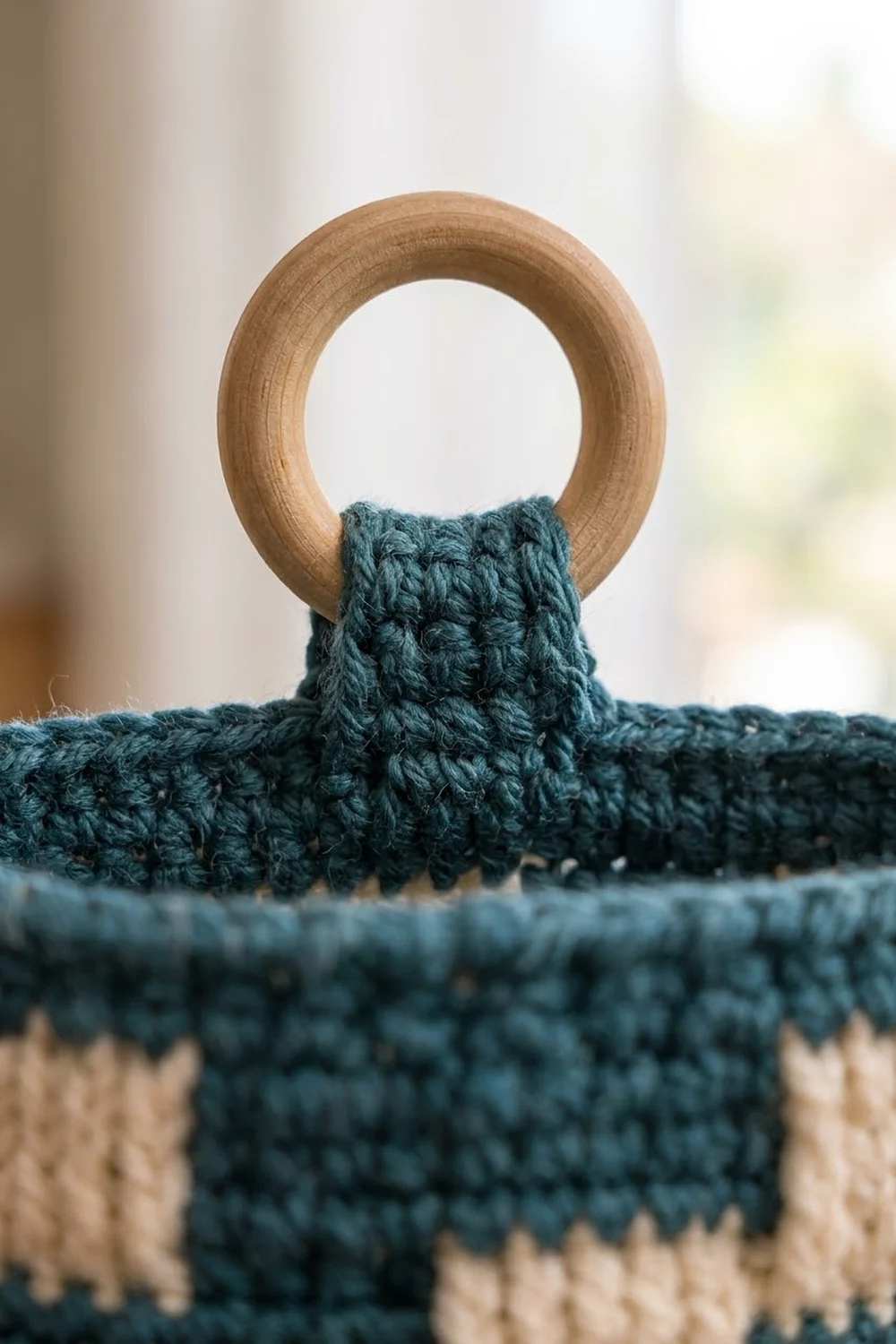
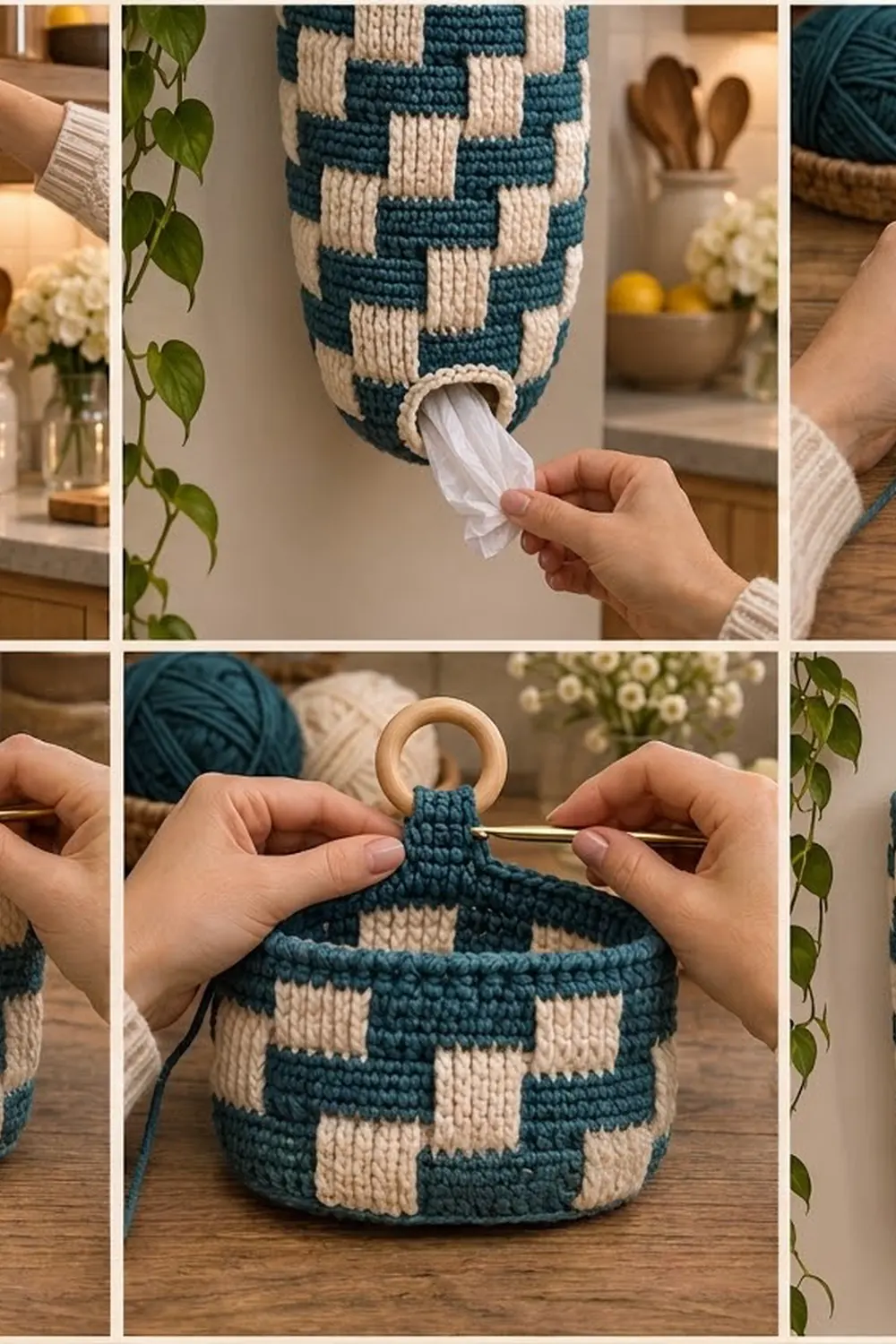
This hanging bag holder is a tall, soft tube with a staggered brick design in deep teal and warm cream. The blocks shift two stitches every band, so the pattern climbs around the tube in a diagonal stair-step. The top has a solid teal rim and a short tab with a wooden ring for hanging. At the bottom, the tube rounds into a cream dome with a small dispensing hole.
Every stitch is waistcoat stitch, also called knit stitch. It looks like knitted fabric, and it is dense, so the colorwork stays crisp and plastic bags don’t push through the walls. You can use any two contrasting colors. A dark chocolate brown with soft pink gives a gentler look.
The pattern uses US crochet terms. The finished holder is about 18.5 in (47.0 cm) tall, not counting the tab and ring. It is about 5 in (12.7 cm) across as a round tube, or 8 in (20.3 cm) wide laid flat. The dispensing hole is about 1.25 in (3.2 cm) across.
Construction is simple. You start at the dispensing hole and increase out into a rounded base. Then you work the tube upward in tapestry crochet, carrying the unused color inside the stitches. You finish with a solid teal rim and a tab that wraps around the wooden ring. It’s all one piece, so there is no seaming.
Finished Size and Construction
- Finished size: 18.5 in (47.0 cm) tall; 8 in (20.3 cm) wide laid flat; 16 in (40.6 cm) around
- Skill level: Intermediate (tapestry crochet in the round)
- Terminology: US
- Yarn weight: Worsted (#4)
- Hook: 5.0 mm (H-8)
- Number of pieces: 1, worked in the round from the bottom up
- Layout: a single vertical tube with a domed base and a hanging tab
- Piece size before rim: 17.5 in (44.5 cm) tall, base plus body
- Rim (border) depth: about 1 in (2.5 cm), solid teal
- Hanging tab: 6 sts wide, 14 rows long, folded over a 2 in (5.1 cm) wooden ring
Materials
Yarn: Use a smooth worsted-weight cotton or cotton blend, about 180 m per 100 g (197 yd per 3.5 oz). Cotton keeps the stitches sharp and holds its shape when the holder is full. Acrylic also works, but the tube will be a bit softer and may stretch more.
- Color A, deep teal: 150 g, about 270 m (295 yd)
- Color B, cream: 140 g, about 252 m (276 yd)
The amounts allow for the carried strand in tapestry crochet, and they include a safety margin of about 10%.
Tools:
- 5.0 mm (H-8) crochet hook
- One wooden ring, 2 in (5.1 cm) across
- Locking stitch marker
- Tapestry needle
- Scissors
- Measuring tape
- A rolled towel or cardboard tube to use as a blocking form
Abbreviations (US Terms)
- ch: chain
- sc: single crochet
- inc: 2 sc in the same stitch
- sl st: slip stitch
- st(s): stitch(es)
- rnd(s): round(s)
- ws: waistcoat stitch
- A / B: teal / cream
Waistcoat stitch (ws): Look at a stitch in the round below. You’ll see a V on the front of the fabric. Insert your hook through the center of that V, between its two legs, so the hook comes out the back of the fabric under the top loops. Yarn over and pull up a loop, then yarn over and pull through both loops on the hook. Each new stitch sits right on top of the one below, which gives the knit-look columns.
Tapestry color change: Work the last stitch of a color until 2 loops are left on the hook. Finish that stitch with the new color. Lay the inactive strand along the top of the round and work over it, so it’s hidden inside the stitches. Keep the carried strand relaxed. If you pull it tight, the tube will pucker.
Gauge and Checkpoints
Gauge: 16 sts and 18 rnds = 4 in (10.2 cm) in ws tapestry, worked in the round. Single crochet rounds in this pattern match that gauge.
Test first: Waistcoat stitch is tighter than flat sc, so don’t trust a flat swatch. Instead, ch 32 and join. Work 1 rnd of sc, then 16 rnds of ws following the brick bands. That tube should measure 8 in (20.3 cm) around, which is 4 in (10.2 cm) laid flat. Sixteen rounds should be about 3.6 in (9.1 cm) tall.
Checkpoints:
- After Rnd 1, the hole edge should be 4 in (10.2 cm) around, about 1.25 in (3.2 cm) across.
- After Rnd 7 you should have 64 sts, and the edge should be 16 in (40.6 cm) around.
- After Rnd 8, the base should be about 1.5 in (3.8 cm) tall, measured from the hole edge up the side.
- After Rnd 24 (the first 4 bands), the body should be 3.6 in (9.1 cm) tall and 8 in (20.3 cm) wide laid flat.
- After Rnd 80, the body should be 16 in (40.6 cm) tall, and the whole piece 17.5 in (44.5 cm).
If your piece is too big: go down to a 4.5 mm (7) hook, and check that your carried strand isn’t making the stitches loose.
If your piece is too small: go up to a 5.5 mm (I-9) hook. Also check that the carried strand isn’t pulling the tube in.
Don’t change the stitch counts. The colorwork needs exactly 64 sts.
Domed Base
Use Color B (cream). Work in a continuous spiral and move the marker up each round. Keep the start of the round at the center back, which is where the tab will go.
Foundation: Ch 16, sl st to the first ch to make a ring. Don’t twist the chain.
Rnd 1: Ch 1, sc in each ch around. Place the marker in the first st. (16 sts)
Rnd 2: (Sc 1, inc) 8 times. (24 sts)
Rnd 3: (Sc 2, inc) 8 times. (32 sts)
Rnd 4: (Sc 3, inc) 8 times. (40 sts)
Rnd 5: (Sc 4, inc) 8 times. (48 sts)
Rnd 6: (Sc 5, inc) 8 times. (56 sts)
Rnd 7: (Sc 6, inc) 8 times. (64 sts)
Rnd 8: Sc in each st around. (64 sts)
Each round adds only 8 sts. That’s fewer than a flat circle needs at this size, so the base cups upward into a soft dome rather than lying flat. That shape is what lets bags slide easily toward the hole.
Body: Staggered Brick Tapestry
Join Color A (teal) and carry it from here on. Every body stitch is ws, always 64 sts per round. One band is 4 rnds of the same color sequence. The 8-st repeat (4 teal, 4 cream) fits exactly 8 times around.
Each band starts 2 sts further along than the band before it. That’s what makes the diagonal stair-step.
Band A: (4 ws A, 4 ws B) 8 times. (64 sts: 32 A, 32 B)
Band B: 2 ws B, (4 ws A, 4 ws B) 7 times, 4 ws A, 2 ws B. (64 sts: 2 + 56 + 4 + 2)
Band C: (4 ws B, 4 ws A) 8 times. (64 sts: 32 B, 32 A)
Band D: 2 ws A, (4 ws B, 4 ws A) 7 times, 4 ws B, 2 ws A. (64 sts: 2 + 56 + 4 + 2)
Each band has a teal block that sits 2 sts further along than the one below it. In Band A the teal block is on sts 1–4. In Band B it moves to sts 3–6, then 5–8 in Band C and 7–10 in Band D. When you get back to Band A, it’s on sts 9–12, which is the same position as sts 1–4. So the four bands repeat with no break in the pattern.
Rnds 9–12: Work Band A.
Rnds 13–16: Work Band B.
Rnds 17–20: Work Band C.
Rnds 21–24: Work Band D.
Rnds 25–72: Work Rnds 9–24 three more times, for 4 full repeats in total.
Rnds 73–76: Work Band A.
Rnds 77–80: Work Band B.
That gives you 72 body rounds, which is 18 bands. Every round has 64 sts. The body should now be 16 in (40.6 cm) tall, and the whole piece 17.5 in (44.5 cm).
On the last st of Rnd 80, finish the stitch with Color A. Cut Color B, leaving a 6 in (15.2 cm) tail, and carry that tail inside the next few stitches.
Rim and Hole Edging (Border)
This piece doesn’t need a blanket-style border. Instead, a solid teal rim finishes the top and a cream edging finishes the hole.
Border gauge: The rim is plain sc at the same gauge as the body, 16 sts = 4 in (10.2 cm). Since it uses the body’s full count of 64 sts, it neither flares nor pulls in.
Rnds 81–83: With Color A, sc in each st around. (64 sts each rnd)
Rnd 84: Sc in each st around, then sl st in the next st. (64 sts) Fasten off.
Laid flat, every rim round has 32 sts across the front and 32 sts across the back, for a total of 32 + 32 = 64. The tube has no corners, so there are no corner stitches to add. The rim is 4 rounds, about 1 in (2.5 cm) deep. That brings the finished height to 17.5 in + 1 in = 18.5 in (47.0 cm).
Hole edging: Turn the holder upside down. Join Color B in any free loop of the foundation chain. Ch 1, then sc in each of the 16 free loops. Sl st to the first sc. (16 sts) Fasten off.
The edging uses the same 16 sts as the foundation, so the hole stays 4 in (10.2 cm) around. The extra layer rolls outward slightly, which gives a firm cream rim that won’t stretch out from bags being pulled through.
Hanging Tab and Ring
Find the center back. It’s where your rounds started, and the small color jog sits there too. Count 3 sts to the right of that point.
Row 1: Join Color A in that st. Ch 1, then sc in the same st and the next 5 sts. (6 sts)
Rows 2–14: Ch 1, turn, sc in each st across. (6 sts)
Fasten off and leave a 12 in (30.5 cm) tail. The tab should be about 3.1 in (7.9 cm) long.
Thread the tab through the wooden ring, front to back. Fold the last 1 in (2.5 cm) down inside the rim, then whipstitch the end and both sides to the inside of the rim. About 1.5 in (3.8 cm) of tab will show above the rim, with the ring at the top. The tab covers the color jog at the center back.
Final Blocking
- Weave in all the tails on the inside. Weave each tail through stitches of its own color.
- Lightly mist the holder with water, or hover a steam iron over it without touching. Cotton handles steam well, but acrylic should only be misted.
- Slide a rolled towel or a cardboard tube about 5 in (12.7 cm) across into the holder.
- Gently ease the tube to 18.5 in (47.0 cm) tall and 16 in (40.6 cm) around. Line up the brick columns so they run straight.
- Shape the base into a smooth dome around a small rolled cloth, and press the hole edging flat.
- Let it dry completely on the form, standing upright.
Final Quality-Control Checklist
- Every body round has exactly 64 sts, and every band has 4 rnds.
- The teal blocks shift 2 sts each band, forming an even diagonal.
- No carried strands show on the outside.
- The base is a smooth dome with a 16-st cream hole edging.
- The rim is 4 rnds of solid teal, 1 in (2.5 cm) deep.
- The tab is centered at the back and sewn securely, and the ring hangs straight.
- The holder is 18.5 in (47.0 cm) tall and 8 in (20.3 cm) wide laid flat.
Troubleshooting
Blocks lean or spiral: Waistcoat stitch can drift slightly. Make sure you insert the hook into the true center of each V. Also count each band at its first round so you catch shifts early.
Cream peeks through the teal blocks, or the other way around: Keep the carried strand at the back of your work, and pull it snug against the stitches below before you work over it.
The tube puckers or narrows: The carried strand is too tight. Every few stitches, spread out the stitches on your hook to give the strand some slack.
The base is flat instead of domed: You may be working the base loosely. Go down half a hook size for Rnds 1–8.
The hole is too tight for bags: Rework the foundation with ch 20, then add 4 more stitches spread across Rnds 1–6 so you still reach 64 sts at Rnd 7.
The tab stretches: Sew the folded end right across its whole width, not just at the corners.
Care
Hand wash in cool water and lay flat or hang to dry over a tube. Don’t put cotton in the dryer, because it shrinks and can blur the colorwork.
Final Notes
Here’s the full measurement chain. The 16-st hole edging is 4 in (10.2 cm) around. It increases to 64 sts, which is 16 in (40.6 cm) around. The base is 1.5 in (3.8 cm) tall. Then come 72 body rounds, or 18 bands, measuring 16 in (40.6 cm) and bringing the piece to 17.5 in (44.5 cm). The 4-round rim adds 1 in (2.5 cm), for a finished height of 18.5 in (47.0 cm). If your gauge swatch and checkpoints match, the finished holder will too.
Happy crocheting!