

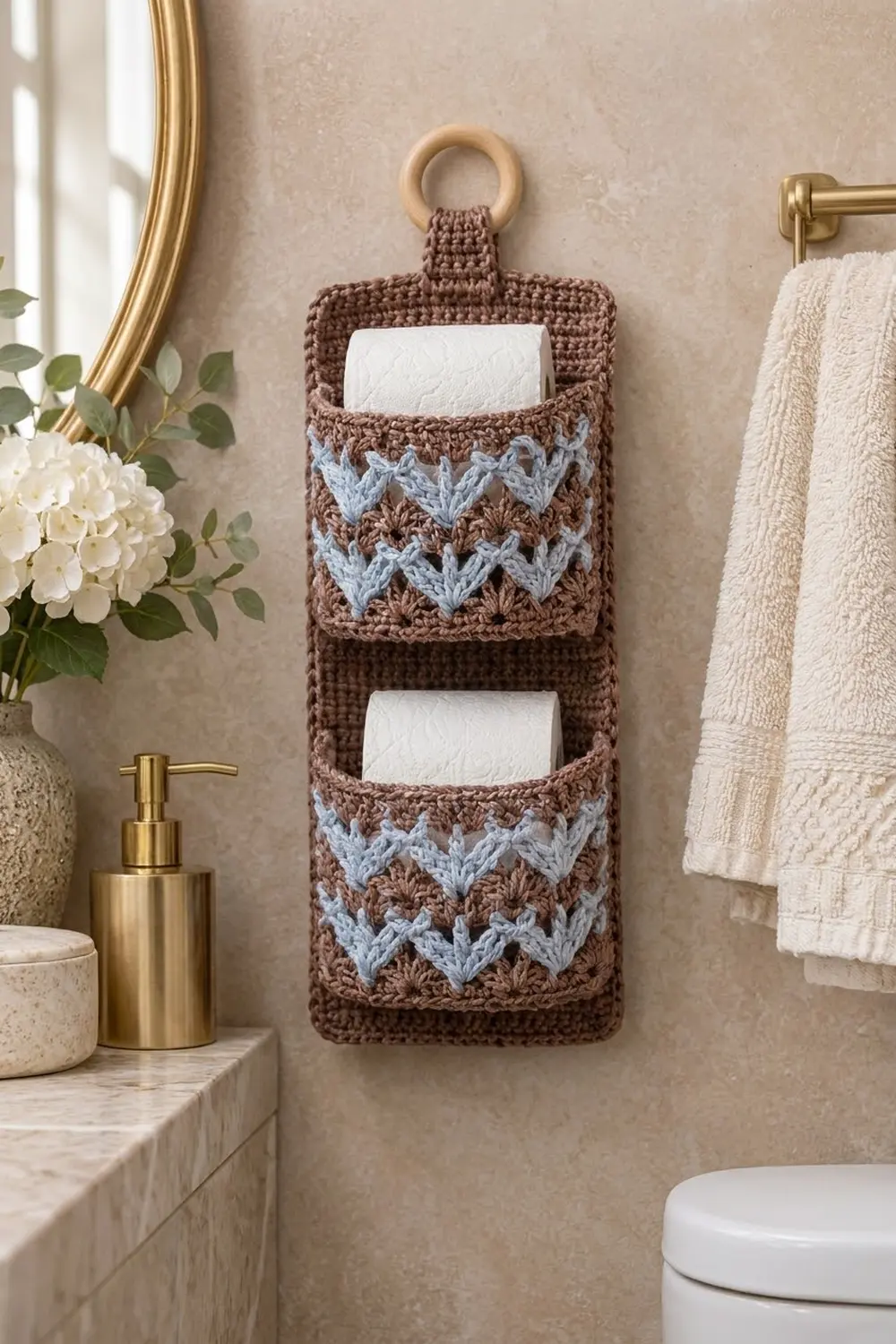
This hanging toilet paper holder keeps two spare rolls neat and close to hand. A long cocoa-brown panel hangs from a wooden ring, and two deep pockets sit on the front. Each pocket front has two bands of sky-blue V-fans that zigzag across the fabric, with small brown fans between them.
The look is soft and calm: a warm brown base, a cool light-blue accent, and plain single crochet everywhere except the pocket fronts. It suits a neutral bathroom with natural wood, brass, or stone accents.
This pattern uses US crochet terms. The finished panel measures 6.75 in (17.1 cm) wide by 20.5 in (52.1 cm) long, not counting the tab and ring. Each pocket is 6.75 in (17.1 cm) wide, 4.5 in (11.4 cm) tall, and about 3.1 in (7.9 cm) deep.
Construction is simple. You make one back panel and two pockets. Each pocket is a flat pocket front plus a long gusset strip. You sew the gussets to the fronts, sew the pockets onto the panel, work one border round, and then crochet the tab and fold it over the ring.
Finished Size and Construction
- Finished size: 6.75 in × 20.5 in (17.1 cm × 52.1 cm) panel, plus tab and ring
- Skill level: Easy–Intermediate
- Terminology: US
- Yarn weight: Worsted (#4), cotton or cotton blend
- Hook: 4.5 mm (US 7)
- Number of pieces: 5 crocheted pieces (1 back panel, 2 pocket fronts, 2 gussets), plus the tab worked from the border
- Layout: 2 pockets stacked vertically on 1 panel
- Pocket size: 6.75 in (17.1 cm) wide × 4.5 in (11.4 cm) tall × 3.1 in (7.9 cm) deep
- Panel size before border: 6.25 in × 20 in (15.9 cm × 50.8 cm)
- Border depth: 1 round of sc, about 0.25 in (0.6 cm) on each side
Materials
Pick a smooth worsted cotton or cotton blend. Cotton holds its shape, copes with bathroom humidity, and shows the fan texture clearly. Avoid fuzzy or very stretchy yarns, because the pockets need to keep their shape when full.
- Color A – Cocoa Brown: 280 g / 434 m (475 yd)
- Color B – Sky Blue: 25 g / 39 m (43 yd)
- 4.5 mm (US 7) crochet hook
- Wooden ring, 2 in (5.1 cm) inside diameter
- Tapestry needle
- 6 locking stitch markers
- Scissors, tape measure, blocking pins
These amounts include a margin of about 15%, which covers your gauge swatch and the color-change tails.
Abbreviations (US Terms)
- ch – chain
- sc – single crochet
- dc – double crochet
- sl st – slip stitch
- st(s) – stitch(es)
- sp – space
- sk – skip
- rep – repeat
- RS / WS – right side / wrong side
Special stitch – Arrow Fan (AF): (2 dc, ch 2, 2 dc) all in the same stitch. The outer dc of neighboring fans lean toward each other and meet at the sc between them, which gives the blue zigzag.
Gauge and Checkpoints
Gauge: 16 sc and 18 rows = 4 in (10.2 cm) in sc worked flat.
On the pocket front, the fan rows are tuned so that 25 sts also measure 6.25 in (15.9 cm), the same as the panel.
Make one pocket front first, as your test piece. If it measures 6.25 in (15.9 cm) wide and 4 in (10.2 cm) tall before its border, the rest of the pattern will fit.
Checkpoints:
- Panel after Row 20: 6.25 in (15.9 cm) wide, 4.4 in (11.2 cm) tall
- Panel after Row 90: 6.25 in × 20 in (15.9 cm × 50.8 cm)
- Pocket front after Row 12: 6.25 in × 4 in (15.9 cm × 10.2 cm)
- Pocket front after border: 6.75 in × 4.5 in (17.1 cm × 11.4 cm)
- Gusset: 15.25 in × 3.1 in (38.7 cm × 7.9 cm)
Too big? Go down half a hook size. Too small? Go up half a hook size. Don’t change the stitch counts, because every seam depends on them.
Back Panel
Use Color A.
Foundation: Ch 26.
Row 1 (RS): Sc in 2nd ch from hook and in each ch across. Turn. (25 sc)
Rows 2–90: Ch 1 (does not count as a st), sc in each st across. Turn. (25 sc)
Fasten off after Row 90 and weave in the ends. Count from the bottom: Row 1 is the bottom edge and Row 90 is the top edge.
Pocket Front (Make 2)
Odd rows are RS rows. To change color, work the last st of the row before the new color until 2 loops remain on the hook, then pull the new color through. Cut the old color and leave a 6 in (15.2 cm) tail.
Foundation (A): Ch 26.
Row 1 (RS): Sc in 2nd ch from hook and each ch across. Turn. (25 sc)
Row 2 (WS): Ch 1, sc in each st across, changing to B in the last st. Turn. (25 sc)
Row 3 (RS, B): Ch 1, sc in first st, sk 2 sts, AF in next st, sk 2 sts, sc in next st; rep from * 3 more times, changing to A in the last sc. Turn. (5 sc, 4 AF)*
Row 4 (WS, A): Ch 1, sc in first sc, ch 2, sc in ch-2 sp of next AF, ch 2, sc in next sc; rep from * 3 more times. Turn. (9 sc, 8 ch-2 sps)*
Row 5 (RS): Ch 1, sc in first sc, ch 1, 3 dc in next sc, ch 1, sc in next sc; rep from * 3 more times. Turn. (5 sc, 4 three-dc fans, 8 ch-1 sps)*
The ch-2 spaces of Row 4 are skipped. Each brown fan sits right above the center of a blue fan.
Row 6 (WS): Ch 1, sc in first sc, sc in ch-1 sp, sc in each of next 3 dc, sc in ch-1 sp, sc in next sc; rep from * 3 more times, changing to B in the last sc. Turn. (25 sc = 1 + 4 × 6)*
Row 7 (RS, B): Rep Row 3, changing to A in the last sc. (5 sc, 4 AF)
Row 8 (A): Rep Row 4. (9 sc, 8 ch-2 sps)
Row 9: Rep Row 5. (5 sc, 4 fans, 8 ch-1 sps)
Row 10: Rep Row 6, without the color change. (25 sc)
Rows 11–12: Ch 1, sc in each st across. Turn. (25 sc) Do not fasten off.
Pocket Front Border (A): Ch 1. Working around the piece, put 3 sc in each corner st. Work 23 sc across the top and the bottom between the corners. On each side, work 14 sc into the row ends: 1 sc per sc row (Rows 2, 4, 6, 8, 10, 11) and 2 sc per fan row (Rows 3, 5, 7, 9). Sl st to the first sc.
Count: 12 corner sc + (2 × 23) + (2 × 14) = 86 sc. Measured from corner center to corner center, each top and bottom edge has 27 sts and each side has 18 sts.
Fasten off. Weave in all color tails along the side edges.
Gusset (Make 2)
Use Color A.
Foundation: Ch 62.
Row 1: Sc in 2nd ch from hook and each ch across. Turn. (61 sc)
Rows 2–14: Ch 1, sc in each st across. Turn. (61 sc)
Fasten off and leave a 60 in (152.4 cm) tail for sewing.
Front edge (Row 14): Place markers in sts 18 and 44. This splits the edge into 18 / 27 / 18, and the marked sts are shared.
Back edge (foundation side): Place markers in sts 19 and 43. This splits the edge into 19 / 25 / 19, and the marked sts are shared.
Make All Pieces
- Color A only: 1 back panel, 2 gussets
- Colors A + B: 2 pocket fronts (B is used only in Rows 3 and 7)
Layout (panel seen from the front, RS facing):
          ( ring )
           [tab]
+-----------------------+  Row 90
|      plain panel      |  Rows 65–90
+-----------------------+
|     UPPER POCKET      |  Rows 46–64
+-----------------------+
|      plain panel      |  Rows 23–45
+-----------------------+
|     LOWER POCKET      |  Rows 4–22
+-----------------------+
|      plain panel      |  Rows 1–3
+-----------------------+  Row 1
Joining
Use the gusset tail and a whipstitch, working through one stitch on each side for every stitch.
Step 1 – Gusset to pocket front. Hold the gusset’s Row 14 edge against the pocket front border, wrong sides together. Start at one top corner center of the front.
- Gusset sts 1–18 → the 18 border sts down one side
- Gusset sts 18–44 → the 27 border sts across the bottom
- Gusset sts 44–61 → the 18 border sts up the other side
That makes 61 gusset sts matched to 61 border sts (86 − 27 + 2 = 61, because both top corner centers are shared). The pocket opening stays free: the front’s top edge and the gusset’s short ends.
Step 2 – Pocket to panel. Place markers on the panel at Rows 4 and 22 for the lower pocket, and at Rows 46 and 64 for the upper pocket. Sew the gusset’s foundation edge onto the RS of the panel:
- Gusset sts 1–19 → the posts of st 1 in Rows 22 down to 4 (19 rows)
- Gusset sts 19–43 → the posts of the 25 sc of Row 4
- Gusset sts 43–61 → the posts of st 25 in Rows 4 up to 22 (19 rows)
Again, 19 + 25 + 19 − 2 = 61. Repeat for the upper pocket, using Rows 46–64.
Tension: Pull each stitch snug but not tight. The seam should lie flat and shouldn’t make the panel pucker.
Size checkpoint: The panel should still measure 6.25 in (15.9 cm) wide. Each pocket should stand about 3.1 in (7.9 cm) deep when you open it.
Border
Border gauge: 1 sc in each stitch along the top and bottom, and 1 sc in each row end along the sides. Sc row ends in sc fabric lie flat at this ratio.
Round 1 (A): With the RS facing, join A in the top-right corner st. Ch 1, 3 sc in the corner st. Work 23 sc across the top, 3 sc in the corner, and 88 sc down the side (1 per row end, Rows 89–2). Then 3 sc in the corner, 23 sc across the bottom, 3 sc in the corner, and 88 sc up the side. Sl st to the first sc.
Count: 12 + (2 × 23) + (2 × 88) = 234 sc. Measured corner center to corner center, the top and bottom have 27 sts each and the sides have 92 sts each: (2 × 27) + (2 × 92) − 4 shared corners = 234.
Why the math works: The corners use st 1 and st 25 of the top and bottom rows, which leaves 23 sts between them. They also use the row ends of Rows 1 and 90, which leaves 88 row ends per side. The border adds about 0.25 in (0.6 cm) on every edge, so 6.25 in becomes 6.75 in (17.1 cm) and 20 in becomes 20.5 in (52.1 cm).
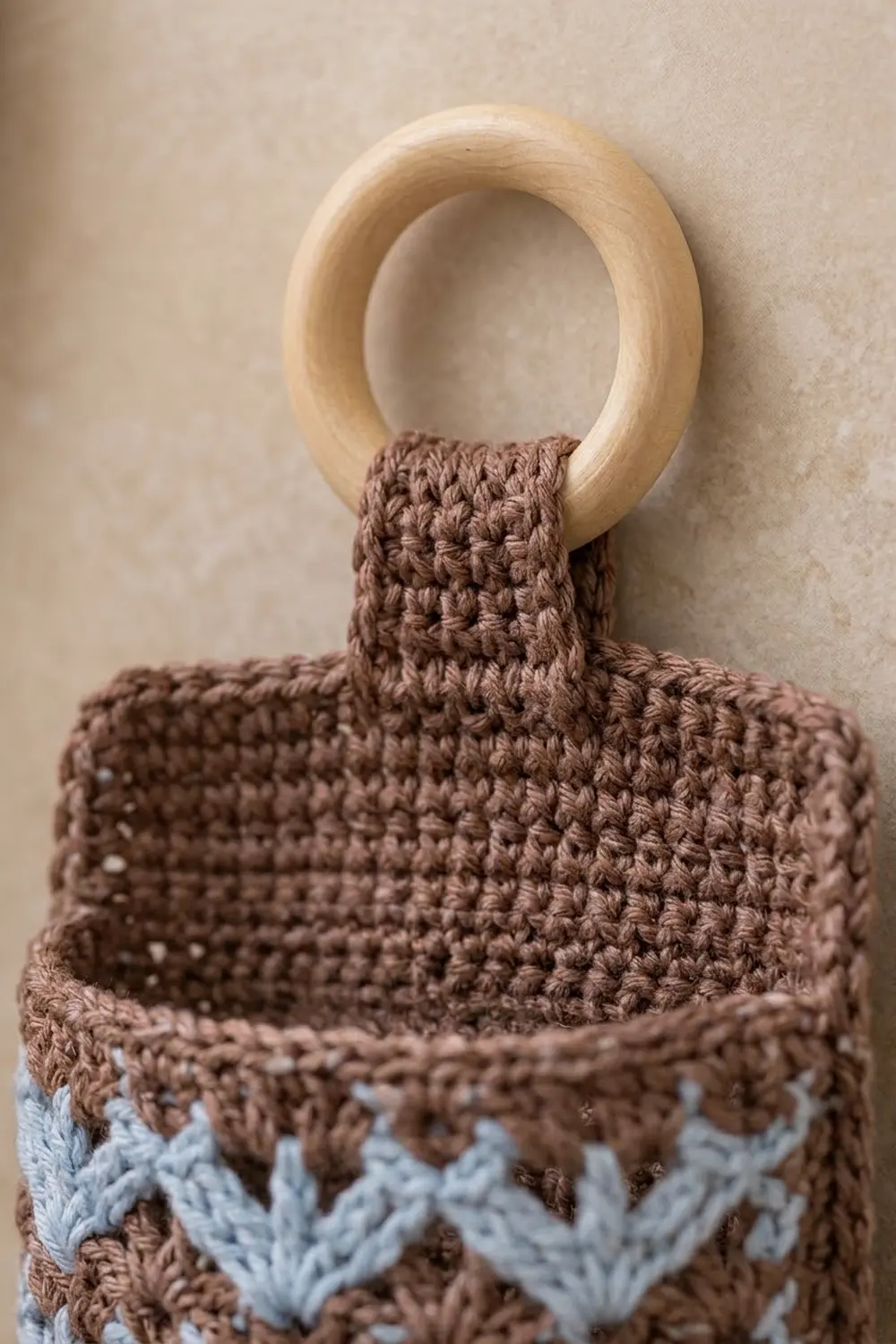
Hanging Tab: Count the 27 top sts from corner center to corner center. Skip 10, join A in the 11th st, and work Row 1 as 1 sc in each of the next 7 sts. (7 sc) Then, for Rows 2–22: ch 1, turn, sc in each st. (7 sc)
The tab is 1.75 in (4.4 cm) wide and 4.9 in (12.4 cm) long. Pass it through the ring, fold it to the WS, and sew the last row across the back of the panel, just below the border.
Final Blocking
- Weave in all ends first, especially the blue tails at the pocket edges.
- Mist the whole holder with water until it’s damp but not soaked.
- Pin the panel flat to 6.75 in × 20.5 in (17.1 cm × 52.1 cm).
- Push each pocket open from inside so the gusset stands up. A rolled towel or a spare toilet roll works well.
- Gently open each blue Arrow Fan so the zigzag lies even.
- Let it dry completely, at least 12 hours, before you take out the pins.
Final Quality-Control Checklist
- Panel is 6.75 in × 20.5 in (17.1 cm × 52.1 cm) and its edges are straight
- Border is 234 sc with crisp 3-sc corners
- Each pocket front has two blue bands of 4 Arrow Fans each
- Every gusset seam matches 61 sts to 61 sts
- Pockets line up with each other and with the panel edges
- Tab is centered over 7 sts and firmly sewn behind the panel
- Ring hangs straight and the panel doesn’t twist
- No loose tails show on the RS
Troubleshooting
Pocket front is wider than the panel. Your fan rows are loose. Work the dc in Rows 5 and 9 more snugly, or use a 4.0 mm hook for Rows 3–10 only.
Blue fans don’t meet in a zigzag. Check that you skipped exactly 2 sts on each side of every AF in Rows 3 and 7.
Side edges of the pocket front ripple. Work 1 sc instead of 2 into each fan-row end. Then remove 1 sc from the matching gusset section so the counts still match.
Gusset seam won’t line up. Recount the 61 sts and check the marker positions (18/44 on the front edge, 19/43 on the back edge).
Panel pulls in at the pockets. Your seam tension is too tight. Unpick the seam and sew it again more loosely.
Holder tilts. The tab is off-center. Re-join it at the 11th of the 27 top sts.
Care
Hand wash in cool water with mild soap, press out the water in a towel, and dry flat, reshaping the pockets while damp. Don’t tumble dry.
Final Notes
The measurement chain is short. 25 sts give 6.25 in (15.9 cm) on both the panel and the pocket fronts. The pocket front border gives 86 sts, and 61 of them meet the 61-st gusset. The gusset’s other edge meets the panel along 19 + 25 + 19 sts. Finally, the 234-st border brings the panel to 6.75 in × 20.5 in (17.1 cm × 52.1 cm). If each count matches at its checkpoint, the holder hangs straight and holds both rolls neatly.
Happy crocheting!