

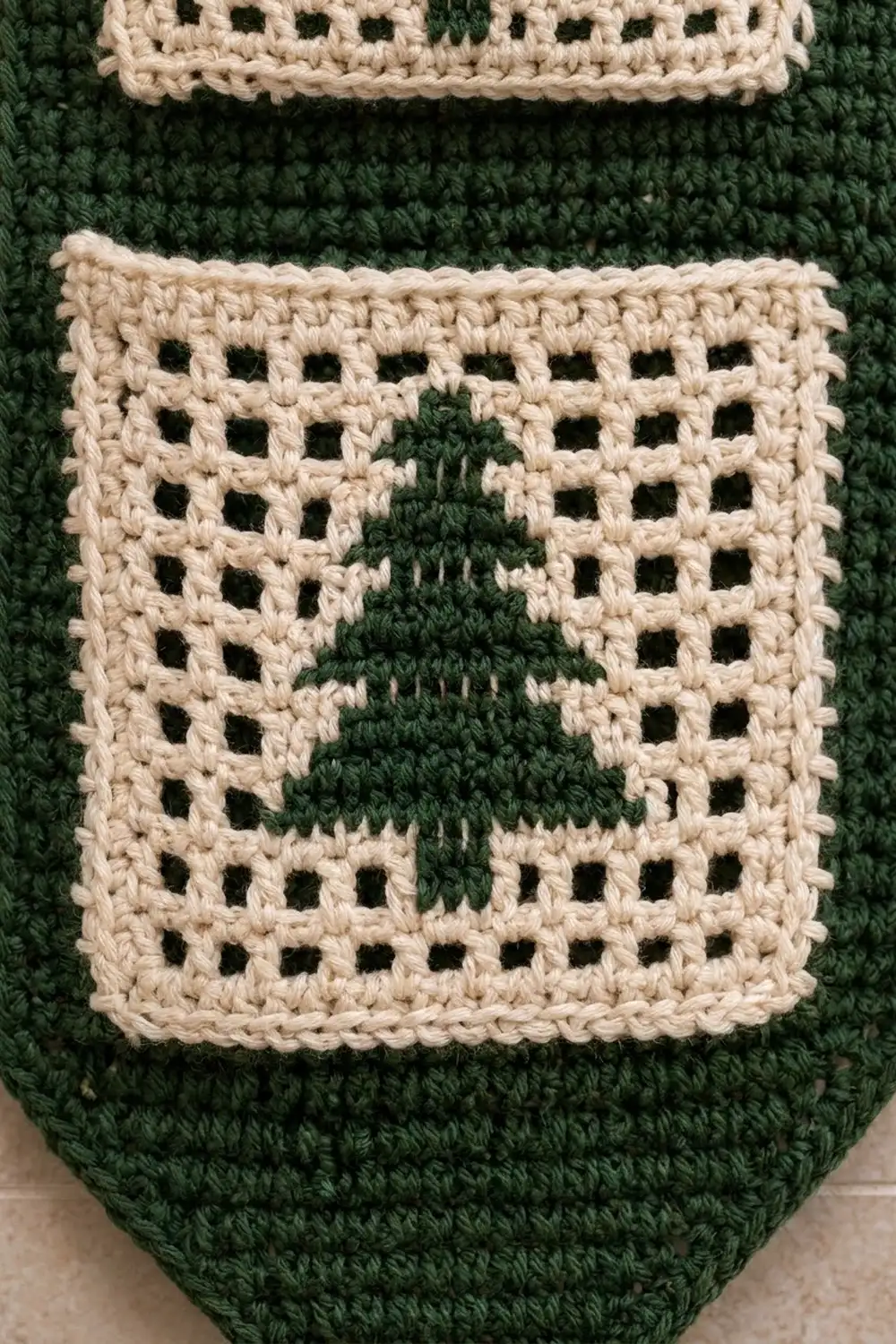
This hanging toilet paper holder has a deep forest-green backing panel and three cream filet-mesh pockets. Each pocket has a stepped evergreen tree worked in solid green blocks. The holder hangs from a wooden ring, so a towel hook or wall hook is all you need. It looks festive in December but quiet enough to leave up all winter.
It uses two colors: dark green for the panel and trees, and cream for the pockets and sewing. The open mesh shows a little of the green panel behind it, which makes the trees stand out.
This pattern uses US crochet terms. The finished holder is 7.5 in (19.1 cm) wide and hangs about 27 in (68.6 cm) from the bottom point to the top of the ring fold. Each pocket is 10.5 in (26.7 cm) wide and 5.5 in (14.0 cm) tall when laid flat.
You work the panel bottom-up in single crochet. It starts at the point, grows to full width, runs straight, then narrows to a tab. You work the pockets flat in filet crochet with a single crochet edge. You then sew the pockets on, add a green border to the panel, and fold the tab around the ring.
Finished Size and Construction
- Finished size: 7.5 in (19.1 cm) wide × about 27 in (68.6 cm) hanging length
- Skill level: Intermediate (filet color changes, easing seams)
- Terminology: US
- Yarn weight: Worsted (#4)
- Hook: 5.0 mm (H-8)
- Number of pieces: 4 crocheted pieces (1 panel, 3 pockets) plus 1 wooden ring
- Layout: 3 pockets stacked vertically on 1 panel
- Pocket size: 10.5 × 5.5 in (26.7 × 14.0 cm) flat; 10 × 5 in (25.4 × 12.7 cm) before the pocket edge
- Panel size before border: 7 in (17.8 cm) wide × 28.4 in (72.1 cm) long, unfolded
- Border depth: 0.25 in (0.6 cm), 1 round of sc
Materials
Use a smooth worsted-weight yarn: acrylic, cotton-acrylic blend, or soft cotton. A firm, low-fuzz yarn shows the filet squares best and keeps the panel stiff enough to carry three rolls.
- Dark green: 150 g / 300 m (about 328 yd)
- Cream: 80 g / 160 m (about 175 yd)
These amounts include a margin of about 15–20% for swatching and sewing.
Tools:
– 5.0 mm (H-8) crochet hook
– Wooden ring, 3 in (7.6 cm) outer diameter
– Tapestry needle
– Stitch markers (at least 6)
– Measuring tape
– Blocking mat and rust-proof pins
– Scissors
Abbreviations (US Terms)
- ch: chain
- sc: single crochet
- dc: double crochet
- sc2tog: single crochet 2 together
- sk: skip
- st(s): stitch(es)
- sp: space
- RS / WS: right side / wrong side
Special technique: filet stitch numbering. Each pocket row has 35 sts. Odd-numbered sts (1, 3, 5 … 35) are always dc “posts.” Even-numbered sts are either open (ch 1, sk 1) or filled (dc into the ch-1 sp or st below). One square is a post plus the st beside it, so 17 squares make 35 sts. In a green run, every st in the stated range is a green dc, including both posts at its ends.
Color change: Work the last dc before the change until 2 loops remain on the hook. Then yarn over with the new color and pull through.
Gauge and Checkpoints
- Single crochet (panel): 16 sts and 18 rows = 4 in (10.2 cm), so 4 sts and 4.5 rows per inch
- Filet / dc (pocket): 14 sts and 8 rows = 4 in (10.2 cm), so one mesh square is about 0.57 in (1.4 cm)
Make one pocket first. It is the quickest real gauge test. Before adding its edge, it should measure 10 × 5 in (25.4 × 12.7 cm).
Checkpoints:
– Pocket after Row 10: 10 × 5 in (25.4 × 12.7 cm)
– Pocket after edge: 10.5 × 5.5 in (26.7 × 14.0 cm)
– Panel after Row 14: 7 in (17.8 cm) wide, 3.1 in (7.9 cm) tall
– Panel after Row 104: 23.1 in (58.7 cm) long
– Panel after Row 114: 25.3 in (64.3 cm) long
– Panel after Row 128: 28.4 in (72.1 cm) long
If your piece is too big, go down 0.5 mm. If it’s too small, go up 0.5 mm. Panel width matters most, because the pocket seams are counted to its 28 sts.
Backing Panel (Make 1, Dark Green)
Bottom point (increasing):
Row 1: Ch 3, sc in 2nd ch from hook and in next ch. (2 sc)
Row 2: Ch 1, turn, 2 sc in each st. (4 sc)
Row 3: Ch 1, turn, 2 sc in first st, sc in each st to last st, 2 sc in last st. (6 sc)
Rows 4–14: Repeat Row 3. Each row has 2 more sts than the last, so Row n has 2 × n sts. (Row 14: 28 sc)
Checkpoint: 7 in (17.8 cm) wide, 3.1 in (7.9 cm) tall.
Body:
Rows 15–104: Ch 1, turn, sc in each st across. (28 sc per row, 90 rows)
Body length is 20 in (50.8 cm). Place markers at the ends of Rows 18, 48, and 78. These are the bottom seam rows for the pockets.
Shoulders (decreasing):
Row 105: Ch 1, turn, sc2tog, sc in each st to last 2 sts, sc2tog. (26 sc)
Rows 106–114: Repeat Row 105. (Row 114: 8 sc)
Tab:
Rows 115–128: Ch 1, turn, sc in each st across. (8 sc per row)
Fasten off and weave in ends. The tab is 2 in (5.1 cm) wide and 3.1 in (7.9 cm) long.
Pocket (Make 3, Cream with Green Trees)
With cream, ch 37.
Row 1 (solid bottom row): Dc in 4th ch from hook and in each ch across. The skipped 3 ch count as st 1. (35 sts)
Row 2 (open): Ch 4, turn (counts as st 1 dc plus st 2 ch-1). Sk next st, dc in next st (st 3), ch 1, sk 1, dc in next st, repeat to end. Work the last dc in the top of the turning ch. (35 sts, 17 open squares)
From here on, start every row the same way. If st 2 is open: ch 4, turn. Each open st is ch 1, sk 1. Each post is a dc in the post below. Each filled st is a dc in the ch-1 sp or dc below. The tree is symmetric around square 9, so the green ranges below work in either direction.
- Row 3: Green sts 17–19 (trunk, 1 square). All other sts cream mesh.
- Row 4: Green sts 11–25 (7 squares).
- Row 5: Green sts 13–23 (5 squares).
- Row 6: Green sts 13–23 (5 squares).
- Row 7: Green sts 15–21 (3 squares).
- Row 8: Green sts 15–21 (3 squares).
- Row 9: Green sts 17–19 (1 square, treetop).
- Row 10: All open mesh in cream.
Each row has 35 sts.
Carrying colors: Hide the cream inside the green dc as you work across each green run. Leave the green on the WS at the end of its run. On the next row, bring it loosely across no more than 6 sts and catch it under the first green st. The back of the pocket faces the panel, so short carries won’t show.
Checkpoint: 10 × 5 in (25.4 × 12.7 cm).
Pocket edge (cream): Don’t fasten off. Turn the work so you can go around all four sides.
Rnd 1: 3 sc in the top corner st, sc in the next 33 sts, 3 sc in the last top st. Work 20 sc down the side (2 sc per dc row-end). 3 sc in the first foundation ch, sc in the next 33 foundation chs, 3 sc in the last foundation ch. Work 20 sc up the second side. Sl st to the first sc. (118 sc)
Counts per side: Top and bottom have 37 sts each, including the center sc of each corner group. Each side has 24 sts, including both corners. Check: 37 + 37 + 24 + 24 − 4 shared corners = 118. ✓
Fasten off, leaving a 48 in (121.9 cm) cream tail for sewing. Block flat to 10.5 × 5.5 in (26.7 × 14.0 cm).
Make All Pieces
- Dark green panel: 1
- Cream pockets with green trees: 3, each with a 48 in (121.9 cm) tail
- Wooden ring: 1
Layout on the panel (bottom to top):
Rows 115–128   [ tab ]
Rows 105–114   [ shoulders ]
Rows 102–104   margin
Rows 78–101    [ POCKET 3 ]
Rows 72–77     gap
Rows 48–71     [ POCKET 2 ]
Rows 42–47     gap
Rows 18–41     [ POCKET 1 ]
Rows 15–17     margin
Rows 1–14      [ point ]
Check: 3 + 24 + 6 + 24 + 6 + 24 + 3 = 90 body rows. ✓
Joining
Sew the pockets to the RS of the panel with the cream tail and a whipstitch. Go through the back loop of each pocket edge sc and fully under one panel st.
Bottom seam (Pocket 1, panel Row 18): The pocket’s bottom side has 37 sts. The panel row has 28 sts. Ease the extra 9 sts into the center:
- Sew pocket sts 1–5 to panel sts 1–5, one to one.
- Sew 3 pocket sts to 2 panel sts, 9 times. This joins pocket sts 6–32 to panel sts 6–23.
- Sew pocket sts 33–37 to panel sts 24–28, one to one.
Check: 5 + 27 + 5 = 37 pocket sts, and 5 + 18 + 5 = 28 panel sts. ✓ The eased center pulls the pocket bottom into a shallow cup.
Side seams: The bottom corner is already attached. Sew the remaining 23 side sts, ending with the top corner, to the outermost panel st (st 1 on one side, st 28 on the other) in Rows 19–41. Use 1 pocket st per panel row. The pocket side stretches very slightly to fit, which keeps it upright.
The pocket’s 37-st top edge is not sewn. Because it is wider than the 28-st panel, it bows forward about 2.5 in (6.4 cm) to hold the roll.
Repeat for Pocket 2 (bottom Row 48, sides Rows 49–71) and Pocket 3 (bottom Row 78, sides Rows 79–101).
Tension: Pull each stitch snug but not tight. The seam should lie flat, not pucker the green.
Checkpoint: Each pocket covers 24 panel rows, or 5.3 in (13.5 cm). The gaps between pockets are 1.3 in (3.3 cm).
Border
Border gauge: 4 sc per inch along straight edges, 1 sc per row-end on vertical edges. That matches the sc row gauge closely enough to lie flat.
Join dark green in the first st of Row 128 (top of the tab).
Rnd 1:
– Tab top: 3 sc in the first st, sc in the next 6 sts, 3 sc in the last st. (12 sc)
– Tab side: 1 sc in each row-end of Rows 127–115. (13 sc)
– Shoulder: Over Rows 114–105, sc in the next 2 row-ends, 2 sc in the next row-end 3 times, then sc in the last row-end. (13 sc over 10 row-ends)
– Body side: 1 sc in each row-end of Rows 104–15. (90 sc) Work behind the pocket edge where the two meet.
– Bottom diagonal: Over Rows 14–1, sc, sc, 2 sc in the next 3 row-ends, 4 times, then sc in the last 2 row-ends. (18 sc over 14 row-ends)
– Tip: 2 sc in each of the 2 foundation loops of Row 1. (4 sc)
– Second side: Work 18 sc up the bottom diagonal, 90 sc up the body, 13 sc up the shoulder, and 13 sc up the tab, in the same way.
– Sl st to the first sc. (284 sc)
Check: 12 + 13 + 13 + 90 + 18 + 4 + 18 + 90 + 13 + 13 = 284. ✓
Why the math works: Vertical edges match row gauge 1:1. Each diagonal row moves 1 st (0.25 in / 0.6 cm) sideways and 1 row up. That makes each diagonal step longer than one row height, so it needs about 4 sc per 3 rows. The extra sc keep the angled edges from pulling in.
Fasten off and weave in ends. The panel now measures 7.5 in (19.1 cm) wide.
Attach the ring: Pass the tab through the wooden ring from front to back. Fold the top 7 rows (Rows 122–128, 1.6 in / 4.1 cm) behind the panel. Whipstitch the bordered tab edge across the back of Row 121 with green yarn. The hanging length from the bottom tip to the fold is now about 27 in (68.6 cm).
Final Blocking
- Spray the whole holder lightly with water, or steam acrylic from above without touching it.
- Pin the panel flat to 7.5 in (19.1 cm) wide. Keep the long sides straight and parallel.
- Pin the bottom point and shoulders symmetrically.
- Stuff each pocket with a rolled towel so it dries in a rounded shape.
- Gently square the filet holes with your fingertips.
- Let it dry completely before removing pins.
Final Quality-Control Checklist
- Each pocket has 17 squares across and 10 rows, with a tree centered on square 9
- Each pocket edge has 118 sc
- Each pocket bottom seam joins 37 pocket sts to 28 panel sts
- Pockets sit at Rows 18–41, 48–71, and 78–101
- The panel border has 284 sc and lies flat
- The tab is folded at Row 121 and sewn securely
- The holder hangs straight, with the pockets level
- All ends are woven in on the WS
Troubleshooting
Mesh squares look tall and narrow: Your dc are loose. Go down a hook size, or chain more firmly.
Tree edges look ragged: Change color on the last yarn-over of the dc before the run, not after it.
Green carries show through the holes: Shorten the carries, and keep them behind solid green sts.
Pocket won’t hold a roll: Re-sew the bottom seam with all 9 eased groups centered.
Panel edges ripple: You have too many border sc. Skip the extra 2-sc increases on the diagonals.
Holder sags or stretches: Use a firmer yarn, or go down to a 4.5 mm hook for the panel.
Care
Hand wash in cool water and lay flat to dry, reshaping the pockets while damp. Don’t hang it to dry wet, because the weight will stretch the panel.

Final Notes
Every measurement here builds on the one before it:
– The panel’s 28 sts at 4 sts per inch give 7 in (17.8 cm). The border brings it to 7.5 in (19.1 cm).
– Each pocket’s 35 sts at 3.5 sts per inch give 10 in (25.4 cm). Its edge brings it to 10.5 in (26.7 cm).
– Easing 37 pocket sts onto 28 panel sts turns each flat pocket into a cup.
– Three 24-row pockets with 3-row margins and 6-row gaps fill the 90-row body exactly.
Check your gauge on the first pocket, count at each checkpoint, and the finished holder will come out at the stated size.
Happy crocheting!