

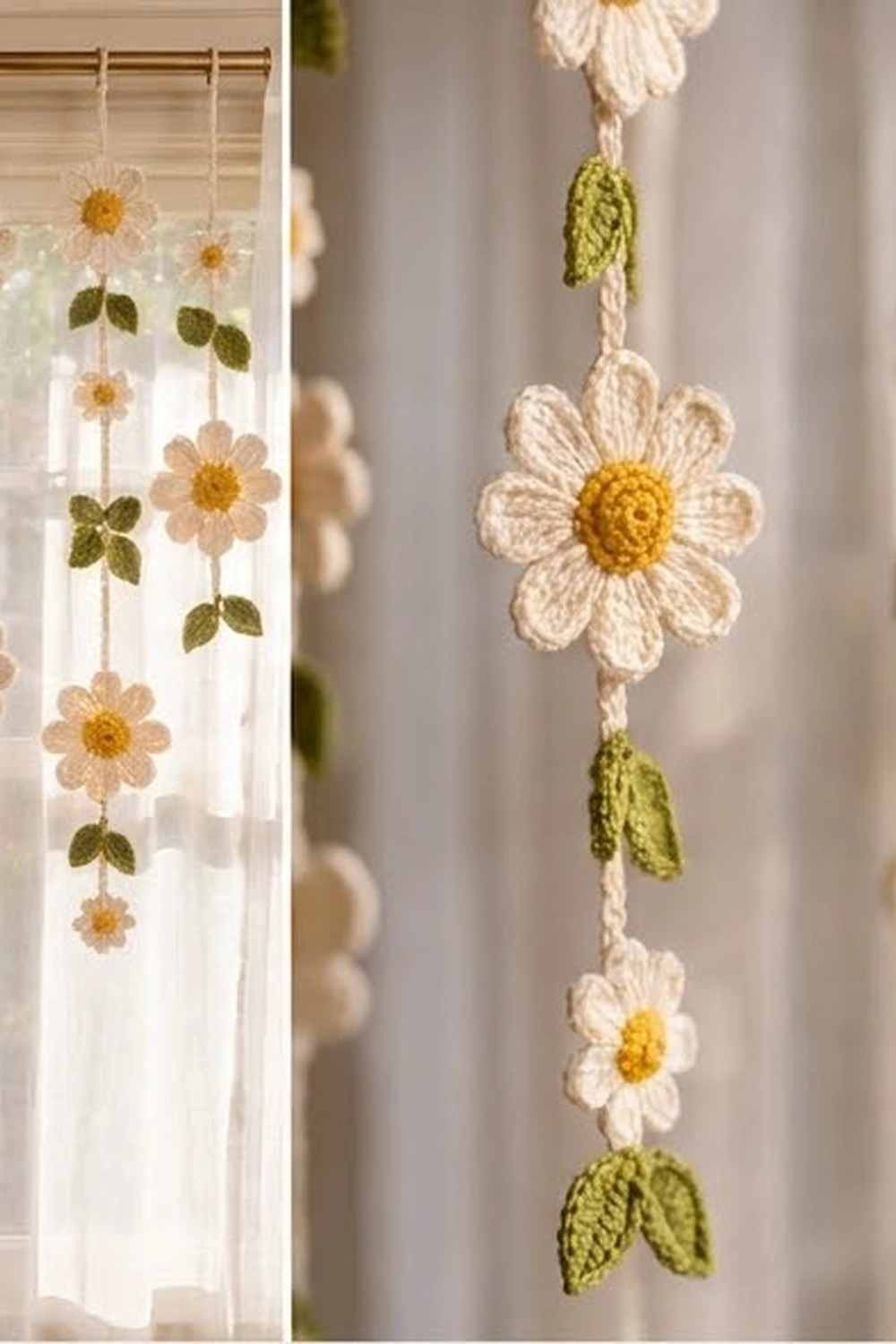
This hanging curtain is made of cream-and-mustard daisies spaced along slim cream cords, with pairs of olive-green leaves between them. Each strand alternates large and small daisies, so light passes through and the flowers seem to float in front of the window.
The palette is soft cream for the petals and cord, warm mustard for the flower centers, and olive green for the leaves. It suits a farmhouse or cottage look, and it works just as well in a kitchen window or a nursery as across a doorway. All instructions use US crochet terms.
One strand measures 33.5 in (85.1 cm) from the top of its hanging loop to the bottom tail. The large daisies are 3.5 in (8.9 cm) across, the small daisies 2.5 in (6.4 cm), and the leaves 2 in (5.1 cm) long. The curtain in the photo uses seven identical strands.
You’ll crochet the daisies in the round, the leaves around a foundation chain, and the cord as a chain with a slip-stitch return row. Then you sew the daisies and leaf pairs to the cord at marked chain positions. Because every piece is measured against the cord gauge, everything sits where it should.
Finished Size and Construction
- Strand size: 33.5 in (85.1 cm) long, 3.5 in (8.9 cm) at its widest
- Skill level: Easy–intermediate
- Terminology: US crochet terms
- Yarn weight: DK (light, #3) cotton
- Hook: 3.5 mm (E-4)
- Pieces per strand: 14 (3 large daisies, 2 small daisies, 8 leaves, 1 cord)
- Layout per strand: large daisy, leaf pair, small daisy, leaf pair, large daisy, leaf pair, small daisy, leaf pair, large daisy
- Piece sizes: large daisy 3.5 in (8.9 cm); small daisy 2.5 in (6.4 cm); leaf 2 in × 1 in (5.1 × 2.5 cm)
- Size before border: cord body 31.5 in (80.0 cm), plus a 4 in (10.2 cm) chain loop
- Border depth: there’s no frame border. The loop edging adds about 0.25 in (0.6 cm) of thickness only.
Materials
Choose a smooth, mercerized DK cotton with good stitch definition, about 125 m per 50 g. Cotton holds the petal shapes, resists stretching on long hanging cords, and survives sunlight better than acrylic.
Yarn for one strand:
– Cream: 22 g (55 m)
– Mustard yellow: 7 g (18 m)
– Olive green: 12 g (30 m)
Yarn for a 7-strand curtain:
– Cream: 200 g (500 m)
– Mustard yellow: 50 g (125 m)
– Olive green: 100 g (250 m)
The curtain quantities include a margin of roughly 15% for swatching, tails, and sewing.
Tools:
– 3.5 mm (E-4) hook
– Tapestry needle
– Locking stitch markers (about 10 per strand)
– Scissors
– Tape measure
– Blocking mat and rust-proof pins
– Spray bottle
Abbreviations (US Terms)
- ch – chain
- sl st – slip stitch
- sc – single crochet
- hdc – half double crochet
- dc – double crochet
- tr – treble crochet
- sk – skip
- st(s) – stitch(es)
- MR – magic ring
- BB – back bump of a chain
Special stitch – back-bump slip stitch (BB sl st): Insert the hook under the horizontal bump on the back of the chain, yarn over, and pull through the chain and the loop on the hook. This makes a firm, non-stretch cord with a neat chain face on the front.
Gauge and Checkpoints
- Stitch gauge: 5 sc = 1 in (2.5 cm)
- Cord gauge: 4 ch = 1 in (2.5 cm), measured after the BB sl st return row
Make one large daisy, one small daisy, one leaf, and a 20-ch test cord before you start the rest. Check them against these measurements:
- Large daisy center after Rnd 2: 1.25 in (3.2 cm)
- Large daisy finished: 3.5 in (8.9 cm), tip to opposite tip
- Small daisy center after Rnd 2: 1 in (2.5 cm)
- Small daisy finished: 2.5 in (6.4 cm)
- Leaf: 2 in (5.1 cm) long, 1 in (2.5 cm) wide
- Test cord: 20 ch = 5 in (12.7 cm)
If your pieces come out too big, go down 0.25 mm in hook size. If they’re too small, go up 0.25 mm. Keep the motif gauge and the cord gauge matched. The daisy spans on the cord are set to equal the daisy diameters, so if one is off, the daisies will crowd or gap.
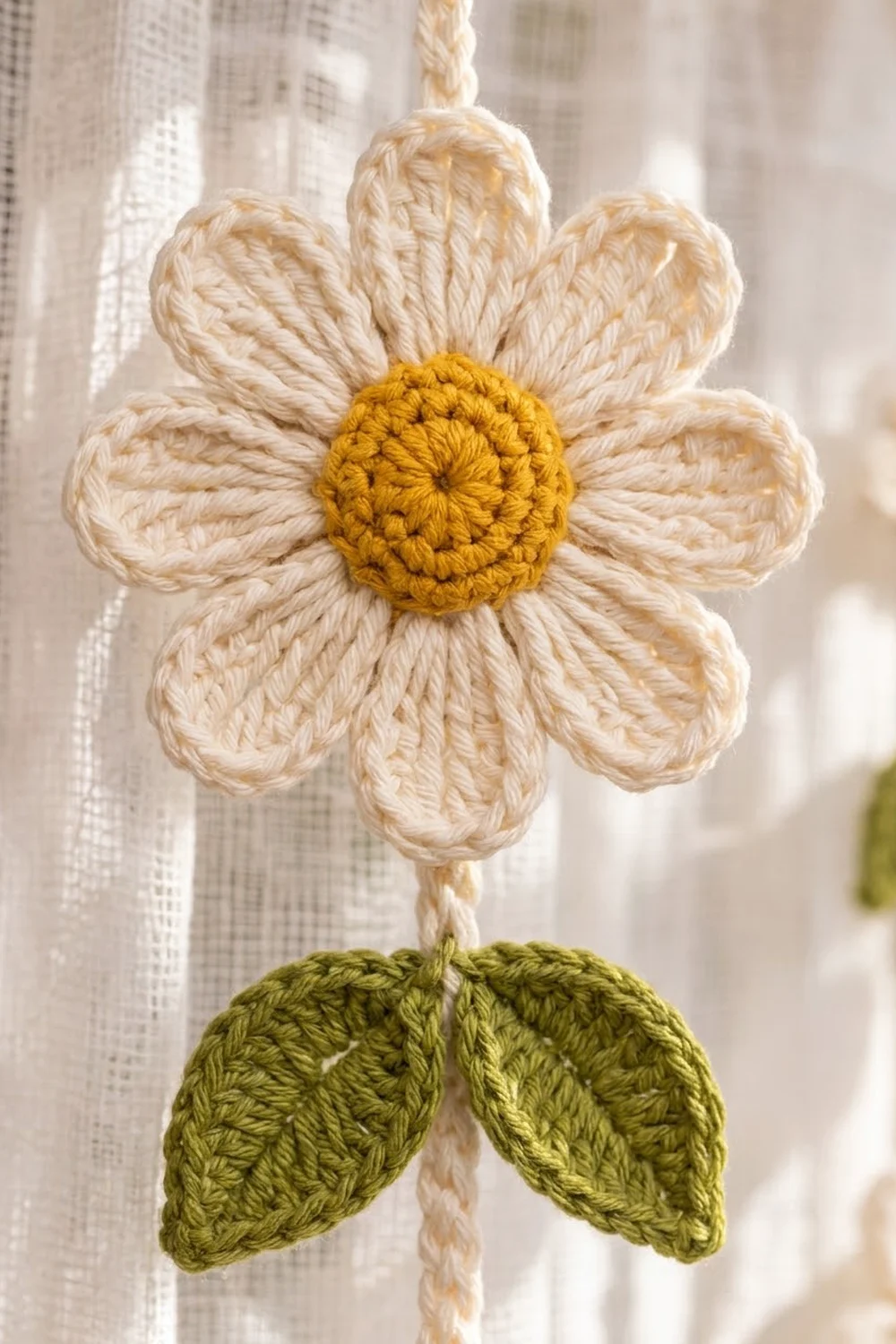
Large Daisy (Make 3 per Strand)
Center (mustard)
Rnd 1: Work 10 sc in a MR. Sl st to the first sc. (10 sts)
Rnd 2: Ch 1, 2 sc in each st around. Sl st to the first sc. (20 sts)
Fasten off the mustard. Checkpoint: the center measures 1.25 in (3.2 cm).
Petals (cream)
Rnd 3: Join cream with a sl st in any st. Ch 1, sc in the same st, ch 7, sk next st. Sc in next st, ch 7, sk next st. Repeat from * 8 more times. Sl st to the first sc. (10 sc and 10 ch-7 loops; all 20 sts of Rnd 2 used)
Rnd 4: In the next ch-7 loop work (sc, hdc, 2 dc, 2 tr, 2 dc, hdc, sc), then sl st in the next sc of Rnd 3. Repeat from * around. (10 petals of 10 sts each = 100 petal sts, plus 10 sl sts)
Fasten off and weave in the ends. Each petal grows from short sides to a rounded tr tip, which gives the oval petal shape in the photo. Checkpoint: 3.5 in (8.9 cm) across.
Small Daisy (Make 2 per Strand)
Center (mustard)
Rnd 1: Work 8 sc in a MR. Sl st to the first sc. (8 sts)
Rnd 2: Ch 1, 2 sc in each st around. Sl st to the first sc. (16 sts)
Fasten off the mustard. Checkpoint: 1 in (2.5 cm).
Petals (cream)
Rnd 3: Join cream in any st. Ch 1, sc in the same st, ch 5, sk next st. Sc in next st, ch 5, sk next st. Repeat from * 6 more times. Sl st to the first sc. (8 sc and 8 ch-5 loops; all 16 sts used)
Rnd 4: In the next ch-5 loop work (sc, hdc, 3 dc, hdc, sc), then sl st in the next sc. Repeat from * around. (8 petals of 7 sts each = 56 petal sts, plus 8 sl sts)
Fasten off. Checkpoint: 2.5 in (6.4 cm) across.
Both daisies have an even number of petals, so one petal tip always sits directly opposite another. That lets the cord pass straight from the top tip to the bottom tip.
Leaf (Make 8 per Strand)
With olive green: Ch 9.
Rnd 1:
1. Starting in the 2nd ch from the hook, work sc, hdc, dc in each of the next 4 ch, hdc. (7 sts)
2. Work 3 sc in the last ch. This is the leaf base.
3. Rotate the work and continue along the opposite side of the foundation chain: hdc, dc in each of the next 4 ch, hdc, sc. (7 sts)
4. Ch 2 and sl st to the first sc to form the pointed tip.
(17 sts plus the ch-2 tip)
Vein: With green, surface sl st from the base to the tip along the center of the foundation chain to make the raised vein. Fasten off and leave a 6 in (15.2 cm) tail at the base for sewing.
Checkpoint: 2 in (5.1 cm) long, 1 in (2.5 cm) wide.
Cord (Make 1 per Strand)
With cream:
1. Ch 16 and sl st in the first ch to form the hanging loop. The loop is 4 in (10.2 cm) around and hangs 2 in (5.1 cm) deep.
2. Ch 126 more for the cord body.
3. Return row: Starting in the 2nd ch from the hook, work a BB sl st in each ch back toward the loop. The ch at the tip counts as a st, so you have 126 sts in total. Sl st into the loop joining point.
Do not fasten off yet; you’ll finish the loop in the Border section.
Checkpoint: the cord body measures 31.5 in (80.0 cm), which is 126 ch ÷ 4 ch per in.
Mark the cord from the loop end downward, counting chains:
| Position | Chains | Length |
|---|---|---|
| Top lead | 1–12 | 3 in (7.6 cm) |
| Large daisy 1 (L1) | 13–26 | 3.5 in |
| Leaf node 1 | 32 | — |
| Small daisy 1 (S1) | 39–48 | 2.5 in |
| Leaf node 2 | 54 | — |
| Large daisy 2 (L2) | 61–74 | — |
| Leaf node 3 | 80 | — |
| Small daisy 2 (S2) | 87–96 | — |
| Leaf node 4 | 102 | — |
| Large daisy 3 (L3) | 109–122 | — |
| Tail | 123–126 | 1 in (2.5 cm) |
Each gap between daisies is 12 ch, or 3 in (7.6 cm), with the leaf node on the 6th ch of the gap. Sum check: 12 + 14 + 12 + 10 + 12 + 14 + 12 + 10 + 12 + 14 + 4 = 126 ✓
Make All Pieces
For one strand:
– Mustard: 5 daisy centers
– Cream: 3 large daisy petal rounds, 2 small daisy petal rounds, 1 cord
– Green: 8 leaves
For a 7-strand curtain:
– 21 large daisies
– 14 small daisies
– 56 leaves
– 7 cords
Strand layout (top to bottom):
   ( O )  hanging loop
     |    ch 1–12
   [ L ]  ch 13–26
    \|/   leaves at ch 32
   [ s ]  ch 39–48
    \|/   leaves at ch 54
   [ L ]  ch 61–74
    \|/   leaves at ch 80
   [ s ]  ch 87–96
    \|/   leaves at ch 102
   [ L ]  ch 109–122
     |    tail ch 123–126
Curtain layout (7 strands, spaced 5 in / 12.7 cm apart):
 |  |  |  |  |  |  |
 1  2  3  4  5  6  7
Optional stagger, as in the photo: For strands 2, 4, and 6, add 12 ch to the top lead. Those cords become 138 ch, or 34.5 in (87.6 cm), and the full strand becomes 36.5 in (92.7 cm). Shift every marker on those strands down by 12.
Joining
Use cream yarn and a tapestry needle to whipstitch the daisies to the back of the cord.
Stitch-to-stitch logic (large daisy):
1. Tack the tr tip of the top petal to the first ch of the daisy’s span, for example ch 13 for L1.
2. Tack the back of the center (Rnd 2) to the middle of the span, ch 19–20.
3. Tack the tr tip of the opposite petal to the last ch of the span, ch 26.
The span is 14 ch, which equals 3.5 in (8.9 cm), the same as the daisy’s diameter. That’s why the cord stays straight behind the flower.
Small daisy: Tack the top tip to the first ch of its span (ch 39 for S1), the center to ch 43–44, and the bottom tip to ch 48. The 10-ch span equals 2.5 in (6.4 cm), the daisy’s diameter.
Leaf pairs: Lay two leaves with their 3-sc bases touching the node ch. Angle the tips up and outward at about 45° on each side to form a V. Whipstitch both bases to the cord with their green tails, passing through the cord 3 times.
Tension: Pull each tack snug but not tight. If a tack puckers the cord, the strand will shorten and the daisies will tilt.
Size checkpoint: Hang the finished strand. It should measure 33.5 in (85.1 cm) overall.
Border (Loop Finish)
A hanging strand has no frame border. The BB sl st return row is the cord’s finished edge. The only edging is on the hanging loop, which takes the strand’s weight on the rod.
Border gauge: 4 sc = 1 in (2.5 cm) around the chain loop, matching the cord gauge.
Loop round: Continuing from the cord, work 16 sc into the ch-16 loop and sl st to the first sc. Fasten off and weave in the end.
Why the math works: The loop has 16 ch, and you work 16 sc into it, one per ch. Working them 1:1 keeps the circumference at 4 in (10.2 cm) instead of flaring or tightening it. The loop fits rods up to 1 in (2.5 cm) in diameter, since that rod’s circumference is about 3.14 in (8.0 cm), so the loop still slides.
Final Blocking
- Spray each daisy and leaf lightly until damp.
- Pin each large daisy to 3.5 in (8.9 cm) and each small daisy to 2.5 in (6.4 cm), with one pin at every petal tip.
- Pin each leaf to 2 in × 1 in (5.1 × 2.5 cm), pulling the tip to a point.
- Let everything dry completely.
- Hang the joined strand from a hook with a light clip on the tail. Mist the cord and let it dry straight.
Final Quality-Control Checklist
- Large daisies have 10 petals and measure 3.5 in (8.9 cm).
- Small daisies have 8 petals and measure 2.5 in (6.4 cm).
- Leaves are 2 in (5.1 cm) long, with a pointed tip and a visible vein.
- The cord body has 126 sts and measures 31.5 in (80.0 cm).
- Daisies sit on the correct chain spans, with a petal tip at the top and bottom.
- Leaf pairs sit at ch 32, 54, 80, and 102 in a symmetrical V.
- The strand measures 33.5 in (85.1 cm).
- All ends are woven in on the back.
Troubleshooting
- Petals ruffle: Your ch loops are too long. Chain more tightly, or go down a hook size for Rnd 3.
- Petals cup inward: Your loops are too short. Loosen your chains.
- Center domes: Your Rnd 2 tension is too tight. Go up 0.25 mm for the mustard rounds.
- Cord stretches over time: Make sure you worked the return row in the back bumps, not the top loops.
- Daisy overhangs its span: Your motif gauge is larger than your cord gauge. Rework the daisy with a smaller hook.
- Leaves curl: Re-block them damp and pin flat.
Care
Hand wash in cool water with mild soap, then press out the water in a towel. Lay the pieces flat to dry, and re-block the daisies if needed.
Final Notes
The measurement chain is simple:
- 5 sc = 1 in (2.5 cm) sets the daisy and leaf sizes.
- 4 ch = 1 in (2.5 cm) sets the cord.
- Each daisy’s span on the cord equals its diameter: 14 ch for 3.5 in (8.9 cm) and 10 ch for 2.5 in (6.4 cm).
- Twelve-ch gaps, 3 in (7.6 cm) each, hold the leaf pairs.
Altogether, 126 ch make a 31.5 in (80.0 cm) cord. With the 2 in (5.1 cm) loop on top, each strand is 33.5 in (85.1 cm). Check your gauge on the first strand, then make the rest to match.
Happy crocheting!