

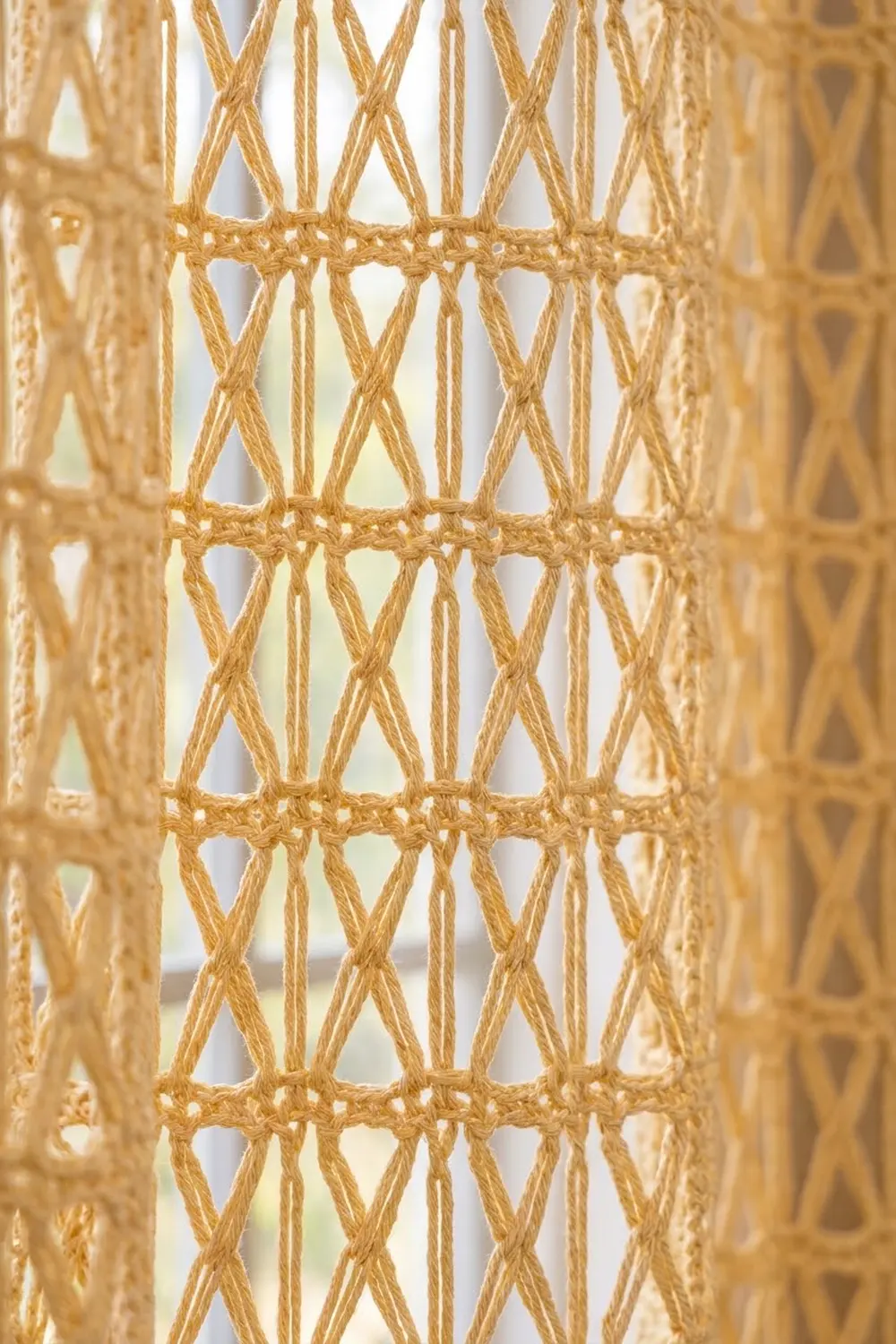
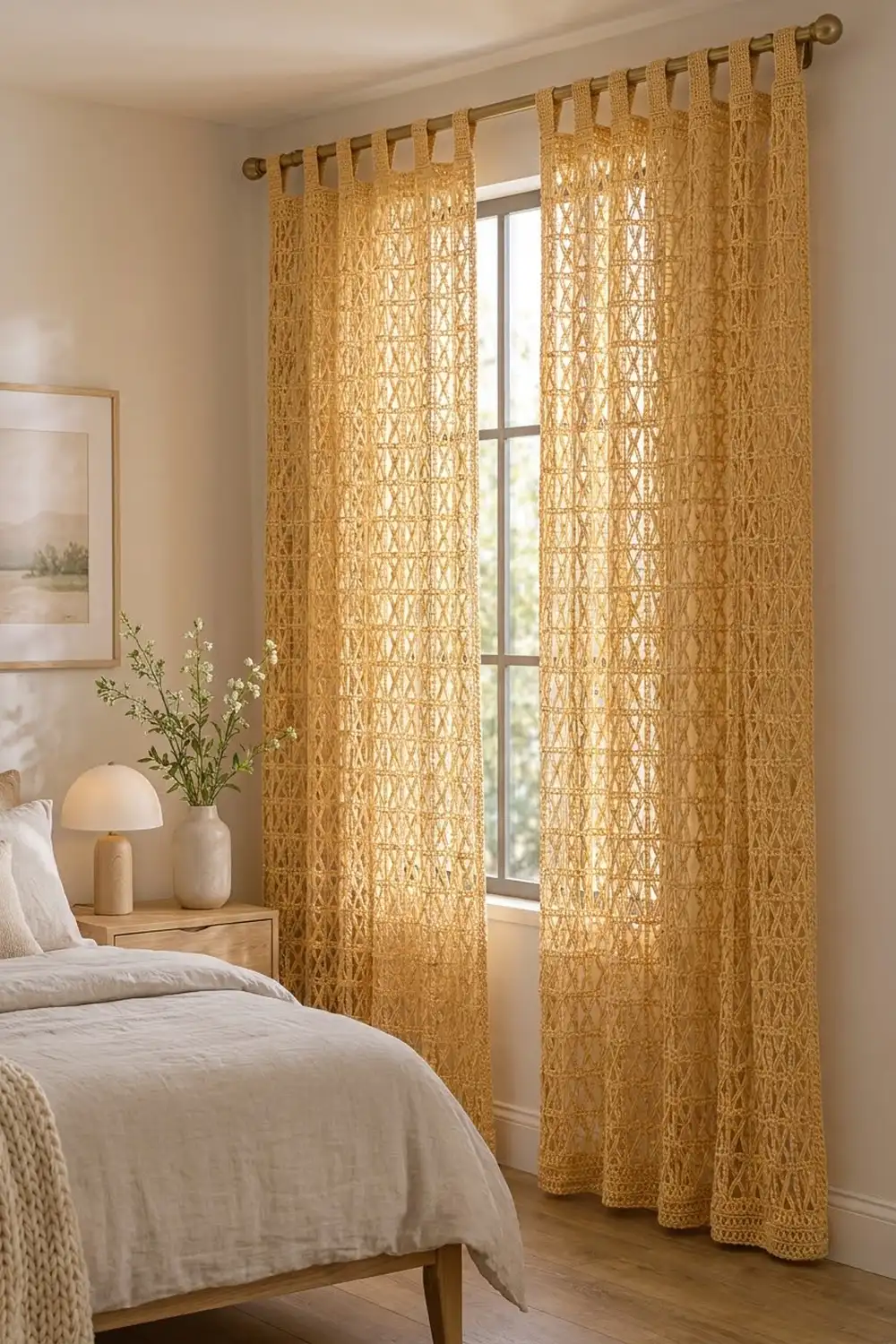
The Honey Lattice Curtain Panel is a tall, airy curtain made from a lattice of crossed stitches. Each row of crosses forms a line of slim X shapes. The legs cross low and open into a V at the top. Plain single crochet bars run across the panel between the cross rows, so the fabric looks like a woven trellis that lets soft light through.
The panel is worked in one color, a warm butter yellow with a golden, honey tone. A dense single crochet hem band weights the bottom edge. Narrow single crochet tabs along the top slide straight onto a curtain rod. The style is relaxed boho with clean lines, and it suits bedrooms, living rooms, and sunny windows.
This pattern uses US crochet terms. One finished panel measures 40 in (101.6 cm) wide and 82 in (208.3 cm) long, not counting the tabs. The tab loops add about 3 in (7.6 cm) above the top edge. For a pair like the one in the photo, make two identical panels.
You work the body flat in rows from the bottom up, alternating a crossed double treble row with a single crochet row. A short top band and eight tabs finish the top. Then you add a hem band into the foundation edge and two rows of edging down each long side.
Finished Size and Construction
- Finished size (one panel): 40 in (101.6 cm) wide x 82 in (208.3 cm) long, plus 3 in (7.6 cm) tab loops
- Skill level: Intermediate
- Terminology: US crochet terms
- Yarn weight: Worsted (weight 4) cotton or cotton blend
- Hook: 5.0 mm (US H-8)
- Number of pieces: 1 panel per curtain (make 2 for a pair; the panels are not joined)
- Layout: Single rectangular panel worked in rows, bottom to top
- Body size before border: 39 in (99.1 cm) wide x 80 in (203.2 cm) long
- Border depth: Hem band 2 in (5.1 cm) deep; side edging 0.5 in (1.3 cm) wide on each side
Materials
Yarn: Choose a smooth worsted weight cotton or cotton blend in a warm butter yellow. Cotton hangs well and keeps the crossed stitches crisp. It also stands up to sunlight better than many acrylics. Avoid fuzzy or very stretchy yarns, which blur the lattice and grow when hung.
- Butter yellow: about 1,100 g (approximately 1,925 m) per panel; double this for a pair
These quantities include a margin of roughly 10 percent for swatching, tension differences, and the tabs.
Tools:
- 5.0 mm (US H-8) crochet hook
- Tapestry needle
- Stitch markers (at least 10)
- Measuring tape
- Scissors
- Rustproof pins and a large blocking surface (a bed, carpet, or foam mats)
- Spray bottle
Abbreviations (US Terms)
- ch: chain
- sc: single crochet
- dc: double crochet
- dtr: double treble crochet (yarn over 3 times, insert hook, pull up a loop, [yarn over, pull through 2 loops] 4 times)
- sk: skip
- st(s): stitch(es)
- BLO: back loop only
- RS / WS: right side / wrong side
Special stitch – Lattice Cross (LX): Worked over 4 sts. Sk 3 sts, dtr in next st, ch 2, then, working in front of the dtr just made, dtr in the first skipped st. The two dtr legs cross low, near the base, and spread apart at the top, where the ch-2 holds them open. One LX gives 4 sts on top: dtr, 2 ch, dtr.
Gauge and Checkpoints
Gauge:
- Single crochet: 16 sts and 16 rows = 4 in (10.2 cm)
- Lattice pattern: 16 sts = 4 in (10.2 cm); 2 pattern repeats (4 rows) = 3.5 in (8.9 cm)
- One pattern repeat (1 LX row + 1 sc row) = 1.75 in (4.4 cm). The LX row is 1.5 in (3.8 cm) and the sc row is 0.25 in (0.6 cm).
Make a gauge swatch first. Ch 22. Sc in 2nd ch from hook and in each ch across: 21 sts. Work Rows 1–2 of the main pattern 4 times, using 4 LX repeats per row instead of 31. Fasten off, wet the swatch, and pin it flat to dry. It should measure 5.25 in (13.3 cm) wide and 7.25 in (18.4 cm) tall. That height is 0.25 in (0.6 cm) for the foundation row plus 4 repeats at 1.75 in (4.4 cm) each.
If the swatch is too big, go down 0.5 mm in hook size. If it is too small, go up 0.5 mm. Fix the width first. If the width is right but the LX rows are too tall or too short, change how high you pull up the first loop of each dtr.
Checkpoints on the panel:
- After the Foundation Row: 39 in (99.1 cm) wide
- After 20 repeats: 35.25 in (89.5 cm) tall
- After all 45 repeats: 79 in (200.7 cm) tall
- After the Top Band: 80 in (203.2 cm) tall
- After the border: 40 in (101.6 cm) x 82 in (208.3 cm)
Always measure with the panel lying flat, not hanging. Hanging lets the weight of the yarn stretch it and throws off the reading.
Main Panel
The stitch count is a multiple of 5 plus 1. The panel uses 31 repeats: 5 x 31 + 1 = 156 sts.
Foundation: Ch 157.
Foundation Row (RS): Sc in 2nd ch from hook and in each ch across, turn. (156 sts)
Check the width now: 156 sts at 4 sts per inch gives 39 in (99.1 cm).
Row 1 (LX row, WS): Ch 3 (counts as dc), *LX over next 4 sts, dc in next st; repeat from * 30 more times, turn. (31 LX and 32 dc including the turning ch; 1 + 31 x 5 = 156 sts)
The final dc goes into the last sc of the row. Each LX sits between two dc pillars, which form the thin vertical lines between the crosses.
Row 2 (sc row): Ch 1, sc in first dc, *sc in next dtr, sc in each of next 2 ch, sc in next dtr, sc in next dc; repeat from * 30 more times, working the last sc in the top of the turning ch-3, turn. (156 sts)
Work into each ch itself, not around the ch-2 space. This keeps every row at exactly 156 sts and keeps the horizontal bar even.
Rows 3–90: Repeat Rows 1–2 another 44 times. (45 repeats total; 90 pattern rows; 156 sts at the end of every row)
From here on, LX rows fall on both RS and WS rows. The crossed dtr looks almost the same from either side, so apart from the tabs the curtain is reversible.
Checkpoint: The panel should measure 79 in (200.7 cm) tall. That is 0.25 in (0.6 cm) for the Foundation Row plus 45 x 1.75 in = 78.75 in (200.0 cm) for the pattern.
Top Band
Rows 91–94: Ch 1, sc in each st across, turn. (156 sts)
These 4 rows add 1 in (2.5 cm). The body now measures 39 in (99.1 cm) x 80 in (203.2 cm). Do not fasten off yet.
Tabs
The panel has 8 tabs. Each tab is 8 sts wide. There are 12 sts between tabs and 4 sts at each end: 4 + (8 x 8) + (7 x 12) + 4 = 156 sts.
Lay the panel flat with the last row at the top. Before you start, place markers at the edges of all 8 tabs.
Tab 1: Ch 1, sk first 4 sts, sl st in the 5th st. Ch 1, sc in the same st and in the next 7 sts, turn. (8 sts)
Tab Rows 2–24: Ch 1, sc in each st across, turn. (8 sts)
Fasten off, leaving a 16 in (40.6 cm) tail. The tab measures 2 in (5.1 cm) wide x 6 in (15.2 cm) long.
Tabs 2–8: Sk 12 sts after the previous tab. Join yarn in the next st, ch 1, sc in the same st and in the next 7 sts, turn. (8 sts) Work Tab Rows 2–24 as for Tab 1, then fasten off with a long tail.
After Tab 8, 4 sts remain unworked at the end, matching the 4 at the start.
Fold the tabs: Fold each tab to the WS of the panel so its last row lies against Row 91 of the Top Band. Use the long tail to whipstitch the 8 sts of the last tab row to the 8 matching sts of Row 91. Each tab now forms a loop about 3 in (7.6 cm) high, which fits a rod up to about 1.5 in (3.8 cm) across.
Border
Border gauge: All border work uses sc at 4 sts per inch and 4 rows per inch, the same as the sc gauge. Each sc row worked along a side adds 0.25 in (0.6 cm) of width.
Hem Band
Turn the panel upside down with the RS facing you. Join yarn in the first unused loop of the foundation chain.
Hem Row 1: Ch 1, sc in each unused loop of the foundation ch across, turn. (156 sts)
Hem Rows 2–3: Ch 1, sc in each st across, turn. (156 sts)
Hem Row 4: Ch 1, sc in BLO of each st across, turn. (156 sts)
Hem Rows 5–6: Ch 1, sc in each st across, turn. (156 sts)
Hem Row 7: Ch 1, sc in BLO of each st across, turn. (156 sts)
Hem Row 8: Ch 1, sc in each st across. (156 sts) Fasten off.
These 8 rows add 2 in (5.1 cm). The two BLO rows leave raised ridges that give the hem its texture. The panel now measures 82 in (208.3 cm) tall before the side edging.
Side Edging
Both long sides get the same stitch count. Work sc evenly along the row ends as follows:
- Each sc row end (Foundation Row, pattern sc rows, Top Band, hem rows): 1 sc
- Each LX row end, which is 1.5 in (3.8 cm) tall: 6 sc
Count per side:
- Foundation Row: 1 sc
- 45 repeats x (6 + 1) = 315 sc
- Top Band: 4 sc
- Hem Band: 8 sc
- Total: 1 + 315 + 4 + 8 = 328 sc
Why the math works: The side is 82 in (208.3 cm) long, and 82 in x 4 sts per inch = 328 sts. Each pattern repeat is 1.75 in (4.4 cm) tall, and 1.75 x 4 = 7 sts, which matches the 6 + 1 placement. The edging therefore lies flat without ruffling or pulling in.
Side Edging Row 1: With the RS facing, join yarn at the top corner of the right side edge. Ch 1, work 328 sc evenly down the side as set out above, turn.
Side Edging Row 2: Ch 1, sc in each st across, turn. (328 sts) Fasten off.
Repeat both rows along the other long side, again starting at a top corner. (328 sts per row)
Two sc rows add 0.5 in (1.3 cm) to each side, so the width grows from 39 in (99.1 cm) to 40 in (101.6 cm). The first and last tabs now sit 1.5 in (3.8 cm) in from each finished side edge, and the tabs stay 3 in (7.6 cm) apart.
Weave in all ends along the sc rows, where they hide best. Avoid weaving through the dtr legs, because that can make them pucker.
Final Blocking
- Fill a basin with cool water and a little mild wash. Put the panel in so it’s fully underwater and let it soak for 15 minutes.
- Lift it out as a bundle, supporting the full weight. Never lift it by one corner, because wet cotton stretches.
- Gently press out the water, then roll the panel in large towels to remove more.
- Spread the panel on your blocking surface, RS up.
- Pin the hem band straight first, to 40 in (101.6 cm) wide.
- Pin each side edge straight to 82 in (208.3 cm), smoothing the sc bars so they run level.
- Open each LX so both legs lie straight and the ch-2 tops form neat V shapes.
- Lay the tabs flat and pin them square.
- Let the panel dry completely, then unpin it.
- Hang the panel for 24 hours before adjusting the rod height. Cotton mesh often drops 1–2 in (2.5–5.1 cm) once it hangs.
Final Quality-Control Checklist
- Every row in the body has 156 sts.
- There are 45 pattern repeats, with 31 LX in each LX row.
- Every LX crosses low and opens into a V at the top.
- The sc bars run straight across without dips.
- The hem band shows two BLO ridges and measures 2 in (5.1 cm).
- Each side edging row has 328 sts and lies flat.
- There are 8 tabs, spaced 3 in (7.6 cm) apart and firmly stitched down.
- The blocked panel measures 40 in (101.6 cm) x 82 in (208.3 cm).
- For a pair, both panels are within 0.5 in (1.3 cm) of each other in length.
Troubleshooting
The crosses lean to one side. Make sure the second dtr goes in front of the first every time, not behind it on some rows.
The panel narrows as it grows. You may be skipping the last st or missing the turning ch-3. Count to 156 on every sc row.
The sc bars look wavy. You are working around the ch-2 instead of into each ch. Work 1 sc into each ch.
The side edging ruffles. You have too many sc on the LX row ends. Use 6 per LX row end and recount to 328.
The side edging pulls in. You have too few sc. Check that each LX row end gets 6 sc.
The two panels differ in length. Compare them flat after blocking. Add or remove one Top Band row on one panel, or reblock to match.
The tabs twist. Fold each tab straight before stitching it down, and match all 8 sts across.
Care
Hand wash in cool water, or machine wash on a gentle cycle inside a mesh laundry bag. Dry flat and reshape. Never dry it on a hanger or a line.
Final Notes
Here is how the measurements fit together. The gauge is 4 sts per inch, so 156 sts make a 39 in (99.1 cm) body. Each repeat is 1.75 in (4.4 cm), and 45 repeats plus the Foundation Row and Top Band give 80 in (203.2 cm). The 2 in (5.1 cm) hem brings the length to 82 in (208.3 cm). The 328-st side edging matches that length and adds 0.5 in (1.3 cm) per side, for a finished width of 40 in (101.6 cm).
Check your swatch, count every sc row, and measure at each checkpoint. Your curtain will hang straight and glow in the sun.
Happy crocheting!