

The Rosewood Fan Lattice Curtain is a lace curtain built from small diamond motifs. Each motif has an open square window in the center and a fan of spokes at every corner, finished with tiny picots. When you join the motifs tip to tip, the gaps between them become a second set of open diamonds, so light passes through in a soft, even pattern.
The curtain uses a single dusty mauve-rose cotton. The color looks warm and vintage in sunlight and calm in the evening. A solid heading band at the top holds the lace straight on the rod, and a tassel hangs below every bottom tip.
This pattern uses US crochet terms. One panel measures 36 in (91.4 cm) wide and 80 in (203.2 cm) long. That length includes a 3 in (7.6 cm) heading band and 5 in (12.7 cm) tassels. The photo shows a matching pair, so make two panels.
Construction is simple and repeatable. You crochet one motif in three rounds and join each new motif to its neighbors on the last round (join-as-you-go). Then you add the heading band across the top tips and tie on the tassels.
Finished Size and Construction
- Finished size (one panel): 36 in (91.4 cm) wide x 80 in (203.2 cm) long, tassels included
- Skill level: Intermediate
- Terminology: US crochet terms
- Yarn weight: Sport weight (#2) cotton
- Hook: 3.5 mm (E-4)
- Number of pieces: 2 panels, each made of 128 motifs (256 motifs total)
- Layout per panel: 8 motifs wide x 16 motifs tall, set on point, joined tip to tip
- Motif size: 4.5 in (11.4 cm) tip to tip, after blocking
- Size before border: 36 in (91.4 cm) x 72 in (182.9 cm)
- Border depth: 3 in (7.6 cm) heading band at the top, plus 5 in (12.7 cm) tassels at the bottom
Materials
Choose a smooth mercerized or matte cotton in sport weight, around 300 m per 100 g. Cotton keeps the fan spokes crisp and stretches little when hanging. Avoid very soft acrylic, because long panels can grow under their own weight.
- Dusty mauve-rose: 1,200 g / 3,600 m for the pair (600 g / 1,800 m per panel)
These amounts include a margin of about 15 percent for swatching, tassels and the odd restart.
Tools:
- 3.5 mm (E-4) crochet hook
- Tapestry needle
- Scissors
- Stitch markers
- Rigid card 5 in (12.7 cm) tall, for tassels
- Blocking mats, rustproof pins, and a spray bottle or steamer
- Tape measure
Abbreviations (US Terms)
- ch – chain
- sl st – slip stitch
- sc – single crochet
- hdc – half double crochet
- dc – double crochet
- sp – space
- st(s) – stitch(es)
- RS – right side
Special stitch – picot: ch 3, sl st in 3rd ch from hook.
Special stitch – tip loop: ch 5. On tips that join to a neighbor, work ch 2, sl st in the neighbor’s tip loop, ch 2 instead.
Gauge and Checkpoints
Make one complete motif before anything else. Block it lightly and measure.
- After Round 1: the inner square measures about 1.5 in (3.8 cm) per side.
- After Round 2: the motif measures about 3.75 in (9.5 cm) from fan tip to fan tip.
- After Round 3: the motif measures 4.5 in (11.4 cm) from tip loop to tip loop.
Band gauge: 16 hdc and 10 rows = 4 in (10.2 cm).
If your motif is larger than 4.75 in (12.1 cm), go down one hook size. If it is smaller than 4.25 in (10.8 cm), go up one hook size. Being off by 0.25 in (0.6 cm) per motif adds up to 2 in (5.1 cm) across the width and 4 in (10.2 cm) down the length, so this check matters.
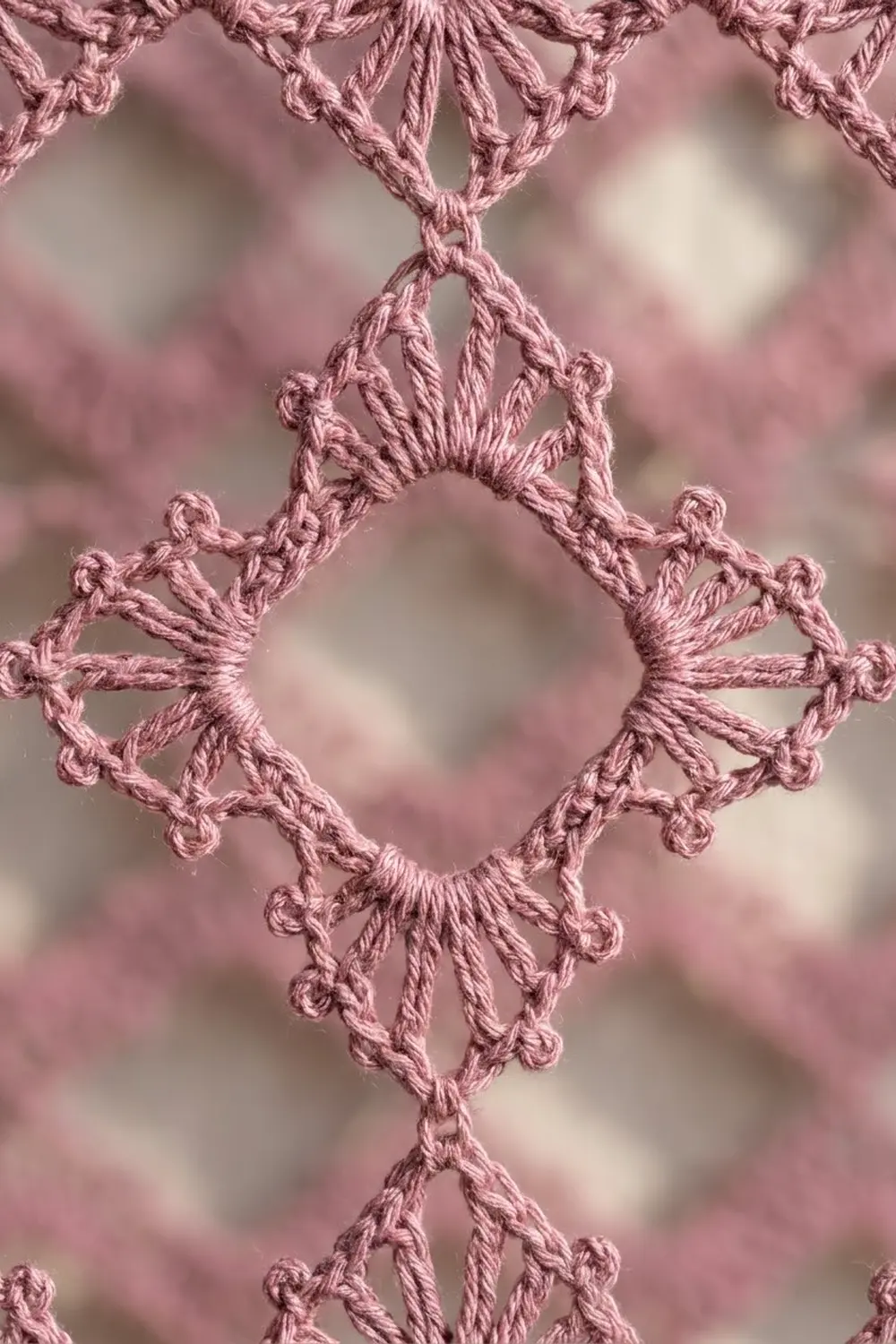
Motif Pattern
Round 1 (Square Center)
Ch 28, sl st in first ch to form a ring. Do not twist the chain.
Ch 1, sc in same ch as join and in next 5 ch, (sc, ch 2, sc) in next ch, *sc in next 6 ch, (sc, ch 2, sc) in next ch; repeat from * 2 more times, sl st in first sc.
Count: 32 sc and 4 corner ch-2 sps (8 sc per side, including both corner sc).
This round forms the open square window. The ring is never filled in.
Round 2 (Corner Fans)
Sl st in next 6 sc, sl st in next ch-2 sp.
Ch 4 (counts as dc and ch 1), (dc, ch 1) 5 times in same sp, dc in same sp. This is the first fan.
*Ch 3, skip next 3 sc, sc in next 2 sc, ch 3, skip next 3 sc, work (dc, ch 1) 6 times and dc in next ch-2 sp; repeat from * 2 more times, ch 3, skip next 3 sc, sc in next 2 sc, ch 3, skip next 3 sc, sl st in 3rd ch of beginning ch-4.
Count: 4 fans of 7 dc and 6 ch-1 sps each (28 dc, 24 ch-1 sps), plus 8 sc and 8 ch-3 sps.
Check the side math: 3 skipped + 2 sc + 3 skipped = 8 sc, which matches the 8 sc per side from Round 1.
Round 3 (Picot Edging and Tip Loops)
Sl st in first ch-1 sp of the fan.
Fan: Ch 1, sc in same sp, picot, sc in next ch-1 sp, picot, sc in next ch-1 sp, tip loop, sc in next ch-1 sp, picot, sc in next ch-1 sp, picot, sc in next ch-1 sp.
Side: 4 sc in next ch-3 sp, sc in next sc, picot, sc in next sc, 4 sc in next ch-3 sp.
*Fan (begin with sc in first ch-1 sp, no ch 1), Side; repeat from * 2 more times. Sl st in first sc. Fasten off and weave in ends.
Count per fan: 6 sc, 4 picots, 1 tip loop. Count per side: 10 sc, 1 picot.
Round total: 64 sc (24 in fans + 40 on sides), 20 picots, 4 tip loops.
The tip loop sits directly above the 4th (center) dc of each fan, so the fan stays even and the tip points straight out.
Make All Pieces
Each panel uses 128 motifs, and the pair uses 256, all in dusty mauve-rose. Only the first motif of each panel is made on its own. You join every other motif on its Round 3.
Work in rows from the top of the panel down, left to right.
        Col: 1 2 3 4 5 6 7 8
Band   [=====================]
Row 1        ◇ ◇ ◇ ◇ ◇ ◇ ◇ ◇
Row 2        ◇ ◇ ◇ ◇ ◇ ◇ ◇ ◇
Row 3        ◇ ◇ ◇ ◇ ◇ ◇ ◇ ◇
 ...         (repeat rows)
Row 16       ◇ ◇ ◇ ◇ ◇ ◇ ◇ ◇
Tassels      T T T T T T T T
Each ◇ is one motif, set on point. Its top, bottom, left and right tips touch the neighboring motifs.
Joining
Use join-as-you-go on Round 3. Work Rounds 1 and 2 of the new motif as usual, then work Round 3 until you reach a tip that must connect.
Joining a tip: In place of the tip loop, ch 2, insert hook from front to back through the neighbor’s tip loop, sl st, ch 2. Continue Round 3 as written.
- Row 1, Col 1: no joins.
- Row 1, Cols 2–8: join the left tip to the right tip of the motif on the left.
- Rows 2–16, Col 1: join the top tip to the bottom tip of the motif above.
- Rows 2–16, Cols 2–8: join the top tip to the motif above and the left tip to the motif on the left.
Each join connects one tip to one tip. The ch 2 + sl st + ch 2 replaces the ch-5 tip loop, so the motif keeps the same size and the same count. No stitches are added at seams. Picots are never joined and stay free.
Tension: Keep the joining chains the same length as your normal ch 5. Tight joins pull the diamonds into hourglass shapes, and loose joins let the motifs sag apart.
Size checkpoint: After Row 1, the strip should measure 36 in (91.4 cm) from left tip to right tip after a light press. After Row 16, the panel should measure 72 in (182.9 cm) from top tip to bottom tip.
Border: Heading Band and Tassels
The border goes only on the top and bottom edges. The side tips stay open as part of the lace.
Border gauge: 16 hdc = 4 in (10.2 cm), so 4 sts per inch. Each motif column is 4.5 in (11.4 cm) wide, which equals 18 sts. Eight columns x 18 sts = 144 sts = 36 in (91.4 cm).
Row 1 (Bridging Row)
With RS facing, make a slip knot and ch 8, 3 sc in top tip loop of Row 1, Col 1 motif, *ch 15, 3 sc in top tip loop of next motif; repeat from * 6 more times, ch 7, then ch 2 more for turning.
Count: 8 ch + (8 x 3 sc) + (7 x 15 ch) + 7 ch = 8 + 24 + 105 + 7 = 144 sts. The 2 turning ch do not count.
The chains run straight across each V-shaped valley between motifs, which gives the band its scalloped lower edge.
Rows 2–7 (Solid Band)
Row 2: Hdc in 3rd ch from hook and in each st across, turn. (144 hdc)
Rows 3–7: Ch 2 (does not count), hdc in each st across, turn. (144 hdc each row)
Row 8 (Hanging Loops)
Ch 1, *sc in next 7 sts, ch 12, skip next 4 sts, sc in next 7 sts; repeat from * 7 more times. Fasten off.
Count: 112 sc and 8 ch-12 loops. Each repeat covers 7 + 4 + 7 = 18 sts, and 8 repeats = 144 sts, so one loop sits centered above each motif column.
Band depth: Row 1 is about 0.25 in (0.6 cm), Rows 2–7 are about 2.4 in (6.1 cm), and Row 8 is about 0.25 in (0.6 cm), for a total of about 3 in (7.6 cm).
Tassels
Make 8 tassels per panel. Wrap yarn 20 times around the 5 in (12.7 cm) card. Tie the top with a separate strand, cut the bottom, and wrap the neck 0.5 in (1.3 cm) below the top. Trim to 5 in (12.7 cm). Tie one tassel to the bottom tip loop of each Row 16 motif.
Why the math works: The band’s 144 sts equal 8 columns x 18 sts, and 18 sts at 4 sts per inch is exactly one 4.5 in (11.4 cm) motif. So the band lies flat across the 36 in (91.4 cm) of lace without ruffling or pulling.
Final Blocking
- Weave in all ends securely before blocking.
- Spray the panel lightly until evenly damp, or soak it and press the water out in a towel.
- Lay the panel on mats in sections. Pin the band straight to 36 in (91.4 cm).
- Pin each column of tips in a straight vertical line, 4.5 in (11.4 cm) apart.
- Pin the panel length to 72 in (182.9 cm) from the band to the bottom tips.
- Open each fan by pinning gently at the tip loop, and nudge the picots outward.
- Let it dry completely. If your mats are short, move the pins along to block the next section.
- Repeat for the second panel, matching the measurements exactly.
Final Quality-Control Checklist
- Each panel has 128 motifs in 8 columns and 16 rows.
- Every motif has 4 fans of 7 dc and 20 picots.
- Every joined tip uses ch 2, sl st, ch 2.
- No picots are joined by mistake.
- The band has 144 sts on every row.
- There are 8 hanging loops, one centered above each column.
- There are 8 tassels, one under each bottom tip.
- Both panels measure 36 in (91.4 cm) x 80 in (203.2 cm) including tassels.
Troubleshooting
The center window is twisted or uneven. The starting chain twisted. Restart and lay the ch-28 flat before joining.
Fans curl forward. Your dc are too tight. Relax your yarn tension, or use a hook 0.25 mm larger for Round 2 only.
The motif cups. Round 3 is too tight across the sides. Check that you used exactly 4 sc in each ch-3 sp.
Panel is narrower than 36 in (91.4 cm). Your joins are tight. Block firmly, and make later joins the same length as a full ch 5.
Band ruffles or pulls. Recount Row 1. It must be 144 sts before you start the hdc rows.
Tassels flare unevenly. Wrap the neck tighter and steam the strands straight.
Care
Hand wash in cool water with mild soap, press out the water without wringing, and dry flat, pinning back to size. Rehang only when completely dry.

Final Notes
The measurements build on each other simply. One motif is 4.5 in (11.4 cm), so eight motifs make 36 in (91.4 cm) across and sixteen rows make 72 in (182.9 cm) down. The 144-st band matches 8 columns x 18 sts and adds 3 in (7.6 cm). The 5 in (12.7 cm) tassels bring each panel to 80 in (203.2 cm). Check your first motif and keep your joins even, and the pair will hang straight and match.
Happy crocheting!