

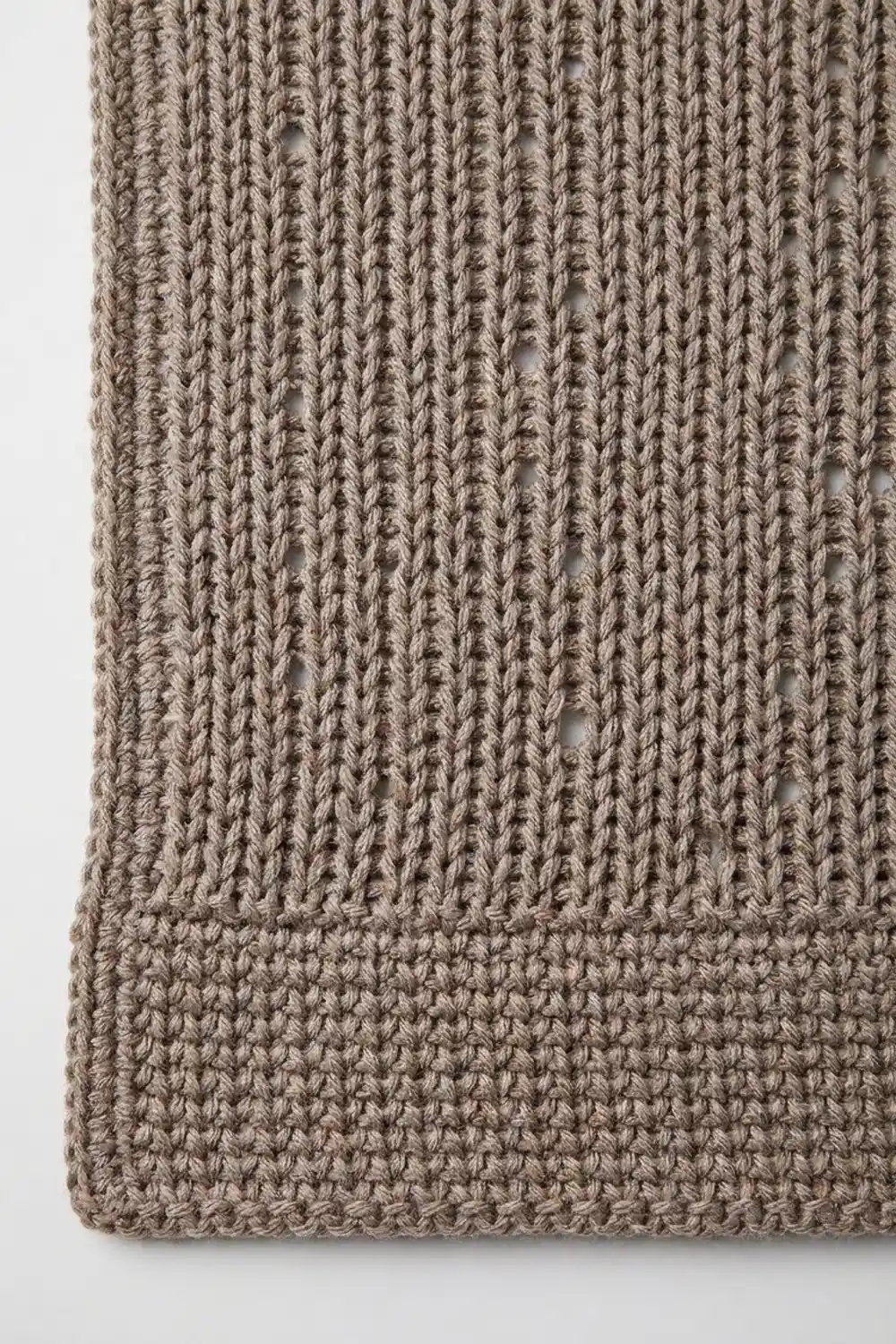
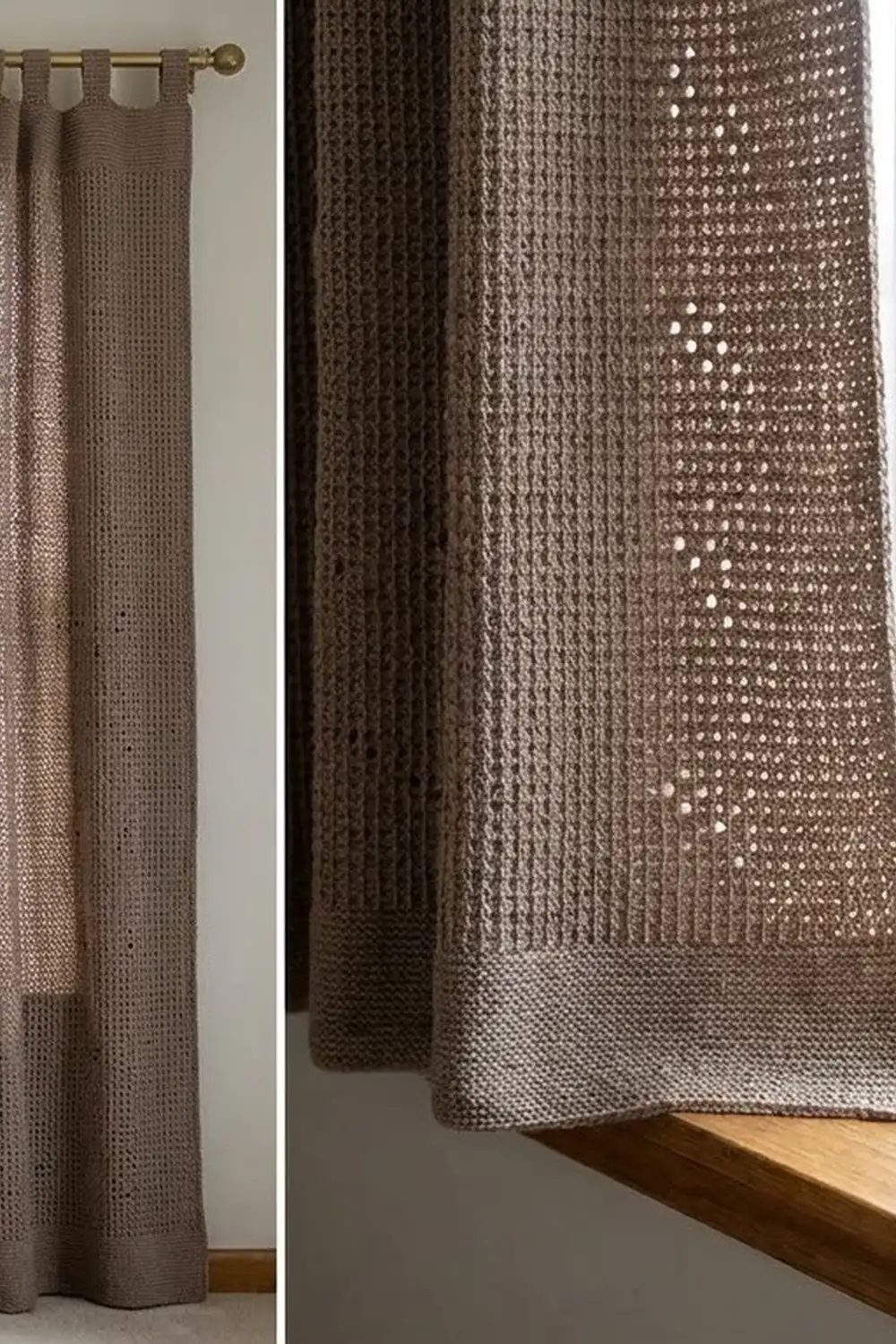
This curtain panel is worked in Tunisian simple stitch, which gives the fabric neat, knit-like vertical columns. Small round eyelets are scattered across the body in a staggered half-drop layout, so daylight comes through in soft dots instead of solid stripes.
The panel is one solid color, a warm mushroom taupe that suits wood floors, brass rods, and neutral walls. Plain bands frame the eyelet field at the hem and at the top. A two-round single crochet border tidies all four edges, and six tabs hold the panel on the rod. The style is quiet and modern, with a hand-knit feel.
All terms are US crochet terms. The finished panel measures 41 in (104.1 cm) wide by 85 in (215.9 cm) long. The tab loops rise 3 in (7.6 cm) above the top edge, so the panel hangs 88 in (223.5 cm) from the top of the rod to the hem.
You work one rectangle from the hem upward in Tunisian rows and bind it off. Then you add a single crochet border with a standard hook, work six tabs directly off the top edge, and fold each tab to the back. The pattern makes one panel. For a pair, make a second identical panel.
Finished Size and Construction
- Finished size: 41 in x 85 in (104.1 cm x 215.9 cm), plus 3 in (7.6 cm) tab loops
- Skill level: Intermediate
- Terminology: US crochet terms
- Yarn weight: Worsted (weight 4)
- Hooks: 6 mm (US J-10) Tunisian hook with cable; 5 mm (US H-8) standard hook
- Number of pieces: 1 panel (tabs are worked directly onto it)
- Layout: single rectangle, with the eyelet field framed by plain bands
- Piece size before border: 40 in x 84 in (101.6 cm x 213.4 cm)
- Border depth: 0.5 in (1.3 cm) on each edge, 2 rounds
Materials
Choose a smooth worsted yarn with good stitch definition. A cotton-acrylic or cotton-wool blend works best. It shows the Tunisian columns clearly, washes well, and stretches less than pure cotton when it hangs. Avoid fuzzy or very dark yarns, because they hide the eyelets.
Yarn (per panel):
- Mushroom taupe: 1,600 g, about 3,200 m (3,500 yd)
That is about sixteen 100 g skeins of roughly 200 m (219 yd) each. The quantity includes a margin of about 10 percent for the swatch, the tabs, and differences in tension. Buy all skeins from one dye lot, and double the amount for a pair.
Tools:
- 6 mm (US J-10) Tunisian hook with a cable at least 40 in (101.6 cm) long
- 5 mm (US H-8) standard crochet hook
- Tapestry needle
- About 10 stitch markers
- Measuring tape
- Rust-proof pins and a large blocking surface
Abbreviations (US Terms)
- ch – chain
- sc – single crochet
- sl st – slip stitch
- sp – space
- st(s) – stitch(es)
- RS / WS – right side / wrong side
- Tss – Tunisian simple stitch: insert the hook from right to left under the next front vertical bar, yarn over (yo), pull up a loop, and leave it on the hook
- Tes – Tunisian end stitch: insert the hook under both strands of the last vertical bar, yo, pull up a loop
- RetP – return pass: yo, pull through 1 loop; *yo, pull through 2 loops; repeat from * until 1 loop remains
Special stitch – Eyelet (ey): On the forward pass, yo and skip the next vertical bar. The yo stays on the hook and counts as 1 loop, so the stitch count does not change. Work it off normally on the return pass. On the next forward pass, work a Tss under the yo strand as if it were a bar. The skipped bar opens into a small round hole.
Stitch count note: The loop already on the hook at the start of each forward pass counts as the first stitch.
Gauge and Checkpoints
Tunisian gauge: 16 sts and 14 rows = 4 in (10.2 cm) in Tss and in the eyelet pattern with the 6 mm hook, after blocking.
Border and tab gauge: 16 sc and 18 rows = 4 in (10.2 cm) with the 5 mm hook.
Test one piece first. Make a swatch before you start the panel. Ch 24 and work Row 1 as written in the pattern (24 sts). Work 2 plain rows. Next, work 2 repeats of the 8-row eyelet sequence, with 4 edge sts on each side and eyelets every 8 sts across the 16 center sts. Finish with 2 plain rows (21 rows total). Bind off, wash, and block. The swatch should measure 6 in x 6 in (15.2 cm x 15.2 cm).
Then pin the top of the swatch to a board and let it hang for a day. A heavy curtain stretches in length. If your swatch grows more than about 0.25 in (0.6 cm), measure the panel while it hangs rather than flat.
If your swatch is too big, go down 0.5 mm. If it is too small, go up 0.5 mm. Tunisian crochet tends to be firm, so many crocheters need a larger hook than the yarn label suggests.
Panel checkpoints (measured flat):
- After Row 7: 40 in (101.6 cm) wide and 2 in (5.1 cm) tall
- After Row 147: 42 in (106.7 cm) tall
- After Row 287: 82 in (208.3 cm) tall
- After Row 294: 84 in (213.4 cm) tall
Panel
With the 6 mm Tunisian hook, ch 160.
Row 1 (foundation): Insert the hook in the back bump of the 2nd ch from the hook, yo, and pull up a loop. Pull up a loop in the back bump of each remaining ch across. (160 loops on hook.) RetP.
Plain Row (PR): The loop on the hook is st 1. Tss in each of the next 158 sts, then Tes in the last st. (160 loops.) RetP.
Bottom Band
Rows 2–7: Work PR. (160 sts in each row.)
The band is 7 rows, 2 in (5.1 cm) tall. It stays solid so the hem hangs straight and has some weight.
Eyelet Field
The eyelet field is an 8-row repeat. Each eyelet row has 19 eyelets, and the two eyelet rows are offset by 4 sts to make the staggered dot pattern.
Eyelet Row A: St 1 is on the hook. Tss in each of the next 6 sts, *ey, Tss in each of the next 7 sts; repeat from * 18 more times. Tes in the last st. (160 loops: 1 + 6 + 152 + 1. Eyelets fall on sts 8, 16, 24 … 152.) RetP.
Eyelet Row B: St 1 is on the hook. Tss in each of the next 10 sts, *ey, Tss in each of the next 7 sts; repeat from * 17 more times. Ey, Tss in each of the next 3 sts, then Tes in the last st. (160 loops: 1 + 10 + 144 + 1 + 3 + 1. Eyelets fall on sts 12, 20, 28 … 156.) RetP.
The 8-row repeat:
- Rows 1–3: PR
- Row 4: Eyelet Row A
- Rows 5–7: PR
- Row 8: Eyelet Row B
Rows 8–287: Work the 8-row repeat 35 times. (280 rows, 160 sts in every row, 80 in / 203.2 cm.)
Place a marker every 5 repeats (40 rows) to make counting easier. At each marker, check that the width is still 40 in (101.6 cm). If the panel is narrowing, you have probably missed a Tss under a yo strand.
Top Band
Rows 288–294: Work PR. (160 sts in each row.) This band is 7 rows, 2 in (5.1 cm) tall, matching the bottom band.
Bind off: *Insert the hook in the next bar as for a Tss, yo, and pull through both the bar and the loop on the hook; repeat from * across. Work the last sl st as for a Tes. This leaves one top stitch over each of the 160 columns. Fasten off.
The panel now measures 40 in x 84 in (101.6 cm x 213.4 cm).
Border
Switch to the 5 mm standard hook. The smaller hook keeps the edge firm and stops the Tunisian sides from rolling.
Border gauge: 4 sc per 1 in (2.5 cm) along every edge, which matches the panel’s width of 4 sts per 1 in (2.5 cm).
Round 1 (RS): With the RS facing, join yarn in the first foundation ch.
- Bottom: Ch 1, then sc in each of the 160 foundation chs (160 sc).
- Corner: Ch 1.
- Side: Along the 294 row ends, *sc in each of the next 6 row ends, 2 sc in the next row end; repeat from * 41 more times (336 sc).
- Corner: Ch 1.
- Top: Sc in each of the 160 bind-off sts (160 sc).
- Corner: Ch 1.
- Side: Repeat the side instructions (336 sc).
- Corner: Ch 1.
Join with a sl st to the first sc. (992 sc and 4 corner ch-1 sps.)
Round 2: Ch 1. Sc in each sc around, working (sc, ch 1, sc) in each corner ch-1 sp. Join with a sl st to the first sc and fasten off. (Top and bottom: 162 sc each. Sides: 338 sc each. Total: 1,000 sc and 4 corner ch-1 sps.)
Why the math works: 160 sc at 4 sc per inch is exactly 40 in (101.6 cm), the width of the panel. Each side has 294 rows at 3.5 rows per inch, which is 84 in (213.4 cm). At 4 sc per inch, that edge needs 84 x 4 = 336 sc. One extra sc every 7 row ends adds 294 / 7 = 42 sc, so 294 + 42 = 336. In Round 2, each (sc, ch 1, sc) corner adds 1 sc to each of the two sides it joins, so every side grows by exactly 2. The two rounds add 0.5 in (1.3 cm) to each edge, which gives 41 in x 85 in (104.1 cm x 215.9 cm).
Tabs
The top edge of Round 2 has 162 sc between the corner spaces. Count them from right to left with the RS facing. Each tab is 10 sts wide, and the tabs are 20 sts apart:
sc 1       : edge
sc 2-11    : Tab 1
sc 12-31   : gap
sc 32-41   : Tab 2
sc 42-61   : gap
sc 62-71   : Tab 3
sc 72-91   : gap
sc 92-101  : Tab 4
sc 102-121 : gap
sc 122-131 : Tab 5
sc 132-151 : gap
sc 152-161 : Tab 6
sc 162     : edge
Check: 2 + (6 x 10) + (5 x 20) = 162. Each tab is 2.5 in (6.4 cm) wide, and the tab centers are 7.5 in (19.1 cm) apart. Mark every tab before you start.
Row 1: With the RS facing and the 5 mm hook, join yarn in the first st of the tab. Ch 1, sc in the same st and in each of the next 9 sts, turn. (10 sc.)
Rows 2–36: Ch 1, sc in each st across, turn. (10 sc.)
The tab is now 8 in (20.3 cm) long. Fasten off, leaving a 16 in (40.6 cm) tail.
Fold the tab to the WS and pin its last row flat on the back of the top band, 2 in (5.1 cm) below the top edge. Whipstitch the last row in place, then sew the two layers together along both side edges for 0.5 in (1.3 cm) for strength. This leaves a 3 in (7.6 cm) loop, which fits a rod up to about 1.5 in (3.8 cm) in diameter. Repeat for all 6 tabs.
Final Blocking
- Weave in all ends along the border or inside plain columns, never across an eyelet.
- Soak the panel in cool water with a little wool wash for 20 minutes.
- Press out the water gently without wringing, then roll the panel in towels.
- Lay it flat with the RS up.
- Ease it to 41 in x 85 in (104.1 cm x 215.9 cm). Do not stretch the length, because hanging adds length on its own.
- Pin the sides straight every 4 in (10.2 cm), and nudge each eyelet round with a fingertip.
- Let the panel dry completely, then hang it for a day and check the length again.
Final Quality-Control Checklist
- Every row has 160 sts, and the panel is 40 in (101.6 cm) wide before the border.
- Each eyelet row has 19 eyelets, and the eyelet rows alternate A and B.
- The bottom and top bands are each 7 plain rows.
- Round 2 has 162 sc on the top and bottom and 338 sc on each side.
- The corners lie flat and square.
- All 6 tabs are the same length and evenly spaced.
- The hem hangs straight without waving.
Troubleshooting
The edges curl. This is normal for Tunisian simple stitch. The border and blocking flatten it.
The panel slants or narrows. You may be skipping the first bar or missing the Tes. Count 160 loops at the end of every forward pass.
The eyelets are tiny, or there are too many stitches. You worked a yo without skipping the next bar.
The border ruffles. Add the extra sc every 8 row ends instead of every 7.
The border pulls in. Use a slightly larger border hook.
The panel is too long after hanging. Before you add the border, take out the bind-off and a few top-band rows, then bind off again.
Care
Hand wash, or machine wash in a mesh bag on a gentle cool cycle, and dry the panel flat. Never hang it while it is wet, because the weight will stretch it.
Final Notes
At a gauge of 16 sts and 14 rows per 4 in (10.2 cm), 160 sts and 294 rows make a panel of 40 in x 84 in (101.6 cm x 213.4 cm). Two border rounds bring it to 41 in x 85 in (104.1 cm x 215.9 cm). Six 3 in (7.6 cm) tab loops give a hanging length of 88 in (223.5 cm). If your swatch matches the gauge and you check the panel at every marker, your curtain will match these measurements.
Happy crocheting!